High precision, high reliability, and radiation resistance—the technological breakthroughs behind aerospace image sensors are quietly pushing the boundaries of human understanding of the universe.
On Earth, we use mobile phones to take photos and monitoring devices to ensure safety, all of which rely on image sensors. However, once these devices enter space, everything changes dramatically. Image sensors in space must withstand extreme temperatures, high-intensity radiation, and vacuum environments while maintaining extremely high precision and stability.
As pointed out in the paper “Research Status and Development Trends of Image Sensors for Aerospace” published by the Chongqing Institute of Optoelectronic Technology in China, aerospace image sensors are hailed as the “retina” of modern information systems, undertaking key tasks such as Earth observation, astronomical detection, and spacecraft control.
(If you are interested in this article and want to delve deeper into the relevant technical details, please contact the author for the original text.)
The “Dual Heroes” of Aerospace Image Sensors: CCD and CMOS
Image sensors are mainly divided into two categories: CCD (Charge-Coupled Device) and CMOS image sensors. CCD has long dominated due to its high sensitivity, low noise, and excellent image quality, while CMOS has gradually become a new choice in the aerospace field due to its low power consumption, high integration, and radiation resistance.
Whether CCD or CMOS, aerospace-grade sensors must possess performance far exceeding that of civilian devices. They need to operate in temperatures as low as minus several tens of degrees Celsius and may face high-temperature tests under direct sunlight; they must maintain data accuracy in strong radiation environments and operate stably in microgravity. These stringent requirements drive continuous innovation and breakthroughs in aerospace image sensor technology.
CCD: The Classic Choice for Space Observation
Since the invention of CCD by Bell Labs in 1969, it has become the “veteran” of aerospace remote sensing due to its outstanding imaging quality. The PRISM instrument on Japan’s ALOS satellite, the European “Sentinel” series satellites, and China’s “Tianwen-1” Mars probe all widely use CCD sensors.
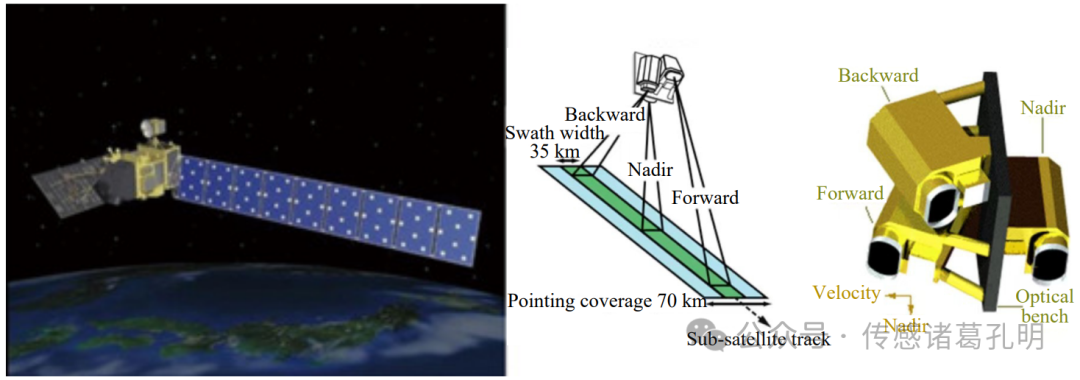 Diagram of ALOS Satellite and PRISM
Especially in the field of Earth observation, CCD can achieve high resolution and multi-spectral imaging, helping scientists monitor surface changes, resource distribution, and natural disasters. For example, China’s independently developed high-resolution stereo mapping satellite has achieved a scale of 1:50000 for stereo mapping, providing important data support for agriculture and land management.
In aerial observation, CCD performs exceptionally well. The CCD370 sensor developed by E2V is designed for X-ray imaging and can detect soft X-rays with photon energies between 200–2000 electron volts, providing unprecedented clarity for astronomical research. The CCID51M CCD developed by Lincoln Laboratory has a quantum efficiency exceeding 85% in the visible light range, providing strong technical support for deep space exploration.
CMOS: The Emerging Force in Aerospace
Although CMOS image sensors started later, their low power consumption and high integration characteristics are very suitable for aerospace applications. Especially with the rise of micro-nano satellites, CMOS sensors have become the ideal choice for these small spacecraft. In 2011, Canon developed the world’s largest CMOS image sensor at that time, with a chip size of 202mm × 205mm, demonstrating the potential for CMOS technology to scale up.
The EU used the CMOSIS CMV12000 commercial CMOS sensor in the HyperScout hyperspectral imager, achieving hyperspectral imaging by directly installing a linear variable filter on the sensor surface. This design greatly simplifies the optical system structure, reducing the size and weight of the equipment.
China’s “Naxing-1” satellite also used a CMOS camera for Earth imaging experiments, proving the practical value of CMOS technology in the aerospace field. In 2020, China launched a monolithic TDI CIS product with a pixel size of 3.2 microns, achieving a quantum efficiency of about 65% in the 550 nanometer band, with a maximum TDI level of 128, reaching an internationally advanced level.
Technological Breakthroughs in Special Application Scenarios
In spacecraft control, image sensors play an irreplaceable role. In 2017, Japan equipped the “Hayabusa2” spacecraft with the E2V CCD47-20 image sensor, initially used for spacecraft navigation to reach the target asteroid and develop a digital terrain model based on image data. This high-precision navigation capability ensures the successful implementation of deep space exploration missions.
In 2019, the European Space Agency’s Euclid satellite mounted the E2V CCD273 image sensor on its star sensor, combining it with gyroscopes for high-precision attitude control of the main telescope. This high-precision attitude control capability is crucial for astronomical observation satellites, ensuring that the telescope remains stably pointed at the observation target over the long term.
Imaging technology in extreme environments has also made significant breakthroughs. To address issues such as the significant drop in star brightness encountered when surveying planets near stars, the Lincoln Laboratory at MIT developed the CCD-80 image sensor. This sensor is a deep-depletion back-illuminated frame transfer device, operating in the 600–1050 nanometer band, with a quantum efficiency exceeding 80% in the 650–900 nanometer wavelength range.
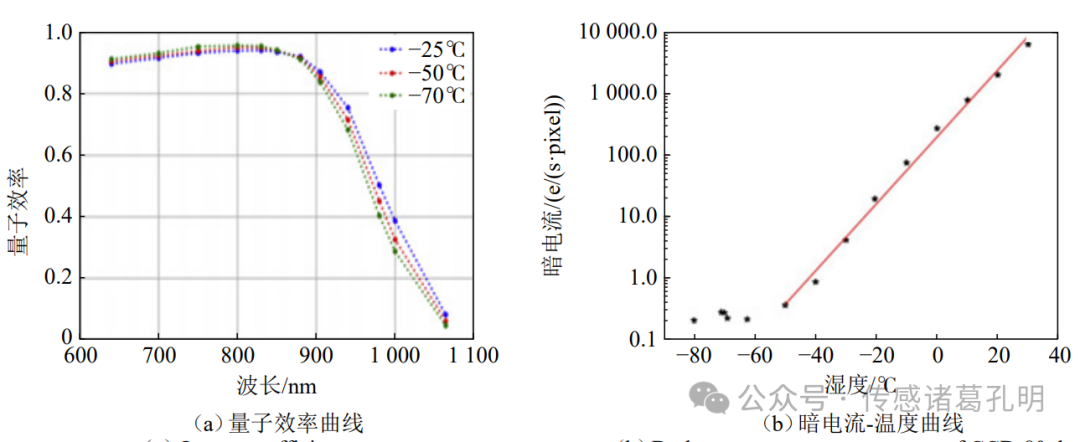 Performance Comparison of CCD-80 Device at Different Temperatures
Technological Frontiers: Intelligent Sensing and Multi-Dimensional Imaging
The paper points out that aerospace image sensors are developing towards lightweight, intelligent, and multi-dimensional sensing. Event-driven image sensors can decide whether to read data based on pixel brightness changes, significantly reducing data redundancy and processing burdens. In 2019, Western Sydney University studied the feasibility and unique capabilities of using event-driven image sensors for space situational awareness on ground-based telescopes, demonstrating the potential of this new type of sensor in aerospace applications.
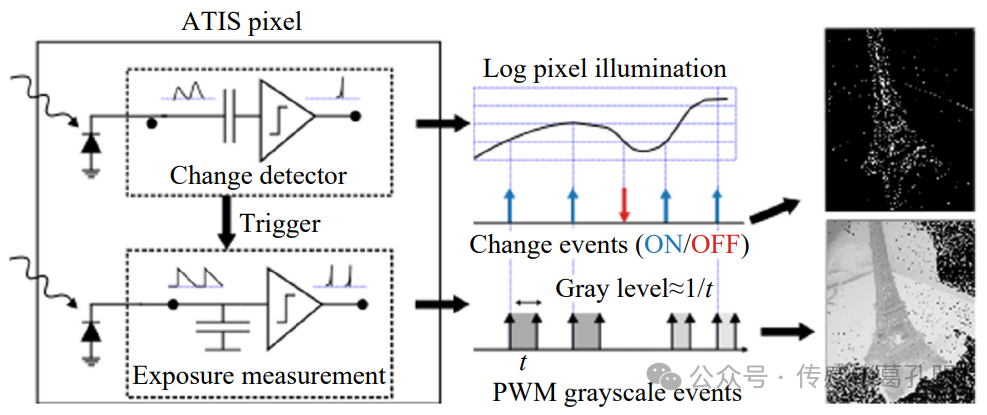 ATIS Pixel Function Diagram
Intelligent image sensors that integrate sensing and computing can directly complete feature extraction at the sensor end, significantly improving processing efficiency. Sony developed an intelligent image sensor based on 3D stacking technology, integrating photosensitive pixels, storage units, and control logic, achieving extremely high readout rates and frame rates. This intelligent image sensor can read static images of 19.3 million pixels at a frame rate of 120 frames per second, enabling real-time data processing.
Polarization imaging sensors are another important development direction. By integrating nano-metal gratings on the sensor surface, they can detect the polarization state of light waves, greatly enhancing imaging capabilities in high-reflectivity, low-contrast environments. In 2010, a research team at the University of Washington fabricated aluminum nanowire gratings with a line width of 70 nanometers and a period of 200 nanometers on a CCD chip with a pixel size of 7.4 microns, achieving a million-pixel polarization imaging sensor.
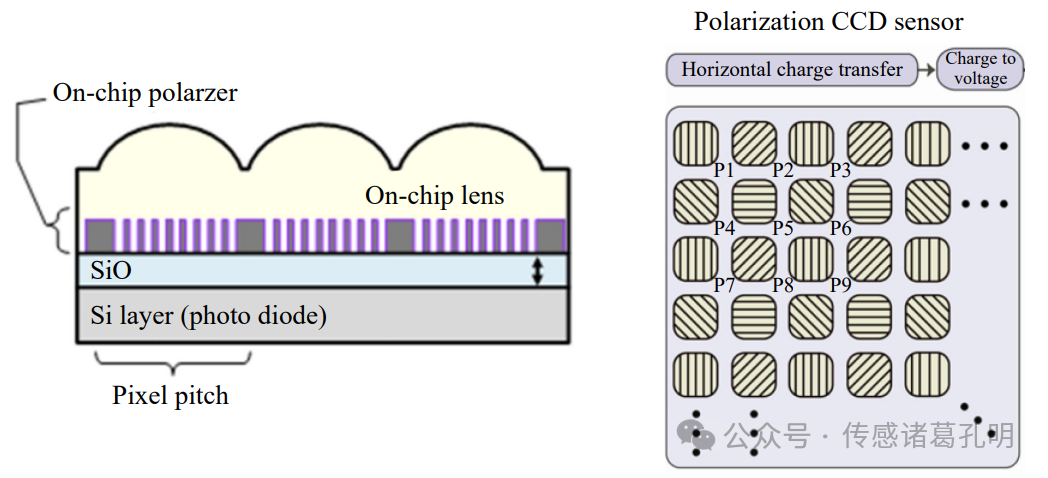 Polarization Imaging System Based on Nano Gratings
Future Outlook: Higher Performance, More Functions
The development of aerospace image sensors will not stop. Researchers are developing quantum image sensors capable of detecting single photons, achieving high-sensitivity imaging under extremely low light conditions. In 2018, Professor Eric Fossum’s research team developed a quantum image sensor using a 45-nanometer back-illuminated 3D stacking process, achieving a readout noise of 0.2 electrons and a dark current of 0.16 electrons/second per pixel at room temperature, enabling high-speed, high-resolution, and precise photon counting imaging under normal temperature conditions.
Small pixel technology is also continuously advancing, with pixel sizes shrinking from 10 microns to 2.5 microns, allowing for more pixels to be integrated on the same size chip. The pixel size of the Emerald 67M sensor from Teledyne E2V has been reduced to 2.5 microns, with an array size of 8192×8192 and a frame rate of 65 frames per second, and is progressing towards even smaller pixel sizes. This development greatly facilitates the simultaneous integration of multiple sensors in a system, potentially enabling new functions such as wide video surveillance.
However, these advancements also bring new challenges. The reduction in pixel size may lead to interference between pixels, potentially affecting dynamic range and image quality. How to maintain high performance while miniaturizing is a key issue that engineers need to address. Additionally, new types of neuromorphic vision sensors and bionic vision image sensors are currently under development and are expected to be applied in the aerospace field in the future.
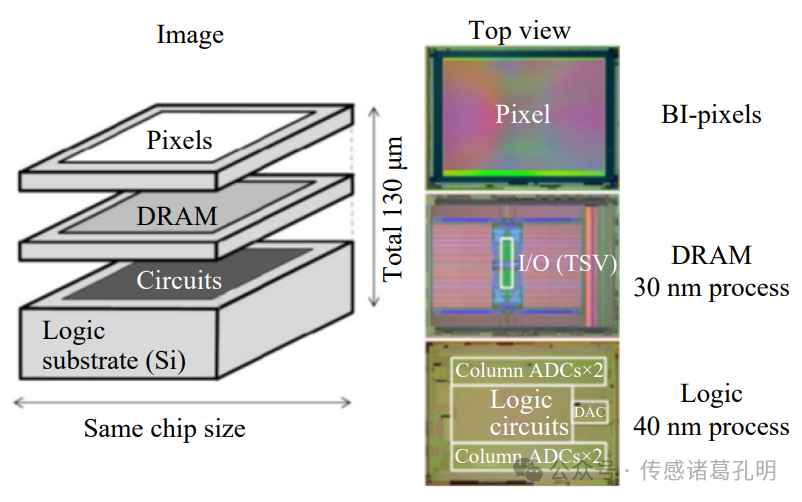 Diagram of Intelligent Image Sensor
China’s Achievements in Aerospace Image Sensors
China has also made significant achievements in the field of aerospace image sensors. In 2020, to obtain detailed images of the Mars landing area, the “Tianwen-1” probe launched by China used a multi-spectral TDI CCD image sensor with an array size of 6144×96, achieving a resolution of 0.5 meters at an altitude of 265 kilometers, providing important technical support for detailed surveys of the Martian surface.
In the civilian sector, China has independently developed a civilian high-resolution stereo mapping satellite, which uses three panchromatic time-delay integration CCDs and one multi-spectral image sensor, capable of achieving a scale of 1:50000 for stereo mapping, used in agriculture and land resources. These achievements mark that China has reached an internationally advanced level in the field of aerospace image sensors.
The progress of aerospace image sensors is not just an improvement in technical parameters, but also an expansion of human cognitive boundaries. From monitoring changes on Earth to exploring the mysteries of deep space, from spacecraft navigation to research on the origins of the universe, these high-performance “eyes of aerospace” are helping us see the true face of the universe.
With the maturation of new types of neuromorphic vision sensors and bionic vision image sensors, future aerospace image sensors will undoubtedly be more intelligent and efficient, contributing more to human space endeavors. In this process, Chinese researchers are making significant contributions to the development of global aerospace image sensor technology through independent innovation.