
Click the blue text above to follow me

【Introduction】
In the fields of industrial automation and instrumentation, sensors and transmitters are often used together, but their functional positioning and core roles are fundamentally different, and many practitioners may confuse the two. In simple terms:A sensor is a “signal collector” that converts physical quantities into raw electrical signals; a transmitter is a “signal processor” that standardizes, amplifies, or converts the raw electrical signals for easier reception by subsequent devices. Below, we will break down the differences in detail across six core dimensions, using scenarios to clarify the distinctions:
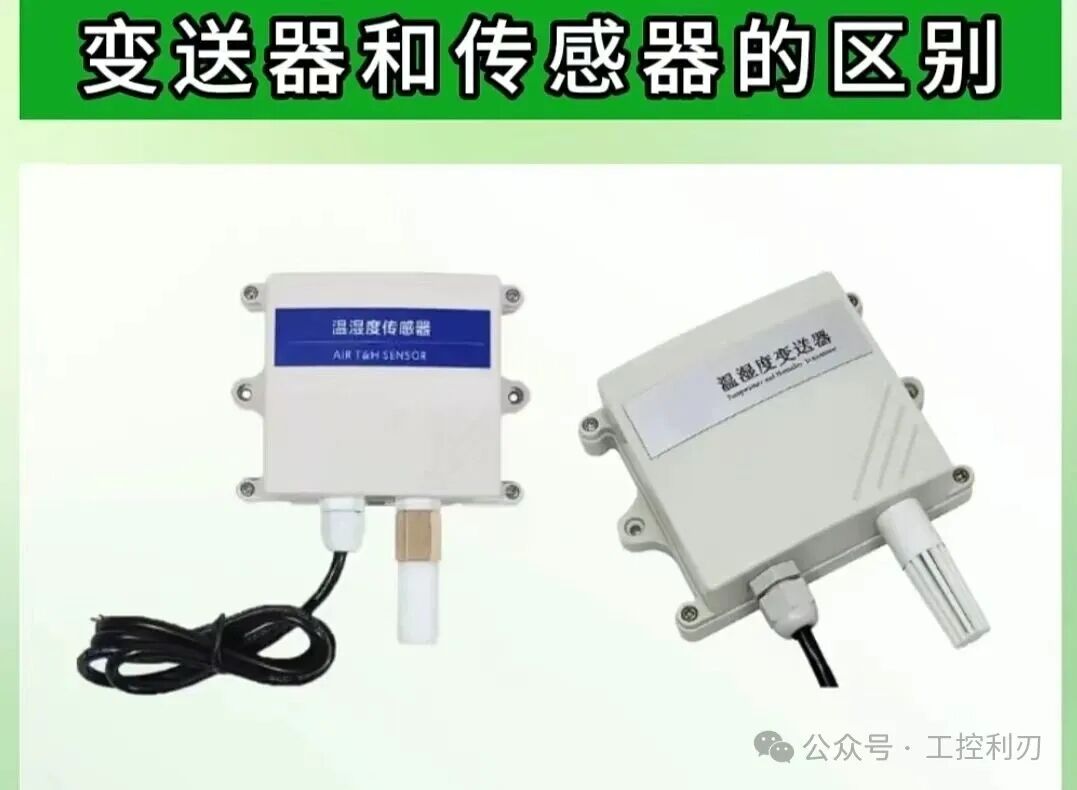
1. Core Definitions and Functions: “Collection” vs “Processing”
-
Sensor: Essentially a “physical quantity – electrical signal converter”, its core function is **”to perceive and collect”. It can directly contact or sense the target physical quantity (such as temperature, pressure, humidity, flow, displacement, etc.) and convert it intonon-standardized raw electrical signals **— for example, a platinum resistance temperature sensor will have its resistance value fluctuate between tens to hundreds of ohms with temperature changes; a pressure sensor may output a weak voltage signal of 0-50mV or a raw current signal of 4-20mA (except for some sensors with simple integrated conversions).Example: Using a thermocouple to measure the temperature of an oven, the thermocouple is the sensor that converts temperature differences into millivolt-level (mV) voltage signals, which is a typical “raw electrical signal”.
-
Transmitter: Essentially a “signal conditioning and conversion device”, its core function is **”to process and standardize”. It does not directly sense physical quantities but receives the raw electrical signals output by the sensor, and through amplification, filtering, linearization, cold junction compensation (such as in temperature transmitters), it converts them intoindustrial standard signals ** (most commonly 4-20mA DC current signals or 0-10V DC voltage signals), which are then transmitted to PLCs, DCS, dashboards, and other secondary devices.Example: The aforementioned thermocouple outputs 0-50mV voltage (corresponding to 0-500℃), this signal is too weak and susceptible to interference for long-distance transmission. At this point, connecting a “temperature transmitter” will convert the 0-50mV into a 4-20mA standard current (4mA corresponds to 0℃, 20mA corresponds to 500℃), which can then be accurately recognized by the PLC.
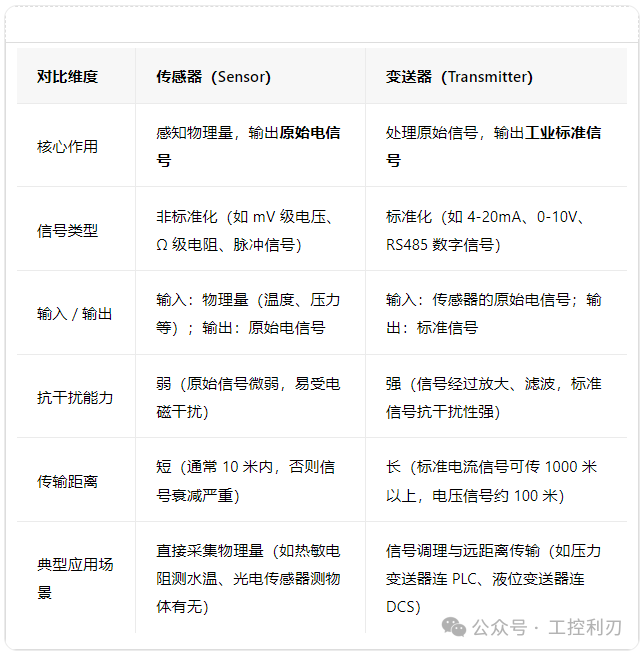
2. Key Differences Comparison: From Signals to Application Scenarios
To visually distinguish, we will summarize the differences across six core dimensions in a table:
3. Special Cases: Confusion Points in “Integrated” Devices
Many manufacturers now produce integrated devices that combine “sensors + transmitters” (such as “integrated temperature transmitters” or “integrated pressure sensors”). These devices contain both the sensor module that perceives the physical quantity and the transmitter module that processes the signal, capable of directly outputting a 4-20mA standard signal. However, this does not mean that the two have no differences — it simply means that the manufacturer has integrated two independent functions into one housing; fundamentally, it is still a two-step logic of “first collecting, then processing”, rather than merging the two into a new device.
For example, if you buy an “integrated level sensor”, upon disassembly, you will find two parts: one part is the float/capacitive “level sensing module” (i.e., the sensor), and the other part is the “signal conversion circuit” (i.e., the transmitter), with the final output of the 4-20mA signal still being the result processed by the transmitter.
Summary: Distinguishing in One Sentence
- To determine “whether it is a sensor”: check if itdirectly contacts/senses the physical quantity, and whether it outputs “unprocessed raw signals”;
- To determine “whether it is a transmitter”: check if itonly receives electrical signals without touching physical quantities, and whether it outputs “standard signals that can be transmitted over long distances”.
In simple terms:A sensor is the “eye” responsible for “seeing”; a transmitter is the “mouth” responsible for translating what is “seen” into a language that others can understand..
Previous Recommendations
Don’t panic when encountering motor failures! Understanding these ten core issues will help you troubleshoot like a fish in water.
BYD Recruitment: 10 Electricians and Mechanics (8-10k)
Before taking the low-voltage electrician certification, you must understand these processes! Don’t waste your time (there are exam question benefits at the end of the article).
Hiring Electrical Engineers with an annual salary of 200,000-400,000!
Hiring Robotics Engineers with an annual salary of 180,000! If you understand, come!
If you are an electrician and still don’t know how to connect a frequency converter, don’t mix in the electrical circle anymore.
Student unit, hiring 6 electrical and instrumentation personnel! (Contact number at the end of the article).
Hiring! Electrical Engineer (Design Direction)
7 Ladder Diagrams You Must Learn for PLC Study, if you don’t know, hurry up and take a look!
Hiring, hiring, hiring! (Contact information at the end of the article).