High-resolution 3D printing technology based on two-photon polymerization plays a critical role in various fields such as quantum information processing, precision measurement, optical atomic clocks, and mass spectrometry. Traditional large three-dimensional (3D) Paul traps have approximately harmonic potential wells and high capture efficiency, but their ion-electrode distance is about 1 mm, which limits further miniaturization due to processing difficulties. In contrast, surface traps based on planar electrodes can achieve large-scale two-dimensional arrays through microfabrication techniques and support integration with photonics. However, the arrangement of electrodes on a single plane leads to enhanced anharmonicity of the potential well, reduced well depth, and requires ions to be close to the electrodes to maintain reasonable frequencies, exposing them to electric field noise and introducing heating and quantum gate errors. Although attempts have been made to construct microfabricable 3D traps through wafer stacking structures, the design freedom remains limited. Balancing miniaturization, scalability, and high performance has always been a significant challenge in this field.In light of this, The Lawrence Livermore National Laboratory of the U.S. Department of Energy Professor Hartmut Häffner, Professor Juergen Biener, Shuqi Xu (first author and corresponding author), Xiaoxing Xia (co-first author and corresponding author) and others demonstrated a high-resolution 3D printing technology based on two-photon polymerization (2PP) that can fabricate miniaturized three-dimensional Paul trap arrays. In experiments, Ca⁺ ions were successfully captured in the 3D printed ion trap, achieving strong confinement with a radial frequency range of 2 MHz–24 MHz. The tight confinement reduced cooling requirements, achieving high-quality Rabi oscillations using only Doppler cooling, and also demonstrated two-qubit gate operations with a fidelity of 0.978 ± 0.012 for the prepared Bell state. This achievement proves that 3D printing can combine the high performance of traditional 3D traps with chip-level scalability, providing new design freedom and manufacturing pathways for quantum information processing. The related research results were published in Nature under the title “3D-printed micro ion trap technology for quantum information applications.” 【Comparison and Performance Analysis of Paul Trap Types】The research first compared three typical types of traps: traditional 3D Paul traps, surface traps, and 3D printed traps (Figure 1). Traditional 3D traps have a large well depth and nearly harmonic potential wells (Figure 1a), but they are large and difficult to scale; surface traps (Figure 1b) are easy to integrate on a large scale but sacrifice well depth and frequency; 3D printed traps (Figure 1c) combine high well depth, high frequency, and scalability. Further numerical simulations indicate that under the same electrode spacing, driving frequency, and RF voltage, the pseudo-potential of 3D printed traps is closer to harmonic form and significantly better than that of surface traps (Figure 2a). With the stability parameter q held constant, the capture frequency of 3D traps is about twice that of surface traps; at the same driving frequency, the frequency can even increase fivefold (Figure 2b). Higher frequencies help reduce heating, increase operational speed, and decrease cooling complexity. Meanwhile, the power consumption of 3D traps can be reduced by about an order of magnitude while maintaining the same performance. Their harmonic potential wells can also effectively suppress frequency drift caused by dielectric charging.
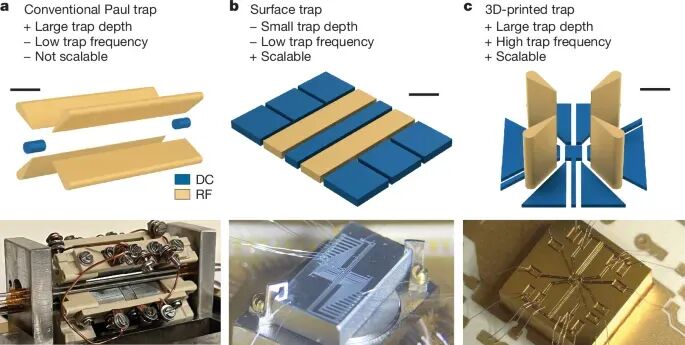 Figure 1. Comparison of Paul Trap Variants
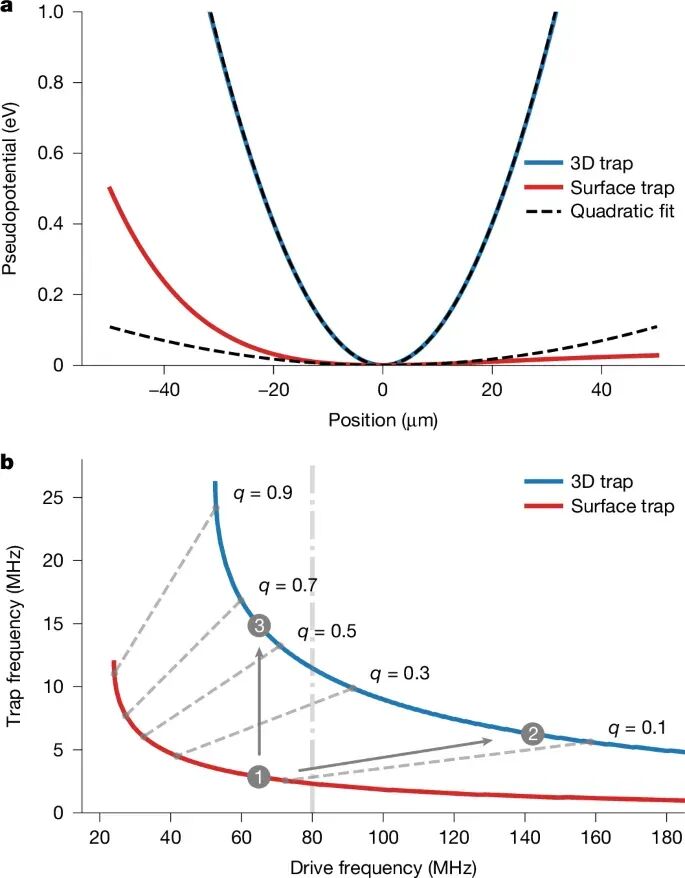 Figure 2. Performance Comparison of 3D Traps and Surface Traps【3D Printing and Structural Design】The research team used the Nanoscribe two-photon lithography system to manufacture micro linear Paul traps (Figure 3). The process includes: first printing 3D polymer structures in photoresist, then depositing a 1 μm thick Au or Al metal layer through electron beam evaporation to achieve conductivity. The electrode isolation is ensured by designing undercut structures, and a “T” cross-section and suspended sidewalls are used in the wiring section to improve insulation reliability (Figures 3d, 3e). This process does not require a mask and can complete rapid iterations from design to device within 1–2 days. The research prepared two typical traps: 3D-100-Au-V (electrode spacing of 200 μm, ion-electrode distance of 100 μm, gold coating) and 3D-75-Al-V (ion-electrode distance of 75 μm, aluminum coating), both integrated with a DC electrode array on a sapphire substrate (Figure 3f).
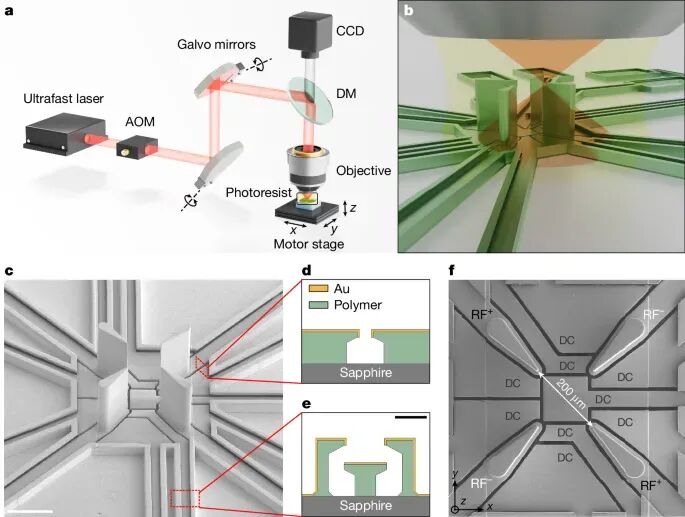 Figure 3. 3D Printing Process and SEM Image of 3D Printed Trap (3D-100-Au-V)【Ion Capture and Cooling Performance】In the 3D-100-Au-V trap, the RF driving frequency is ωrf/2π = 51.6 MHz, and the radial capture frequency ωr/2π can be tuned between 2.09–24.15 MHz (Figure 4). At the highest frequency, the stability parameter q = 0.903, close to the theoretical limit of 0.911. The research team measured the average phonon number n using laser spectroscopy, and the results indicate that the cooling temperature at different radial frequencies aligns well with the theoretical limit of Doppler cooling (Figure 5a). At ωr/2π = 21.29 MHz, n ≈ 0.5 (Figure 5b). Under this condition, the single-qubit Rabi oscillation contrast was 0.994 during the first oscillation₋₀₀₁₀⁺₀.₀₀₆, and the 11th oscillation still maintained 0.993₋₀.₀₃₁⁺₀.₀₀₇, corresponding to a π pulse error rate of ≲10⁻⁴ (Figure 5c). This indicates that 3D printed traps can achieve high-quality quantum operations without complex sideband cooling.
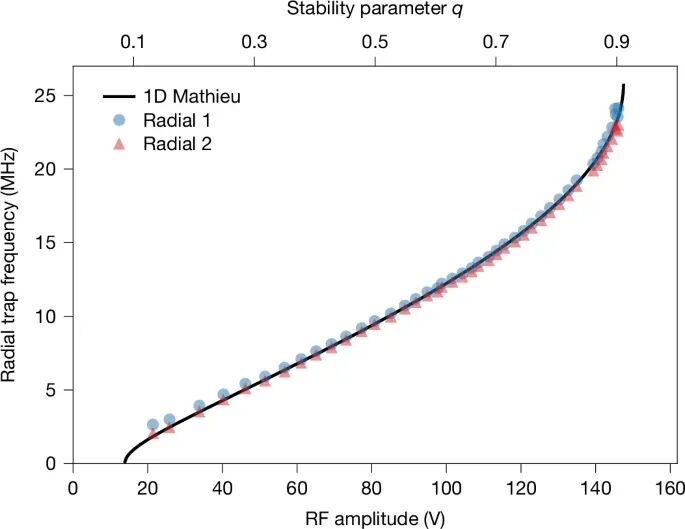 Figure 4. Radial Trap Frequency Scan【Two-Qubit Gates and Long-Term Capture】In the 3D-75-Al-V trap, the research achieved two-qubit gates based on Mølmer–Sørensen interaction, with the axial COM mode frequency of ωa/2π = 3 MHz, and gate duration of 100 μs. The experimentally obtained fidelity of the Bell state was 0.978 ± 0.012 (Figure 5d), with errors primarily arising from spin coherence limitations rather than heating effects. Additionally, the experiment showed that under ultra-high vacuum (approximately 4 × 10⁻¹¹ Torr), Ca⁺ ions can be stably stored for several hours, maintaining periodic exchange positions, demonstrating good long-term stability.
 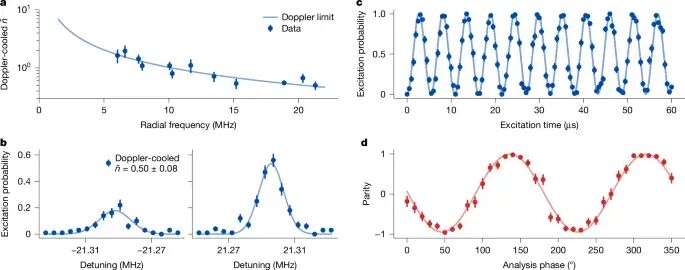 Figure 5. Cooling and Gate Operations【Scalability and Process Optimization】Repetitive testing of the 3D printed ion traps showed that the size variation of 200 identical designed central regions in the plane and height directions was only about 2.2%, mainly due to measurement errors (Figures 6a–c). The average surface roughness of the metal coating was only 6.5 nm, better than the control group of the same sapphire substrate (Figure 6d). To improve yield and reduce time, the research proposed a hybrid process: pre-fabricating DC electrodes and wiring on microfabricated silicon wafers, then printing RF electrodes (Figure 6e). This reduced the printing time from 14 hours to 30 minutes, significantly improving yield. 3D printing can also achieve extreme designs, such as grid electrodes that reduce the surface area adjacent to ions (Figure 6f) or horizontal traps parallel to the substrate (Figure 6g), providing possibilities for exploring electric field noise mechanisms and new systems.【Discussion and Application Prospects】Compared to traditional macroscopic 3D traps and surface traps, the capture frequency of 3D printed traps is increased by about four times, which significantly enhances the speed of ion lattice splitting, merging, and transport. The high frequency also reduces cooling requirements, allowing gate errors to be suppressed below 10⁻⁵ using only Doppler cooling, which will greatly accelerate the operational efficiency of quantum computers based on quantum charge-coupled device (QCCD) architecture. Moreover, this technology shows advantages in scalability: theoretically, over 1000 trap region arrays can be achieved per square centimeter (Figure 6h), and can be coupled with integrated photonic circuits for large-scale optical control. In addition to quantum information processing, 3D printed micro traps may also find applications in space mass spectrometry, precision metrology, and optical atomic clocks, enhancing signal-to-noise ratio and stability; their harmonic potential wells also provide critical conditions for high-speed quantum information processing using trapped electrons.
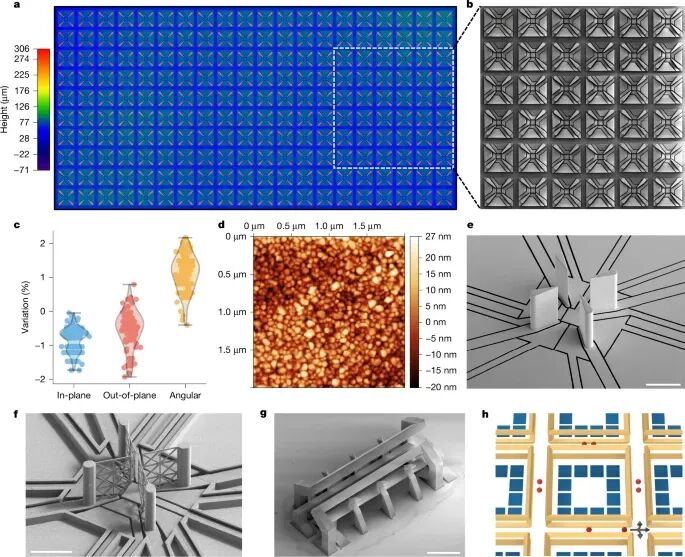 Figure 6. Outlook【Summary】This article presents and validates a microfabricated Paul trap technology based on two-photon polymerization 3D printing. This method combines high frequency, deep harmonic potential wells, and chip-level scalability, demonstrating tremendous potential for quantum computing, precision measurement, and optical clocks. As the resolution and speed of 3D printing continue to improve, this platform is expected to further expand geometric design freedom and deeply integrate with photonics and microelectronics, thereby accelerating the development of next-generation quantum information processing and precision scientific equipment.Xu, S., Xia, X., Yu, Q. et al. 3D-printed micro ion trap technology for quantum information applications. Nature (2025). https://doi.org/10.1038/s41586-025-09474-1Source: Polymer Science Frontiers