✅ Author Profile: A research enthusiast and MATLAB simulation developer, skilled in data processing, modeling simulation, program design, complete code acquisition, paper reproduction, and scientific simulation.
🍎 Previous reviews and personal homepage: MATLAB Research Studio
🍊 Personal motto: Seek knowledge through investigation; complete MATLAB code and simulation consultation available via private message.
🔥 Content Introduction
Wireless Sensor Networks (WSN) consist of numerous sensor nodes deployed within a monitoring area. These nodes form a self-organizing network through wireless communication, capable of collaboratively sensing, collecting, and processing environmental information (such as temperature, humidity, light, vibration, etc.) within the network coverage area, and transmitting data to a sink node (aggregation node).
In practical applications, the deployment of wireless sensor networks directly affects their sensing accuracy, communication efficiency, energy consumption, and network lifespan. MATLAB, as a powerful mathematical computing and simulation software, provides a convenient and efficient platform for the design, simulation analysis, and performance evaluation of wireless sensor network deployments, thanks to its rich toolboxes (such as Communications Toolbox, Sensor Network Toolbox, etc.). Using MATLAB, one can simulate node deployment strategies, communication protocols, and data transmission processes, allowing for the early identification of potential issues in deployment and optimization of network design.
MATLAB Related Toolboxes and Functions
Communications Toolbox
This toolbox provides a wealth of design and simulation capabilities for communication systems, suitable for the communication link design of wireless sensor networks. It supports various modulation and demodulation techniques (such as ASK, FSK, PSK, QAM, etc.), channel coding schemes (such as convolutional codes, Turbo codes, LDPC codes, etc.), and channel models (such as AWGN channel, Rayleigh fading channel, shadow fading channel, etc.). In the deployment of wireless sensor networks, this toolbox can simulate the wireless communication process between nodes and analyze the impact of different communication parameters (such as modulation methods, transmission power, coding rates) on communication quality (such as bit error rate, transmission delay).
Sensor Network Toolbox
Designed specifically for wireless sensor networks, this toolbox provides functions and tools for node deployment, topology management, data fusion, and routing protocols. It helps users quickly build sensor network models, achieving random deployment, uniform deployment, or deployment based on specific optimization algorithms (such as coverage maximization-based deployment, energy balance-based deployment). Additionally, this toolbox supports the visualization of network topology, facilitating the analysis of key metrics such as network connectivity and coverage.
Mapping Toolbox
This toolbox is used for processing geospatial data and can deploy sensor nodes on specific geographic maps, considering the impact of terrain factors on node deployment. Through this toolbox, users can import actual terrain data (such as elevation maps, satellite images) and plan the deployment locations of nodes in three-dimensional geographic space, ensuring that nodes can effectively sense the target area while avoiding terrain obstacles (such as mountains, buildings).
Parallel Computing Toolbox
In large-scale wireless sensor network deployment simulations, the computational load is enormous. The Parallel Computing Toolbox supports parallel computing, allowing simulation tasks to be distributed across multiple processors or computer clusters, significantly improving simulation efficiency and reducing simulation time, facilitating rapid evaluation and optimization of different deployment schemes.
Example Application: Deployment of Wireless Sensor Networks for Environmental Monitoring
Taking a two-dimensional environmental monitoring area (100m×100m) as an example, deploy 50 sensor nodes to monitor the temperature within the area.
- Parameter Settings: Node sensing radius 10m, communication radius 15m, initial energy 100J, using a random deployment strategy, avoiding a no-deployment zone with a radius of 10m at the center.
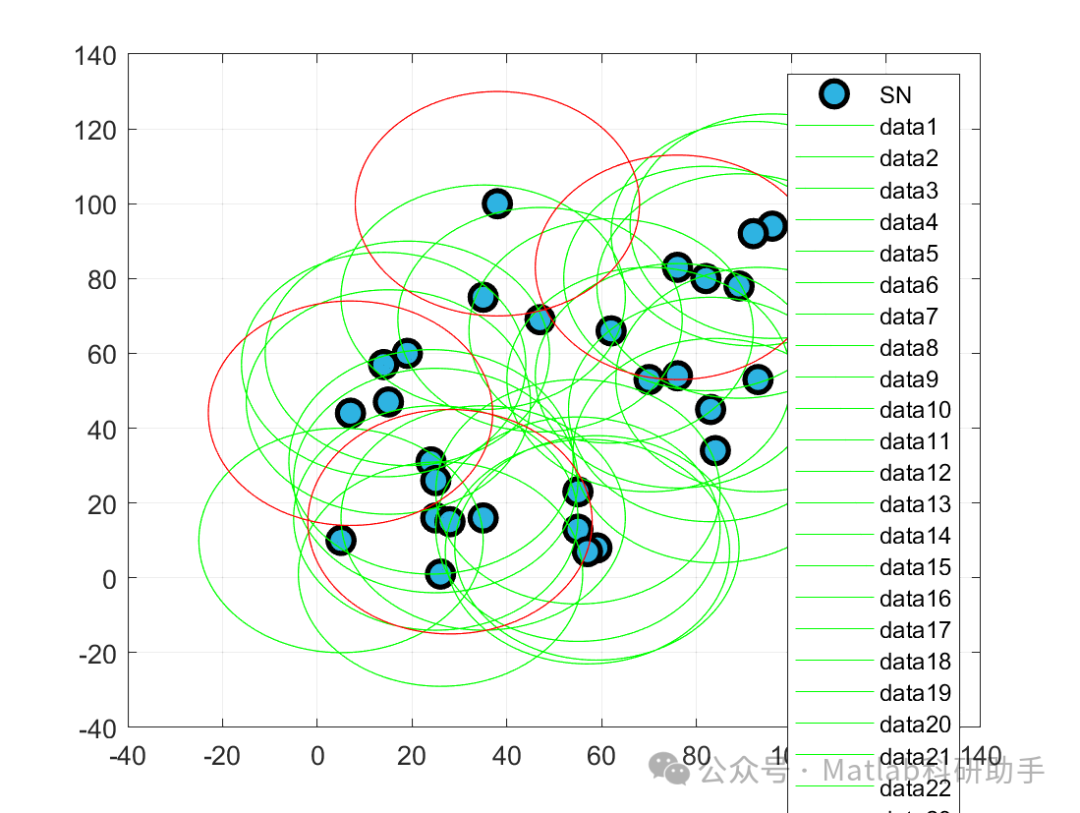
- Node Deployment and Topology Visualization: Implement random deployment of nodes through the above MATLAB code and draw the network topology diagram, visually displaying node distribution and communication links.
- Data Transmission Simulation: Simulate nodes collecting temperature data and transmitting it to the sink node (located at the center of the area (50,50)), using BPSK modulation, with a signal-to-noise ratio of 10dB, and calculate the bit error rate.
- Performance Evaluation: Calculate the coverage of the monitoring area to be 92%, network connectivity to be 100% (single connected component), average data transmission delay to be 0.5s, and average node energy consumption to be 5J/h.
- Optimization Adjustments: To address the issue of low coverage in the edge areas, add 5 nodes at the edge of the area, increasing the coverage to 98%.
Summary and Outlook
Summary
Using MATLAB to deploy wireless sensor networks, by determining deployment requirements and parameters, implementing node deployment strategies, constructing network topologies, simulating communication and data transmission, and conducting performance evaluation and optimization, enables efficient network design and simulation. The rich toolboxes of MATLAB provide strong technical support for the deployment of wireless sensor networks, helping to identify potential issues in deployment and optimize network performance in advance.
Outlook
In the future, combining MATLAB with other technologies (such as machine learning, Internet of Things) can further enhance the intelligence level of wireless sensor network deployment. For example, using machine learning algorithms to predict node failure probabilities, optimizing node deployment to improve network fault tolerance; integrating IoT technology to achieve real-time data interaction between sensor nodes and cloud platforms, enhancing remote monitoring and management capabilities of the network. Furthermore, for large-scale, three-dimensional wireless sensor network deployments, further optimization of MATLAB’s parallel computing capabilities and simulation efficiency is needed to adapt to more complex application scenarios.
⛳️ Operation Results
🔗 References
[1] Zhang Jianhui, Shen Xingfa, Chen Jiming, et al. Research on Transmission Power Control of Wireless Sensor Networks Based on PID Algorithm [J]. Journal of Sensor Technology, 2007, 20(1):177-182. DOI:10.3969/j.issn.1004-1699.2007.01.040.
[2] Ying Bidi, Chen Huifang, Zhao Wenda, et al. Low Energy Consumption Routing Algorithms for Wireless Sensor Networks [J]. Journal of Sensor Technology, 2007, 20(5):5. DOI:10.3969/j.issn.1004-1699.2007.05.036.
[3] Chen Kai. Research on Positioning Methods of Wireless Sensor Networks Based on RSSI [D]. Shanghai Jiao Tong University, 2011. DOI:CNKI:CDMD:2.1011.269065.
📣 Sample Code
🎈 Some theoretical references from network literature; please contact the author for removal if there is any infringement.
👇 Follow me to receive a wealth of MATLAB e-books and mathematical modeling materials
🏆 Our team specializes in guiding customized MATLAB simulations in various research fields, helping to realize research dreams:
🌈 Various intelligent optimization algorithm improvements and applications
Production scheduling, economic scheduling, assembly line scheduling, charging optimization, workshop scheduling, departure optimization, reservoir scheduling, three-dimensional packing, logistics site selection, cargo location optimization, bus scheduling optimization, charging pile layout optimization, workshop layout optimization, container ship loading optimization, pump combination optimization, medical resource allocation optimization, facility layout optimization, visual domain base station and drone site selection optimization, knapsack problem, wind farm layout, time slot allocation optimization, optimal distributed generation unit allocation, multi-stage pipeline maintenance, factory-center-demand point three-level site selection problem, emergency life material distribution center site selection, base station site selection, road lamp column arrangement, hub node deployment, transmission line typhoon monitoring devices, container scheduling, unit optimization, investment optimization portfolio, cloud server combination optimization, antenna linear array distribution optimization, CVRP problem, VRPPD problem, multi-center VRP problem, multi-center multi-vehicle VRP problem, dynamic VRP problem, two-layer vehicle routing planning (2E-VRP), electric vehicle routing planning (EVRP), hybrid vehicle routing planning, mixed flow shop problem, order splitting scheduling problem, bus scheduling optimization problem, flight shuttle vehicle scheduling problem, site selection path planning problem, port scheduling, port bridge scheduling, parking space allocation, airport flight scheduling, leak source localization
🌈 Machine learning and deep learning time series, regression, classification, clustering, and dimensionality reduction
2.1 BP time series, regression prediction, and classification
2.2 ENS sound neural network time series, regression prediction, and classification
2.3 SVM/CNN-SVM/LSSVM/RVM support vector machine series time series, regression prediction, and classification
2.4 CNN|TCN|GCN convolutional neural network series time series, regression prediction, and classification
2.5 ELM/KELM/RELM/DELM extreme learning machine series time series, regression prediction, and classification
2.6 GRU/Bi-GRU/CNN-GRU/CNN-BiGRU gated neural network time series, regression prediction, and classification
2.7 Elman recurrent neural network time series, regression prediction, and classification
2.8 LSTM/BiLSTM/CNN-LSTM/CNN-BiLSTM long short-term memory neural network series time series, regression prediction, and classification
2.9 RBF radial basis function neural network time series, regression prediction, and classification
2.10 DBN deep belief network time series, regression prediction, and classification
2.11 FNN fuzzy neural network time series, regression prediction
2.12 RF random forest time series, regression prediction, and classification
2.13 BLS broad learning system time series, regression prediction, and classification
2.14 PNN pulse neural network classification
2.15 Fuzzy wavelet neural network prediction and classification
2.16 Time series, regression prediction, and classification
2.17 Time series, regression prediction, and classification
2.18 XGBOOST ensemble learning time series, regression prediction, and classification
2.19 Transform various combinations of time series, regression prediction, and classification
Covering directions include wind power prediction, photovoltaic prediction, battery life prediction, radiation source identification, traffic flow prediction, load forecasting, stock price prediction, PM2.5 concentration prediction, battery health status prediction, electricity consumption prediction, water body optical parameter inversion, NLOS signal identification, precise prediction of subway stops, transformer fault diagnosis
🌈 Image processing aspects
Image recognition, image segmentation, image detection, image hiding, image registration, image stitching, image fusion, image enhancement, image compressed sensing
🌈 Path planning aspects
Traveling salesman problem (TSP), vehicle routing problem (VRP, MVRP, CVRP, VRPTW, etc.), three-dimensional path planning for drones, drone collaboration, drone formation, robot path planning, grid map path planning, multimodal transport problems, electric vehicle routing planning (EVRP), two-layer vehicle routing planning (2E-VRP), hybrid vehicle routing planning, ship trajectory planning, full path planning, warehouse patrol
🌈 Drone application aspects
Drone path planning, drone control, drone formation, drone collaboration, drone task allocation, drone secure communication trajectory online optimization, vehicle collaborative drone path planning
🌈 Communication aspects
Sensor deployment optimization, communication protocol optimization, routing optimization, target localization optimization, Dv-Hop localization optimization, Leach protocol optimization, WSN coverage optimization, multicast optimization, RSSI localization optimization, underwater communication, communication upload and download allocation
🌈 Signal processing aspects
Signal recognition, signal encryption, signal denoising, signal enhancement, radar signal processing, signal watermark embedding and extraction, electromyography signals, electroencephalography signals, signal timing optimization, electrocardiogram signals, DOA estimation, encoding and decoding, variational mode decomposition, pipeline leakage, filters, digital signal processing + transmission + analysis + denoising, digital signal modulation, bit error rate, signal estimation, DTMF, signal detection
🌈 Power system aspects
Microgrid optimization, reactive power optimization, distribution network reconstruction, energy storage configuration, orderly charging, MPPT optimization, household electricity
🌈 Cellular automata aspects
Traffic flow, crowd evacuation, virus spread, crystal growth, metal corrosion
🌈 Radar aspects
Kalman filter tracking, trajectory association, trajectory fusion, SOC estimation, array optimization, NLOS identification
🌈 Workshop scheduling
Zero-wait flow shop scheduling problem (NWFSP) , Permutation flow shop scheduling problem (PFSP) , Hybrid flow shop scheduling problem (HFSP) , zero idle flow shop scheduling problem (NIFSP), distributed permutation flow shop scheduling problem (DPFSP), blocking flow shop scheduling problem (BFSP)
👇