Reported by Electronic Enthusiasts (Author/Zhang Ying)Since 2025, as artificial intelligence technology continues to penetrate various industries, edge AI chips have become a key driving force in the transformation of the smart industry. Qualcomm CEO Cristiano Amon stated that AI will become a new computing interface, focusing not only on computational tasks at the edge but also on human-centered experiences, transforming user interactions into AI agents, and continuously expanding into AI hardware devices such as smartphones, glasses, watches, and cars, with edge AI chips becoming the main driving force for the deployment of AI devices.
Rockchip Chairman and CEO Li Min pointed out that benefiting from the emergence of large models and the influx of substantial intellectual resources, the AIoT industry is transitioning from the 1.0 era to the 2.0 era. Shanghai HiSilicon also stated that the efficient implementation of edge AI relies on deep collaboration among terminal devices, terminal chips, and developers. Companies like Huawei, MediaTek, and Samsung are all increasing their investments in AI chips.
Thanks to the explosive demand from scenarios such as smart homes, smart cars, smart industry, and education, AIoT chip listed companies have released impressive Q3 financial reports. This article will summarize the latest report highlights from ten AIoT chip companies to see which companies have experienced significant increases in performance and net profit. What are the driving factors behind this? How has the expansion into overseas markets changed? What breakthroughs have been made in new edge AI chip products?
Nine Companies Reported Profit Growth, Q3 Net Profit Soars 2.67 Times, Driven by Automotive, Industrial, and Wearable Markets
Recently, Electronic Enthusiasts compiled data from the semi-annual reports of ten major AIoT companies listed in China, ranking their operating revenue, net profit, and growth rates for the first three quarters of 2025. The ten companies are OmniVision Technologies, GigaDevice Semiconductor, Amlogic, Beijing Junzheng, Goodix Technology, Hengxuan Technology, Rockchip, Allwinner Technology, Espressif Systems, and Tailing Microelectronics.
Statistics of Revenue and Net Profit for Ten AIoT Chip Listed Companies in the First Three Quarters
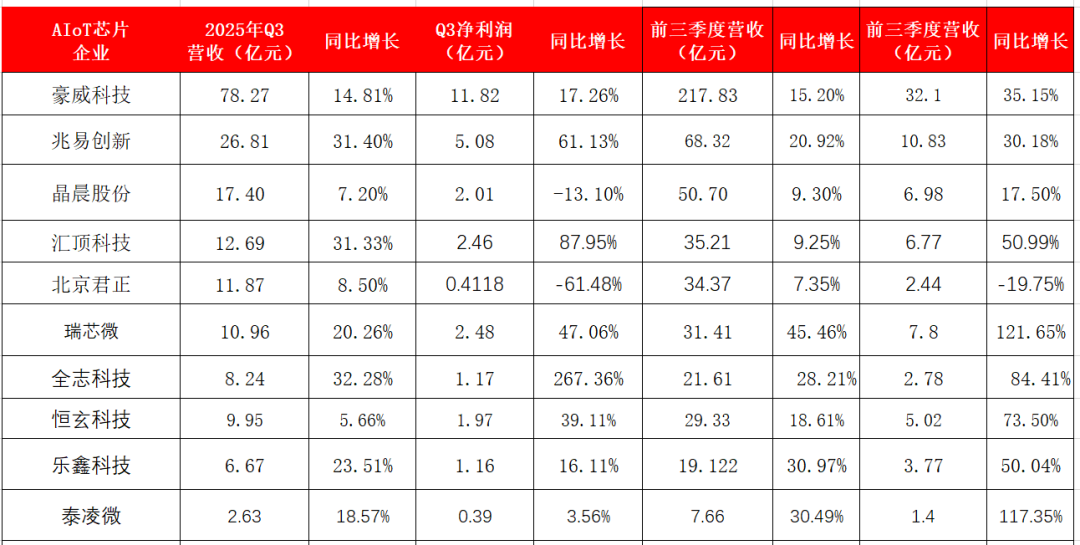
Image: Compiled by Electronic Enthusiasts based on public data
In the first three quarters of this year, five companies surpassed 3 billion in revenue, with OmniVision leading at 21.783 billion, a 15.2% increase compared to the same period last year. GigaDevice ranked second with revenue of 6.832 billion, a year-on-year increase of 20.92%. Amlogic, Goodix Technology, and Beijing Junzheng ranked third, fourth, and fifth, with revenues of 5.07 billion, 3.521 billion, and 3.437 billion respectively, showing year-on-year growth of 9.3%, 9.25%, and 7.35%.
In the first three quarters of 2025, OmniVision achieved operating revenue of 21.783 billion, a 15.20% increase year-on-year; net profit attributable to shareholders reached 3.210 billion, a 35.15% increase year-on-year. OmniVision stated that this growth is attributed to seizing market opportunities, with a rapid increase in penetration in the automotive intelligent driving sector and significant expansion in the smart imaging terminal application market, such as panoramic and action cameras. The company has also improved its gross margin through product structure optimization and supply chain management.
Rockchip’s performance in the first three quarters was impressive, achieving significant growth in both revenue and net profit, while expanding its position in the AIoT market through new product launches. Rockchip achieved revenue of 3.141 billion, a year-on-year increase of 45.46%; net profit attributable to shareholders was 780 million, a year-on-year increase of 121.65%. In September, Rockchip showcased two new edge AI products at the Industrial Expo: the RK1828 co-processor and the RV1126BJ industrial vision chip. These products form a “computing power + perception” product matrix, marking the company’s transition from edge computing chips to an edge AI platform ecosystem. In the robotics sector, the RK3588 platform has been used in industrial inspections, AGV transportation, cleaning, and companion robots.
In terms of quarterly performance, Rockchip achieved revenue of 1.096 billion in Q3, a year-on-year increase of 20.26%, but a quarter-on-quarter decrease of 5.63%, mainly due to the transition of some customers’ mid-to-high-end AIoT products from DDR4 to DDR5, influenced by the supply shortage and price surge of DDR4 memory chips, which affected short-term demand.
Allwinner Technology’s Q3 performance was outstanding, achieving operating revenue of 824 million, a year-on-year increase of 32.28%, with continuous business expansion; net profit attributable to shareholders reached:117 million, a staggering increase of 267.36%,significantly enhancing profitability. With the market demand rebounding, the company is actively promoting the landing of downstream products in 2025, with rapid revenue growth in key segments such as robotic vacuum cleaners, smart automotive electronics, and smart vision.
Among the ten AIoT chip companies, nine reported profit growth, while one experienced a decline. Six companies saw significant profit increases, including Rockchip, Allwinner Technology, Hengxuan Technology, Goodix Technology, Espressif Systems, and Tailing Microelectronics. Among them, five listed companies reported net profits exceeding 500 million, namely OmniVision (3.21 billion), GigaDevice (1.083 billion), Rockchip (780 million), Amlogic (698 million), Goodix Technology (677 million), and Hengxuan Technology (502 million).
Beijing Junzheng achieved operating revenue of 3.437 billion in the first three quarters of 2025, a year-on-year increase of 7.35%, with 60% of its revenue coming from memory chips. However, its computing chips showed highlights, with its embedded MPU products continuously expanding application scenarios in the AIoT field, achieving revenue of 908 million in the first three quarters, a year-on-year increase of 11.79%, leading the growth rate among all product lines, highlighting the effectiveness of its AIoT strategy.
Driven by continuous investment in edge AI products, the expansion of overseas customer layouts, and the unexpected shipment of new products, Tailing Microelectronics has seen significant increases in revenue across all product lines. On October 27, Tailing Microelectronics released its Q3 2025 report. Thanks to growing customer demand, new customer development, and the start of bulk shipments of new products, the company achieved revenue of 766 million in the first three quarters, a year-on-year increase of 30.49%; net profit was 140 million, a year-on-year increase of 117.35%.
Hengxuan Technology, as a leading SoC provider for wearables, has continued to deepen its presence in the smart wearable market in the first three quarters of 2025, maintaining its leading market position; at the same time, it has expanded into new low-power smart hardware markets such as smart glasses, wireless microphones, and smart recording assistants, achieving revenue of 2.933 billion in the first three quarters, a year-on-year increase of 18.61%; net profit attributable to shareholders was 502 million, a year-on-year increase of 73.50%.
Overseas markets continue to grow, with significant increases in Wi-Fi 6 and SoC shipments.
Amlogic’s overseas revenue accounted for 88.9% of its total revenue in the first half of 2025, although the Q3 report did not fully disclose the overseas revenue proportion. Amlogic’s overseas market revenue reached 1.558 billion, a year-on-year increase of 81.4%, significantly higher than the company’s overall revenue growth rate of 10.4%; the overseas revenue proportion remains around 90%, becoming the core engine driving the company’s growth.
In terms of products, Amlogic has launched over 20 commercial chips equipped with self-developed edge intelligent computing units, with shipments exceeding 14 million in the first three quarters, a year-on-year increase of over 150%. The sales of 6nm chips are also continuously rising, with an expected annual shipment of 10 million units. Additionally, the W series and C series products have performed strongly in the market, with the W series shipments exceeding 13 million units, and the C series seeing a continuous increase in orders in the smart vision field, showing promising prospects.
OmniVision stated in an investor communication in August that due to strong overseas demand for automotive CIS, panoramic and action cameras, and emerging markets, the growth rate of its overseas business is significantly faster than the overall rate, driving the company’s total revenue growth of 15.5% and net profit growth of 48%.
Espressif Systems’ semi-annual report disclosed that its overseas sales have steadily increased, with the ESP32 series chips and Wi-Fi 6 new products being the main export products, with Europe and the United States remaining core regions. It is reported that the ESP32 series chips, including the classic ESP32, cost-effective C3/C2, and high-performance S3, are the most widely used chips by overseas customers for smart homes, electrical lighting, and smart appliances.
The company achieved a cumulative operating revenue of 1.912 billion in the first three quarters, a year-on-year increase of 30.97%; cumulative net profit reached 376.8 million, a year-on-year increase of 50.04%.
Hengxuan Technology’s overseas revenue in the first half of 2025 was 470 million, a year-on-year increase of about 38%, accounting for 24.3% of total revenue, with growth significantly faster than domestic revenue. Export products include the new generation 6nm smart wearable SoC BES2800, the previous generation BES2700 series, and low-power Wi-Fi/BT combo chips, with the growth of orders for TWS earphone chips from overseas customers being the main driver.
Tailing Microelectronics has seen continuous growth in overseas markets, with Wi-Fi 6 multimode edge AI chips, 2.4 GHz/5 GHz dual-band Wi-Fi 6 + BLE 5.3 combo, and built-in self-developed AI acceleration units targeting AI IPC, low-power imaging, and Matter-Video terminals, achieving bulk shipments in Q3 2025, with overseas smart home customers starting to ramp up orders.
Domestic AIoT new products are being launched one after another, supporting the deployment of differentiated computing power devices.
Allwinner quickly launched the V821 smart AI glasses solution this year, which has received positive market feedback, helping several terminal customers achieve bulk shipments. Recently, at the Anbo Conference, Allwinner fully showcased the next-generation fully integrated smart vision chip V881 for smart glasses, which has been comprehensively upgraded in imaging functions, chip size, and dual Wi-Fi 6 interconnectivity. The V881’s camera resolution has been upgraded from 4K to 24 million pixels, supporting sensor inputs of up to 24M pixels and allowing simultaneous access to three cameras. The V881 integrates dual-band Wi-Fi 6 and Bluetooth 5.4 modules, providing a stable, low-latency wireless transmission channel for high-definition video streams, with higher transmission rates and lower power consumption, and memory upgraded from DDR2 to DDR4, significantly increasing download transmission rates by 400% and capacity by 100%.The V881 can reach a maximum frequency of 1.4GHz and integrates a 1 Tops NPU capable of supporting commonly used CNN operators.
Allwinner’s V881 can seamlessly upgrade from the V821 wearable solution, better meeting the stringent requirements of lightweight wearable devices for structure and power consumption, assisting customers in efficiently completing secondary development and product launches.
In the first three quarters of 2025, GigaDevice’s flagship GD32H7 series with a core frequency of 600 MHz and double-precision FPU (GD32H75E / 759 / 757 / 737, etc.) has entered mass production, and the industrial-grade AI-MCU has completed design and entered the tape-out stage; another AI-MCU aimed at consumer electronics is in the product definition stage, both integrating self-developed NPU, targeting to provide 0.5–1 TOPS local computing power with power consumption < 50 mW, to meet the endpoint AI needs of battery-powered devices.
Beijing Junzheng has identified market window opportunities driven by edge AI and, as an important representative of domestic chips, has released the company’s first AI MCU (G32S10M), achieving a breakthrough in this field. The chip adopts a multi-core heterogeneous design based on the RISC-V architecture: large cores with a frequency of over 800MHz, supporting 128-bit SIMD processing; small cores also reach frequencies of up to 400MHz while maintaining low power consumption; a dedicated AI computing unit NPU (0.5 Tops); and integrated large-capacity PSRAM. This significantly enhances edge AI computing capabilities while maintaining high real-time performance of the MCU, truly achieving “control + intelligence” integration.
Goodix Technology has launchedultrasonic fingerprint sensors, second-generation under-display light sensors, and the new generationsmart audio amplifier TFA9865, and automotive-grade smart haptic drivers in the first three quarters of 2025. The ultrasonic fingerprint sensor has been used in over ten flagship models, including the vivo X100 Ultra, with more high-end projects expected to be introduced in 2025. The automotive-grade smart haptic driver completed small-batch verification for models from BYD, Hongqi, and others in the first half of 2025, with mass production expected to begin in Q4 2025. The new generation smart audio amplifier TFA9865 has been used in the moto razr 60 & edge 60 series, leading the industry in sound quality and battery life.
Tailing Microelectronics has two new edge AI chip products in mass production in the first three quarters of 2025: TL721X, which features ultra-low power consumption at 1 mA, integrates Bluetooth 5.3/BLE/Zigbee/Thread, and can run lightweight voice or sensor AI algorithms, with sales exceeding 10 million in the second quarter; and TL751X, which features a multi-core CPU + NPU + DSP architecture, higher computing power, and supports BLE/Zigbee/Thread/Matter protocols, targeting high-end smart homes, AI speakers, and multimode gateways, with bulk shipments starting in Q3.
In Conclusion
Edge AI chips have entered a “scale explosion period” in 2025, but opportunities and challenges coexist. Rapid growth in AI PCs, AI smartphones, AI glasses, and AI toys has created massive demand for specific scenarios, but the industry must overcome four hurdles: mass production costs, toolchain unification, commercial monetization, and supply chain security.
Industries such as industrial, automotive, and home have varying requirements for precision, latency, and temperature range. Those who can quickly meet customers’ differentiated needs and create value for customers in chip compatibility, framework compatibility, and cross-platform migration will capture more market share.

Disclaimer:This article is original to Electronic Enthusiasts, please indicate the source when reprinting. For group discussions, please add WeChat elecfans999, for submission and interview requests, please email [email protected].
More Hot Articles to Read
-
Netizens are outraged! Xiaopeng’s humanoid robot IRON is accused of “impersonating a real person”? Cutting open the skin to prove it
-
The robotic vacuum cleaner has “defected”
-
Xiaomi warns! Upstream industry chain price restructuring, AI terminal devices may face price increases
-
These storage companies have seen explosive profit growth, with the highest reaching 1994.42%, is the “super cycle” stable?
-
ANSHI China’s latest announcement: Counting the “three sins” of Dutch ANSHI, seamless connection of wafer supply
Click to Follow and Star Us
Set us as a star to not miss any updates!