
At the 36th Great Wall Cardiology Conference and the Asian Cardiology Conference 2025, during the “Ventricular Arrhythmia Catheter Ablation Forum”, Professor Chen Songwen from Shanghai First People’s Hospital delivered an in-depth report on “Treatment Methods and Strategies for Hemodynamically Unstable Ventricular Tachycardia.” Professor Chen pointed out that hemodynamically unstable ventricular tachycardia is a critical clinical condition, and traditional ablation strategies face significant challenges due to limited mapping time. He emphasized that the application of Mechanical Circulatory Support (MCS) is the cornerstone for achieving precise activation mapping, and a profound understanding of the substrate combined with the application of new ablation energy is key to improving the surgical success rate for such high-risk patients.
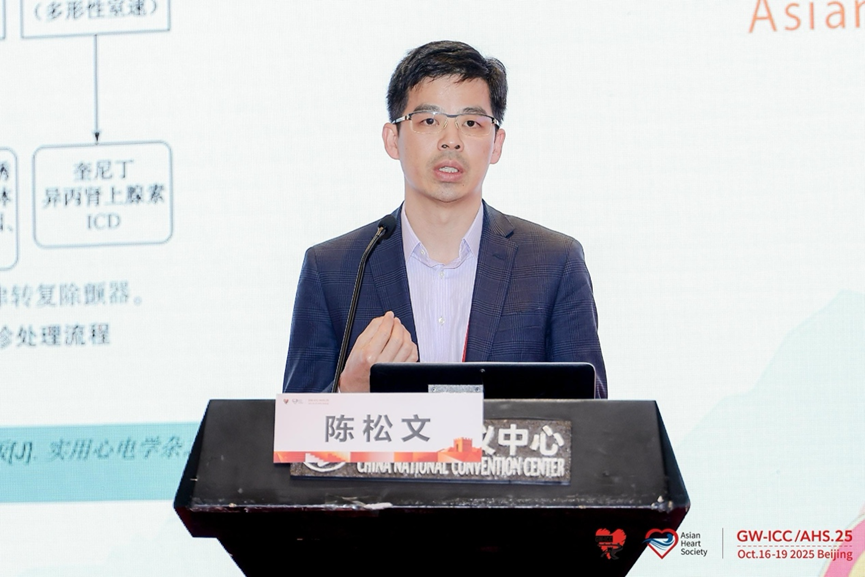
Professor Chen Songwen: Treatment Methods and Strategies for Hemodynamically Unstable Ventricular Tachycardia
Professor Chen Songwen first clarified the clinical dilemma, stating that hemodynamically unstable ventricular tachycardia can occur in both organic and non-organic heart diseases. The first step in treatment is always immediate electrical cardioversion, followed by rapid identification and correction of acute ischemia, electrolyte disturbances, and other triggers. However, when drug therapy is ineffective, catheter ablation becomes a necessary approach.
He pointed out that the core contradiction faced by catheter ablation is that the most precise “activation mapping” can accurately locate critical isthmuses, but the process is time-consuming, and patients with hemodynamic instability cannot tolerate it at all. Therefore, clinicians are forced to rely on “substrate mapping” under sinus rhythm, which involves voltage mapping to find low-voltage areas, late potentials, or LAVA potentials. However, Professor Chen cautioned that simple substrate mapping often leads to excessive ablation areas, potentially damaging still-functional myocardium, thereby increasing the risk of heart function deterioration and postoperative mortality.
How to solve this dilemma of “needing precision while being quick”? Professor Chen proposed a solution centered on Mechanical Circulatory Support (MCS). He emphasized that for unstable ventricular tachycardia unresponsive to drugs, MCS methods such as ECMO or Left Ventricular Assist Devices (LVAD) are the “only supportive means” for achieving safe and precise ablation. MCS can provide patients with a stable hemodynamic platform, transforming a critical unstable state into a controllable stable state, thus winning valuable time for the operator. With this support, doctors can confidently perform gold-standard “activation mapping” and “drag mapping,” achieving precise localization of the critical isthmus of the ventricular tachycardia circuit, minimizing ineffective ablation and myocardial damage.
Professor Chen further pointed out that even if the target is found with MCS assistance, the second challenge lies in how to achieve effective ablation, especially when facing deep substrates in the myocardial mid-layer or epicardium. He analyzed that the depth of traditional radiofrequency ablation (about 6 mm) is often insufficient to penetrate scars that can be over ten millimeters thick. Therefore, stronger energy strategies must be employed, including bipolar radiofrequency ablation and intravenous alcohol ablation. He particularly mentioned the potential of Pulsed Field Ablation (PFA) and cited data showing that the combined application of PFA and radiofrequency ablation (PFA followed by RF) may produce deeper damage than single energy, providing a promising new weapon for tackling deep substrates.
Conclusion
Professor Chen Songwen’s report systematically outlined a new blueprint for the treatment of hemodynamically unstable ventricular tachycardia, shifting from “passive response” to “active intervention.” In the face of this high-risk challenge, the core strategy is to “grasp both hands”: on one hand, using mechanical circulatory support methods like ECMO to “buy time and create conditions,” transforming instability into stability to achieve precise activation mapping; on the other hand, actively exploring new energy sources such as bipolar radiofrequency, alcohol ablation, and pulsed field ablation to solve the ablation challenges of deep myocardial substrates. This multidimensional strategy of “precise mapping + effective damage” will bring new hope for saving more lives of critically ill patients with ventricular tachycardia.
GW-ICC/AHS 2025
Click to read the original text and follow the latest news