




Thailand Headlines
Thailand Headlines
▼
Nearly 60 foreign PCB manufacturers establish operations in Thailand
4
According to reports from Thai media on September 4, as the world moves towards the era of artificial intelligence, the market value of companies in the AI chip supply chain continues to soar. Although Thailand is not a leading innovator like China or the United States, it is also eager not to miss this opportunity and is determined to become one of the global centers for “Printed Circuit Board” (PCB) production.
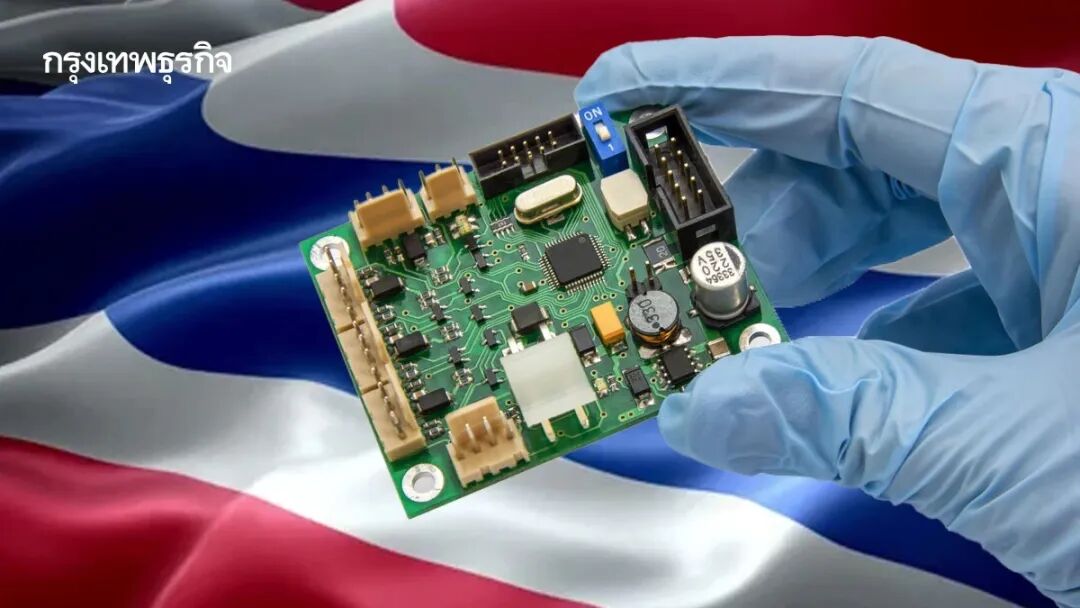
The so-called PCB is a circuit board covered with copper lines, used to install various electronic components, including chips, resistors, capacitors, power connectors, etc. PCBs are considered the infrastructure of the electronic world, as important as the AI chips themselves, and are key components that enable smartphones, cars, AI servers, and even supercomputers to function.
According to Nikkei Asia, the province of Ayutthaya in Thailand is becoming a new hotspot for PCB manufacturing. The Chinese PCB giant and important supplier to NVIDIA, Victory Giant Technology (VGT), is accelerating the installation of new equipment for its second factory in Thailand, which was established less than a year after its acquisition of the Taiwanese company APCB Group.
Moreover, the Taiwanese company GCE is also operating at full capacity in Thailand, producing PCBs for NVIDIA’s networking equipment. Taiwanese PCB giants Zhen Ding Tech and Unimicron are also taking the lead in establishing a presence in the Thai market.
Many PCB companies admit that the “demand for AI” is the biggest driving force behind their choice of Thailand as a new production base. VGT’s market value has surpassed $32.6 billion, exceeding Zhen Ding Tech (the world’s largest in revenue, with a market value of $5.97 billion), indicating that the AI wave is driving the PCB industry to achieve leapfrog growth.
The manager of Ta Liang Technology, a drilling equipment supplier, pointed out: “Any company in the AI supply chain is becoming a key force driving the rise and growth of Thailand’s PCB industry.”
KCE, Thailand’s largest PCB manufacturer, revealed to reporters: “Although demand from the automotive industry remains weak, we have already purchased land, but the timing for expanding the new factory has not yet been decided.” KCE has considerable expertise in PCB production for the automotive and other industrial sectors.
A Taiwanese industrial strategy research institution predicts that the output value of Thailand’s PCB industry will grow from $3.5 billion in 2024 to $5.62 billion in 2030, with an average annual growth rate of 7.6%, higher than the global average.
In less than three years, nearly 60 PCB manufacturers from mainland China and Taiwan have established operations in Thailand, including leading companies such as Zhen Ding, Unimicron, Shenzhen South Circuit, and Victory Giant Technology. These investments have also driven upstream and downstream equipment and material suppliers to set up operations in Thailand.
Thailand hopes to become the “second largest PCB production center in the world” after mainland China. Although the United States imposes a 19% retaliatory tariff on Thai products, the impact is limited, as PCB components are often transshipped to Vietnam, India, and other places for assembly before being exported to the United States.
Chairman of Zhen Ding, Shen Qingfang, stated that the expansion in Thailand is a key part of the company’s record investment plan of NT$60 billion, aimed at seizing the huge opportunities brought by the AI wave. Chairman of Unimicron, Zeng Zichang, revealed that the company has prepared land in Thailand for up to five factories, with initial products including PCBs for satellites and gaming consoles, and does not rule out the possibility of transferring some high-end chip PCB production lines to Thailand in the future.
However, the influx of foreign PCB manufacturers into Thailand also brings new challenges. The first is cultural differences. The general manager of the automation department at Mitsubishi Electric’s Thailand factory, Weijai, pointed out that local workers are accustomed to a work-life balance, while foreign manufacturers are used to a fast-paced, high-pressure work rhythm, which has caused some friction in the initial stages of cooperation.
Secondly, there is a talent war. Weijai stated that although Thailand has a large number of engineers in the automotive industry, there is a severe shortage of talent in the PCB industry. A manager from WTT, a subsidiary of China Zhongfu Circuit in Thailand, added that engineers and office staff who can speak Chinese are particularly scarce, leading to intense competition for talent. An industry executive in Thailand revealed that the salary of production managers has skyrocketed from about 40,000 baht per month to 80,000 to 100,000 baht in just 2 to 3 years, but it is still difficult to meet demand.
Martin Leou, a senior industry expert with decades of experience in mainland China and Taiwan, and a consultant for the Thailand Printed Circuit Board Association (PCBA), pointed out that cultivating local talent is the “most important challenge” for Thailand to maintain competitiveness in this industry. The association is currently establishing training centers with government support to cultivate a new generation of talent in the electronics and PCB industry.
In addition, Thailand’s production costs are relatively high. A senior executive from a Chinese automation equipment company stated that when considering efficiency and benefits, the labor costs in Thailand are about three times higher than in China. Moreover, it is difficult to persuade employees from mainland China and Taiwan to work in Thailand long-term, forcing companies to offer very high subsidies and incentives.
Many manufacturers also stated that although nearly 60 new factories have been built in Thailand, the entire industrial ecosystem is still in its infancy, and most high-end materials and equipment still need to be imported. It will take at least several more years to form a complete industrial cluster.
Analyst Zhang Yuansong from Taiwan’s ISTI believes that in the future, foreign manufacturers in Thailand will gradually increase the production of mid-to-high-end PCBs, which will drive continuous growth in output value. However, he also warned that global economic fluctuations, geopolitical risks, and Thailand’s insufficient infrastructure and rising labor costs may pose obstacles to development.
Analyst Zhao Shifang from the Taiwan Economic Research Institute holds a cautious attitude, believing that it is still unclear whether Thailand can become a PCB center, especially as market demand outside of AI may be impacted by U.S. tariff policies. She reminded that many new factories in Southeast Asia currently only have 1 to 2 production lines, and whether they can expand to an economic scale depends on global economic recovery and the policy environment.
In summary, Thailand is at a critical “crossroads”. If it can solve the issues of talent, costs, and industrial ecology, it is expected to leverage the wave of foreign investment to become the “third largest technology supply chain base in the world” after mainland China and Taiwan.
(Translation: Juliette; Review: WAN; Source: bangkokbiznews)
www.thaiheadlines.comFor more news and information, please follow the latest news account of Thai Headlines—Thai News Agency





Don’t forget to like and share after reading!
