Click the image to read the full article for free
DRT Assisted Diagnosis of La2Zr2O7 Modified Al-Doped Li7La3Zr2O12 Solid Electrolyte StructuresYongjian Zhou, Yaqing Zhou, Jiawen Tang, Xiaoyi Li, Hao Zhou, Xiaohuang*, Bingbing Tian*Institute of Micro-Nano Optoelectronics, Shenzhen University, Ministry of Education Joint Laboratory of Two-Dimensional Materials Optoelectronic Technology International CooperationParis Institute of Political Studies
【Literature Link】
Zhou, YJ., Zhou, YQ., Li, XY. et al. Distribution of relaxation times assisted grain and grain boundary structural diagnosis of La2Zr2O7-modified Al-doped Li7La3Zr2O12 solid electrolyte. Rare Met. (2025). https://doi.org/10.1007/s12598-024-03068-y【Background Introduction】In recent years, the demand for lithium batteries (LIB) has increased significantly, primarily due to the rapid expansion of electric vehicles and the energy storage industry. However, the presence of flammable organic solvents and the risk of electrochemical failures have raised safety concerns. To address these safety issues and the growing demand for lithium batteries, researchers in the scientific community have been striving to develop highly safe all-solid-state batteries utilizing solid electrolytes. The stability of the garnet oxide Li7La3Zr2O12 (LLZO) solid electrolyte in the presence of lithium metal, along with its performance during lithium stripping and plating processes, makes it one of the candidates for high energy density all-solid-state batteries. Among them, Al-doped LLZO has lower production costs and is easier to scale up. However, due to the complex mechanisms of gas-liquid-solid sintering and phase structure transitions, achieving high ionic conductivity and critical current density (CCD) in Al-doped LLZO ceramics is challenging. Therefore, it is necessary to study the preparation of Al-LLZO ceramics using inexpensive solid-phase sintering methods, optimizing performance at lower production costs by changing sintering conditions or adding modifiers.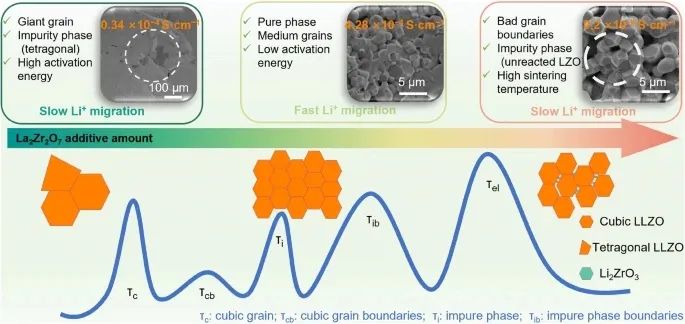 【Original Abstract】The garnet-type Li7La3Zr2O12 (LLZO) solid electrolyte is considered a promising choice for all-solid-state batteries due to its significant characteristics such as high ionic conductivity and wide electrochemical window. Although Al-doped LLZO (Al-LLZO) is critical for achieving LLZO ceramics with high critical current density, the characteristics of its grain and grain boundary structures remain largely elusive. In this work, electrochemical impedance spectroscopy (EIS) technology combined with the distribution of relaxation times (DRT) method was used to study the structural changes of Al-LLZO ceramics modified by La2Zr2O7 (LZO) additives. Additionally, the effects of sintering temperature and electrolyte testing temperature on the structural changes of the ceramics were investigated using the DRT tool. By optimizing experimental conditions, such as the added LZO concentration and the sintering temperature of Al-LLZO, further improvements were made to the study. This enabled us to successfully identify Al-LLZO solid electrolytes with uniform morphology, moderate grain size, and high density. By adding 6wt% LZO to the Al-LLZO solid electrolyte, we achieved the purest cubic phase and the best lithium ion conductivity. Under this condition, the conductivity of the sintered Al-LLZO ceramics at room temperature exceeded 4.2×10⁻⁴ S·cm−1, with a critical current density of up to 0.6 mA·cm−2.【Article Highlights】1. Study the reaction mechanisms of different concentrations of LZO additives with Al-LLZO solid electrolytes.2. Use the DRT mathematical tool to convert the electrochemical impedance spectroscopy data of solid electrolytes from the frequency domain to the time domain for the analysis of the grains and grain boundaries of the electrolytes.【Content Summary】Recently, Associate Professor Bingbing Tian of Shenzhen University and Associate Researcher Xiaohuang Huang published a research article titled “DRT Assisted Grain and Grain Boundary Structural Diagnosis of La2Zr2O7 Modified Al-Doped Li7La3Zr2O12 Solid Electrolyte” in Rare Metals, successfully using the DRT mathematical tool to assist in analyzing the changes in the grains and grain boundaries of Al-LLZO solid electrolytes with sintering temperature and modifier dosage. The study focused on the structural diagnosis of LZO-modified Al-LLZO, emphasizing the use of the distribution of relaxation times (DRT) mathematical tool to achieve high critical current density (CCD) and moderate Li+ ionic conductivity. Accurate EIS data in the frequency range of up to 8 MHz were applied in the DRT calculations, which helped identify discrete relaxation times associated with various structures in Al-LLZO prepared under different parameters. In this work, comprehensive characterization methods such as time frame analysis, X-ray diffraction (XRD), and scanning electron microscopy (SEM) were effectively employed to gain a thorough understanding of lithium ion transport across grains and grain boundaries. At the same time, a method for diagnosing the performance-structure correlation of ceramic electrolytes was provided, which aids in the rapid optimization of preparation parameters.【Illustrative Analysis】
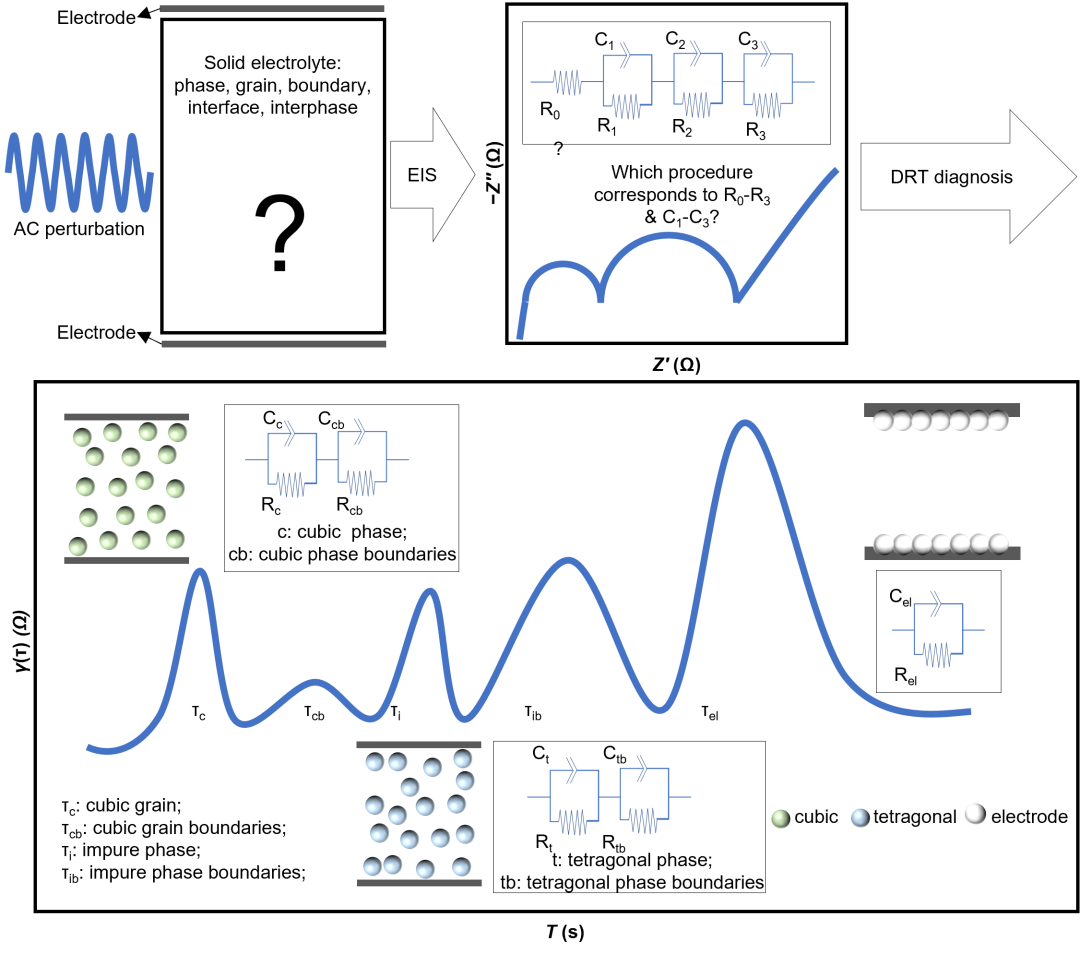 Illustration 1 DRT tool-assisted analysis of the measured high-resolution Nyquist plot for analyzing the structure and mechanisms of LLZO grains and grain boundaries. This illustration indicates the diagnosis of grain and grain boundary structures using DRT. Under alternating current signals of various frequencies, the EIS plots derived from the solid electrolyte can be modeled as multiple series resistors and capacitors (R||C) circuits. By transforming the impedance spectrum (frequency domain) into the time domain, DRT plots can be obtained. This method allows for the matching of grains, grain boundaries, and impurities in the solid electrolyte, facilitating the differentiation of various components of these series circuits.
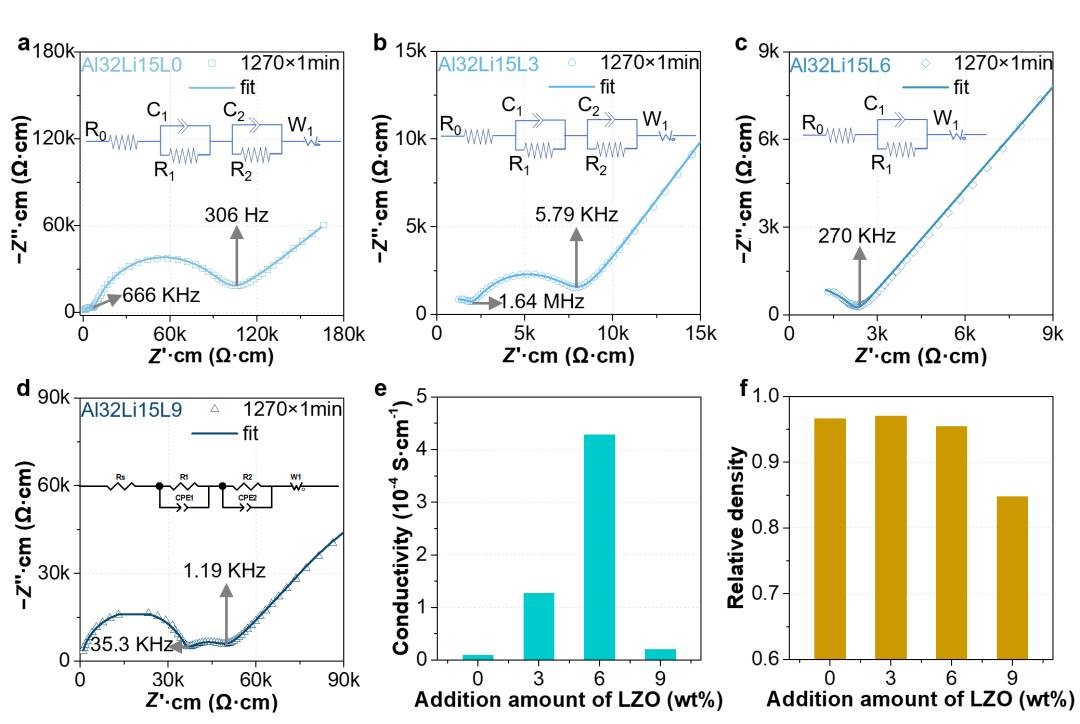 Figure 1 (a-d) shows the normalized Nyquist plots and equivalent circuits of Al32Li15+LZO (0~9 wt%) ceramic electrolytes sintered at 1270℃ for 1 minute at room temperature; (e) and (f) represent the ionic conductivity and density (ρ theoretical=5.078 g·cm−3) of Al32Li15+LZO ceramic electrolytes sintered at 1270℃ for 1 minute, respectively. This result indicates that after the Nyquist plot and conventional EIS fitting analysis, there is no distinguishable form regarding the shape and inflection point values of the impedance spectra among different samples. The variation of inflection point frequencies lacks clear patterns, thus the fitting circuit cannot accurately distinguish the components of the solid electrolyte’s grains and grain boundaries, only showing a certain correlation between the density of the electrolyte and its ionic conductivity.
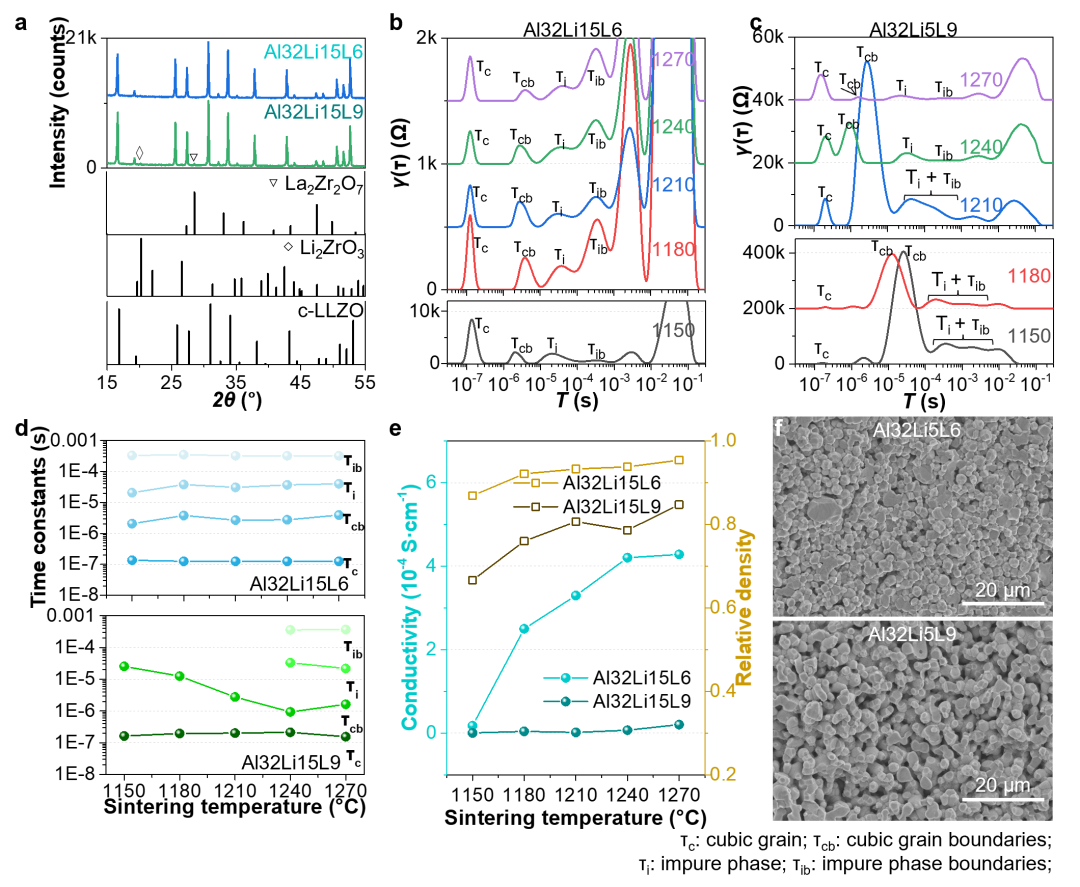 Figure 2 (a) shows the XRD plots of Al32Li15L6 and Al32Li15L9 at different sintering temperatures (1150~1270℃); (b-c) represent the DRT plots of Al32Li15L6 and Al32Li15L9 at different temperatures, respectively; (d) corresponds to the τc, τcb, τi, and τib values obtained from the DRT plots (b) and (c); (e) shows the ionic conductivity and density of the ceramics; (f) presents the cross-sectional SEM images of Al32Li15L6 and Al32Li15L9 ceramic electrolytes sintered at 1150℃. This figure indicates that both high-density and low-density Al32Li15L6 and Al32Li15L9 solid electrolyte ceramics possess cubic phase grains with high ionic conductivity, but the low-density Al32Li15L9 exhibits lower ionic conductivity. Analysis of Al32Li15L9 using the DRT tool revealed that it has high impedance and large time constants, corresponding to high impedance cubic phase grain boundaries and high ionic impedance at the grain boundaries.
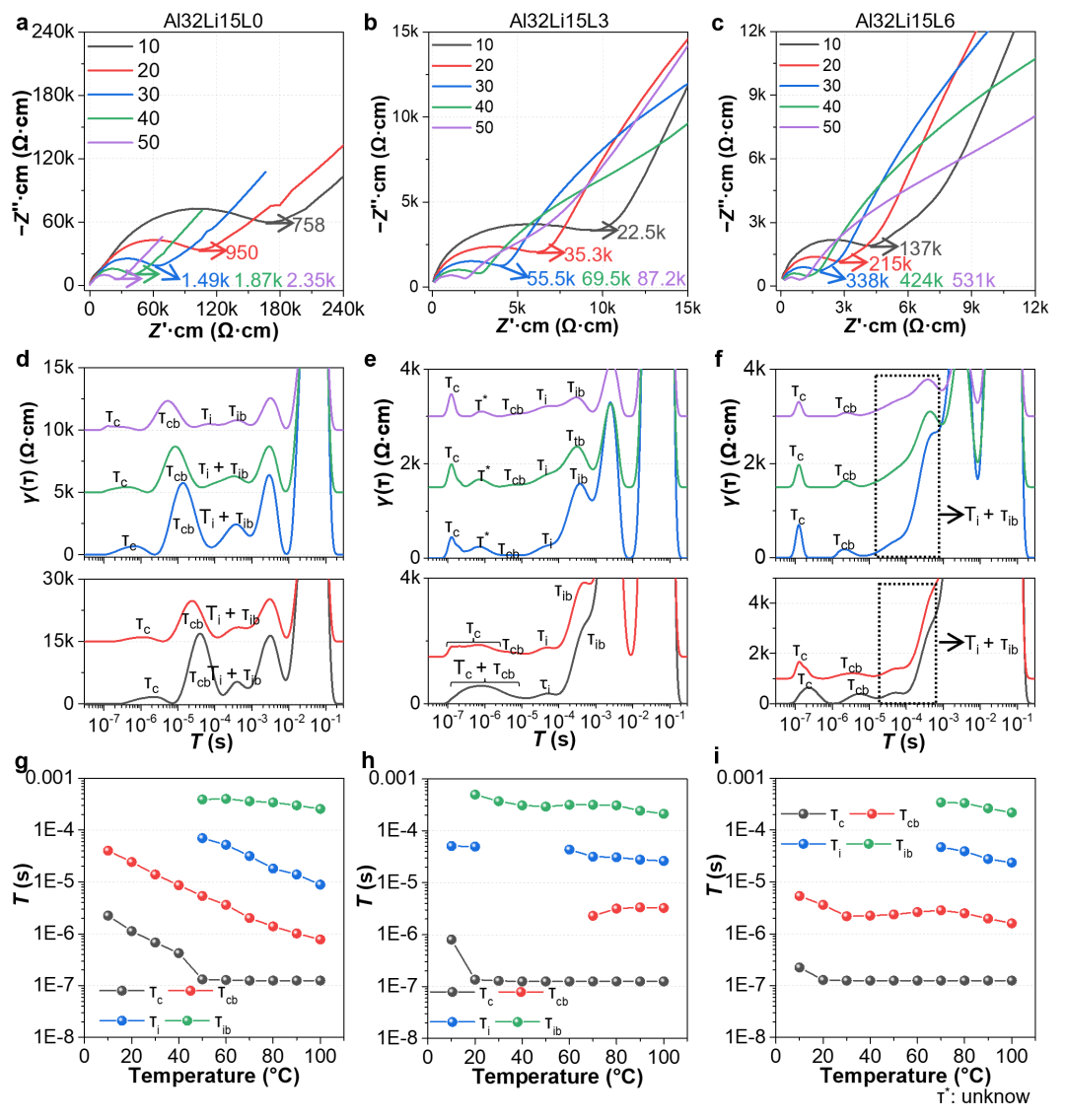 Figure 3 (a) shows the XRD plots of Al32Li15L0 and Al32Li15L3 at different sintering temperatures (1150~1270℃); (b-c) represent the DRT plots of Al32Li15L0 and Al32Li15L3 at different temperatures, respectively; (d) corresponds to the τc, τcb, τi, and τib values obtained from the DRT plots (b) and (c); (e) shows the ionic conductivity and density of the ceramics; (f) presents the cross-sectional SEM images of Al32Li15L0 and Al32Li15L3 ceramic electrolytes sintered at 1150℃. This figure indicates that there are significant differences in the ionic conductivity of high-density Al32Li15L0 and Al32Li15L3 solid electrolyte ceramics. However, analysis of Al32Li15L0 and Al32Li15L3 using the DRT tool revealed that their time constants differ only slightly, while the corresponding impedance values differ by more than an order of magnitude, indicating that excluding the impact of low density on the grain boundaries, the changes in the impedance values corresponding to the respective time constants can be analyzed to reveal the variations in grain and grain boundary structures.
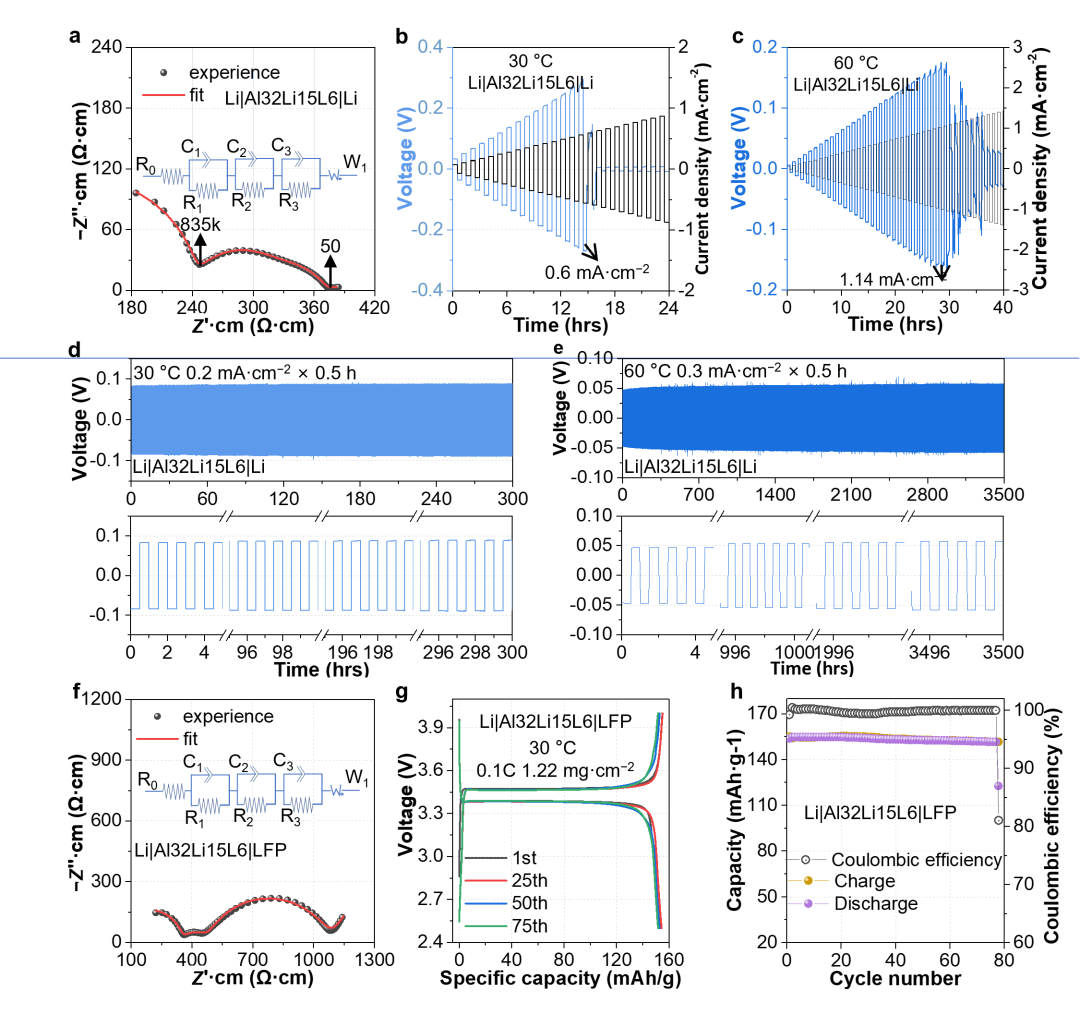 Figure 4 (a-c) shows the normalized Nyquist plot, (d-f) DRT plots, and (g-i) the corresponding time constant values τc, τcb, τi, and τib of Al32Li15L0, Al32Li15L3, and Al32Li15L6 ceramic solid electrolytes at different testing temperatures (10~50℃). This figure indicates that the analysis of the impedance spectra of Al32Li15L0, Al32Li15L3, and Al32Li15L6 ceramic solid electrolytes using the DRT tool at different testing temperatures shows that at relatively low temperatures, the time constants of the cubic phase of Al32Li15L6 ceramics remain stable, and their corresponding impedance is also relatively low, demonstrating that the Al32Li15L6 solid electrolyte possesses a highly stable grain and grain boundary structure and good ionic transport capability.Figure 5 shows the (a) reaction mechanism of different concentrations of La2Zr2O7 additives in Al32Li15 solid electrolyte; (b) schematic diagram of Li+ migration evolution. This figure indicates that achieving high Li+ migration performance in Al-LLZO largely depends on the LZO modifier, which modifies the grain and grain boundary structures of the solid electrolyte Al-LLZO. By adding an appropriate amount of LZO, two objectives can be achieved: it partially consumes Li2O, helping to stabilize the cubic phase of Al-doped LLZO, while not adversely affecting the ceramic sintering process. At the same time, ceramics with high ionic conductivity can be achieved. Moreover, by controlling the amount of modifier, a large number of ceramic materials with high ionic conductivity can be mass-produced, with quality very close to industrial production standards. This optimization method is expected to adapt to future industrial production, thus playing a crucial role in promoting the industrialization of all-solid-state lithium batteries.
 Figure 6 shows the performance of Li|Al LLZO|Li symmetric battery. (a) Nyquist plot and equivalent circuit; (b) and (c) represent the constant current density (CCD) curves tested at 30℃ and 60℃, respectively; (d) and (e) represent the cycling performance tested at 30℃ and 60℃, respectively; (f) shows the Nyquist plot and equivalent circuit of Li LFP full battery performance, (g) charge-discharge curves, and (h) long-cycle curves. This figure indicates that after optimizing the amount of LZO modifier and its impact on the structure of Al-LLZO composites, and determining the best sintering conditions, the production scale of ceramic materials with high ionic conductivity (4.2×10⁻⁴ S·cm−1) was successfully expanded. The quality of these electrolytes is highly consistent with industrial production standards. Under the established ceramic electrolyte preparation conditions (synthesizing high-performance Al32Li15L6 solid electrolyte by annealing at 1240℃ for 5 minutes), Li|Al LLZO|Li lithium symmetric batteries and Li-LiFePO4 full batteries were successfully prepared, demonstrating high stability against metallic lithium and LiFePO4 cathodes.【Full Conclusion】1. Under the high density conditions of Al-LLZO ceramics, the influence of the time constant on the ceramic structure’s grains and grain boundaries is minimal. However, the more pronounced the tetragonal phase structure in the ceramics, the higher the γ(τ) value, leading to greater impedance of the grains and grain boundaries, thus weaker ionic migration capability.2. The La2Zr2O7 modifier participates in the reaction between gaseous Li2O and tetragonal LLZO, generating cubic LLZO and Li2ZrO3. When the added modifier La2Zr2O7 is too little, excess Li2O cannot be consumed, resulting in some tetragonal LLZO remaining in the ceramics. Conversely, when too much modifier La2Zr2O7 is added, excessive Li2O is consumed or residual La2Zr2O7 is left, hindering the completion of ceramic sintering. Only by adding an appropriate amount of La2Zr2O7 can the optimal performance of Al-LLZO solid electrolytes be achieved.3. High-performance Al32Li15L6 solid electrolyte was synthesized by annealing at 1240℃ for 5 minutes, with a high ionic conductivity of 4.2×10⁻⁴ S·cm−1.【Author Biography】
 Bingbing Tian, Ph.D., Associate Professor at Shenzhen University, PhD supervisor.Graduated with a bachelor’s degree from Zhengzhou University in 2008, a master’s degree from South China University of Technology in 2011, and a Ph.D. from the University of Paris VI in 2014.Since 2015, he has been engaged in postdoctoral research at Shenzhen University and the National University of Singapore.Joined Shenzhen University in 2017 and was selected for Shenzhen’s overseas high-level talent program and Nanshan District’s leading talent program.Mainly engaged in research on new energy materials and devices such as lithium-ion batteries, solid electrolytes, and solid-state lithium batteries.In recent years, he has published over 100 SCI papers in international chemistry, chemical engineering, and energy materials fields, with over 50 SCI papers published as the first author or corresponding author in journals such as Angewandte Chemie International Edition, Advanced Materials, Advanced Functional Materials, ACS Energy Letters, Nano Energy, and Energy Storage Materials.He has applied for over 20 Chinese invention patents and 6 PCT patents.He has presided over multiple projects including the National Natural Science Foundation, Guangdong Provincial Natural Science Foundation, Shenzhen Science and Technology Plan, and various horizontal projects.Xiaohuang Huang, Ph.D., Associate Researcher at Shenzhen University, engaged in research and development of inorganic lithium-ion solid electrolytes (oxides LLZO, NASICON, etc., sulfides LPSC, LGPS, Thio-LISICON II, etc., halides LZC, LIC, LNOC, etc.) and solid-state battery devices, focusing on material structure, solid-state electrochemistry, electrolyte product development and application, and the fabrication of all-solid-state battery devices, actively promoting industry-university-research technology development projects.He has presided over national and enterprise projects, published over 30 academic papers (SCI), and applied for over 10 patents.
Editor: Huang Qinghe
Proofreader: Qiao Shuang
Reviewer: Ma Wen