Co-authored by Ji Danwen, Zhang Man, and Lou Yongqi, the paper “Exploring an ANT-inspired mapping approach for embedded design practitioners: a case-informed process,” also known as “探索面向嵌入式设计实践者的 ANT 启发映射方法:基于案例的过程”, was published in 2025 in the CoDesign journal. This journal is an international peer-reviewed publication under Taylor & Francis, focusing on theories, methods, and practices of “co-design,” covering topics such as design arts, human-computer collaboration, and community design. The journal ranks in the Q1 (top 25%) category across multiple fields, including Architecture, “Computer Graphics and Computer-Aided Design,” and Visual Arts and Performing Arts, and is classified as a top-tier journal in the arts by the Chinese Academy of Sciences.
Paper Overview
This study explores an ANT (Actor-Network Theory)-inspired mapping approach aimed at enhancing the co-creation (co-design) process in social innovation by facilitating a more comprehensive understanding of complex socio-technical systems. Given the lack of available tools to support embedded designers in understanding the evolving actor networks, this paper proposes and designs a visual thematic mapping method to promote an ongoing, contextualized reflection process. This method helps embedded designers locate, visualize, and interpret the evolving relationships among diverse actors, thereby transforming fragmented actions into a more holistic understanding of the co-creation process. Through a visual thematic analysis of design actions in context, this study surfaces and reflects on the concepts of ‘Bridging’, ‘Narrating’, and ‘Prototyping’. These concepts are not predefined categories but emergent heuristics used to grasp the dynamic relationships and interactions within the network, offering a situated and tentative understanding of how people collectively enact social change, with the potential for application across various embedded professional domains.
Abstract
This study explores an ANT-inspired mapping approach aimed at enhancing the co-design process in social innovation by enabling a more comprehensive understanding of complex socio-technical systems. Addressing the lack of accessible tools that support embedded designers in making sense of evolving actor-networks, the paper presents the design of a visual thematic mapping approach that fosters an ongoing, situated process of reflection. The approach assists embedded designers in situating, visualizing, and interpreting evolving relationships among diverse actors, thereby transforming fragmented actions into a more holistic understanding of the co-design process. Through a visual thematic analysis of design actions in the context, this study surfaces and reflects the concepts of ‘Bridging’, ‘Narrating’, and ‘Prototyping’. These concepts are not predefined categories but emergent heuristics that capture the dynamic relationships and interactions within the network, offering a situated and tentative understanding of how people collectively enact social change, with the potential to be applied across embedded professional domains.
—
This paper includes five chapters, with the following excerpts:
Discussion
Overall, the visualization approach proposed in this study has the potential to support designers in recognizing shared patterns of actions among entrepreneurs, institutions, and community residents within a community – patterns that might remain tacit or dispersed without such systematic representation. By tracing design actions such as bridging, narrating, and prototyping across time and space, designers can better reflect on how roles and relationships evolve, and how these influence broader trajectories of collective transformation.
Additionally, this visualization approach enables designers to observe broad patterns and systemic relationships while maintaining awareness of ground-level dynamics. Through comparative topology analysis, it has the potential to provide strategic insights for community development. Designers in this case study have observed promising indications of opportunities for new prototyping activities by examining network segments that share similar bridging characteristics and narrative structures but show different levels of prototyping engagement. This approach suggests new possibilities for identifying connections between seemingly disparate activities, helping designers pinpoint potential intervention points. To some extent, the approach moves beyond retrospective documentation, lending strategic insight for ongoing co-design work by offering a momentary step-back perspective – the ‘balcony view’ – for embedded design practitioners.
However, while this visualization approach offers promising affordances, it also comes with important limitations. Although it helps surface patterns of community transformation and stakeholder interactions, it may oversimplify the underlying micro-negotiations that drive participation. The informal nature of many interactions makes it difficult to fully capture the subtle mechanisms of trust-building, power dynamics, and network stability.
The author serves both as a researcher and as an embedded designer, enabling firsthand engagement in the project while maintaining a reflective and analytical perspective and is able to structure network data – a condition not always present in co-design contexts. The resulting visualizations are shaped by modeling choices (e.g., node definitions, relation types), and alternative framings could lead to different topologies. While some aspects of analysis can be semi-automated, data collection and interpretation remain resource-intensive and context-specific. To improve scalability, we are exploring lighter data capture methods, such as transcribed voice logs from collaborators, and integrating the workflow into everyday tools like calendars, chats, and dashboards – reducing friction while supporting real-time mapping.
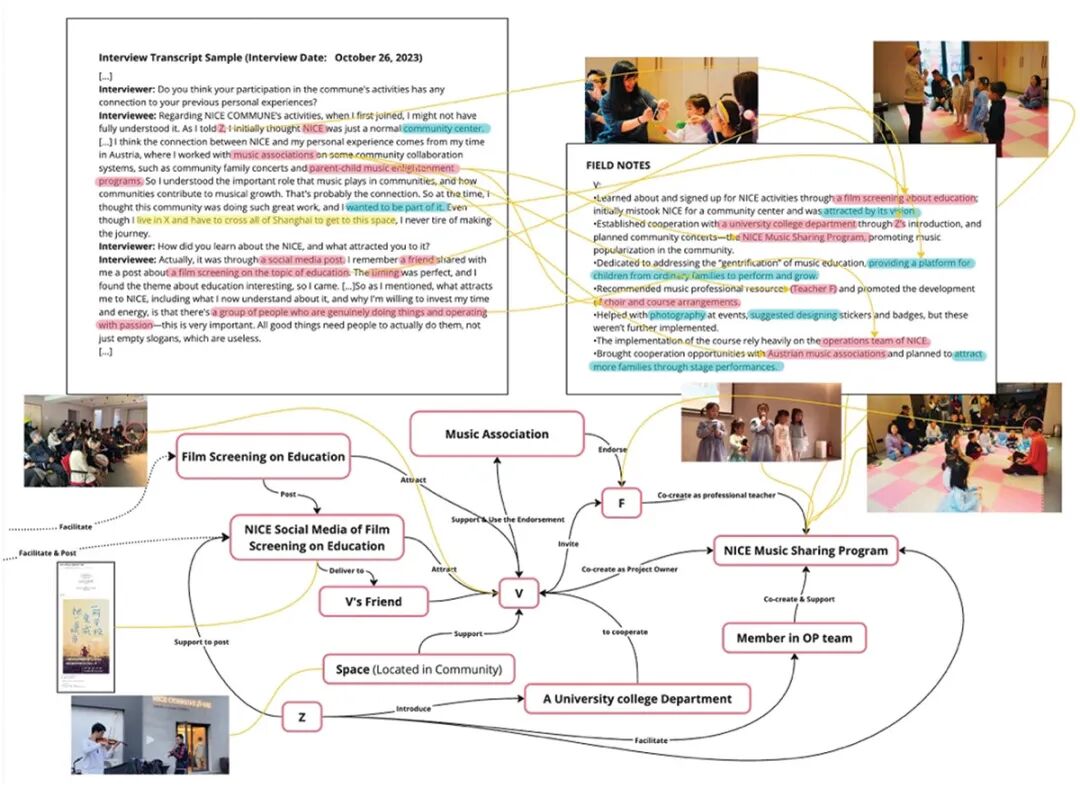
Figure 1. Example of mapping of NICE COMMUNE’s community development. Nodes represent human/non-human actants (e.g., social media posts, programs, institutional partners); directed edges illustrate translation sequences (e.g., recruitment, collaboration, resource mobilization). Timestamps emphasize temporal unfolding, while edge labels highlight actors-mediated reconfigurations. And causal agency in socio-material stabilization.

Figure 2. Schematic representation of systematically recording. This diagram distills key translation processes into structured relations, encoding sequential dependencies that drive community transformation. Nodes represent actors (A) and events (E), while directed edges depict participation, invitation, and project (P) formation.
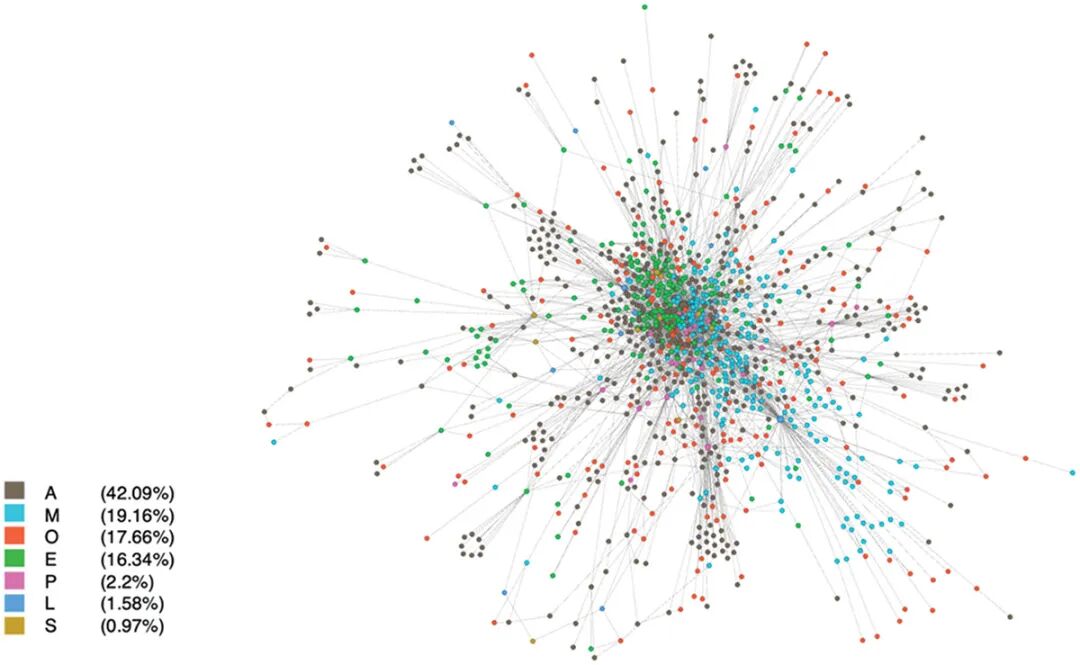
Figure 3. Heterogeneous network in NICE. This visualization depicts the NICE network’s structure, showing diverse actors (A, M, O, E, P, L, S) and their interactions. Nodes represent human and non-human actants, while directed edges capture participation, collaboration, and mediation. A total of 1,135 nodes and 3,070 edges were recorded (visualized with Gephi).
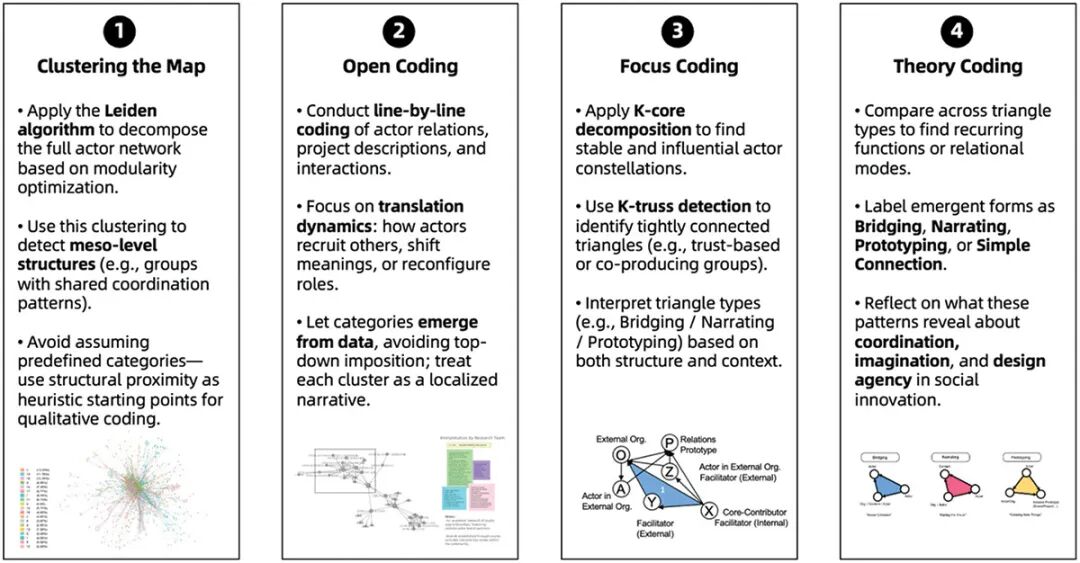
Figure 4. This timeline summarizes our exploratory mixed-method workflow: (1) community detection to segment the network; (2) open coding to surface meanings and actor roles; (3) focus coding using K-core and K-truss to identify structural motifs; and (4) theoretical coding to abstract translation types. Each step integrates qualitative interpretation with network metrics, supporting ANT-informed analysis.
References
-
Abildgaard, M. S. 2019. “When Doors Are Removed for Our Own Safety: The Material Semiotics of Telephone Booths.” Design and Culture 11 (2): 213–236.
-
Akama, Y. 2015. “Being Awake to Ma: Designing in Between-Ness as a Way of Becoming With.” Codesign 11 (3–4): 262–274.
-
Arenas, A., A. Díaz-Guilera, and C. J. Pérez-Vicente. 2006. “Synchronization Reveals Topological Scales in Complex Networks.” Physical Review Letters 96 (11): 114102.
-
Barbrook-Johnson, P., and S. P. Alexandra. 2022. “Fuzzy Cognitive Mapping.” In Systems Mapping: How to Build and Use Causal Models of Systems, edited by P. Barbrook-Johnson and A. S. Penn, 79–95. Cham: Springer International Publishing.
-
Binder, T., E. Brandt, P. Ehn, and J. Halse. 2015. “Democratic Design Experiments: Between Parliament and Laboratory.” Codesign 11 (3–4): 152–165.
-
Bollobás, B. 1998. “Random Graphs.” In Modern Graph Theory, edited by B. Bollobás, 215–252. New York, NY: Springer.
-
Breuer, E., L. Lee, M. De Silva, and C. Lund. 2016. “Using Theory of Change to Design and Evaluate Public Health Interventions: A Systematic Review.” Implementation Science 11 (1): 63.
-
Buchanan, R. 2019. “Systems Thinking and Design Thinking: The Search for Principles in the World We Are Making.” She Ji: The Journal of Design, Economics, and Innovation 5 (2): 85–104.
-
Callon, M. 1984. “Some Elements of a Sociology of Translation: Domestication of the Scallops and the Fishermen of St Brieuc Bay.” Sociological Review 32 (1_supp): 196–233.
-
Callon, M., A. Rip, and J. Law, eds. 1986. Mapping the Dynamics of Science and Technology: Sociology of Science in the Real World. 1st ed. London: Palgrave Macmillan.
-
Charmaz, K. 2017. “Constructivist Grounded Theory.” Journal of Positive Psychology 12 (3): 299–300.
-
Ciuccarelli, P., and D. Ricci. 2009. “Complexity Maps.” Designing Connected Places, edited by E. Lupo, and C. Campagnaro, 51–65. Bologna: Editrice Compositori.
-
Dyehouse, M., D. Bennett, J. Harbor, A. Childress, and M. Dark. 2009. “A Comparison of Linear and Systems Thinking Approaches for Program Evaluation Illustrated Using the Indiana Interdisciplinary GK-12.” Evaluation and Program Planning 32 (3): 187–196.
-
Ekomadyo, A. S., and A. Riyadi. 2020. “Design in Socio-Technical Perspective: An Actor-Network Theory Reflection on Community Project ‘Kampung Kreatif’ in Bandung.” Archives of Design Research 33 (2): 19–37.
-
Forlizzi, J. 2013. “The Product Service Ecology: Using a Systems Approach in Design.” Relating Systems Thinking and Design 2013 Symposium Proceedings, Oslo, Norway, Oct 9-11, 2013. Article #029. https://rsdsymposium.org/product-service-ecology/.
-
Fortunato, S. 2010. “Community Detection in Graphs.” Physics Reports 486 (3–5): 75–174.
-
Geertz, C. 1973. The Interpretation of Cultures: Selected Essays. New York: Basic Books.
-
Giordano, F., N. Morelli, A. De Götzen, and J. Hunziker. 2018. “The Stakeholder Map: A Conversation Tool for Designing People-Led Public Services.” Service Design and Innovation Conference: Proof of Concept, Politecnico di Milano, 18th-19th-20th, June 2018, 582–597. https://servdes.org/wp/wp-content/uploads/2018/07/48.pdf.
-
Goodman, E., E. Stolterman, and R. Wakkary. 2011. “Understanding Interaction Design Practices.” In Proceedings of the SIGCHI Conference on Human Factors in Computing Systems. Vancouver BC Canada: 1061–1070. ACM.
-
Haraldsson, H. 2004. Introduction to system thinking and causal loop diagrams. Lund: Department of Chemical Engineering, Lund University.
-
Heifetz, R. A., A. Grashow, M. Linsky, and M. Linsky. 2009. The Practice of Adaptive Leadership: Tools and Tactics for Changing Your Organization and the World. Boston, MA: Harvard Business Press.
-
Heifetz, R. A., and M. Linsky. 2017. Leadership on the Line, with a New Preface: Staying Alive Through the Dangers of Change. Revised ed. Boston, MA: Harvard Business Review Press.
-
Huang, J., X. Huang, and J. Xu. 2022. “Truss-Based Structural Diversity Search in Large Graphs.” IEEE Transactions on Knowledge and Data Engineering 34 (8): 4037–4051.
-
Jensen, C. B. 2019. “Is Actant-Rhizome Ontology a More Appropriate Term for ANT?” In The Routledge Companion to Actor-Network Theory, edited by A. Blok, I. Farías, and C. Roberts, 73–86. London: Routledge.
-
Ji, D., and Z. Li. 2023. “Embedded Actors in Design Objects: Reflexivity in Design for Social Innovation.” IASDR Conference Series. https://dl.designresearchsociety.org/iasdr/iasdr2023/fullpapers/102.
-
Latour, B. 1987. Science in Action: How to Follow Scientists and Engineers Through Society. Cambridge, MS: Harvard University Press.
-
Latour, B. 1996. “On Actor-Network Theory: A Few Clarifications.” 369–381.
-
Latour, B. 1999. “On Recalling Ant.” Sociological Review 47 (1_suppl): 15–25.
-
Latour, B. 2000. On the Partial Existence of Existing and Non-Existing Objects. Chicago, IL: University of Chicago Press.
-
Latour, B. 2005. Reassembling the Social: An Introduction to Actor-Network-Theory. Clarendon Lectures in Management Studies. Oxford; New York: Oxford University Press.
-
Laurent, B., and M. Tironi. 2015. “A Field Test and Its Displacements. Accounting for an Experimental Mode of Industrial Innovation.” Codesign 11 (3–4): 208–221.
-
Law, J., and A. Mol. 2001. “Situating Technoscience: An Inquiry into Spatialities.” Environment & Planning D, Society & Space 19 (5): 609–621.
-
Li, Z., Y. Lu, W.-P. Zhang, R.-H. Li, J. Guo, X. Huang, and R. Mao. 2018. “Discovering Hierarchical Subgraphs of k-Core-Truss.” Data Science and Engineering 3 (2): 136–149.
-
Lich, H., J. B. U. Kristen, L. Frerichs, and G. Dave. 2017. “Extending Systems Thinking in Planning and Evaluation Using Group Concept Mapping and System Dynamics to Tackle Complex Problems.” Evaluation and Program Planning 60:254–264.
-
Lindström, K., and Å. Ståhl. 2015. “Fi Gurations of Spatiality and Temporality in Participatory Design and After – Networks, Meshworks and Patchworking.” Codesign 11 (3–4): 222–235.
-
Lou, Y. 2018. “Designing Interactions to Counter Threats to Human Survival.” She Ji: The Journal of Design, Economics, and Innovation 4 (4): 342–354.
-
Lou, Y., and J. Ma. 2018. “Growing a Community-Supported Ecosystem of Future Living: The Case of NICE2035 Living Line.” In Cross-Cultural Design. Applications in Cultural Heritage, Creativity and Social Development, Lecture Notes in Computer Science, edited by P.-L.-P. Rau, 320–333. Cham: Springer International Publishing.
-
Ma, J., and Y. Lou. 2022. “Neighborhood Regeneration Through Cultivating an Innovation Ecosystem of Future Living-The Case of NICE2035.” Architectural Journal 3:20–27.
-
Marres, N. 2019. “As ANT Is Getting Undone, Can Pragmatism Help Us Re-Do It?” In The Routledge Companion to Actor-Network Theory, edited by A. Blok, I. Farías, and C. Roberts, 112–120. London: Routledge.
-
Mattozzi, A. 2019. “What Can ANT Still Learn from Semiotics?” In The Routledge Companion to Actor-Network Theory, edited by A. Blok, I. Farías, and C. Roberts, 87–100. London: Routledge.
-
Mauri, M., and P. Ciuccarelli. 2016. “Designing Diagrams for Social Issues.” Future Focused Thinking – DRS International Conference, edited by P. Lloyd and E. Bohemia, June, Brighton, United Kingdom, 27–30.
-
Mkrtchyan, L., L. Podofillini, and V. N. Dang. 2015. “Bayesian Belief Networks for Human Reliability Analysis: A Review of Applications and Gaps.” Reliability Engineering and System Safety 139:1–16.
-
Mol, A. 2010. “Actor-Network Theory: Sensitive Terms and Enduring Tensions.” Kölner Zeitschrift für Soziologie und Sozialpsychologie 50 (1): 253–269. https://hdl.handle.net/11245/1.330874.
-
Mol, A., and J. Law. 1994. “Regions, Networks and Fluids: Anaemia and Social Topology.” Social Studies of Science 24 (4): 641–671.
-
Morelli, N., and C. Tollestrup. 2007. “New representation techniques for designing in a systemic perspective.” In Nordes 2007: Design Inquiries, 27-30 May. Stockholm, Sweden: University of Arts, Craft, and Design.
-
Palmås, K., and O. von Busch. 2015. “Quasi-Quisling: Co-Design and the Assembly of Collaborateurs.” Codesign 11 (3–4): 236–249.
-
Pedersen, S. 2020. “Staging Negotiation Spaces: A Co-Design Framework.” Design Studies 68:58–81.
-
Petersen, T. B. 2022. “Suiting Children for Institutions: The Development, Calibration and Stabilization of the One-Piece Snowsuit.” Journal of Design History 35 (1): 1–15.
-
Rakova, O., and O. Fedorenko. 2021. “Sticky Notes Against Corporate Hierarchies in South Korea: An Ethnography of Workplace Collaboration and Design Co-Creation.” Design Studies 76:101033.
-
Ricci, D. 2010. “Seeing What They Are Saying: Diagrams for Socio-Technical Controversies.” Design and Complexity – DRS International Conference 2010, 7-9 July, Montreal, Canada, edited by D. Durling, R. Bousbaci, L. Chen, P. Gauthier, T. Poldma, S. Roworth-Stokes, and E. Stolterman. https://dl.designresearchsociety.org/drs-conference-papers/drs2010/researchpapers/100.
-
Rieple, A., and A. Van Den Broek. 2019. “Using Actor-Network Theory to Reveal Strategy Processes in Design Firms.” Conference Proceedings of the Academy for Design Innovation Management 1 (1).
-
Schillmeier, M. 2019. “How does thinking with dementing bodies and A. N. Whitehead reassemble central propositions of ANT?.” The Routledge Companion to Actor-Network Theory, edited by A. Blok, I. Farias, and C. Roberts, 133–142. London: Routledge.
-
Schoffelen, J., S. Claes, L. Huybrechts, S. Martens, A. Chua, and A. Vande Moere. 2015. “Visualising Things. Perspectives on How to Make Things Public through Visualisation.” Codesign 11 (3–4): 179–192.
-
Schön, D. A. 2017. The Reflective Practitioner: How Professionals Think in Action. London: Routledge.
-
Sevaldson, B. 2011. “Giga-Mapping: Visualisation for Complexity and Systems Thinking in Design.” Nordes 4. http://nordes.org/opj/index.php/n13/article/view/104.
-
Storni, C. 2012. “Unpacking Design Practices: The Notion of Thing in the Making of Artifacts.” Science, Technology, and Human Values 37 (1): 88–123.
-
Storni, C. 2015. “Notes on ANT for Designers: Ontological, Methodological and Epistemological Turn in Collaborative Design.” Codesign 11 (3–4): 166–178.
-
Stuedahl, D., and O. Smørdal. 2015. “Matters of Becoming, Experimental Zones for Making Museums Public with Social Media.” Codesign 11 (3–4): 193–207.
-
Traag, V. A., L. Waltman, and N. J. Van Eck. 2019. “From Louvain to Leiden: Guaranteeing Well-Connected Communities.” Scientific Reports 9 (1): 5233.
-
Ugander, J., L. Backstrom, C. Marlow, and J. Kleinberg. 2012. “Structural Diversity in Social Contagion.” Proceedings of the National Academy of Sciences 109 (16): 5962–5966.
-
Venturini, T., A. Kristian Munk, and M. Jacomy. 2019. “Actor-Network Versus Network Analysis Versus Digital Networks: Are We Talking About the Same Networks?” In digitalSTS: A Field Guide for Science & Technology Studies, edited by J. Vertesi, D. Ribes, C. DiSalvo, Y. Loukissas, L. Forlano, D. K. Rosner, S. J. Jackson, and H. Rose Shell, 510–524. Princeton, NJ: Princeton University Press.
-
Venturini, T., D. Ricci, M. Mauri, L. Kimbell, and A. Meunier. 2015. “Designing Controversies and Their Publics.” Design Issues 31 (3): 74–87.
-
Wang, J., and J. Cheng. 2012. “Truss Decomposition in Massive Networks.” Proceedings of the VLDB Endowment 5 (9): 812–823.
-
Yaneva, A. 2009. “Making the Social Hold: Towards an Actor-Network Theory of Design.” Design and Culture 1 (3): 273–288.
Read the full article at the following link
https://www.tandfonline.com/doi/full/10.1080/15710882.2025.2555334?scroll=top&needAccess=true
Cite this article
Ji, D., Zhang, M., & Lou, Y. (2025). Exploring an ANT-inspired mapping approach for embedded design practitioners: a case-informed process. CoDesign, 1–27. https://doi.org/10.1080/15710882.2025.2555334
Welcome to follow us

Official Website丨https://www.sustainx.com.cn

SustainXLab
Research Center for Complex Socio-Technical Systems Design led by Professor Lou Yongqi, focusing on sustainable design innovation, addressing the issues of “DesignX agenda” related to the design of complex socio-technical systems, systematically considering the new roles, methods, paths, and tools of design in solving problems related to environment, health, transportation, human habitation, industry, and education in the era of artificial intelligence.

——-
Text and images by Ji Danwen
Edited by Zhang Man
Proofread by Zhang Man