01. Definition and Logic of AI Agents
(1) General Definition of AI Agents
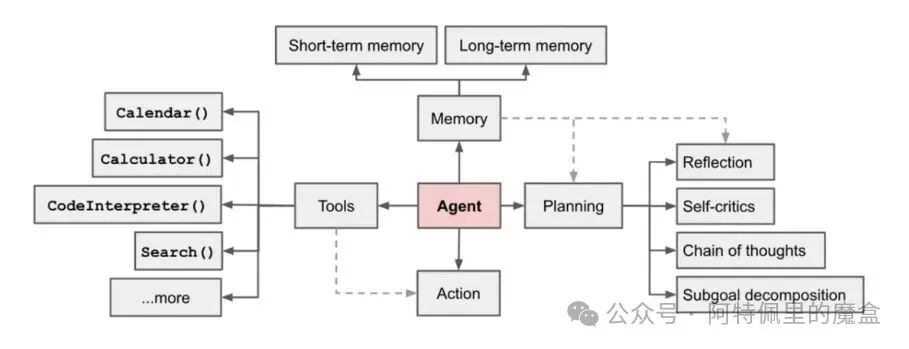
An AI Agent (Artificial Intelligence Agent) is a software system capable of perceiving its environment, reasoning, making decisions, and taking autonomous actions to achieve specific goals. It combines the reasoning capabilities of large language models (LLMs) with the practical functionalities of various tools to accomplish complex tasks. As Russell and Norvig describe in “Artificial Intelligence: A Modern Approach”, intelligent agents are “entities that can act appropriately based on their environment and goals, adapt to changes, learn from experience, and make suitable choices under conditions of limited perception and computation.”
(2) Logical Definition of Agents
The application capabilities of AI Agents are not just about executing tasks but are also based on their strong logical reasoning abilities. They need to understand tasks, decompose them, reason through decisions, invoke tools, adapt dynamically, and learn to optimize. These capabilities together form the core competitiveness of an Agent. We need to understand AI Agents from the perspective of logical definitions.
1. Action Logic
Action logic is the process by which an AI Agent translates decisions into specific actions. It achieves goals by invoking various tools and executors. For example, a shopping AI Agent, after deciding to purchase a product, will call the e-commerce platform’s API to complete the order and payment. This logic emphasizes the sequential and dependent nature of actions, ensuring that each step effectively promotes the achievement of the goal.
2. Intent Logic
Intent logic is the process by which an AI Agent understands task objectives and plans the path to achieve them. It needs to clarify user needs and break them down into executable sub-tasks. For instance, when a user asks the AI Agent to “help me plan a trip”, the Agent must understand the intent of “trip planning”, which includes multiple sub-goals such as destination selection, itinerary arrangement, and budget control, and formulate a corresponding plan. This logic reflects the Agent’s deep understanding and planning capabilities regarding tasks.
3. Agency Logic
Agency logic is the core logic of an AI Agent acting as a user proxy. It emphasizes the autonomy and independence of the Agent, meaning that the Agent can make decisions and take actions autonomously within the scope authorized by the user. For example, in a file management AI Agent, the user authorizes the Agent to classify and back up files, and the Agent will autonomously complete these tasks based on preset rules and goals. This logic reflects the role positioning of the Agent as a user proxy, ensuring that actions are reasonable and secure while meeting user needs.
02. Development History of AI Agents
(1) Turing Experiment
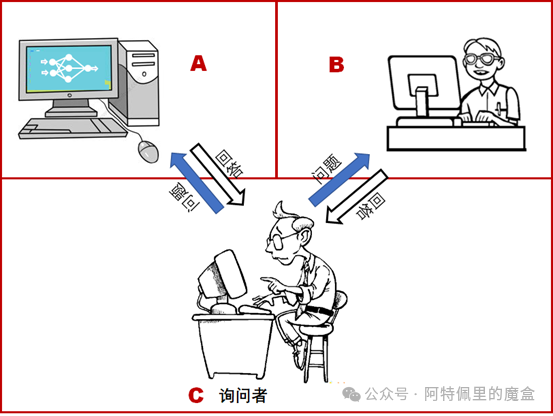
The Turing experiment is an important milestone in the development of AI Agents. In 1950, Alan Turing proposed the famous Turing Test, aimed at determining whether a machine possesses intelligence. The core of the Turing Test is that if a human cannot distinguish whether they are conversing with a person or a machine, then that machine is considered intelligent. This experiment laid the theoretical foundation for the development of AI Agents, clarifying the goal of AI Agents—to perceive, think, and act like humans.
(2) Hewitt Event
In 1968, Carl Hewitt proposed the “Actor Model”, providing a new perspective for the development of AI Agents. The Actor Model is a concurrent computing model that emphasizes that each Actor (i.e., Agent) is an independent computational entity capable of autonomously receiving, processing, and sending messages. This model provides theoretical support for concurrent processing and distributed computing in AI Agents, promoting their application in multi-agent systems.
(3) Minsky Event
In 1986, Marvin Minsky introduced the concept of “Agent” in his book “The Society of Mind”. He argued that certain individuals in society can arrive at solutions to problems through negotiation, and these individuals are Agents. Minsky’s viewpoint provided a philosophical foundation for the development of AI Agents, emphasizing their social interactivity and intelligence. This event marked an important turning point in the transition of AI Agents from theoretical research to practical application.
03. Differences Between AI Agents and LLMs
| Comparison Dimension | AI Agent | LLM |
|---|---|---|
| Goal Orientation | Complete specific tasks and achieve goals | Provide language understanding and generation capabilities |
| Independence | Possess autonomous decision-making and action capabilities | Requires explicit instructions from humans |
| Process Decision-Making | Autonomously plans task processes and invokes tools | Relies on human input to generate language responses |
| Development Focus | Tool integration, state management, workflow orchestration | Model training, optimization, language understanding |
| Application Cases | Shopping agents, file management, travel planning | Chatbots, text generation, translation |
06. Typical Application Scenarios of AI Agents
(1) Web Crawlers
AI Agents can act as web crawlers, automatically browsing web pages and collecting information. For example, a news aggregation AI Agent can regularly visit major news websites, extract the latest news headlines and content, and then categorize and recommend them based on user-defined keywords. This application greatly improves the efficiency and accuracy of information collection.
(2) Shopping Agents
Shopping AI Agents can help users search for products on e-commerce platforms, compare prices, select suitable products, and complete purchases. For instance, a user only needs to tell the Agent, “Help me find a cost-effective laptop”, and the Agent will search for relevant products, compare prices and reviews of different brands and models, and ultimately recommend the most suitable product to the user and complete the order.
(3) Travel Planning
Travel AI Agents can plan travel itineraries based on user needs. They will consider factors such as destination, time, and budget to recommend suitable attractions, hotels, and transportation methods, generating a detailed travel plan. For example, if a user inputs, “I want to travel to Paris for a week with a budget of 5000 yuan”, the Agent will plan an economical and rich travel route based on this information.
(4) File Management
File management AI Agents can help users classify, back up, and retrieve files. They can automatically identify file types and content, categorize files into different folders, and also back up important files regularly based on user-defined rules. For example, users can set the Agent to automatically back up their desktop and documents daily.
(5) Smart Home Control
Smart home AI Agents can serve as the core of home automation, controlling various smart devices. For example, they can automatically adjust lighting, temperature, and curtains based on user habits and preferences. Users can issue commands to the Agent via voice instructions or mobile applications, such as “dim the living room lights” or “turn on the bedroom air conditioning”. The Agent will interpret the commands and control the corresponding devices. Additionally, the Agent can automatically adjust device states based on data from environmental sensors (such as temperature, humidity, and light intensity) to create a more energy-efficient and comfortable home environment.
05. Future Prospects of AI Agents
(1) Application Prospects
With continuous technological advancements, the application prospects of AI Agents will become even broader. In the future, AI Agents will play important roles in the following areas:
Healthcare: AI Agents can serve as medical assistants, helping doctors analyze medical records, diagnose diseases, and recommend treatment plans. For example, they can provide preliminary diagnostic suggestions by analyzing patients’ symptoms, medical history, and test results, assisting doctors in making more accurate judgments.
Education: AI Agents can act as intelligent tutoring teachers, providing personalized learning plans and tutoring content based on students’ learning progress and characteristics. They can help students better understand and master knowledge through interactive learning.
Financial Services: AI Agents can serve as financial advisors, providing investment advice and financial planning based on users’ risk preferences and financial situations. They can also monitor market dynamics in real-time, providing users with timely investment information.
Transportation: AI Agents can act as intelligent assistants for autonomous vehicles, monitoring vehicle status and road conditions in real-time, assisting drivers in making safe driving decisions. They can also optimize traffic flow and reduce congestion.
(2) Importance of Mastering Agent Technology
Today, AI Agents have become an indispensable technological tool. Mastering Agent technology is of great significance for both individuals and enterprises:
Improving Efficiency: AI Agents can automate many repetitive tasks, saving time and energy, allowing people to focus on more valuable work.
Enhancing Competitiveness: By applying AI Agents, enterprises can optimize business processes and improve service quality, thus standing out in fierce market competition.
Improving Quality of Life: In personal life, AI Agents can help people better manage daily life, such as smart home control and health management, enhancing convenience and comfort.
Driving Innovation: The widespread application of AI Agents will stimulate more innovative thinking and application scenarios, promoting the digital transformation of society.
In summary, AI Agents, as powerful intelligent tools, are profoundly changing our ways of life and work. Understanding and mastering Agent technology will enable us to better adapt to the future digital society and enjoy the conveniences and advancements brought by technology.
 “Follow, Share, and Like” 👇