As a core technical position in the field of industrial automation, PLC electrical engineers are responsible for key tasks such as electrical system design, programming and debugging, and troubleshooting. Their professional capabilities directly impact the efficiency and stability of industrial production. To become a qualified PLC electrical engineer, one must gradually accumulate knowledge from various aspects, including theoretical foundations, practical skills, and industry literacy, to steadily build core professional competitiveness.
A solid theoretical foundation is the core prerequisite for entry. First, one must master the basics of electrical control, clearly understand circuit principles, the characteristics and selection logic of high and low voltage electrical components, and thoroughly grasp the core logic of relay control circuits, which is the basis for understanding PLC control logic. Secondly, one should delve into core PLC knowledge, proficiently understand the programming concepts of mainstream PLC brands (such as Siemens, Mitsubishi, Omron), master common programming methods like ladder diagrams and function block diagrams, and understand the working principles and wiring specifications of PLC input and output modules. Additionally, knowledge of industrial communication is essential, including familiarity with the configuration of common communication protocols such as Modbus and PROFINET, understanding the logic of building industrial networks, and having a basic understanding of HMI (Human-Machine Interface) design principles, as well as the interaction principles between interfaces and PLCs, laying a theoretical foundation for subsequent practical applications.
Strong practical skills are the key support for establishing oneself in the field. Theoretical learning must be combined with practical application. First, one must possess the ability to design electrical systems, capable of drawing standardized electrical schematics based on production needs, reasonably selecting and laying out PLCs, sensors, actuators, and other equipment to ensure that system design is both practical and safe. Secondly, one should master programming and debugging skills, able to independently write PLC programs, optimize program logic for production scenarios, accurately complete equipment wiring, program downloading, and parameter debugging on industrial sites, and resolve issues such as logical conflicts and signal anomalies that arise during debugging. Furthermore, fault diagnosis and troubleshooting capabilities are indispensable; one must be proficient in using multimeters, oscilloscopes, and other testing tools to quickly locate fault points in PLC modules, circuit lines, and communication links, and develop efficient and feasible maintenance plans to ensure the stable operation of automation systems.
Comprehensive industry literacy is an important guarantee for advancement. The technology in the industrial automation field evolves rapidly, and qualified PLC electrical engineers must maintain a continuous learning mindset, actively follow the development trends of new technologies and equipment, and timely update their knowledge systems to adapt to the automation needs of different industries. They must also strictly adhere to industry standards, proficiently master electrical safety standards and relevant regulations in industrial production, ensuring that design, debugging, and other work are compliant throughout, thereby avoiding safety hazards. Additionally, good communication and collaboration skills are essential; one should be able to independently complete individual technical tasks while efficiently cooperating with mechanical engineers and production operation personnel to accurately meet production needs and promote orderly project implementation. Moreover, one must cultivate a meticulous work attitude, as electrical system design, programming, and debugging work cannot afford any oversight. A rigorous mindset can effectively reduce error rates and improve work quality.
There are no shortcuts to becoming a qualified PLC electrical engineer. One must base their knowledge on theory, prioritize practical skills, and embody industry literacy. By accumulating knowledge through learning and refining skills through practice, one can continuously enhance their professional capabilities to meet job requirements and steadily advance in the field of industrial automation.
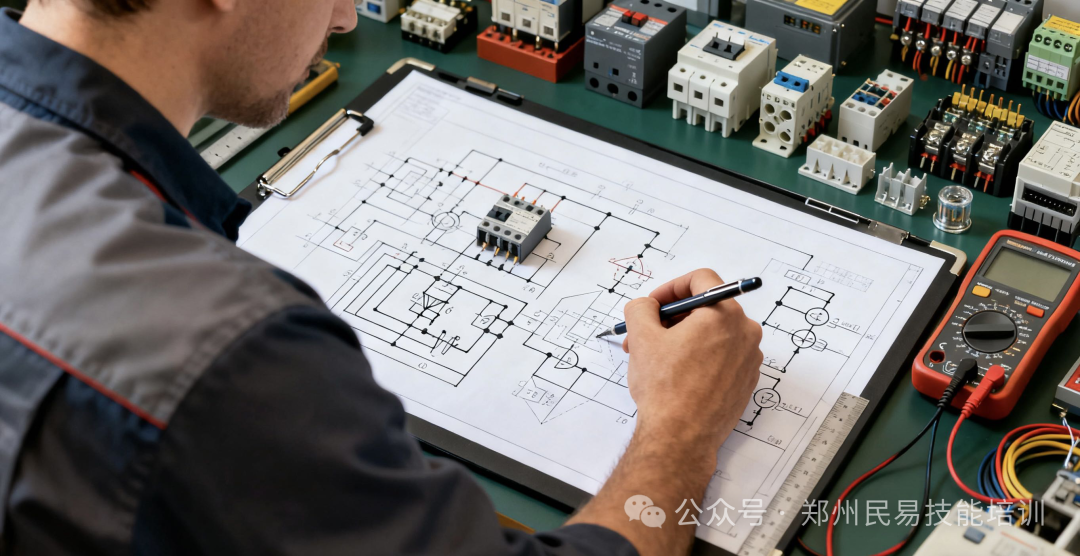
I will present the skills required to become a qualified PLC electrical engineer in a visually rich format, covering 8 segments that encompass theory, practice, and expanded capabilities.Segment 1: Basics of PLC Programming, where the engineer writes ladder diagram programs at a computer, with clear logical instructions displayed on the screen. Segment 2: Electrical Control Circuit Design, where the engineer draws complex electrical schematics on a drawing board, surrounded by samples of components.
 Segment 3: Automation System Debugging, where the engineer operates a PLC control cabinet on the industrial site, using a programmer to connect devices for parameter settings.
 Segment 4: Application of Sensors and Actuators, where the engineer is installing and debugging a photoelectric sensor to ensure accurate detection of object positions.
 Segment 5: HMI (Human-Machine Interface) Design, where the engineer designs an intuitive operating interface on a computer, including buttons, indicator lights, and data display areas.
Segment 6: Configuration of Industrial Communication Networks, where the engineer connects a laptop to a switch to configure PROFINET or Modbus communication protocols.

Segment 7: Fault Diagnosis and Troubleshooting, where the engineer uses a multimeter to measure circuit voltage and troubleshoot faults in the PLC input and output modules.

Segment 8: Mastery of Industry Knowledge and Standards, where the engineer consults the electrical safety standards manual to ensure designs comply with national electrical regulations.

Contact us at 15538070757