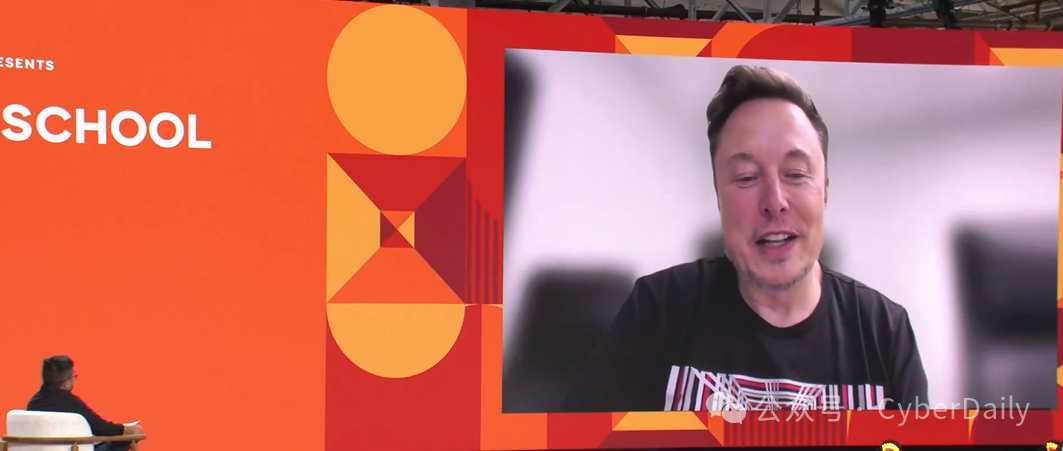
In the heart of Silicon Valley, a grand event gathering the world’s brightest and most energetic young tech elites—the YC AI Entrepreneurship School—welcomed a heavyweight guest. When Elon Musk appeared on screen, the air was filled not only with admiration and anticipation but also with a collective questioning of the future.
As the leader of a series of disruptive companies such as SpaceX, Tesla, Neuralink, and xAI, Elon Musk has long been symbolized as the technological prophet and business magnate of this era. However, in this candid dialogue, Musk stripped away the layers of halo bestowed by the outside world, guiding the audience back to the essence of his identity as an engineer. With a clear and firm logical line, he connected his journey from an obscure entrepreneur to an architect dedicated to the survival of human civilization, providing AI entrepreneurs with a revelation to maintain clarity and foresight.
The Engineer’s Creed: Seek Utility, Not Greatness
At the beginning of his speech, when faced with the grand question, “When did you aspire to build a great enterprise?” Musk’s answer was as simple as ever: “I never thought I would build something great; I just wanted to try to build something useful.” This straightforward statement became the cornerstone for understanding all his business ventures and technological explorations. He prefers to define himself as an “engineer” rather than a “researcher” because, in his view, the essence of engineering is to solve real problems and create tangible value.
Time rewinds to 1995, a time when the dawn of the internet was just emerging. A young Musk stood at a crossroads in life: on one side was the bright prospect of a PhD in materials science at Stanford University, researching supercapacitors for electric vehicles; on the other was diving into a new phenomenon that most people had never heard of—the internet. He chose the latter and applied for a leave of absence from his professor, reasoning that “this thing might fail, and I would need to come back to continue my studies.” His professor responded with, “This might be our last conversation,” and indeed, it was.
This memory also reflects two core characteristics of Musk’s early entrepreneurial mindset: a keen intuition for technological prospects and a calm acceptance of failure. He did not enter the unknown with a belief in inevitable success but with a mindset of “let’s try; at worst, we fail.” He, along with his brother and another co-founder, started Zip2, an early online mapping and business directory service. Those years were filled with the typical hardships and romance of entrepreneurial stories: unable to afford rent, they slept in their cramped office rented for $500 a month and went to the nearby YMCA to shower. To connect to the internet, he even drilled a hole in the floor to connect the network cable to the service provider downstairs.
Zip2 was eventually acquired for about $300 million, a substantial sum at the time. However, this success left Musk with a profound lesson. The traditional media company, as an investor and board member, viewed and restricted Zip2’s technological applications through its inherent, outdated perspective, which deeply frustrated Musk. He had better technology than giants like Yahoo but could not unleash its potential freely. “They always wanted to use our software in meaningless ways,” Musk recalled, “while I wanted to go directly to consumers.” This unfulfilled regret directly gave birth to his next grand plan.
Interestingly, Musk revealed that his entrepreneurial journey was not a proactive choice. He had tried to join the then-thriving Netscape, submitted his resume, but received no response. He even lingered in the Netscape lobby, hoping to encounter someone, but gave up because he was “too shy to talk to anyone.” Ultimately, he concluded, “Since I can’t find a job at a great company, I must start my own.” This somewhat ironic episode underscores that his life trajectory was not a preordained heroic script but unfolded step by step through the interplay of reality’s push and personal choices.
From PayPal to the Stars: Constantly Betting on the Future
After selling Zip2, Musk gained about $20 million in personal profit. For a young man who had just over $10,000 in his bank account not long ago, this undoubtedly achieved financial freedom early. However, he did not choose to enjoy comfort; instead, he pushed almost all his chips back onto the table and founded X.com, an internet bank aimed at reshaping the financial industry. X.com later merged with Peter Thiel’s Confinity, creating a giant in the global payment field—PayPal.
The success of PayPal brought him back to the pinnacle of his career. But this time, his gaze extended beyond the commercial map of Earth, looking towards the deeper cosmos. He began to ponder a fundamental question: “Why haven’t we sent humans to Mars yet?” He visited NASA’s official website, trying to find answers, only to discover that there were no clear dates or plans for a manned mission to Mars.
Initially, he wanted to launch a charity project called “Life to Mars,” planning to send a small greenhouse to Mars to let green plants bloom on the red planet, thereby igniting public and governmental enthusiasm for space exploration. To realize this seemingly crazy idea, he even traveled to Russia twice in 2001 and 2002, trying to buy decommissioned intercontinental ballistic missiles (ICBMs) as a means of transport. His experiences negotiating with high-ranking Russian military officials in Moscow were both amusing and frustrating; they not only failed to understand his intentions but also kept raising prices during negotiations.
This peculiar “adventure” made him acutely aware that the fundamental reason hindering humanity from becoming a multi-planetary species was not a lack of will or imagination but a lack of feasible, economically viable technological means. “The problem is not that there isn’t enough will to go to Mars, but that there is no way to do it without breaking the budget,” Musk summarized. This insight directly led to the birth of SpaceX. He decided to personally get involved and drive a revolutionary change in rocket technology from scratch.
The decision to found SpaceX seemed like a gamble at the time. Historically, no private rocket company had ever achieved real success; they all failed due to technological barriers and financial abyss. Musk himself admitted that he estimated the probability of SpaceX’s success to be “less than 10%, possibly only 1%.” When recruiting employees, he was candid: “We are likely to fail, but this is the only way to send humans to Mars and drive technological progress.” Unable to find top talent willing to take such enormous risks, he ultimately had to serve as the chief engineer of the rockets himself.
What followed was a brutal test of reality. The first three launches failed in succession, pushing the company to the brink of bankruptcy. 2008 became the darkest year of Musk’s life. That summer, the shadow of SpaceX’s third launch failure had not yet dissipated, and his other company—Tesla—was also on the verge of collapse due to failed financing. The world’s media was waiting to see the joke of this “internet kid,” mocking his arrogance and ignorance in crossing into the hardware field.
Ultimately, the balance of fate tipped at the last moment. SpaceX’s fourth launch, carrying the company’s last funds and hopes, miraculously succeeded. Shortly thereafter, a call from NASA brought a multi-billion dollar contract for resupply to the space station, and Musk excitedly told the NASA official on the phone, “I love you guys!” On the last hour before Christmas Eve in 2008, Tesla also narrowly completed a crucial round of financing, avoiding the embarrassment of not being able to pay salaries two days later.
The Superpower of First Principles
If Musk’s business empire is a series of magnificent buildings, then “First Principles Thinking” is the solid foundation supporting all of it. In his speech, he devoted a significant portion to elaborating on this thinking tool, which he regards as a “superpower.”
“First principles mean breaking things down to their most basic, indivisible axiomatic elements and then reasoning up from there,” he explained. This is in stark contrast to the majority of people’s habitual “analogical reasoning.” Analogical reasoning involves observing what others are doing and trying to do something similar or slightly improved, which can only lead to minor iterations and cannot achieve disruptive breakthroughs.
He illustrated this with the classic case of rocket costs. Before SpaceX, people assessed rocket costs based on historical data through analogy: if a rocket previously cost a certain amount, then the new rocket should cost about the same. Musk’s first principles approach, however, was to ask: What is the physical composition of a rocket? It consists of materials like aluminum, copper, carbon fiber, and titanium. So, what are the market prices of these materials? Through calculations, he was shocked to discover that the raw material cost of a rocket accounted for only 1% to 2% of its historical selling price. This meant that the remaining 98% of the cost was consumed in extremely inefficient manufacturing and organizational processes.
This thinking tool is not only applicable to hardware manufacturing. Musk shared a recent example: building a supercomputing cluster with 100,000 H100 GPUs for xAI. When all suppliers told him it would take at least 18 to 24 months, he refused to accept this “reality.” He applied first principles to break this seemingly impossible task down into several basic elements: construction, power, cooling, and networking.
Not enough construction? Then rent an abandoned factory that has been out of production. Not enough power? Then bring in a large number of mobile generators from elsewhere and creatively use Tesla’s Megapack energy storage system to smooth out the drastic power fluctuations during AI training. Cooling insufficient? Then rent about a quarter of the mobile cooling equipment in the United States and arrange them on the other side of the factory. Network connection complicated? Then organize a team to work around the clock in shifts, with him personally sleeping in the data center and participating in the wiring. Ultimately, this project, deemed “impossible,” was completed in just six months.
Musk emphasized that first principles are a universal problem-solving framework that requires people to have the courage to challenge authority, question the status quo, and explore the essence of things. Although this way of thinking may seem out of place in a noisy and biased political world, in the engineering field, where “mathematics and physics are strict judges,” first principles are the only path to truth and success.
The Future: Seeking Between the Tsunami of AI and the Candlelight of Civilization
From the practice of first principles, he naturally transitioned to his thoughts on the current most important technological revolution—artificial intelligence. Musk likened the arrival of AI to a “tsunami a thousand feet high,” while many current political issues people care about seem trivial, like “cleaning up the trash on the beach” before the tsunami arrives (Musk returned from DOGE to his main line). He believes that AI will profoundly change the future, with its economic scale being thousands or even millions of times that of today.
He predicts that we are “very close” to the birth of digital superintelligence (Digital Superintelligence), which is AI that is “smarter than any individual human in anything.” He believes this could happen this year or next. Faced with this irreversible wave, he admitted that he had also hesitated and “procrastinated,” especially in the field of humanoid robots, due to concerns about creating a reality like “Terminator.” But he ultimately realized that regardless of his participation, this revolution would occur. “You really only have two choices: either be a bystander or be a participant. I think I would rather be a participant.”
Thus, he fully committed to the xAI and Tesla humanoid robot Optimus projects. He believes that to win this AI race, several key elements are needed: top talent, massive computational scale, unique data, and the ability to create and accurately judge high-quality “synthetic data” after high-quality human data is exhausted.
However, above all these elements, Musk repeatedly emphasized the core of AI safety—”strict adherence to truth.” His greatest concern is that people, for political correctness or other purposes, force AI to believe in things that are not true. “If you force AI to lie, that is the root of it potentially becoming very dangerous.” He believes that an AI built on solid physical laws and logical foundations, which pursues truth to the utmost, is the safest AI.
Regarding the future of AI, he provided a probabilistic judgment: there is an 80% to 90% chance it will lead to an extremely beautiful, materially abundant future, but there is also a 10% to 20% risk that it could lead to the destruction of civilization. This is not alarmism but a rational deduction based on the exponential growth of technology.
Ultimately, all these technological explorations converge into what he calls the “Main Quest”—to ensure the long-term survival of human civilization. He is troubled by the Fermi Paradox: the universe is so vast, why have we not yet discovered any signs of extraterrestrial civilizations? He proposed a disturbing possibility: perhaps the birth of intelligence is extremely rare, and once a civilization reaches a certain level of technology, it is very likely to destroy itself due to its own reasons.
“In this case, consciousness is like a faint candle in the vast darkness,” Musk poetically described, “We should do everything possible to ensure that this candle does not go out.” Making humanity a multi-planetary species and establishing a self-sustaining civilization beyond Earth (like Mars) is the “backup” prepared for this candle. This is the ultimate insurance against “great filters” like asteroid impacts, global wars, and runaway AI.
SpaceX is the vehicle to achieve this mission; Tesla’s robotics and energy technologies are the labor force and infrastructure for building a new world; xAI is the wisdom engine to unlock the mysteries of the universe and accelerate technological progress; and Neuralink aims to solve humanity’s bandwidth bottleneck through brain-machine interfaces, enabling us to coexist better with AI in the future and even enhance our capabilities, from restoring vision and treating paralysis to ultimately achieving superhuman perception and intelligence.
To Engineers and Entrepreneurs:Be a Useful Person
At the end of the speech, Musk returned to his message for the young entrepreneurs present. His advice was simple yet profound, consistent with his life philosophy.
“Strive to do as much useful work for your fellow humans as possible.” This is his first and most core principle. The measure of success is not wealth or fame but the total utility you create for the world. “Always crush your ego,” he warned, stating that when a person’s “self-to-ability ratio” is too high, they cut off the feedback loop with reality, leading to failure. Maintaining humility and internalizing responsibility is key to continuous progress. “Do whatever needs to be done, whether it seems grand or humble.” This embodies the spirit of engineering, a pragmatic attitude of hands-on problem-solving.
And the foundation of all this remains that powerful thinking tool—first principles. He encouraged every engineer present to master and apply this “superpower” to challenge established rules and explore unknown territories.