Dynamic Optimization of Edge Computing at Intersection of Wusi West Road and Wenjing Street
Since the start of the school season on February 22, the traffic flow in Xining has gradually increased, and the intersection of Wusi West Road and Wenjing Street, located in the core area of the Chengxi District, has faced a more severe traffic test. This intersection bears the complex traffic flow from surrounding schools, commercial areas, and residential areas, with an average daily vehicle count exceeding 25,000. In the face of the triple challenges of tidal traffic, short-distance overflow, and turning conflicts, traditional fixed-cycle signal control can no longer meet dynamic traffic demands. The Xining traffic police timing center has deployed an edge computing single-point adaptive control system, enabling traffic lights to possess the capability of “thinking and adapting” for the first time. This opens up a new path for alleviating congestion on urban main roads—by real-time sensing multiple traffic parameters such as queue length and headway, the system conducts a traffic situation assessment every 2 seconds, dynamically adjusting the phase timing scheme, transforming the signal cycle from mechanical timed switching to a “traffic flow-driven” intelligent response.
Overview of Intersection Issues
1. Wusi West Road exhibits significant tidal traffic characteristics, with a marked increase in westward flow during the morning peak and eastward flow during the evening peak;
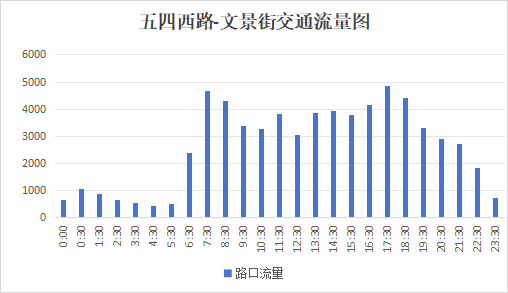
Figure shows the daily traffic variation at the intersection of Wusi Street and Wenjing Street
2. The distance between the east exit and the adjacent intersection is less than 300m, making overflow at the intersection very likely;3. During morning and evening peak hours, there is a large volume of right-turning traffic at the south exit, which can easily lead to intersection conflicts.
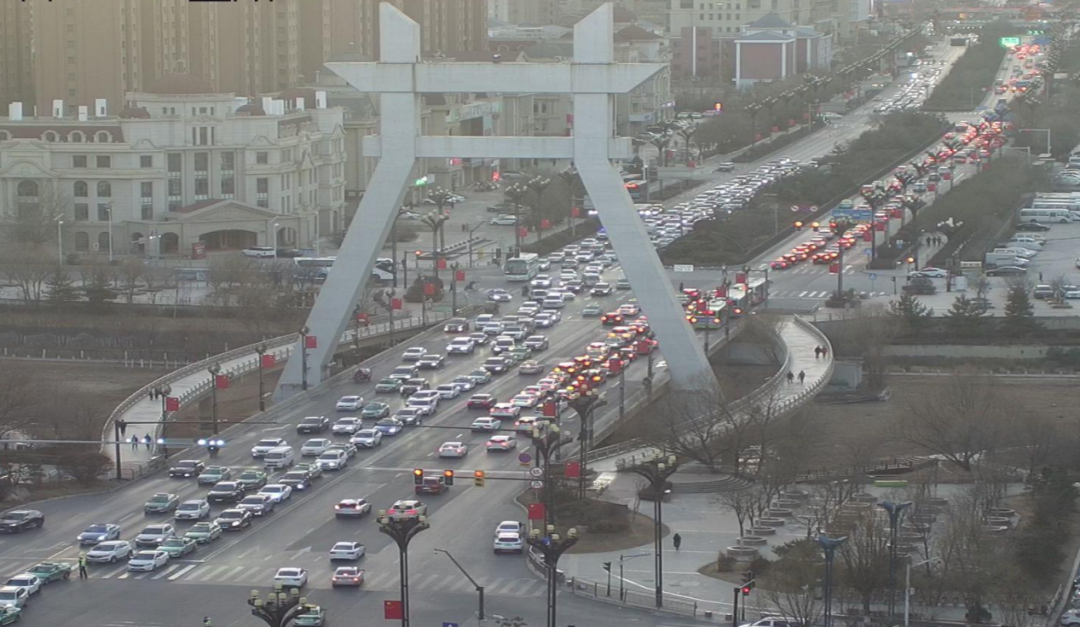
Figure shows the overflow of vehicles queuing in both directions before optimization during peak hoursSignal Optimization MeasuresUpgrading the original fixed-cycle signal scheme to an edge computing single-point adaptive control, with specific strategies as follows:1. Scheme Optimization Adjustments:(1) Morning and evening peak signal scheme:① Reduce the green light duration at the south exit, lowering the signal cycle and the mixed phase duration in the east-west direction;② Change the release sequence at the intersection, adjusting from the original west exit single release → east-west mixed release → east exit single release mode to: east exit single release → east-west mixed release → west exit single release mode;③ Increase right control at the south exit to reduce the overflow frequency from the west to east on the overpass;④ Automatically configure the signal cycle between 130 to 170 seconds based on traffic flow;2. Off-Peak Signal Scheme① Increase the duration of east-west mixed release, shorten the signal cycle at the intersection, and improve intersection efficiency;② Cancel right control at the south exit, allowing uncontrolled right turns during off-peak hours;③ Automatically configure the signal cycle between 90 to 120 seconds based on traffic flow;(2) Single Point Optimization Strategy① During peak hours, vehicles queuing from the west to east on the overpass overflow, the single-point signal scheme reduces the green light time at the west and south exits, increasing it at the east exit to alleviate overflow frequency;② During off-peak hours, shorten the signal cycle at the intersection to reduce parking delay and improve overall intersection efficiency.Effects of Signal Optimization
Xining has added a pilot at the intersection of Wusi West Road and Wenjing Street this week, based on existing adaptive signal control intersections at Kunlun Road-Wenbo Road and Xiguan Street-Wenbo Road. Data shows that vehicle passing efficiency at the new pilot intersection has improved by 9.4%, and the average green loss time has decreased by 5.2 seconds. Now, let’s demonstrate how the edge computing adaptive system dynamically adjusts the signal scheme at the intersection:
The edge computing adaptive system dynamically adjusts the green light duration based on real-time traffic flow analysis: the green loss time at the east exit has decreased from 4.8 seconds to 2.5 seconds, at the west exit from 5.2 seconds to 3 seconds, and at the south exit from 6.5 seconds to 3.5 seconds, with an overall reduction of 45.3% in green loss time. This system not only ensures vehicle passing efficiency but also avoids wasting green light duration, significantly improving intersection throughput.
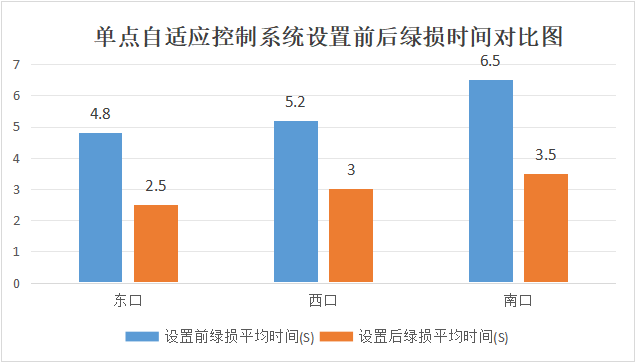
Figure shows the comparison of green loss before and after optimization of the single-point adaptive control system
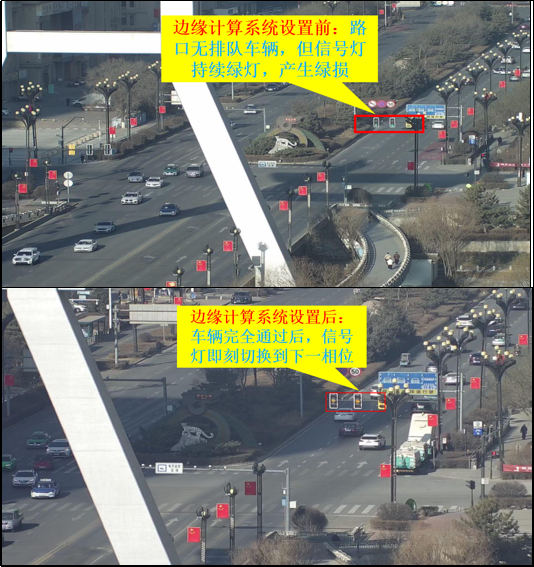
It can be clearly observed from the above figure that the green loss at the intersection has significantly decreased before and after optimization
 Source: Xining Traffic PoliceEditor: Liu XinghaiEditor-in-Chief: Ma JingEditorial Team: Feng Lichen, Zhao Hongqi