
Click the blue text to follow us

This article is the second part of the “How IoT Works” series, where we will introduce the key elements of IoT in a simple and understandable way.
The IoT solution consists of four basic elements: 1. Sensors 2. Network Connections 3. Data Processing 4. User Interface In the previous article “How IoT Works: Sensors”, we learned how to collect data in IoT applications. The next step is to send the data to a cloud-based service platform for processing. So how does it get there? In this article, we will focus on the second element on the list: network connections.
What are Network Connections?
Network connections are part of the IoT puzzle, enabling “things” to communicate and exchange data with each other. Network connections can be achieved through wired or wireless networks. However, wired networks are not suitable for most IoT applications because their coverage is limited to areas reachable by cables. Most IoT applications require a larger coverage area, so we will focus on wireless network connections in this article.
IoT Connection Options There are many network connection options for IoT, such as cellular, satellite, Wi-Fi, Low Power Wide Area Network (LPWAN), and Bluetooth. When choosing a network connection option, there are many factors to consider: coverage (the maximum distance data can be sent), bandwidth (how much data can be sent), power consumption (battery life), cost, reliability, and availability, etc. The best network connection option will have a wide range, high bandwidth, low cost, and low power consumption. Unfortunately, such connection technology does not yet exist; for example, increasing coverage often increases power consumption, and increasing bandwidth typically increases cost. Let’s take a look at some of the most commonly used network connection options for IoT. At the end of the article, you will see a very simple table comparing and summarizing these options. Low Power Wide Area Network (LPWAN)Low Power Wide Area Network (LPWAN), such as Lora and Sigfox, is relatively new, with only a few countries having nationwide low-power wide area network coverage. According to McKinsey, in 2017, LPWAN covered 20% of the global population. Moreover, McKinsey predicts that by 2022, LPWAN will cover 100% of the global population.
It is clear that LPWAN has two important features:
1. Low power (using small batteries that can last for years)
2. Long-distance communication (measured in kilometers)
LPWAN technology is based on the concept of intermittently sending small amounts of data (e.g., a few times a day), which makes low power consumption possible.
One use case for LPWAN is smart waste management, where bins are equipped with liquid level sensors that only clean when necessary. In this use case, occasionally sending small amounts of data to the cloud is sufficient. Instead of having a real-time monitoring system, it is better to have a battery that can last a long time (e.g., years) and a reasonable network connection cost for each bin.
Cellular
Cellular connections are the most common choice: it is the type of network connection your phone uses to send and receive data. Cellular connections have many advantages; they are a reliable choice that offers not only high bandwidth but also long-distance communication. Cellular connections also have good availability (unlike the current LPWAN).
The downside is that cellular connections have relatively high costs and high power consumption. However, some new cellular networks are designed to address these issues, one of which is Narrowband IoT (NB-IOT), which is an LPWAN technology that utilizes existing cellular network infrastructure.
Due to its high power consumption and high cost, cellular connections are not the best choice for many IoT use cases. However, they can be used for tracking expensive assets that move long distances (such as vehicles, shipping containers, etc.).
Satellite
Satellite communication has high bandwidth and high range, but it also has high power consumption. The benefit of satellite communication is that it can work anywhere on Earth. Therefore, if you need to receive information about containers sailing in the ocean, satellite communication may be the only option.
Bluetooth Low Energy and Wi-Fi
Bluetooth and Wi-Fi are the best choices for short-range communication. They have higher bandwidth than LPWAN and lower power consumption than satellite and cellular networks.
In addition to traditional Bluetooth, there is a newer version called Bluetooth Low Energy (BLE). The technology used by BLE enables much lower power consumption, requiring only a small fraction of the energy needed by traditional Bluetooth.
One example of an IoT use case using Bluetooth/Wi-Fi is asset tracking in hospitals (or other indoor locations). By using multiple Bluetooth/Wi-Fi access points, you can triangulate the location of assets.Conclusion Below is a table that provides a very simple summary of the network connection options introduced above.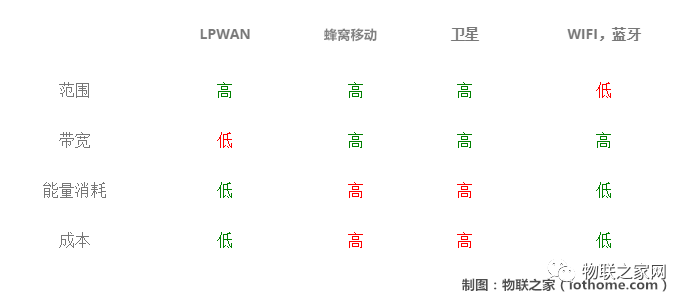 To our knowledge, all options have pros and cons, and the right choice depends on your specific IoT use case.What is the Next Step in the IoT Workflow?So far, we have collected data through sensors and used network solutions to send the data to cloud service platforms. Next, we need to make the data useful, which means we need to process it. Stay tuned for our next article “How IoT Works: Data Processing”!Lightwing is a comprehensive enterprise with nearly twenty years of system integration service capabilities.Based on the requirements of national and industry weak current system integration service standards, and focusing on three major system integration fields: Intelligent Building System (IBMS), Computer Network System (CNMS), and Security Prevention System (SPS), we utilize various system integration technologies such as structured cabling technology, building automation technology, computer network communication technology, computer network security technology, multimedia application technology, and security prevention technology to provide customers with overall system integration solutions that meet personalized needs,helping enterprises and social organizations achieve digital transformation and upgrading.The Power of Technology is Changing the WorldLightwing looks forward to cooperating with you

 Scan the QR code to get closer to Hebei Lightwing
AI + Digital Application Scenarios