For a long time, I couldn’t distinguish between the CAN and RS-485 buses because I felt there was no significant difference in the circuits; both are differential and connect to conversion chips. RS-485 basically requires only a serial port, while CAN requires a proprietary interface. I have used CAN bus once, but I have used RS-485 bus quite a lot. Today, let’s discuss the differences between the two.First, let’s talk about thecommonalities of the two buses as shown in Table 1
| Characteristic | CAN Bus |
| Physical Medium | Twisted Pair |
| Topology | Nodes are connected in parallel on a pair of buses, with 120-ohm termination resistors required |
| Transmission | Differential Transmission |
| Communication | Half-Duplex Asynchronous |
Table 1CAN Bus Circuit Diagram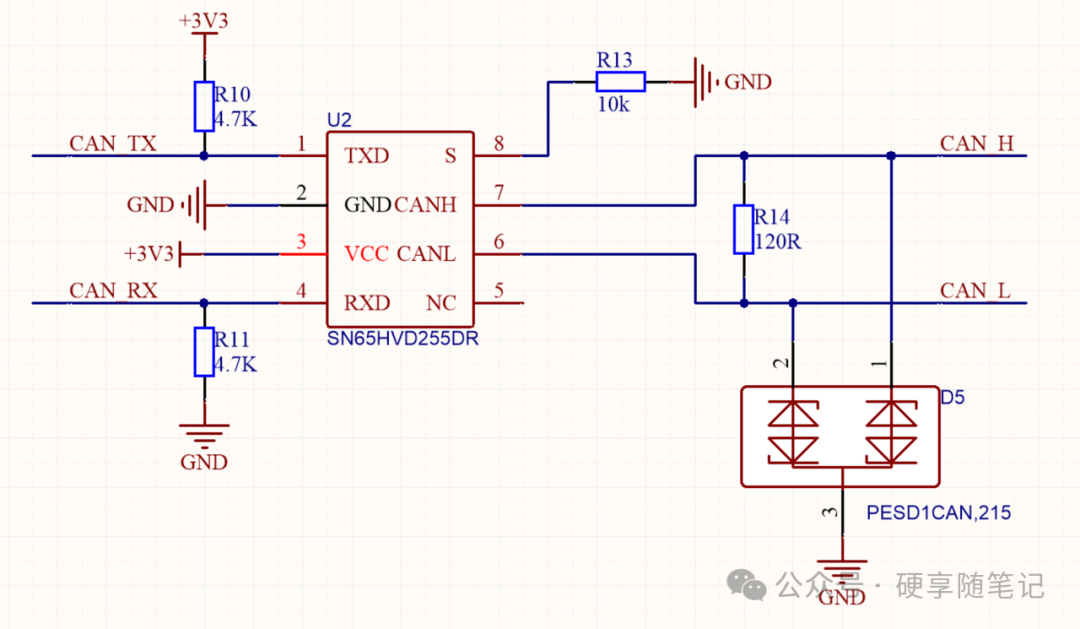 Figure 1RS-485 Bus Circuit Diagram
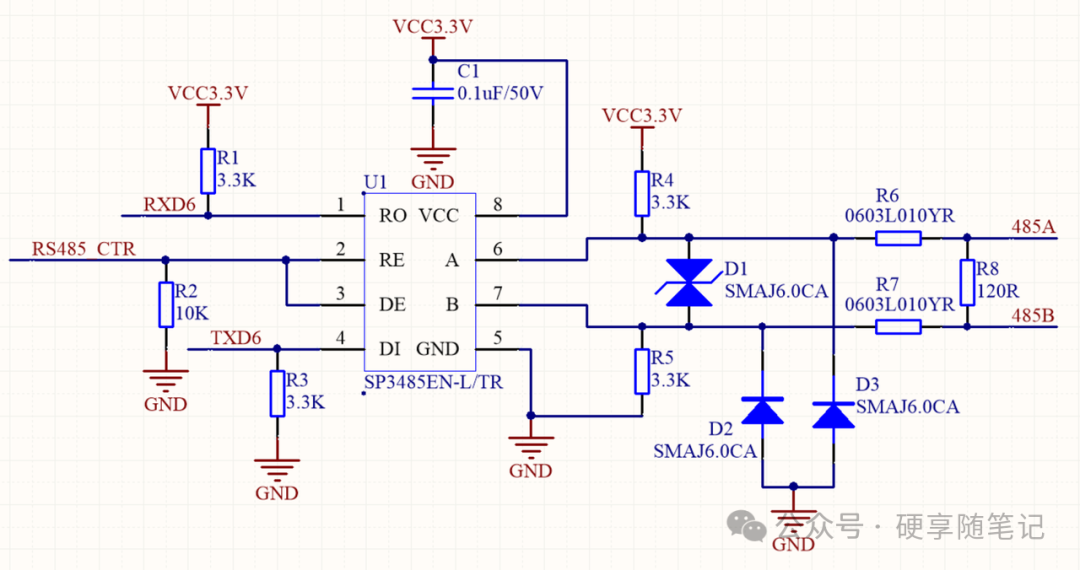 Figure 2So what are the differences between RS-485 and CAN buses?As shown in Table 2
| Characteristic | CAN Bus | RS-485 Bus |
| Protocol Layers | Includes Physical Layer + Data Link Layer | Defines only the Physical Layer |
| High-Level Protocols | Natively supported (e.g., CANopen, J1939) | Requires external protocols (e.g., Modbus) |
| Communication Mode | Multi-Master Architecture (all nodes equally compete for the bus) | Master-Slave Architecture (master polls, slaves respond passively) |
| Node Count | Up to 110 (limited by signal delay) | Theoretically 32 (standard load), expandable to 256 |
| Interference Resistance | Very Strong (built-in error detection and retransmission mechanisms) | Moderate (depends on external protocol for error handling) |
| Error Handling | Automatic retransmission, fault node isolation (e.g., Bus-off) | No native error handling, requires upper-layer protocol implementation |
| Maximum Rate | 1 Mbps (at 40 meters) | 10 Mbps (at 12 meters) |
| Real-Time Performance | High (priority arbitration, low latency) | Low (master-slave polling, latency depends on master) |
Table 2In summary, the CAN bus has an inherent advantage over RS-485 in terms of interference resistance. The CAN bus comes with a complete set of “solutions” from its inception, and its characteristics of low latency, interference resistance, node count, and all nodes competing for the bus have led to its application in the automotive field, where safety and reliability are paramount. Meanwhile, the RS-485 bus, with its flexibility, high transmission rate, and relatively strong interference resistance (compared to other buses), is also widely used in industrial and other sectors.
Disclaimer:
This article maintains neutrality regarding all original and reprinted articles’ statements and viewpoints. The articles are provided solely for readers’ learning and communication. The copyright of the articles, images, etc., belongs to the original authors. If there is any infringement, please contact us for removal. WeChat ID: Hard Sharing NotesWelcome to share and progress together