Force and torque are common physical quantities in non-standard automation projects. When measuring force and torque, sensors are required, with the two most common types being strain gauge sensors and piezoelectric sensors. Although both can be used for measuring force and torque, there are significant differences in their working principles, performance characteristics, and application suitability.
Working Principle
A strain gauge sensor consists of a fine resistive element that deforms when subjected to force. When the strain gauge sensor experiences force, the internal strain gauge is stretched or compressed, changing its resistance. This change in resistance is converted into an electrical signal proportional to the applied force through a Wheatstone bridge circuit.
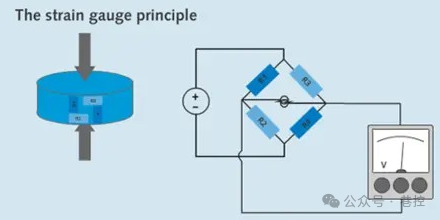
Advantages of strain gauge sensors: They provide very stable long-term measurements, better compensation for temperature changes, and can achieve extremely high precision. Disadvantages: The quality of signal acquisition improves with the slope of the strain gauge’s elastic deformation, meaning it has a softer structure with a lower natural frequency, making it unsuitable for fast measurement events. Additionally, material fatigue and over-strain due to deformation are critical issues for this measurement principle.
Piezoelectric sensors utilize materials that generate charge under mechanical stress. When force is applied, they produce electrical charge, which is proportional to the applied force.
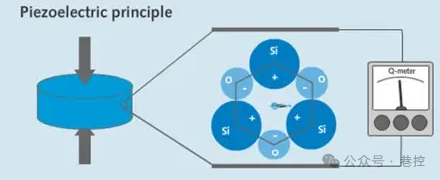
Advantages of piezoelectric sensors: The charge effect is caused by movements within the atomic structure, resulting in extremely small deformations, which allows for the realization of very rigid structures with high inherent frequencies, making them ideal for capturing rapid or high-frequency changes. Disadvantages: The charge is very unstable, and without perfect isolation, it will dissipate over time. This makes long-term stable measurements difficult, especially when measuring small forces. Additionally, piezoelectric sensors are more affected by temperature changes.
Performance Characteristics
1、Geometric Shape
Strain gauge sensors typically use durable metal structures with built-in strain gauges. The position of the strain gauge within the structure allows it to capture strain at that location. Engineers utilize this feature to design load cells with different geometries and load point characteristics. This diversity enables strain gauge sensors to adapt to various application needs.
According to convention, the geometric shape of the standardized structural shell unit is the origin of the naming of strain gauge sensors. Examples of load cells include beam-type, S-shape, disc-type, or flat beam. Piezoelectric sensors also include these shell designs. The geometric shape of the sensor also depends on application requirements.
Piezoelectric sensor designs are more compact and structurally robust than strain gauges, with small sizes and excellent dynamic response, making them suitable for high-sensitivity applications, widely used in medical robotics and acoustic applications.
Both types of sensors can be used in multi-axis applications and can support compressive, shear, or bending stresses.
2、Measurement Range
Strain gauge sensors typically have a range of 5N to 40MN, while piezoelectric sensors usually range from 5KN to 1MN.
3、Operating Conditions
Strain gauge sensors support static and dynamic loads, while piezoelectric sensors can only support dynamic loads such as vibration, acceleration, and dynamic pressure measurements.
4、Drift
Strain gauge sensors exhibit negligible output drift under long-term loads, whereas piezoelectric sensors experience significant output drift, leading to measurement errors during prolonged loads.
5、Stiffness
Strain gauge sensors have high elasticity, and their durability depends on the load they are subjected to, while piezoelectric sensors have very high stiffness values.
6、Temperature Effects
Both strain gauge and piezoelectric sensors are very sensitive to temperature changes, affecting zero balance, sensitivity, and linearity during temperature variations. Therefore, both have corresponding compensation technologies: strain gauge sensors use self-temperature compensation; piezoelectric sensors adjust temperature changes through charge amplifiers.
7、Repeatability
Both types of sensors can achieve excellent repeatability, meaning consistency between consecutive measurement results.
8、Linearity
Strain gauge sensors have lower linearity errors compared to piezoelectric sensors.
9、Sensitivity
Strain gauge sensor sensitivity depends on the excitation voltage and rated capacity, with units rated in millivolts per volt (mV/V). Piezoelectric sensor sensitivity depends on the materials used and their geometry, rated in picocoulombs per Newton (pC/N).
Application Scenarios
1、Static Monitoring
Strain gauge sensors exhibit almost no drift, making them particularly suitable for long-term monitoring tasks. The so-called creep, which is the reversible change in output signal under sustained applied force, is extremely small, as it can be minimized through careful selection of strain gauge layouts. Due to their working principle, piezoelectric force sensors experience drift, and when measuring, it is estimated that a force of 1 Newton per minute is required. Since the drift value remains constant regardless of the magnitude of the measured force, it is particularly detrimental when measuring smaller forces over extended periods.
2、Dynamic Measurement
Piezoelectric sensors deform very little when force is applied, exhibiting high rigidity. This results in high resonance frequencies, which is advantageous in dynamic applications. However, the entire measurement is crucial to dynamic properties. It is worth noting that the mounting components used for installing the sensor have additional mass, which will affect the overall mass of the system, thus influencing the cutoff frequency. Additionally, many charge amplifiers’ bandwidth depends on the charge, and therefore also on the force being measured. Large forces generate high charges, thus limiting bandwidth. Systems based on strain gauges can achieve higher cutoff frequencies when using sensors rated for larger forces. In principle, force sensors for small forces are soft spring elements, resulting in lower resonance frequencies for the sensors. However, in each case, reference to the data sheet is necessary; piezoelectric sensors are preferred for rapid measurements of small forces, while strain gauge force sensors are generally better for larger forces.
3、Calibration Tasks
Strain gauge sensor circuits can compensate for many error effects, including the influence of temperature on zero point and sensitivity, as well as the effects of linearity or bending moments of the sensor. Additionally, strain gauge sensors support very precise static calibration. Spring elements can also be designed to achieve optimal repeatability, making strain gauge-based force sensors specifically suitable for reference force measurement fields.
4、High Initial Load
When force is applied, piezoelectric sensors generate charge, which can be short-circuited if necessary. The state of the input to the charge amplifier equals the state of “zero” force. Therefore, the input range of the charge amplifier is unaffected even with high initial loads. Thus, piezoelectric sensors can achieve the highest resolution measurements even under adverse conditions.
5、Harsh Environments
Some strain gauge-based sensors offer IP68 protection levels, with sealed housings protecting sensitive strain gauges. This allows these sensors to be used in harsh environments. Piezoelectric sensors use specially sealed cables to ensure a sealed connection with the sensor housing, ensuring high safety.
6、High Precision Requirements
Strain gauge sensors have very high precision, allowing for smaller individual errors. Piezoelectric sensors have slightly higher linearity errors, typically around 0.5% relative to full scale, and are also limited by high drift, which can significantly improve accuracy when calibrated within a certain measurement range.
7、Compact Spaces
Piezoelectric force sensors can be very compact, with some heights even below 4 mm. These sensors are the best solution when integration with existing systems is required. Compromises must be made regarding achievable accuracy, but in many applications, the requirement for extremely small sizes is crucial.
Strain gauge sensors and piezoelectric sensors each have their advantages depending on the application. Strain gauge sensors provide stability and precision when subjected to a wide range of forces, making them the preferred solution for static and general industrial measurements. In contrast, piezoelectric sensors are unparalleled in capturing dynamic and rapid force changes, making them essential for dynamic or impact measurements. Understanding the advantages and disadvantages of both technologies is crucial for engineers to make informed decisions in measurement applications. By selecting the appropriate sensor, they can ensure the accuracy and reliability of their application needs.