
Click the blue text to follow “Textile Guide”
Developing wearable electronic products has become one of the hottest research directions today. Compared with traditional rigid devices, integrated fabric-based wearable electronics are considered the most effective materials for flexible conductive sensing and electronic skin due to their remarkable flexibility and lightweight properties. However, the development of fabric sensors is restricted by low adhesion between fabrics and conductive materials, minimal attachment, and discontinuous spatial conductive networks.
Recently, Professor Li Jialin and Associate Professor Hong Xinghua’s team at Zhejiang Sci-Tech University developed a universal strategy by forming a macroscopic three-dimensional silk fabric structure through jacquard technology, combined with a microscopic plasma-activated hydroxyl iron oxide scaffold and in-situ polymerization of polypyrrole, to design wearable devices with high conductivity and sensitivity for motion recognition and health monitoring.The fabric exhibits high conductivity (resistivity of 0.3 Ω·cm), rapid sensing response (50 ms), excellent durability (>1500 cycles), and a maximum tensile strain of 30%.Additionally, the possible mechanism for the generation of zero-valent iron from the plasma-activated hydroxyl iron oxide scaffold and the induction of polypyrrole polymerization was analyzed.This work provides a new pathway for constructing advanced fabric-based conductive sensor devices, promising applications in health monitoring, smart homes, and virtual reality interactions.
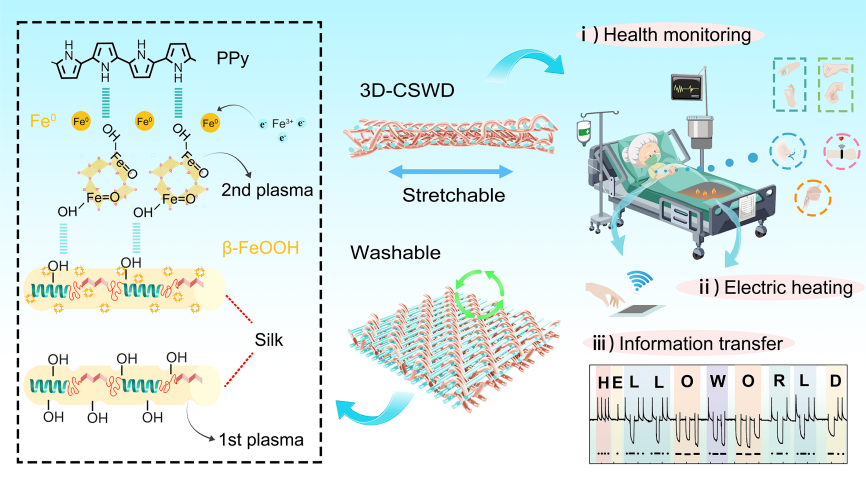
The design and preparation of the 3D highly conductive silk wearable device (3D-CSWD) follows two key processes: (1) Achieving a high-precision silk flexible matrix with continuous two-dimensional plane and three-dimensional spatial interleaving through advanced jacquard weaving technology, enhancing elastic deformation capability, thereby increasing sensing sensitivity. (2) Utilizing two low-temperature plasma treatments: (a) In-situ introducing oxygen-containing functional groups on the silk surface, stabilizing the construction of the FeOOH scaffold under hydrogen bonding; (b) Reactivating the scaffold during subsequent treatment, allowing polypyrrole to preferentially grow on the fabric/FeOOH surface without detaching in the reaction solution, enhancing polymerization efficiency while improving conductivity and wash resistance.
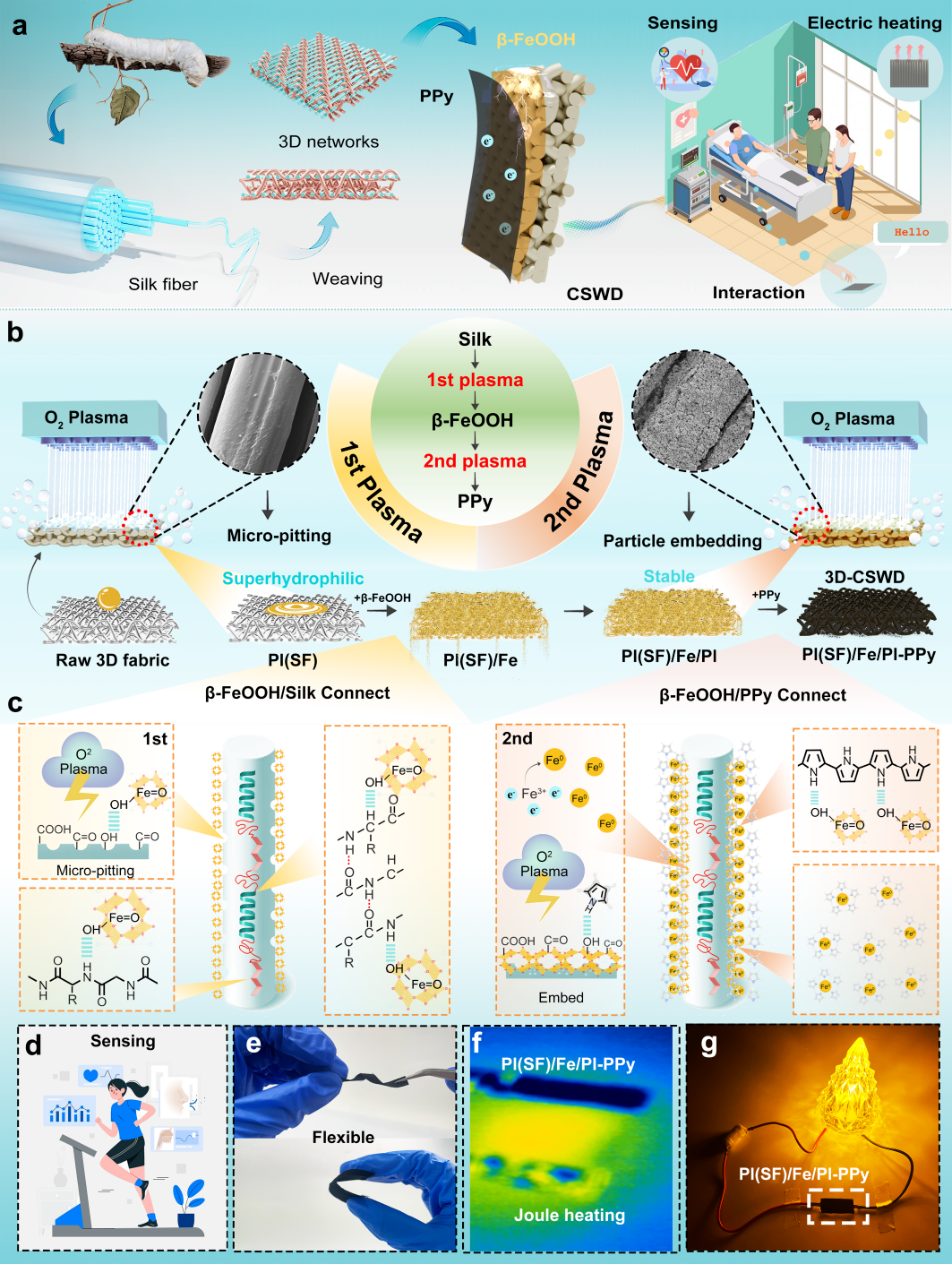
Schematic Diagram of 3D-CSWD Preparation and Application
After the second cold plasma treatment of the fabric, a large number of negatively charged particles and free electrons are generated, which reduce Fe3+; meanwhile, in the process of oxidative polymerization of Py monomer into polypyrrole, Fe3+ acts as an oxidant, being reduced itself to produce Fe(0). Ultimately, the surface of the 3D-CSWD contains not only the conductive polymer polypyrrole but also Fe(0), enhancing the fabric’s conductivity.
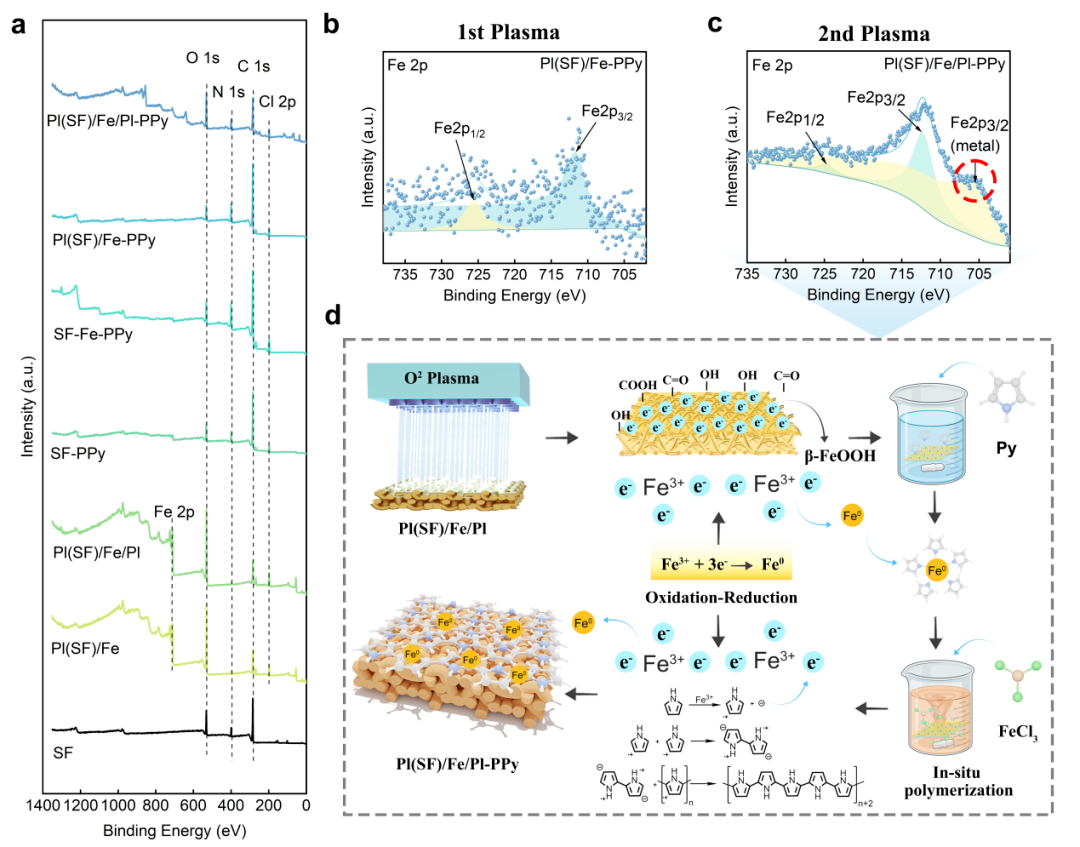
XPS Characterization Results of 3D-CSWD
The surface of the fabric treated with β-FeOOH appears grainy, due to the stacking of polycrystalline β-FeOOH forming a dense layer wrapped around the fiber surface. After the in-situ assembly reaction of polypyrrole, β-FeOOH provides a growth space for polypyrrole.
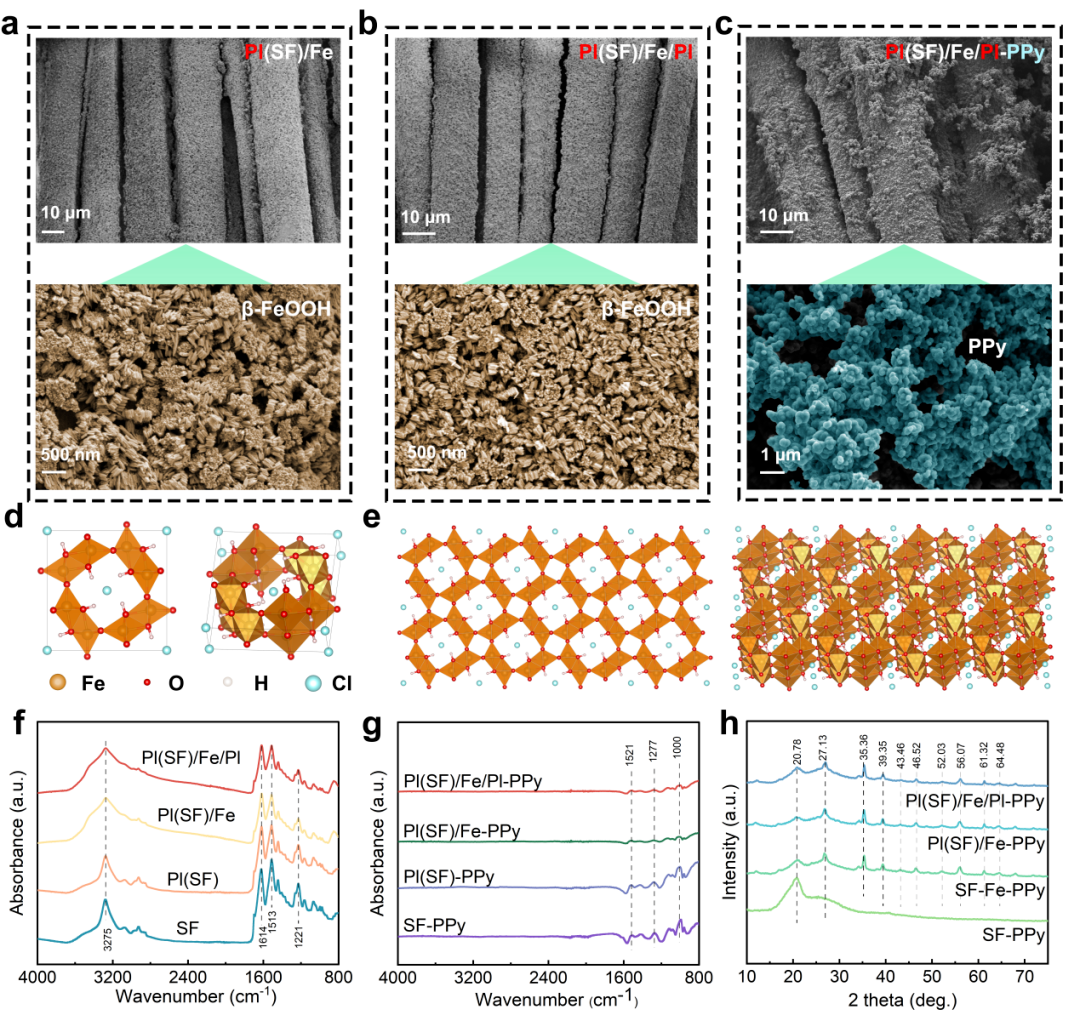
SEM Images, FTIR Spectra, and XRD Patterns of PI(SF)Fe/PI and PI(SF)Fe/PI-PPy
In ordinary woven fabrics, the warp and weft are perpendicular to each other, with a small degree of bending and weak resilience. The weaving structure designed in this study introduces a knot structure that acts like a ‘coil spring’. When the double-layer structure is stretched, the knot structure connects the upper and lower layers of the weft, sliding relatively, gradually transforming from a bent state to a straightened state, providing greater elasticity and ductility. Additionally, the 3D-CSWD exhibits good wash resistance (maintaining high conductivity of 0.6 Ω·cm after 12 washes).

Tensile Sensing Performance of 3D-CSWD
The 3D-CSWD can monitor human movements in real time, with applications ranging from subtle physiological signals to large-scale motion signals. Attaching the fabric to the wrist, throat, and inside a mask can detect different ranges of motion signals such as pulse, swallowing, and breathing. For finger movements, the resistance change rate of the fabric can reach 200%, with joint movements reaching 400%. Furthermore, during swallowing actions, the fabric sensor generates sharp narrow response peaks; while bending the wrist, it produces stable and strong broad response peaks. By identifying and analyzing different response peaks, real-time judgments of human motion states can be made, indicating broad application prospects in non-invasive biomedical monitoring and personal medical diagnostics.
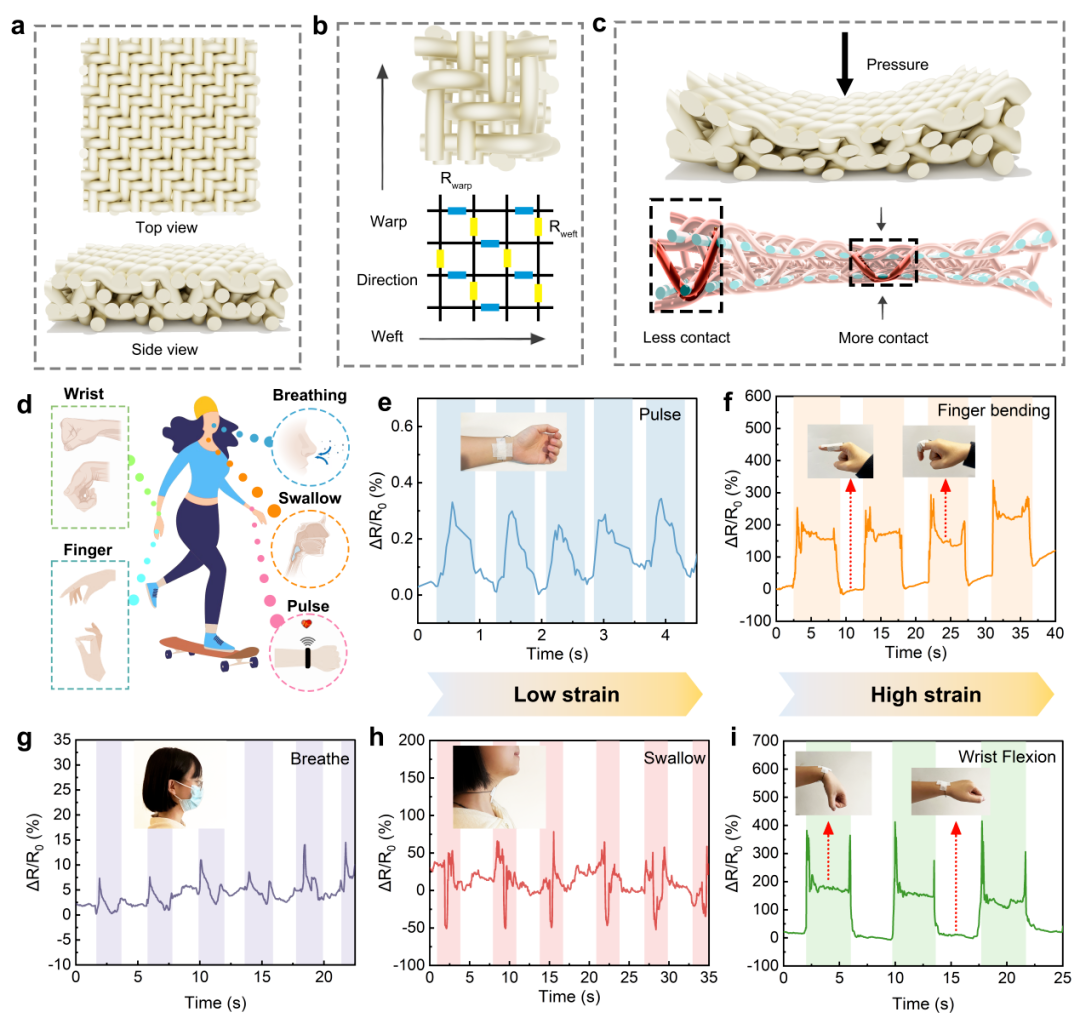
Applications of 3D-CSWD in Real-Time Monitoring
In summary, combining macro multi-dimensional fabric structure design, microscopic plasma activation, and in-situ polymerization strategies, the preparation of 3D highly conductive silk wearable devices demonstrates excellent durability and washability. Due to the specific fabric structure having a certain thickness and stretchability (three times that of ordinary conductive silk woven fabrics), it can monitor human motion states such as pulse, breathing, swallowing actions, and wrist and finger bending; additionally, this device can also transmit Morse code signals for information exchange. This research provides a new design idea for the preparation of fabric-based flexible conductive sensing textiles.
The research results were published in Advanced Fiber Materials under the title “Highly Conductive and Elastic Electronic Silk Fabrics via 3D Textile Macro-design and Microscopic Plasma Activation for Personal Care and Information Interaction.”
Original link: https://doi.org/10.1007/s42765-024-00471-z
Source: Advanced Fiber Materials




【Review】 Previous Excellent WeChat Articles:
Welcome to reprint, please indicate the source, thank you!
“Textile Guide” magazine is a guiding technology journal sponsored by the China Textile Information Center, aiming to provide in-depth reporting and analysis of textile technology development dynamics, authoritative interpretation of technological policies and industry regulations, serving as a barometer for government agencies and industry organizations’ technology policies and trends, and an important window for helping industry and enterprise decision-makers grasp the current state of textile technology and the technical market context.
Textile Guide Official Website:www.texleader.com.cn
Subscription Hotline:010-84463638-8850
Advertising Inquiries:010-84463638-8830