Source: “Xiao Ming Review”
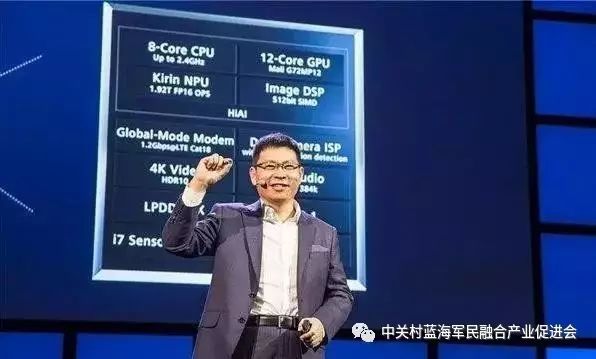

Not long ago, during the “Deep Business Enterprises Enter Huawei” event, Yu Chengdong, CEO of Huawei Consumer BG and Chairman of Huawei Terminal Company, revealed that it was a very difficult decision to develop HiSilicon chips in the past, as making HiSilicon chips resulted in poor performance. If they were to give up, it would be a loss, and if they didn’t use them, they would never grow. However, if they used them, their competitiveness would be very weak.
Nevertheless, Huawei chose to persist, initially performing poorly, then gradually improving, and eventually leading with the Kirin 950 and Kirin 960.
Clearly, Huawei has made continuous breakthroughs, moving from a position of severe lag to gradually leading. Just on the evening of September 2nd, Beijing time, at the IFA 2017 exhibition in Berlin, Huawei officially released the next-generation mobile SoC chip.
Yu Chengdong stated that the Kirin 970 is Huawei’s first artificial intelligence mobile computing platform and the world’s first mobile chip to integrate an independent AI-specific NPU (Neural Processing Unit), utilizing an innovative HiAI mobile computing architecture.
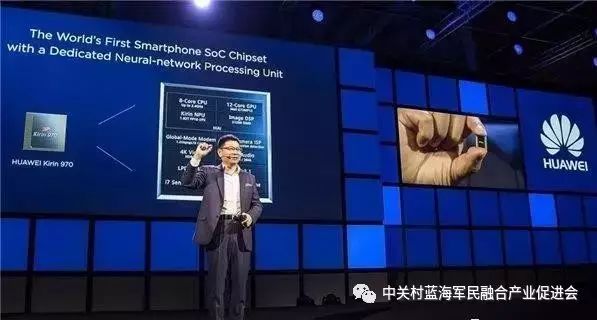
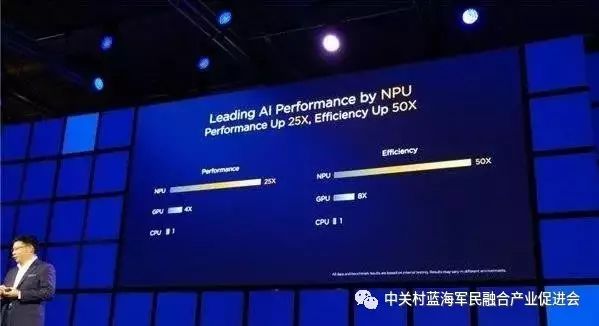
The so-called HiAI mobile computing architecture consists of four main components: CPU, GPU, ISP/DSP, and NPU. As the world’s first mobile chip with an integrated dedicated NPU, Huawei emphasized the NPU neural network unit from the outset, claiming that under the HiAI architecture, AI performance density significantly outperforms that of CPU and GPU, enabling faster completion of more tasks with less energy consumption, greatly enhancing the chip’s computational efficiency.
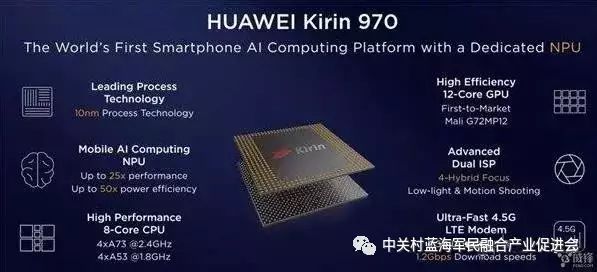
Specifically, at 16-bit floating point (i.e., FP16), the NPU built into the Kirin 970 achieves a computing power of 1.92 TFLOPs. Under AI deep learning, all hardware can coordinate various components within the chip and mobile hardware, such as ISP and DSP, to enhance speed and operate with low power consumption when processing specific tasks.
For example, with the boost of NPU, in image recognition tasks, the performance improves by 25 times compared to the Cortex-A73 CPU, with energy efficiency improving by 50 times. Taking 1000 photos only consumes 0.19% of a 4000mAh battery, with image recognition speed reaching about 2000 images per minute.
In contrast, the Samsung S8 processes only 95 images per minute using the CPU, while the Apple iPhone 7 Plus, using both the CPU and GPU, can only recognize 487 images per minute, making Huawei the clear winner:
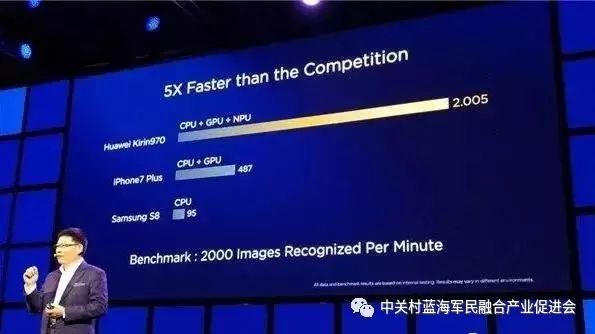
In summary, with the NPU unit, the Kirin 970 is significantly faster in photography and image processing compared to relying solely on CPU and GPU. For competitors, the Kirin 970 maintains high efficiency and is more energy-saving.
In the future, AI independent units integrated into chips will certainly be a trend, as Apple is also working on it, but Huawei has taken the lead, reportedly accelerating development by obtaining AI instruction authorization from the Chinese Academy of Sciences’ Cambrian.
Of course, the so-called AI empowerment in improving computational processing efficiency currently lacks a unified standard for measurement, and one can only rely on Huawei’s official examples for explanation.
Regardless, in the field of AI chips, FP16 and FP8 have become increasingly important because neural networks use decimal numbers as part of their computation matrices, and these floating points do not need to be so precise, meaning FP16 and FP8 are more important than a complete 32-bit or 64-bit floating point.
According to Huawei, AI chips can understand human demands in a human-like manner, possessing high processing speed, high density, and high energy efficiency, with the Kirin 970 being just the beginning and surpassing competitors.
Yu Chengdong stated that the Kirin 970 is faster, stronger, smarter, and provides an outstanding new experience in the era of artificial intelligence. Looking ahead to the future of smartphones, we are at the beginning of an exciting new era. “Mobile AI = Device AI + Cloud AI”, and future smart terminals will be able to see, hear, understand you better, think more like you, and converse to provide better service.

Disappointingly, there was no improvement in the CPU, while the GPU made its debut with Mali-G72.
The Kirin 970 is manufactured using TSMC’s 10nm process technology. Yu Chengdong stated that this chip has a very high level of complexity and integration, incorporating 5.5 billion transistors within a small area of about 100 square millimeters.
In contrast, Qualcomm’s current strongest flagship chip, the Snapdragon 835, integrates 3.1 billion transistors, while Apple’s A10 integrates 3.3 billion. It is currently unclear how many transistors the upcoming A11 will have.
Regarding the CPU, the Kirin 970 has the same eight-core design as the previous generation Kirin 960, consisting of 4 Cortex-A73 big cores with a frequency of 2.4GHz and 4 Cortex-A53 cores with a frequency of 1.8GHz, with no changes in performance since they share the same architecture and frequency.
The rumored 2.8GHz frequency that would beat the Snapdragon 835 has not been realized, but achieving scores on par with the Snapdragon 835 should not be a problem, and thanks to the advancements of the 10nm process, energy efficiency has improved by 20%.
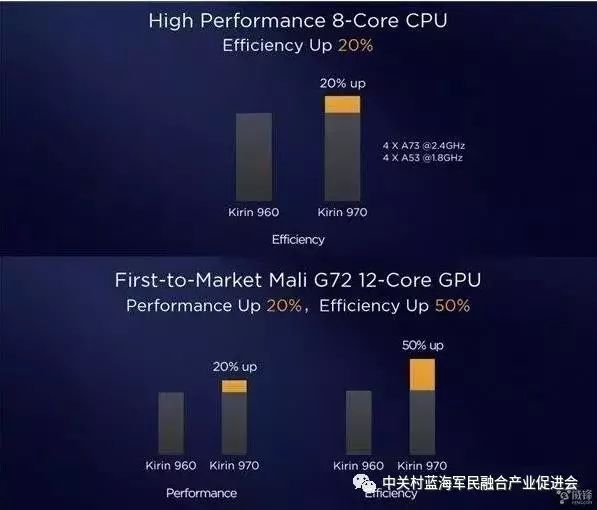
In terms of the GPU, the Huawei Kirin 970 debuts ARM’s Mali-G72 MP12 with 12 cores, marking Huawei’s first use of a double-digit core GPU, significantly improving graphics performance compared to the 960, with a performance increase of 20%, while energy efficiency has decreased by 50%.
However, overall, after reviewing the CPU and GPU, the Kirin 970 has not made significant progress in power consumption; the high power consumption issue of the Kirin 960 has not been completely resolved by the 10nm process.
According to normal chip updates, there should be improvements in performance and reductions in power consumption. However, with no improvement in CPU performance, the power consumption has only decreased by 20%.
From this perspective, the addition of the NPU unit is indeed the focus of Huawei’s upgrade this time, rather than hastily adopting ARM’s A75 and A55 architectures released earlier this year.
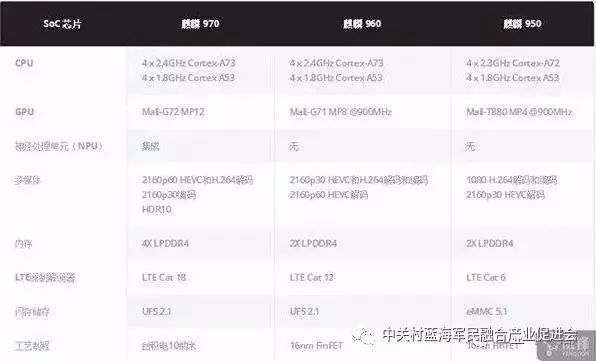
Leading the world with a 4.5G network modem, it also supports UFS 2.1.
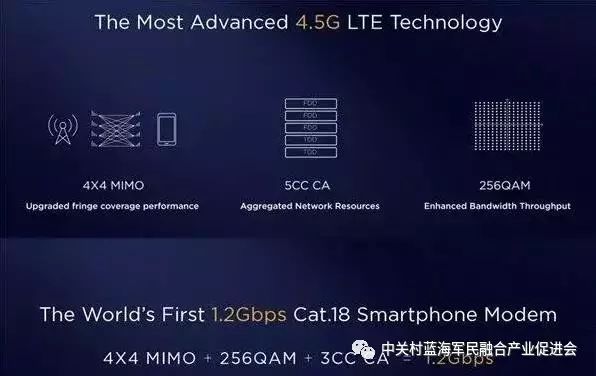
Huawei also debuted a “4.5G, Pre 5G” modem, supporting LET Cat 18 communication specifications, with a maximum downlink peak speed of 1.2Gbps. Other parameters include 4X4 MIMO, 5CC CA, and 256QAM, supporting dual SIM dual VoLTE.
Yu Chengdong stated that this modem can achieve high-rate combinations for operators worldwide. Huawei has conducted high-speed rail tests over 400,000 kilometers, ensuring stable download rates on high-speed trains, eliminating concerns about losing network connectivity on the train.
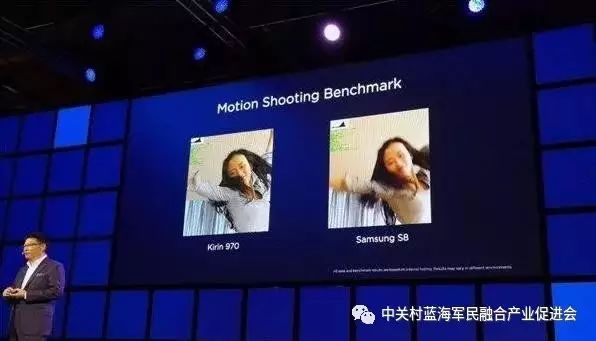
The Kirin 970 provides dual ISP image processing units and Image DSP signal processing units. Thanks to more powerful algorithm optimization and AI neural network assistance, throughput has increased by 25%, supporting AI scene recognition, face tracking, intelligent motion scene detection, and improved night shooting effects.
Therefore, during the launch event, Yu Chengdong showcased devices equipped with the Kirin 970 chip, demonstrating superior photography capabilities compared to Samsung’s Galaxy S8:
Additionally, the Kirin 970 integrates the latest i7 coprocessor, supports 4K HDR10 video decoding, includes TEE and inSE security engines, and offers higher security with integrated HiF-level hard disk chips, supporting audio streaming up to 384KHz/32bit studio-quality audio.
It is important to note that Huawei’s official parameters indicate that the Kirin 970 not only supports LPDDR4X memory but also UFS 2.1 flash storage. It remains unclear whether future devices with the Kirin 970 will still mix eMMC flash, as the previous generation Kirin 960 also supported UFS 2.1.
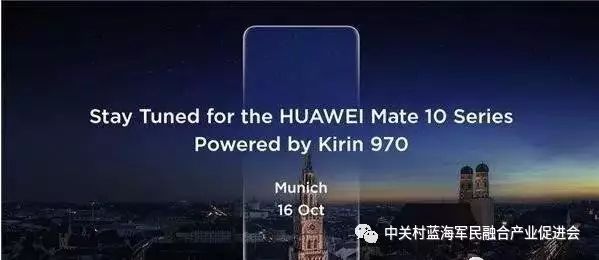
Finally, Yu Chengdong announced that the Huawei Mate 10 will globally debut the Kirin 970 processor, officially launching on October 16 in Munich, Germany.
Yu Chengdong has confirmed that the Mate 10 will be Huawei’s first smartphone with a full-screen design, and the outstanding Kirin 970 makes it even more anticipated.
Currently, it can be confirmed that the Mate 10 will use a screen from JDI, which was recently announced as a full-screen display, with a size of 6 inches, an aspect ratio of 18:9, and a resolution of Quad HD level 2160 x 1080 pixels, utilizing Pixel Eyes technology.
Previously, Yu Chengdong stated that the goal of Huawei’s new flagship Mate 10 is to outdo Apple’s new generation iPhone released at the same time, as the Mate 10 will have powerful overall strength.
Besides the powerful Kirin 970, Yu Chengdong emphasized that this flagship features stunning full-screen design, longer battery life, faster speed, and superior dual-camera performance, along with undisclosed heavyweight features.
To be honest, in terms of CPU performance, the Kirin 970 may not be the fastest chip this year; the fastest in the Android field this year should be the unreleased Snapdragon 836, which is expected to be equipped in Google’s Pixel 2 later this year, while Apple’s upcoming A11 chip is also highly anticipated.