The watershed moment for smart hardware has arrived, transitioning from concept hype to real value
Recently, the concept of AI Agent smart hardware has gained significant attention, with many products adding AI large model voice interaction and network control, boldly claiming to be “AI Agent smart hardware”. We all know: Most of the so-called “AI Agent smart hardware” on the market is more of a gimmick, merely trying to ride the wave of popularity.
So what should true AI Agent smart hardware look like? How can traditional products achieve a genuine AI upgrade?
1. The Essential Differences Between Genuine and Pseudo AI Agent Smart Hardware
The difference between genuine AI Agent smart hardware and ordinary smart hardware is akin to the difference between an excellent employee and an average employee. The former can think proactively, predict needs, and take initiative to achieve goals, while the latter merely executes commands mechanically and passively.
Genuine AI Agent smart hardware possesses four core characteristics:
-
Autonomy: Can operate independently without human intervention, with control over its actions and internal states
-
Reactivity: Can perceive the environment and respond to changes in real-time
-
Proactivity: Can take initiative to achieve goals, rather than just passively responding to commands
-
Sociality: Can interact and collaborate with other agents or humans
For example, a genuine AI Agent smart home system does not wait for you to issue the command “turn on the air conditioning”; instead, it can sense indoor and outdoor temperatures, analyze your living habits, and automatically adjust to a comfortable temperature before you arrive home.
In contrast, pseudo-smart hardware has obvious shortcomings: it can only achieve point intelligence, creating data silos between devices; passive response, unable to proactively serve and predict needs; lack of learning ability, with stagnant intelligence levels.
2. The Architecture of AI Agent Smart Hardware
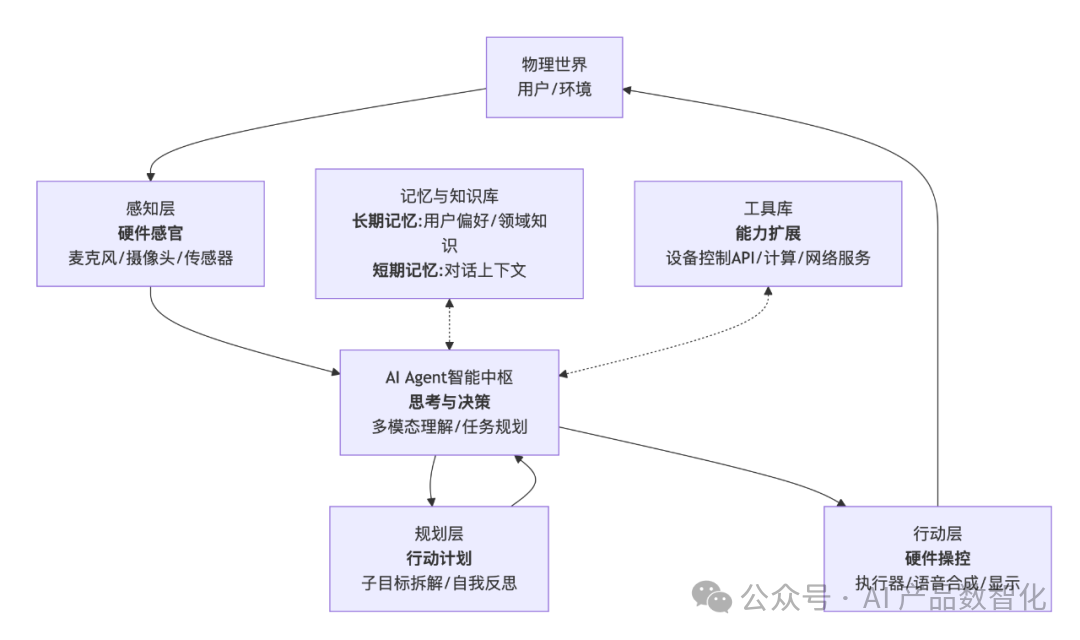
The architecture of AI Agent smart hardware includes five core modules:
-
Perception Module (Eyes and Ears): Equipped with multimodal sensors, allowing the device to comprehensively perceive the environment
-
Decision Module (Brain): Integrates large language models, enabling the device to analyze and make decisions
-
Memory Module (Knowledge Base): Supports short-term memory (dialogue context) and long-term memory (user preferences, knowledge base)
-
Planning Module (Command Center): Can decompose large tasks into subtasks and plan execution processes
-
Execution Module (Hands and Feet): Directs hardware to perform actions through tool invocation interfaces
3. The Implementation Path for Upgrading Traditional Products to AI Agent Smart Hardware
For companies with existing traditional hardware products, the following paths can be taken to achieve intelligent upgrades.
1. Assessment and Planning Stage
Accurately Identify Pain Points: Avoid the trap of “AI for AI’s sake” by always starting from actual user needs. Ask yourself: What specific reasons would customers be willing to pay more for this AI feature?
Feasibility Analysis: Assess technical feasibility, data foundation, and cost-benefit ratio to ensure that investments yield actual commercial value.
2. Minimum Viable Product (MVP) Development
Select 1-2 core scenarios to implement AI features and validate market response. For example, first implement basic voice control functionality, then gradually increase AI capabilities.
Utilize Existing Platforms: Leverage existing AI hardware open platforms like Tuya Developer Platform and Xiao Zhi AI to quickly inject AI capabilities into devices, significantly lowering development barriers.
3. Function Expansion and Optimization
Gradually increase AI capabilities based on user feedback, advancing in three stages:
-
Stage One: Achieve intelligent control of a single device
-
Stage Two: Expand to multi-device interaction
-
Stage Three: Achieve autonomous decision-making and continuous learning for devices
4. Successful Cases and Insights
The following cases demonstrate the successful application of AI Agent smart hardware in different fields and types of enterprises, serving as references for product managers.
1. Hearing Bear AI Phone: Precisely Targeting the Youth Market
The AI phone X3 launched by the Hearing Bear brand, built on a native intelligent OS developed in collaboration with Tongyi Qianwen, precisely targets the youth segment. This device integrates AI capabilities across the entire system and application layers, with all services and interactions triggered and connected by the core AI agent “Teeni”.
Key to Success:
-
Precisely identifying youth needs, such as conversational skills, storytelling, and knowledge acquisition
-
Price set at only 1298 yuan, ensuring commercial viability
-
Users average over 3 hours of daily usage, with AI interaction frequency reaching 89 times per day
Insights: Choose niche markets that have not been defined by giants, reducing market education costs and quickly validating business models.
2. AI Toys: From Function Stacking to Emotional Companionship
Products like AI Hugging Cat from Qu Chao and the Yuan Bao children’s companion robot from Haowei Technology showcase the application prospects of AI in the emotional companionship field. These products not only possess encyclopedic knowledge and daily conversation capabilities but also focus on emotional analysis and psychological guidance.
Innovative Points:
-
AI Hugging Cat can simulate real cat behaviors, responding to user emotions through body language
-
The Yuan Bao robot embeds over 30 psychological assessment models for children, enabling emotional monitoring and behavior analysis
-
Upgrading from “functional toys” to “emotional partners”, creating differentiated value
Insights: The value of AI hardware lies not only in functional enhancement but also in emotional connection and qualitative leaps in user experience.
3. Panasonic Smart Appliances: AI Upgrade Path for Traditional Brands
Panasonic home appliances collaborated with Alibaba Cloud to develop the “Smart Living” AI platform based on the Tongyi Qianwen large model, upgrading products like refrigerators and washing machines to intelligent versions. Through AI agents driven by large models, they achieve smart laundry, smart cooking, and smart ingredient management as proactive services.
Transformation Strategy:
-
Collaborate with traditional tech giants to lower technical barriers
-
Focus on specific scenarios in vertical fields, such as ingredient management and laundry optimization
-
Upgrade from “single function” to “scenario solutions”
Insights: Traditional enterprises can quickly acquire AI capabilities through strategic partnerships, achieving product intelligent upgrades.
Conclusion: From Concept to Value, the Future of AI Agent Smart Hardware
True AI Agent smart hardware is not about technical showmanship, but about effectively solving user pain points, enhancing product competitiveness, and creating commercial value.
For pragmatic product managers, the key lies in identifying scenarios that genuinely warrant AI integration, leveraging existing competitive advantages of their products. Now is the right time to seize the trend of AI Agents. In the next three to five years, almost all smart hardware will be worth redoing with AI Agents. This is not just a technological upgrade, but a reconstruction of business logic: from one-time sales to the long-tail compounding brought by intelligence, from generic experiences to highly personalized long-term value.
#AI #AI Agent #Product Digitalization
Related Articles You Might Like:
Product Digitalization Upgrade: Five Value Judgments and Three Implementation Paths for Decision Makers
Product Digitalization Upgrade: Implementation Paths from Frontend to Backend

We are: A continuous entrepreneurial team in AI smart hardware, composed of the former chief audio scientist of Baidu Smart Screen and the core service provider team of Tencent Cloud’s product digitalization, combining technical depth with commercial breadth.
We can: Provide enterprises with product strategy consulting, AI product digitalization upgrades, and customized enterprise AI agents.
If you are considering product digitalization upgrades, feel free to follow our public account and interact with us【Product Digitalization Architect】 for free proposal suggestions👇