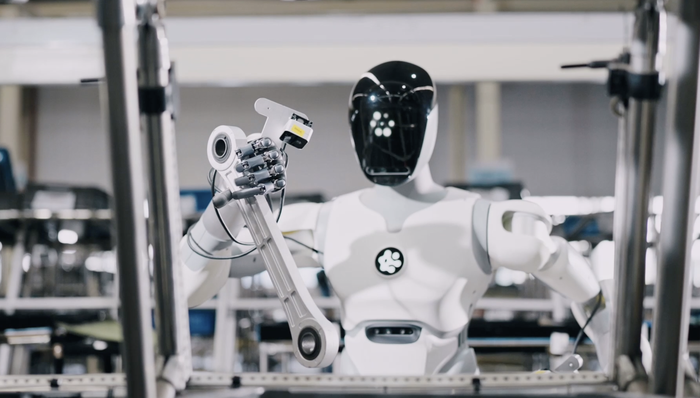
 1. Company Overview and Founding BackgroundZhi Ping Fang Robotics is a high-tech enterprise focused on industrial robot intelligent systems guided by 3D vision and smart logistics solutions. Its core capability lies in integratingadvanced machine vision, deep learning, and robot control technologies, endowing industrial robots with “intelligent eyes and brains,”enabling them to perform complex and precise tasks such as recognition, sorting, and grasping, making it a core enabler in the field of intelligent manufacturing.Founding Background:
- MarketDriven:With the decline of China’s demographic dividend, the transformation and upgrading of manufacturing (“Made in China 2025”), and the continuous rise in labor costs, the trend of “replacing humans with machines” in industry has become irreversible. However, traditional robots can only perform repetitive fixed-path operations and cannot adapt to flexible and intelligent production needs.
- Technological Maturity:Breakthroughs in AI, especially deep learning in image recognition, and the decreasing costs of 3D vision sensors have provided technical feasibility for intelligent robots that achieve “hand-eye coordination.”
- Insights from the Founding Team:The founder Liu Weibin and his team keenly captured that “vision” is the key to unlocking flexible applications for robots, thus founding Zhi Ping Fang to tackle this pain point.
2. Founder: Liu WeibinThe founder of Zhi Ping Fang is Liu Weibin.He is a typical “technology + market” composite entrepreneur:
- Technical Background:He has a solid technical foundation and industry experience in machine vision and automation.
- Market Insight:He has a deep understanding of industrial customer needs and can lead the team to transform cutting-edge technology into products that solve real pain points.
- Leadership Style:He emphasizes the combination of technological innovation and commercialization, with a pragmatic and focused style.
3. Evaluation from All Sectors of SocietyCapital Market:Highly favored. Zhi Ping Fang has received multiple rounds of investment from well-known institutions such as Northern Light Venture Capital, Xiangfeng Investment, and Lenovo Capital. The recognition from the capital market proves the enormous potential of its technological route and business model.Industry and Customers:It has gained a good reputation. Its products are applied among leading customers in industries such as new energy (lithium batteries, photovoltaics), 3C electronics, automotive parts, and logistics, and are considered to effectively enhance production efficiency, stabilize product quality, and reduce labor costs, making it an excellent solution provider for the “labor shortage” and “flexible production” issues.Government and Industry Associations:Recognized as a national high-tech enterprise and a specialized and innovative enterprise, its projects often receive government funding and policy support, being viewed as a representative innovative enterprise in the field of intelligent manufacturing.4. Mission, Vision, and ValuesMission:“Make machines smarter and manufacturing simpler.”This clearly indicates its ultimate goal of reducing the automation threshold in manufacturing and enhancing the level of intelligence through technological means.Vision:To become a global leader in machine vision and robotic intelligent solutions.This shows its ambition not to stop at the domestic market but to participate in global competition.Values (inferred from its culture):
- Customer Success:Ultimately oriented towards solving actual customer problems.
- Technological Innovation:Adhere to technology-driven principles and maintain industry leadership.
- Pragmatic Effort:Emphasize implementation and results, rejecting empty talk.
- Cooperation and Win-Win:Grow together with customers, partners, and employees.
5. Business Model and Innovative TechnologyBusiness Model:
- “Technology + Product + Solution” Model:Not only selling integrated hardware and software standard products (such as 3D vision systems, intelligent robot controllers) but also providing complete solutions tailored to specific scenarios (such as lithium battery cell sorting production lines, unordered grasping feeding solutions).
- Combination of Project-Based and Productization:Providing customized project services for large customers while productizing general technology modules to reduce marginal costs and improve scalability.
Innovative Technologies and Star Products:Star Products/Solutions:
- 3D Vision Unordered Grasping System:Solves the core problem of “how robots can grasp disordered parts in industry,” making it a star product.
- Intelligent Sorting Solution for the Lithium Battery Industry:Provides high-precision and high-speed detection and sorting solutions for processes such as electrode sheets and cells in new energy battery production, becoming a benchmark in the field.
Innovative Technologies:
- High-Precision 3D Vision Algorithms:Can quickly and accurately identify and locate objects under complex lighting, reflections, and background interference.
- Deep Learning Recognition Technology:Used for sorting a wide variety of unordered items without the need for traditional cumbersome programming training.
- Robot Motion Planning and Control Technology:Achieves collision-free and optimal path grasping and placement.
6. Management and Organizational Human Resource CharacteristicsManagement Characteristics:
- Technology-Driven:High proportion of R&D investment, with a core team having a strong technical background.
- Deep Industry Focus:Rather than pursuing a broad approach, it chooses a few key industries (such as lithium batteries, photovoltaics) to delve deeply into, becoming an industry expert.
- Agile Iteration:Tightly aligned with customer needs, with rapid iteration and updates of products and technologies.
Organizational and Human Resource Characteristics:
- Dumbbell-Shaped Organizational Structure:Heavy on R&D (one end) and heavy on market/sales (the other end), with a flat and efficient middle process.
- Equity Incentives:As a tech startup, it likely implements equity or option incentives for core technology and business personnel to attract and retain top talent.
- Interdisciplinary Team Building:The team integrates talents from optics, algorithms, software, mechanics, and automation, emphasizing collaborative efforts.
7. Development Stages and Major Events
- Technology R&D and Startup Phase (2016-2018):The company was established, focusing on foundational technology R&D, refining core algorithms and product prototypes.
- Product Implementation and Market Validation Phase (2018-2020):Launched the first generation of products, gained early benchmark customers, completed angel and Series A financing, validating commercial feasibility.
- Industry Deepening and Scale Expansion Phase (2020-2022):Seized the explosive growth opportunity in the new energy industry, achieved breakthroughs in the lithium battery sector, rapidly increased business volume, and completed subsequent rounds of financing, with team size expanding quickly.
- Globalization and Platform Development Phase (2022-Present):Started expanding into overseas markets while laying out more industries and product lines, moving towards becoming a platform company.
8. Current Scale and RevenueEmployee Count:Based on public information, the total number of employees is estimated to be between 300-500, with R&D personnel accounting for over 50%.Revenue and Profit:As a non-listed company, specific financial data is not disclosed. However, based on its industry position, financing scale, and customer base, its annual revenue is estimated to have reached several hundred million RMB. It is in a period of rapid growth, and profits may be used for continued R&D and market expansion.9. Future Plans, Challenges, and OpportunitiesFuture Plans:
- Industry Expansion:To penetrate more fields such as automotive, general industry, and food and pharmaceuticals from its advantageous industries.
- Technological Deepening:Continue investing in AI algorithms, 3D vision hardware (such as self-developed sensors), and more user-friendly software platforms.
- Global Layout:Expand into overseas markets in Southeast Asia, Europe, etc.
Challenges:
- Competition from Giants:Facing pressure from domestic and international robotics giants (such as KUKA, FANUC, and Siasun) and AI giants (such as Baidu and SenseTime) crossing into its territory.
- Technical Engineering Challenges:Transforming laboratory technologies into stable and reliable products that operate in diverse industrial environments presents significant challenges.
- Talent Competition:Competition for high-end talent in the AI and robotics fields is exceptionally fierce.
Opportunities:
- Policy Tailwinds:National strategies such as “new quality productivity” and “manufacturing power” provide significant policy dividends and market space.
- Essential Need for Industrial Upgrading:Intelligent manufacturing is an inevitable choice for survival and development, with demand continuing to explode.
- Technological Integration:The integration of AI, 5G, IoT, and other technologies is opening up more unprecedented application scenarios.
10. Guidance and Lessons for Startups
- Identify Rigid Pain Points:Zhi Ping Fang’s entry into “industrial vision guidance” addresses a rigid demand in manufacturing automation that has not been well solved, with a sufficiently large and painful market. Startups should look for such “nails” and then use their “hammers” to hit them.
- Build Technical Depth as a Barrier:In the hard technology field, there are no shortcuts. Continuous investment in R&D is essential to establish core technological barriers, which is the foundation for survival.
- Deepen Vertical Industries:Rather than skimming across all industries, it is better to choose one or a few high-value industries to delve deeply into, becoming an absolute expert in that field to establish brand and customer trust.
- Capital-Driven Acceleration:On the right track, leveraging the power of capital can accelerate technology R&D, market expansion, and talent recruitment, seizing the time window.
- “Technology + Business” Dual-Drive:The founding team must understand both technology and the market, ensuring that R&D direction aligns with customer needs, avoiding “technology for technology’s sake.”