Hello everyone, today I would like to share an article published in JACS titled “Development of Photoswitchable Cholesterol Derivatives through Side Chain Replacement.” The corresponding authors are Professor Dirk Trauner from the Department of Chemistry at the University of Pennsylvania, postdoctoral researcher Michael D. Zott, and Professor Luca Laraia from the Department of Chemistry at the Technical University of Denmark. Professor Dirk Trauner’s main research focuses on optogenetics and photopharmacology; Professor Luca Laraia’s main research focuses on sterols and cholesterol transport proteins.

Cholesterol is one of the most important sterols in eukaryotic organisms, capable of directly regulating the fluidity of cell membranes and serving as a ligand in the interactions between ABC transport proteins and T-cell receptors. In addition to its biological functions, cholesterol also plays a significant role in drug delivery and liquid crystals, making the development of functionalized cholesterol probes crucial for studying the biological functions and applications of cholesterol. Traditional fluorescent probes have larger fluorophore volumes, resulting in a significant change in polarity compared to cholesterol, leading to different behaviors; moreover, the labeling of photolabile probes is irreversible, preventing reuse. Therefore, the authors aim to develop a novel cholesterol probe that closely matches the polarity of cholesterol and features a light-controlled switch.
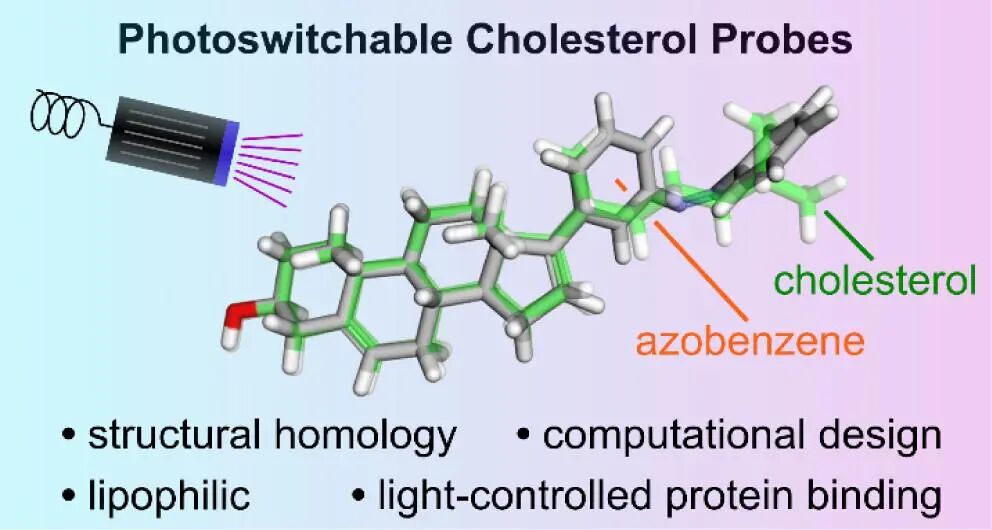
The authors proposed a novel design strategy for a photoswitchable cholesterol (photocholesterol, PChol): retaining the hydroxyl group at position 3 and the tetracyclic backbone structure of cholesterol, while replacing its natural isooctyl side chain with an azobenzene photoswitch unit. They evaluated the structural similarity of multiple PChol candidate molecules to cholesterol through computational simulations. The results showed that most PChol cis configurations are closer to the cholesterol structure than the trans configurations, suggesting they may exhibit better biological activity under illumination.
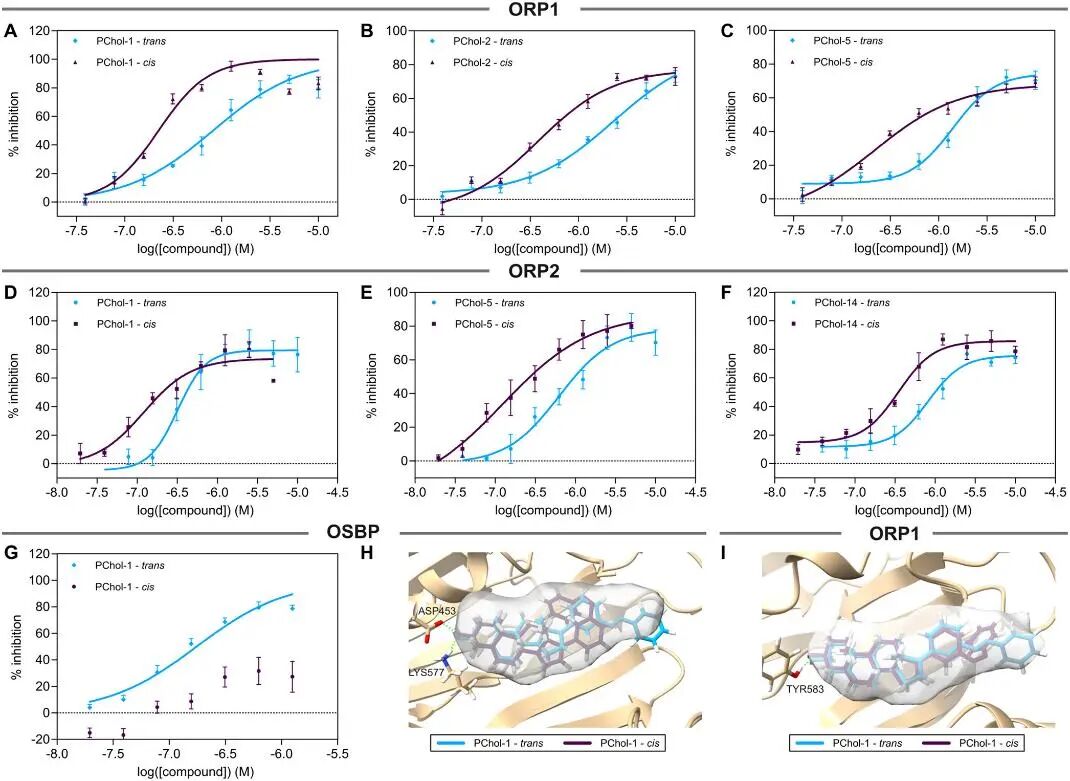
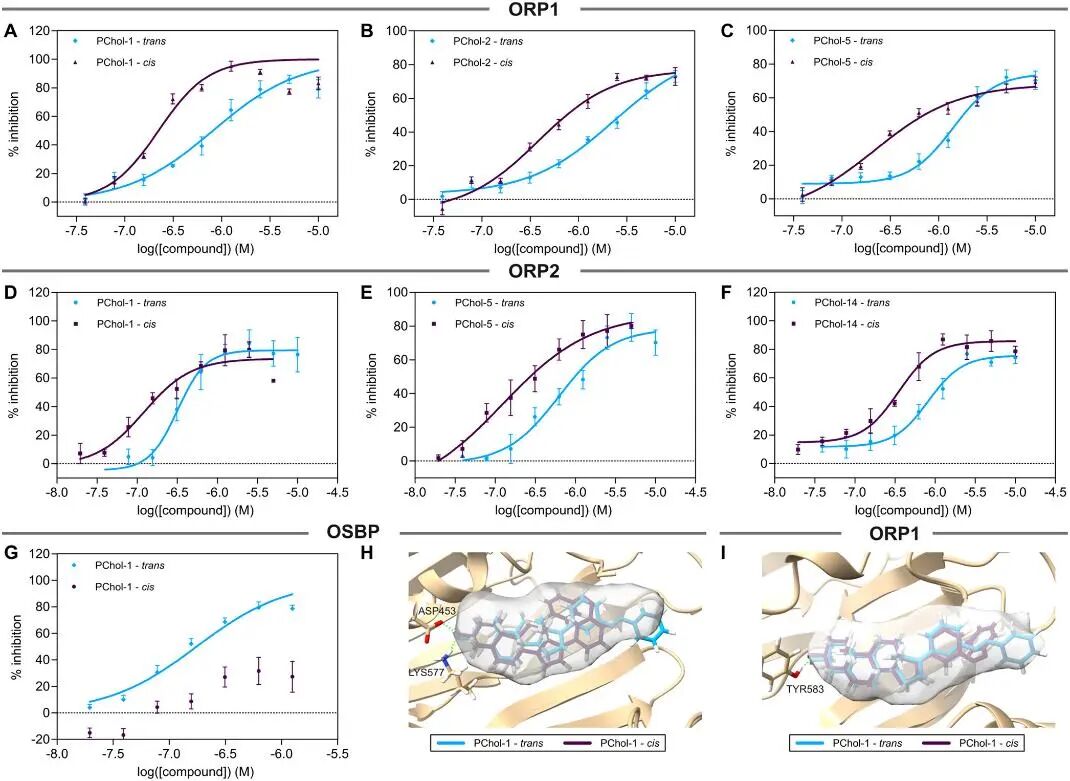
After successfully synthesizing PChol, the authors assessed the binding ability of PChols with cholesterol transport proteins ORP1, ORP2, and OSBP through fluorescence polarization experiments. The results indicated that several PChol exhibited potent inhibitory activity at nanomolar levels, with significant light-dependence in their activity. Among them, the IC50 of PChol-1 for OSBP was 175 nM in the trans configuration, while it was greater than 3000 nM in the cis configuration, showing a difference in activity of more than an order of magnitude. Additionally, PChol-2 showed high selectivity for ORP1, while exhibiting almost no activity against ORP2, demonstrating the potential for light-controlled selective regulation. Molecular docking further indicated that the orientation of PChol in the binding pocket is highly consistent with that of natural cholesterol.
In conclusion, the authors have developed a series of photoswitchable probes that structurally closely mimic cholesterol, providing highly selective light-controlled ligands for the study of cholesterol transport proteins, as well as novel molecular tools for photopharmacology and membrane biology research.
Article Author: ZBY
Editor: LYC
DOI: 10.1021/jacs.5c14582
Original Link: https://doi.org/10.1021/jacs.5c14582