
The higher-order structure is crucial for the function of biomacromolecules. It has been reported that “stapling” modifications can regulate the conformation of peptides to improve their pharmacological activity. Compared to peptides and oligonucleotides, there is a lack of research on the three-dimensional structure of polysaccharides, and there have been no reports on enhancing the binding ability of oligosaccharides to proteins through directed regulation of oligosaccharide structures. Recently, Peter H. Seeberger from the Max Planck Institute in Germany proposed a stapling modification strategy for β-(1,3)-glucans, simulating the naturally occurring triple helix structure by regulating its conformation. Compared to linear polysaccharides, stapled polysaccharides exhibit significantly enhanced binding ability to antibodies. This study provides new insights for the development of polysaccharide-based drugs and vaccines. The work is published under the title “Stapling of β‑Glucans Increases Antibody Binding” in JACS.
Naturally occurring long-chain glucans can form stable triple helix conformations and bind to antibodies, but artificially synthesized short-chain glucans have difficulty forming stable bindings with antibodies due to excessive conformational flexibility (Figure 1), severely limiting the development of polysaccharide-based diagnostic reagents and vaccines. Regulating the conformational space of oligosaccharides can alter their physicochemical properties. Currently, researchers have regulated the three-dimensional structures of peptides and short oligonucleotides in various ways, among which “stapling” modifications are a widely used strategy.
The functional group diversity of sugars is relatively low, with simple monosaccharides containing only primary and secondary hydroxyl groups, making stapling modifications challenging. After constructing the polysaccharide backbone through automated glycan assembly (AGA), functional group modifications of carbohydrate building blocks (BBs) are required to achieve stapling modifications. Inspired by the macrocyclic lactamization reaction of peptides, this paper designed two glucose building units: one with the hydroxyl group at the C6 position replaced by a protected amine, and the other with the hydroxyl group at the C6 position linked to a protected carboxyl group (Figure 2). The choice of modification at the C6 position is due to its orientation towards the exterior of the glucan helix. After constructing the polysaccharide backbone through AGA, the peptide chain can be extended from the amine through solid-phase peptide synthesis (SPPS), followed by macrocyclic lactamization to achieve polysaccharide stapling modifications. This strategy allows for the use of various amino acids to construct connecting arms, enabling diverse regulation of arm length, polarity, and even branching structures.
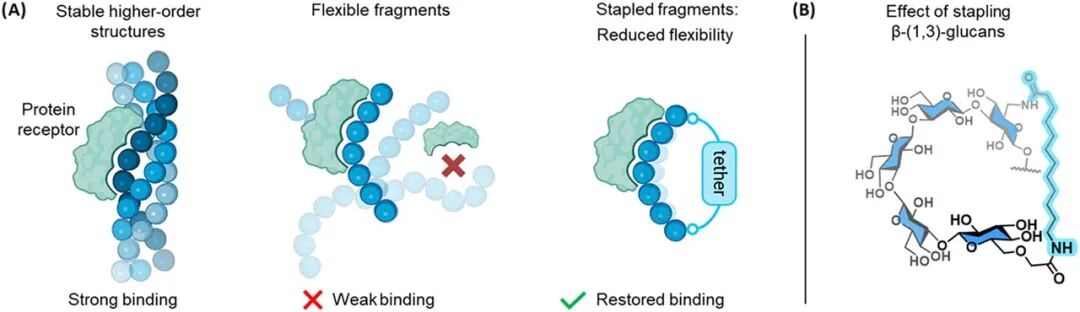
Figure 1
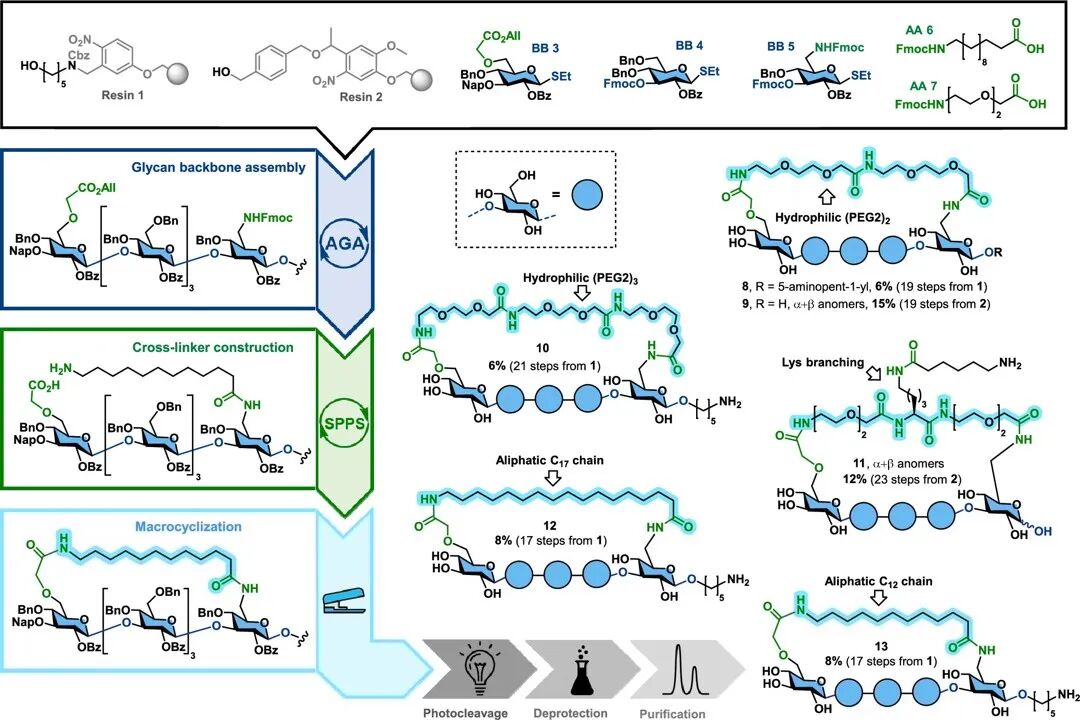
Figure 2
Atomic-level molecular dynamics simulations were conducted to study the impact of stapling modifications on the conformation of glucans. The results showed that the unmodified β-glucan pentamer primarily adopts an extended conformation, while stapling modifications can form a compact, curved glucan conformation (Figure 3).
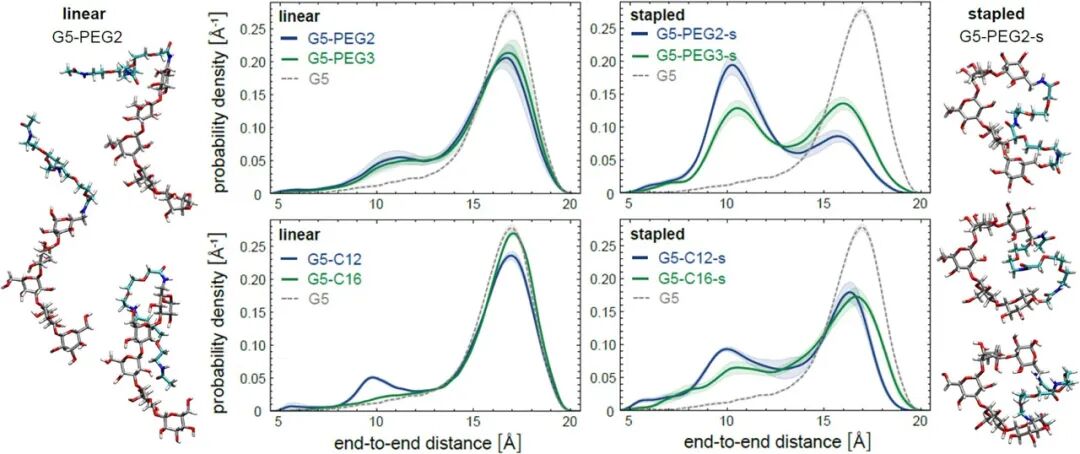
Figure 3
To verify whether the stapling modification of β-glucans can enhance their interaction with protein receptors, the authors employed glycan microarray experiments to screen the binding of two β-glucan antibodies. The results showed that both antibodies exhibited significantly stronger binding to the stapled structure compared to the unmodified polysaccharides (Figure 4). This highlights the importance of polysaccharide conformation in protein recognition and confirms that stapling modifications are an effective tool for regulating polysaccharide conformation.
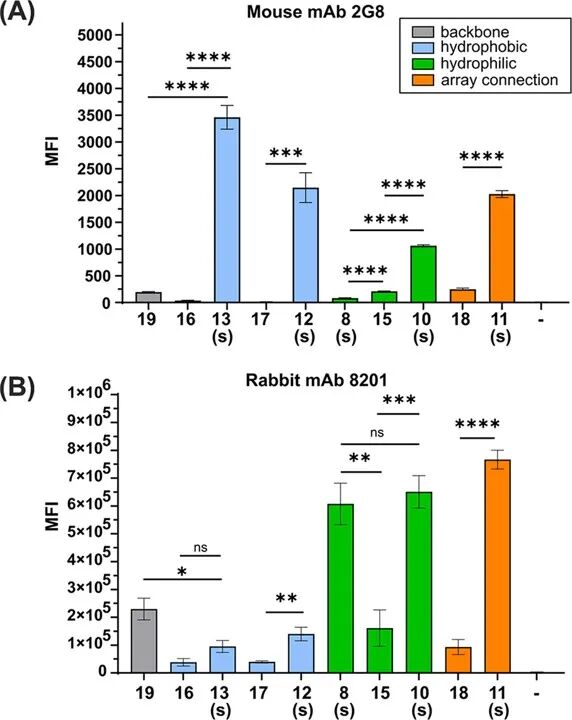
Figure 4
In summary, this study proposes a polysaccharide stapling modification strategy, with molecular dynamics simulations confirming that stapling modifications can alter the conformation of polysaccharides. Glycan microarray analysis indicates that polysaccharide stapling modifications can significantly enhance antibody binding ability. The polysaccharide stapling modification technology highlights the importance of conformational studies in the field of glycoscience, providing new directions for the development of polysaccharide-based drugs and vaccines.
【Article Link】
https://doi.org/10.1021/jacs.5c12690
【DOI Number】
10.1021/jacs.5c12690
【Author of the Post】

Li Wenzheng
Huang Shuo Research Group, PhD Student of 2024
———— /END / ————
Are you also interested in joining us for literature study? We warmly welcome you to submit articles to our public account. Please add the editor’s WeChat: jiafangwang2015 (note: public account submission) for consultation on submission matters.
Light up the “recommendation” so that more people can see it↓↓↓