SoC (System on Chip) is also known as a system-on-chip or SoC, and its architectural concept is illustrated in the figure below. The goal of SoC is to integrate the entire information processing system into a small chip, achieving specific system functions through the collaboration of hardware and software. Generally speaking, SoC has significant capabilities, encompassing almost the entire range of digital and analog circuit systems, and it comes with a complete control system and embedded software.
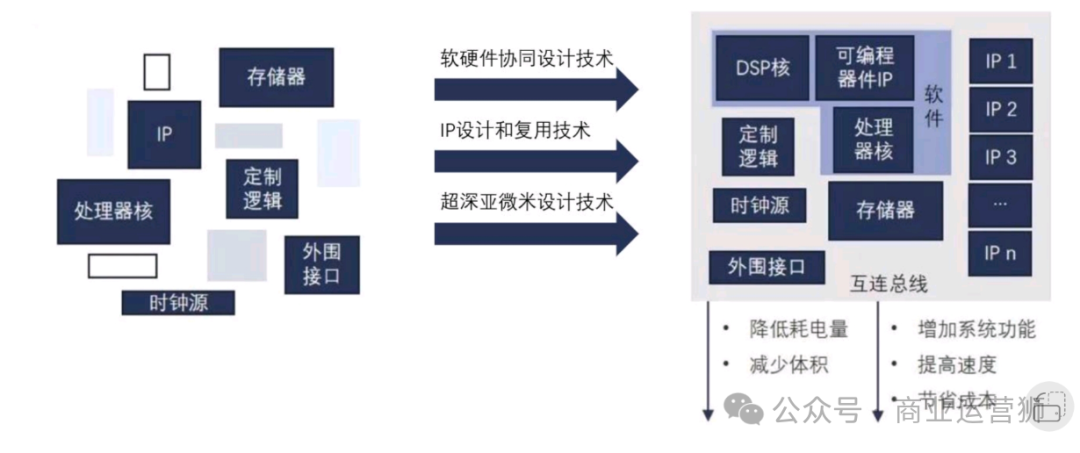
SoC chips have extremely high integration, typically incorporating core components such as CPU, GPU, and memory, with some also managing power supply and controlling external devices. Compared to traditional microprocessor systems, SoC has significant advantages in performance and power consumption, currently holding a dominant position in the terminal chip market, with its application territory continuously expanding.
Rockchip is the leading player in the domestic SoC chip market, with over 20 years of chip design experience. They have created a comprehensive family of processors covering all scenarios, from high-end flagship to machine vision and audio-specific chips, deeply rooted in popular fields such as smart cockpits, robotics, and industrial control. In terms of technology layout, they focus on “big audio, big video, big perception, and big software“, collaborating with major clients like BYD and Ecovacs to jointly promote industry intelligence upgrades.
Let’s take a look at their product line. Rockchip has established a complete chip hierarchy from high-end to mid-high-end, mid-range, and entry-level. The flagship RK3588 series (using 8nm process technology, with AI computing power reaching 6TOPS) has already been mass-produced in several smart cockpit models (such as GAC Haobo HL), with over 20 ongoing projects in full swing. The mid-high-end RK3576 chip can handle Transformer models, with power consumption as low as 1.2W, making it particularly suitable for applications such as lawn mowing robots.
They also have a “Ficus Strategy“, continuously upgrading their technology modules (self-developed IP). For example, the NPU can now support edge models at the level of 3B parameters, and the video processing IP has also achieved breakthroughs in multiple areas. They have also adopted a “Yin-Yang Complementary“ model, where the main SoC chip (Yang chip) collaborates with supporting chips for power management and wireless connectivity (Yin chips) to provide a complete solution.
1. Smart Application Processor Chips
In 2024, they are expected to achieve a revenue of 2.77 billion, a year-on-year increase of 45%. The main products include:
RK3588M: Flagship smart cockpit chip, already in mass production in models like GAC Haobo HL, supporting Android/Linux systems.
RK3576: Mid-high-end chip, with power consumption of only 1.2W, active in scenarios such as interactive large screens and cloud computers.
RK3506: Entry-level chip, supporting 1080P video processing and lightweight AI tasks, shining in applications like charging pile control and PLC controllers.
2.Mixed-Signal Chips
In 2024, they are expected to generate 280 million, a year-on-year increase of 55%. The flagship products include:
RK628F: High-performance video interface chip, providing stable signals.
RK960: Wireless connectivity chip, with excellent communication capabilities.
Power management chip: A perfect partner with the main control chip, optimizing energy consumption.
3. Other Chips
In 2024, they are expected to achieve a revenue of 50 million, a year-on-year increase of 193%. Highlight products include:
RK3399Pro: The main control brain for agricultural robots, supporting precise seeding and pesticide spraying.
RK3358M: In-vehicle instrument central control chip, supporting multi-screen display and Android/Linux systems.
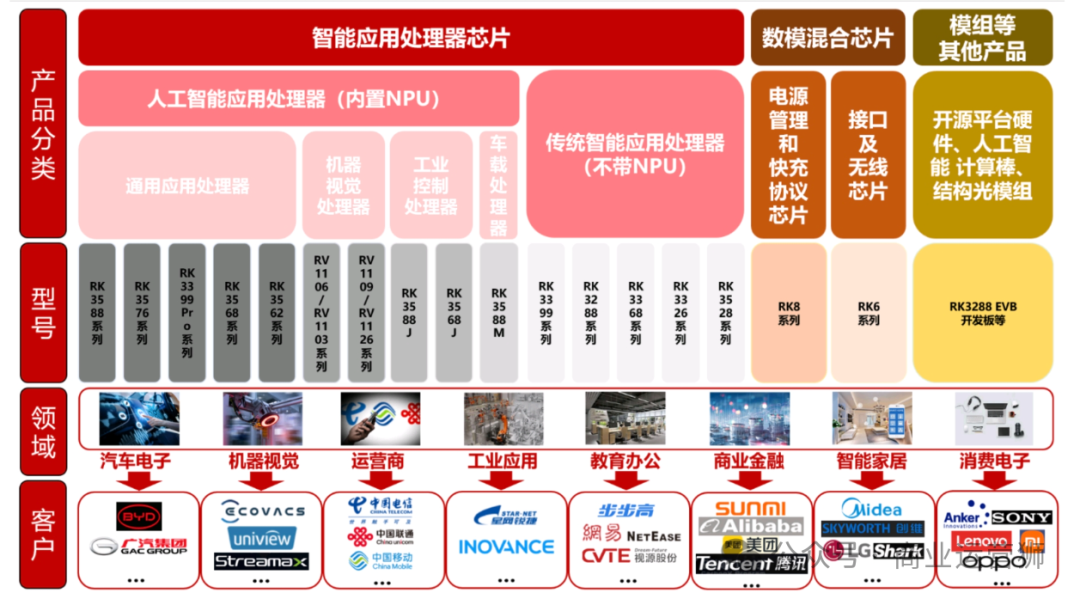
Now let’s take a look at the main industrial fields where their products excel:
1: Automotive Electronics
Smart Cockpit: In 2024, the global market size is expected to reach 366.8 billion (an annual increase of 16.3%), with China accounting for 129 billion (an annual increase of 22.27%). The RK3588M chip has already been mass-produced in over a dozen models, supporting Android/Linux, collaborating with automakers like GAC and SAIC, and partnering with companies like Zhonghong Technology and Qt Group to develop exciting virtualization multi-screen solutions.
In-vehicle Audio: It is expected that by 2025, the global shipment of in-vehicle audio chips will reach 150 million (an annual growth of 10%), with the localization rate increasing from 2% in 2022 to 35% by 2028.The RK2118M chip comes with an AI processor (NPU), supporting AI noise reduction and voice interaction, with over 20 ongoing projects in 2024.
2: Robotics
The Chinese robotics market is expected to reach 47 billion in 2024 (accounting for 40% of the global share), and is projected to reach 108 billion by 2028.
Industrial Robots: The RK3568J chip supports multi-axis control with ultra-fast response times (
10-50 microseconds).
Consumer Robots: In deep collaboration with Ecovacs, the RK3399/RV1108 chips drive high-end robotic vacuum cleaners, with global shipments expected to reach 5.096 million units in 2024, an increase of 11.9%.
Agricultural Robots: In collaboration with Lijun Technology, they launched the RK3399Pro solution, injecting technological power into agriculture.
3.Machine Vision
The RV1126B chip’s computing power has been upgraded to 3TOPS, supporting the AI-ISP architecture, active in scenarios such as power inspection and security warning. Although the global machine vision market size for 2024 is not explicitly stated, Rockchip’s RV series chips have comprehensively covered industrial, consumer, and special scenarios, with a high technical threshold.