Welcome FPGA engineers to join the official WeChat technical group.
Clickthe blue textto follow us at FPGA Home – the largest and best pure FPGA engineering community in China.

In the past month, the FPGA market has been booming. In this article, we will briefly examine the three latest released FPGAs from Xilinx, Intel, and Lattice.
Each of these FPGAs focuses on different aspects of performance enhancement: Xilinx VU57P attempts to overcome memory bandwidth challenges in demanding applications. Intel’s Stratix 10 NX FPGA integrates AI-optimized DSP modules to help implement large AI models with low latency. Moreover, Lattice’s Nexus FPGA aims to redefine low power and small size for FPGAs.
Xilinx VU57P FPGA — High Bandwidth Memory
Over the past decade, computational bandwidth in many application areas has grown exponentially. For example, the number of DSP slices provided by Xilinx FPGAs for machine learning applications has increased from about 2,000 slices in the largest Virtex 6 FPGA to about 12,000 slices in modern Virtex UltraScale + devices. As shown below, a similar trend has been observed in other application areas such as networking technology and video applications.
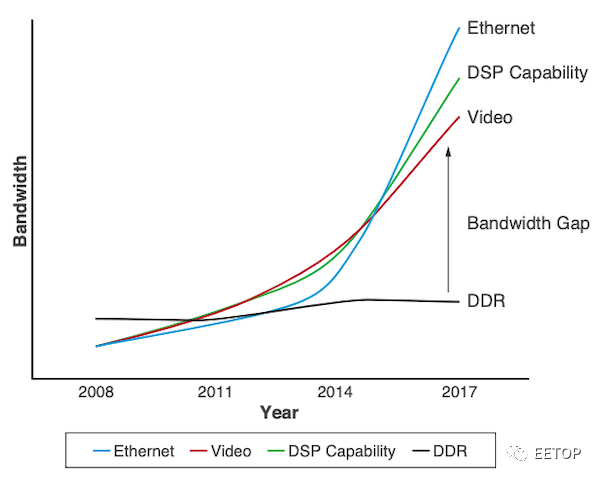
Memory Bandwidth Requirements
The above figure shows that over the past decade, the memory bandwidth of DDR technology has only slightly increased—from DDR3 to DDR4, it has roughly doubled. (It is worth noting that the leap from DDR4 to DDR5 may be more impactful.)
The bandwidth gap in the figure indicates that the limited data transfer rate between the FPGA and memory is a bottleneck in these applications. To address this issue, designers often parallel multiple DDR chips to increase memory bandwidth (not necessarily memory capacity). However, this approach becomes unusable when memory bandwidth exceeds about 85GB/s due to high power consumption, size, cost issues, and PCB design challenges.
Additionally, an effective solution to the memory bandwidth problem is a type of memory based on DRAM, known as High Bandwidth Memory (HBM). In this case, silicon stacking technology can be used to implement DRAM memory and FPGA within the same package, as shown in the figure below.
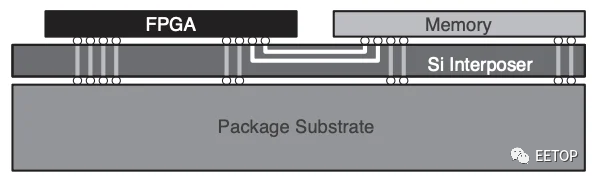
Silicon stacking helps to parallelly implement DRAM memory and FPGA
HBM technology allows us to eliminate the relatively long PCB traces connecting DDR chips to the FPGA. Using integrated HBM interfaces with a large number of pins can significantly increase memory bandwidth, with latency similar to DDR-based technologies.
Xilinx recently released the VU57P FPGA (from the Virtex UltraScale + series), which integrates 16 GB HBM and up to 460GB/s of memory bandwidth. This device features an integrated AXI port switch that allows us to access any HBM memory location from any memory port.
In addition to the energy-efficient computing capabilities and large memory bandwidth discussed above, the VU57P also offers high-speed interfaces such as 100G Ethernet with RS-FEC, 150G Interlaken, and PCIe Gen4. The new device’s 58G PAM4 transceivers support connections to the latest optical standards. This is useful in various applications, such as next-generation firewalls and switches and routers with QoS.
Intel Stratix 10 NX FPGA — AI-Optimized DSP Modules
Many conventional applications of Digital Signal Processing (DSP) require high-precision arithmetic. This is why FPGAs often have DSP modules with high-precision multipliers and adders. For example, the XC7A50T (Xilinx) and 5CGXC4 (Intel) have 120 and 140 18×18 multipliers, respectively.
It has been shown that many deep learning applications can be implemented using fewer bits without significantly sacrificing accuracy. Lower precision approximations reduce the number of computational resources and the required memory bandwidth.
Another advantage of reducing bit width is that lower precision calculations and fewer bits need to be transferred per memory transaction can save power consumption. In fact, according to UC Davis researchers, in many deep learning applications, INT8 or even lower precision calculations can yield acceptable results.
The Intel Stratix 10 NX FPGA is Intel’s first AI-optimized FPGA. These devices integrate arithmetic blocks called AI Tensor Blocks, which contain dense arrays of low-precision multipliers. The basic precision of these blocks is INT8 and INT4, although they support hardware support for FP16 and FP12 numerical formats through shared exponents.
Compared to the DSP modules of the standard Intel Stratix 10 FPGA, the AI Tensor modules (used in the Stratix 10 NX FPGA) can achieve a 15-fold increase in INT8 throughput. The block diagram of the AI Tensor Block is shown below.
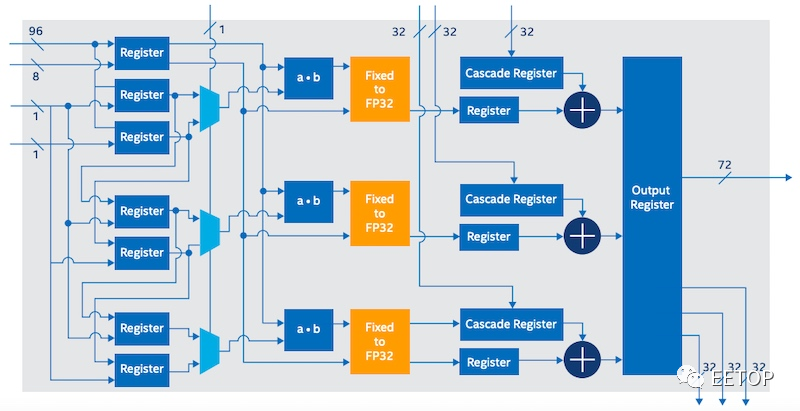
Block diagram of the AI Tensor Block
The most significant feature of the Intel Stratix 10 NX FPGA is the high computational density provided by the AI-optimized computing blocks. However, the new device also integrates two additional features that further assist designers in implementing large AI models with low latency: it supports rich approximate computing memory (integrated HBM) and high bandwidth networking (up to 57.8 G PAM4 transceivers).
Lattice Nexus — Low Power, Small Size FPGA
Lattice Semiconductor recently released its Certus-NX FPGA series, which utilizes 28nm fully depleted silicon-on-insulator (FD-SOI) process technology. FD-SOI was initially developed by Samsung and is somewhat similar to traditional CMOS technology. However, as shown in the figure below, it provides programmable bias for most transistors.
Lattice Semiconductor recently released its Certus-NX FPGA series, which adopts 28nm fully depleted silicon-on-insulator (FD-SOI) process technology. FD-SOI was initially developed by Samsung and is somewhat similar to traditional CMOS technology; however, it can provide programmable bias for most transistors, as conceptually illustrated below.
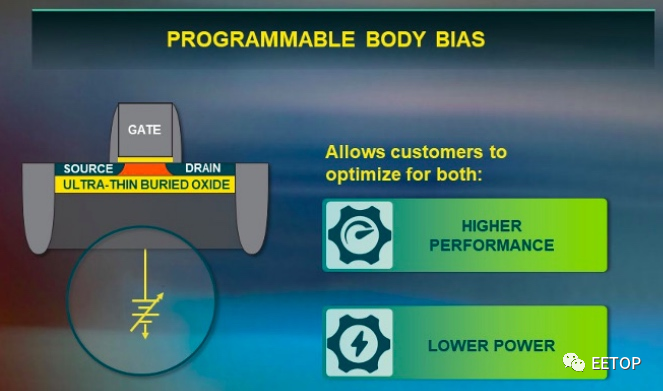
Circuit architecture of the Lattice Nexus platform
The programmable buck voltage significantly reduces chip area and power consumption. Compared to other FPGAs with a similar number of logic units, the Certus-NX’s power consumption is reduced by up to four times.
Due to the use of FD-SOI technology, the new device can be as small as 6mm x 6mm, offering up to twice the I/O per mm² compared to similar FPGAs. The table below compares the Certus-NX-40 with similar products from Intel and Xilinx.
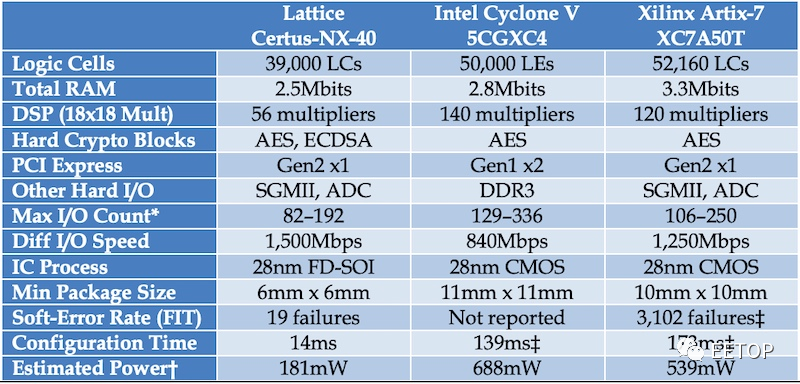
Comparison of three popular FPGAs for PCIe design
It is worth noting that the new device supports AES for bulk encryption and elliptic curve (ECDSA) for authentication. Therefore, it can provide higher security for connected devices. Additionally, it has high resistance to soft errors, making the device suitable for aerospace applications.
FPGA Development Trends
By studying the latest released FPGAs from Xilinx, Intel, and Lattice Semiconductors, we can gain a clearer understanding of the direction of FPGA development—focusing on higher memory bandwidth, AI optimization, low power consumption, and small size.

Welcome engineers in FPGA, embedded systems, signal processing, etc. to follow our public account.

The Largest FPGA WeChat Technical Group in the Country
Welcome everyone to join the national FPGA WeChat technical group, which has tens of thousands of engineers, a group of technology-loving engineers, where FPGA engineers help each other and share knowledge, creating a strong technical atmosphere!Hurry up and invite your friends to join!!

Press and hold to join the national FPGA technical group.
FPGA Home Components Chip City
Advantageous component services, please scan the code to contact the group owner: Jin Juan Email: [email protected] Welcome to recommend to buyers.
ACTEL, AD partial advantageous orders (operating the full series):
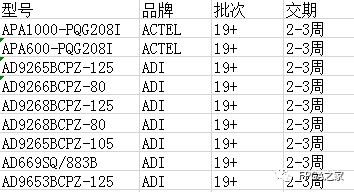
XILINX, ALTERA advantageous stock or orders (operating the full series):
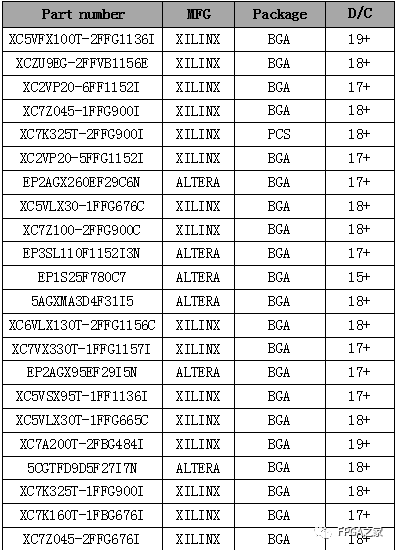
(The above devices are part of the models, for more models please consult the group owner Jin Juan)
Service philosophy: FPGA Home Components self-operated Chip City aims to facilitate engineers to quickly and conveniently purchase components. After years of dedicated service, our customer service covers large listed companies in China, military research units, and small and medium-sized enterprises. Our greatest advantage is emphasizing the service-first philosophy and achieving fast delivery and favorable prices!
Directly managed brands: Xilinx ALTERA ADI TI NXP ST E2V, Micron, and more than a hundred component brands, especially skilled in components subject to US export restrictions.We welcome engineering friends to recommend us to buyers or consult us directly!We will continue to provide the best service in the industry!

Official acknowledgment of FPGA technology group brands: Xilinx, Intel (Altera), Microsemi (Actel), Lattice, Vantis, Quicklogic, Lucent, etc.