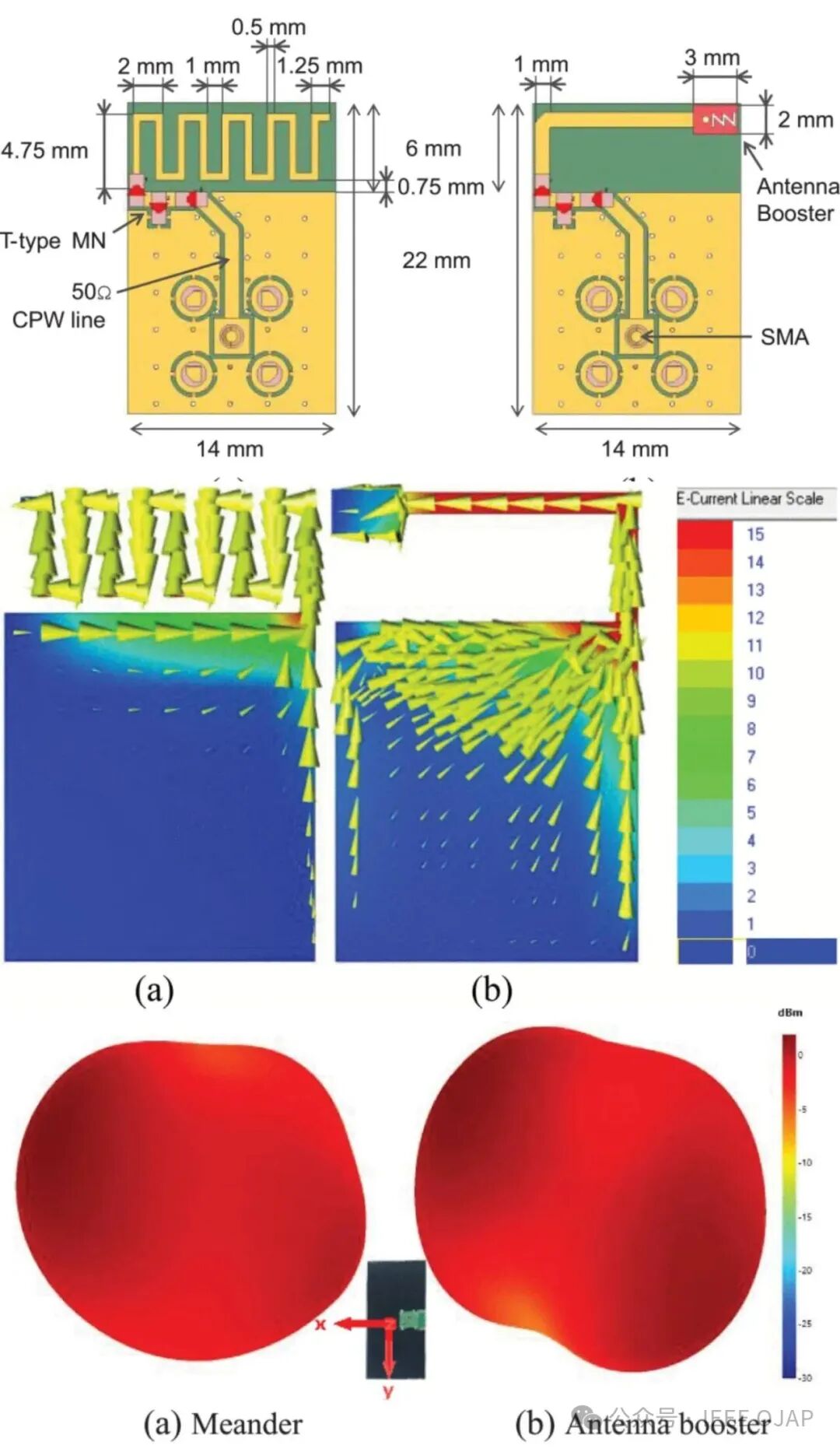
Alejandro Fernández, Mireia Vera, Jose Luis Pina, Aurora Andújar Linares, and Jaume Anguera compared a common meandered antenna with an antenna amplifier in a 21×14 mm module. Additionally, since the final position and size of the module on the device have not yet been determined, both modules were evaluated at four different positions on the device (bottom left, center of the short edge, bottom right, center of the long edge), using printed circuit board (PCB) sizes of 50×50 mm, 75×50 mm, and 100×50 mm. The module antenna system should be robust enough to cover the 2.4-2.484 GHz band in all 12 configurations without changing the antenna geometry and/or matching network, as once certified, the bill of materials (BoM) for the module cannot be altered.
Read link: https://ieeexplore.ieee.org/document/11008543
Abstract: “The Bluetooth standard is widely used in the Internet of Things (IoT) and other wireless devices, often embedded in modules for ease of use, better integration into designs, and certification. In this paper, a common meandered antenna is compared with an antenna amplifier in a 21×14 mm module. Furthermore, since the final placement and size of the module on the device have not been determined, evaluations were conducted at four different positions on the device (left corner, center of the short edge, right corner, center of the long edge) for three different sizes of printed circuit boards (PCBs) (50×50 mm, 75×50 mm, and 100×50 mm). The module antenna system must be robust enough to cover the 2.4 – 2.484 GHz band in all 12 configurations without changing the antenna geometry and/or matching network, as once certified, the bill of materials (BoM) cannot be altered. This ensures optimal antenna performance regardless of its position. The results indicate that the performance of the antenna amplifier outperforms the meandered antenna at all four module positions, with an average total efficiency increase of 2 decibels, a coverage increase of 1.7 times, and greater adaptability of the module position on the PCB.”