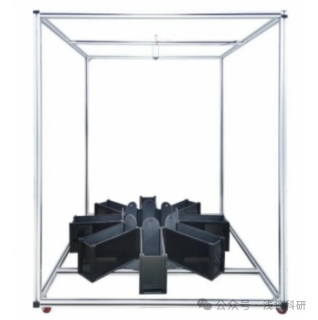
Experimental Principle:
The principle of the Eight-Arm Radial Maze experiment involves animals using the location information of distal markers within the maze to find the arm where food is placed, thereby studying the animals’ spatial reference memory and working memory. It is particularly noteworthy that some drugs affecting hypothalamic function or causing appetite suppression may influence the animals’ motivation to eat in the maze experiment, making it difficult for them to successfully complete the maze task.
Applicable Diseases:
The Eight-Arm Radial Maze experiment is widely used to study neural and psychiatric disease models involving spatial memory and learning abilities, particularly in cognitive impairment models.
Reagents and Consumables:
Experimental Equipment:
1.Mice (test mice and control mice, with detailed strain information)
2.Weighing scale
3.Eight-Arm Maze: consisting of a central area and eight arms, each equipped with a food reward point
4.Visual cues: placed around the maze to provide additional spatial orientation information
5.Camera: used to record the behavior of mice in the maze
6. VisuTrack animal behavior analysis software
7.Eight-Arm Maze container: to prevent mice from escaping
8.Laboratory temperature and humidity control equipment
Preparation Work:
Animal Adaptation: Before the experiment begins, the experimental animals undergo a one-week adaptation training, allowing them to familiarize themselves with the laboratory environment and the structure of the Eight-Arm Maze. During the adaptation period, no food rewards are set, and animals are allowed to freely explore the maze.
Fasting Treatment: One day before the experiment begins, weigh the experimental animals and fast them for 24 hours. During the experiment, maintain the animals’ weight at about 85% of their pre-fasting weight to ensure they have sufficient motivation to eat.
Maze Setup: Ensure the Eight-Arm Maze is clean and odor-free, and randomly select 4 arms to place food rewards according to the experimental design. The visual cues around the maze should remain fixed to allow animals to use these cues for spatial orientation during the experiment.
Experimental Procedure and Specific Steps:
Adaptation Phase:
Day 1: Place each experimental animal in the central area of the maze one by one, allowing them to freely explore the maze for 5 minutes. No food rewards are set during this phase, allowing the animals to adapt to the maze environment.
Day 2: Repeat the operation of Day 1, ensuring the animals are familiar with the maze structure and surrounding visual cues.
Foraging Training:
Days 3-17: Begin foraging training. Place food rewards in the randomly selected 4 arms and turn on the lights for these arms. Place the animals in the central area of the maze and record the arms and order in which the animals enter. The experiment ends and results are recorded when the animals enter the 4 illuminated arms, eat a total of 8 food pieces (2 pieces per arm), or stay in the maze for more than 10 minutes without completing the task. If the animals choose unlit arms, it is considered an entry error. Different sets of 4 arms are randomly selected for training each day.
Exploration Training:
Days 18-20: Conduct exploration training. After placing food in one randomly selected arm and illuminating it, place the animals in the maze. After the animals enter the illuminated arm and eat the food, turn off the light for that arm and immediately randomly select another arm to place food. Complete the exploration task for 8 illuminated arms, with each selected illuminated arm being random. If the animals choose unlit arms, it is recorded as an entry error.
Precautions:
1. The radial maze equipment and experimental procedures used for mice are similar to those for rats, but the specifications of the maze should be smaller than those for rats to reduce the difficulty of behavioral operations for mice.
2. This experiment can also be used solely to test working memory. The only difference is that food is placed in all radial arms instead of just in 4 arms.
3. Chronic stress may affect the animals’ operations in the maze, and there are gender differences. Male rats that have experienced chronic stress may exhibit weakened memory, indicated by an increased error rate; however, their spatial memory may be enhanced, indicated by a decreased error rate.
4. Even under restricted feeding conditions, ensure that the rats gain at least 5 grams per week to avoid diseases caused by malnutrition. Animals in poor physical condition should be excluded.
5. Any items around the maze may be used by the animals as spatial orientation markers. Removing or moving these markers may make it difficult for the animals to operate and reduce the accuracy of arm selection in the maze.
6. The number of arms in the Eight-Arm Maze can vary depending on the experimental purpose, including 8, 16, 24, 32, 40, and 48 arms. The fewer the arms in the maze, the lower the memory requirements for the animals, making operations easier. Typically, an 8 arm maze is used to reduce unnecessary interference and shorten training and testing time.
7. The food used is usually small pieces of chocolate-flavored (one of the preferred flavors for animals) or sweetened breakfast cereal (each piece 10 mg); liquid food (such as chocolate milk or water) can also be used. The latter is particularly suitable for testing certain drugs that affect the animals’ ability to swallow solid food.
8. The two main factors affecting the animals’ operations in the maze are fear of the maze or the observer and the animals’ exploratory habits and the drive for known food in the maze. Excessive fear may prevent the animals from operating in the maze, causing them to stay in one place instead of exploring. A lack of desire for food can produce similar results. Increasing handling of the animals and, if necessary, raising the side walls of the maze arms can help reduce the animals’ fear. If the drive for food is insufficient, the amount of food can be reduced, but body weight and general physical condition must be monitored simultaneously. Generally, the weight of rats should not be less than 80% of their pre-fasting weight; a weight loss of 15% is acceptable for most rats.
9. Unlike the water maze, the radial arm maze is suitable for repeated testing or long-term memory testing. Working memory is generally considered to represent short-term memory, while reference memory represents long-term memory.
10. If animals have motor issues but can still choose arms, this test can be used to differentiate between motor disorders and spatial learning abilities.
11. Since experimental animals cannot spontaneously complete maze tasks, pre-training is required to extend the entire experimental period.
12. To stimulate animals to actively search for arms containing food during the experiment, mild fasting must be conducted during the experimental period.
Common Questions and Solutions:
1. Why are animals uninterested in food or taking too long to eat??
Answer: There was no prior fasting for 24 hours, and the food particles were too large, affecting the experimental results. Fast the animals for 24 hours and control the size of food particles to a diameter of 4-5mm to facilitate fasting without wasting too much time affecting the experimental results.
2. Why are animals not moving or exploring in the maze?
Answer: It may be due to not being gentle enough when placing the animals or environmental noise and other influencing factors, or the scent of the previous batch of animals has not been cleaned, causing stress behavior in the animals.