How FPGA Technology Ignites the Low-Power Revolution in Edge AI?
90% of smart devices still rely on cloud processing for data, and the power consumption bottleneck of local AI inference is becoming the biggest obstacle to the implementation of edge computing. However, a quiet revolution is underway—FPGA, with its dynamically reconfigurable circuits and parallel computing architecture, can improve energy efficiency by over 30%, enabling smartphones, robots, and sensors to make real-time decisions with low power consumption. When industrial predictive maintenance no longer needs to wait for cloud responses, and when smartphones can instantly complete complex image recognition, this is not just an upgrade of chips, but a turning point for smart terminals from “passive execution” to “autonomous thinking.” As the layout of 6G accelerates, FPGA is deeply integrated into the edge AI ecosystem, promoting seamless collaboration between ultra-low latency and local inference. This article will analyze how FPGA reshapes the intelligent future of personal devices and industrial systems, unveiling the underlying logic of the low-power AI revolution.
▸ The Starting Point of Edge AI: Low-Power Bottlenecks and Real-Time Demands
Smart rings sensing emotional fluctuations and smart glasses translating street signs in real-time—these devices are transitioning from data collection to local decision-making. By completing AI inference at the terminal, they achieve millisecond-level responses while avoiding the upload of private data to the cloud, highlighting the core value of edge AI in making terminals truly intelligent.
However, the cost of intelligence cannot be ignored. Multimodal AI needs to process visual, auditory, and physiological signals simultaneously, which is computationally intensive and power-hungry, while wearable devices are limited in size, leaving very little room for battery expansion. Multiple user surveys indicate that many users report that mainstream AI wearable devices struggle to support all-day use, often requiring the disabling of real-time monitoring functions to extend standby time, leading to frequent interruptions in the intelligent experience.
Smart homes face similar challenges. Cameras equipped with edge AI can recognize user actions upon returning home and automatically adjust the environment, but continuous model operation can lead to device overheating and increased power consumption. Manufacturers are often forced to reduce algorithm complexity or decrease inference frequency, making “intelligence” a sporadic response, difficult to achieve always-on proactive service.
The contradiction between real-time performance and low power consumption has become a key constraint for the implementation of edge AI, permeating wearable, home, and industrial terminal scenarios. Only by achieving breakthroughs in energy efficiency without sacrificing response speed can devices transition from “limited intelligence” to “sustained proactive intelligence.” This challenge is driving collaborative innovation in chip architecture and algorithms, such as Qualcomm’s Snapdragon edge AI chip, which is set to triple energy efficiency by 2025, and Horizon’s practical implementations in algorithm compression and scheduling optimization. As storage-compute integrated chips enter mass production, low-power, high-performance edge AI is accelerating towards reality.
▸ FPGA: The Low-Power Core Engine of Edge Computing
When your smartwatch monitors heart rate while also recognizing voice commands, the energy consumption pressure on the chip increases exponentially. In the face of this reality of parallel multitasking, FPGA, with its reconfigurable hardware architecture, is becoming the key to solving the energy efficiency dilemma of edge AI. Unlike traditional chips with fixed circuits, it can dynamically adjust internal logic based on specific tasks, allocating computational power where it is needed, thus significantly reducing ineffective power consumption while maintaining high performance.
The core of this capability lies in its inherent advantage of parallel processing. Taking the XMOS xcore.ai software-defined SoC as an example, it adopts a multi-core real-time architecture that can simultaneously process audio, image, and sensor data streams. Voice wake-up and image recognition are no longer alternating tasks but run truly in parallel, eliminating the delays and energy consumption caused by frequent context switching in traditional processors. More importantly, data fusion inference can be completed locally without repeatedly uploading to the cloud, shortening response times and reducing power consumption from communication, making it particularly suitable for industrial control, remote healthcare, and other scenarios with high real-time requirements.
Compared to ASICs and GPUs, FPGA finds a better solution between flexibility and energy efficiency. While ASICs are highly efficient for specific tasks, they face the awkward situation of being “useless” once algorithms are upgraded; GPUs have strong computational capabilities but consume too much power, making them difficult to adapt to the power supply limitations of edge devices. FPGA supports dynamic hardware optimization after model iteration through field programming. For example, Microchip Technology’s PolarFire FPGA series adopts a non-volatile architecture based on Flash and antifuse, significantly reducing static power consumption under typical edge loads. According to official data, its total power consumption can be reduced by up to 50% compared to similar SRAM-based FPGAs, making it particularly suitable for applications in automotive and industrial environments with strict heat dissipation requirements.
This feature is giving rise to a new generation of smart terminals. Medical manufacturers have developed prototypes of multimodal health monitoring systems based on PolarFire, capable of synchronously analyzing heart rate, movement status, and environmental sounds to assess whether users are experiencing fatigue or potential health risks in real-time. When the system detects signs of abnormal heart rhythms, it immediately alerts users to pause intense activities. This transition from “recording data” to “proactive warning” relies on FPGA’s unique advantages in low-latency processing and multi-protocol integration, effectively breaking through the performance bottlenecks of traditional chips in multi-source information fusion.
FPGA, through hardware-level parallelism and dynamic resource allocation, not only alleviates the power consumption challenges of edge AI but also expands the intelligent processing capabilities of terminal devices. Currently, this technology is accelerating its implementation in automotive electronics, industrial IoT, and other fields. Both Microchip and XMOS support the deployment of lightweight AI frameworks such as TensorFlow Lite Micro, and their development toolchains Libero SoC and xTIMEcomposer have achieved ONNX model import and hardware mapping, making edge intelligence more efficient and autonomous.
FPGA Edge AI Multimodal Data Parallel Processing Flow
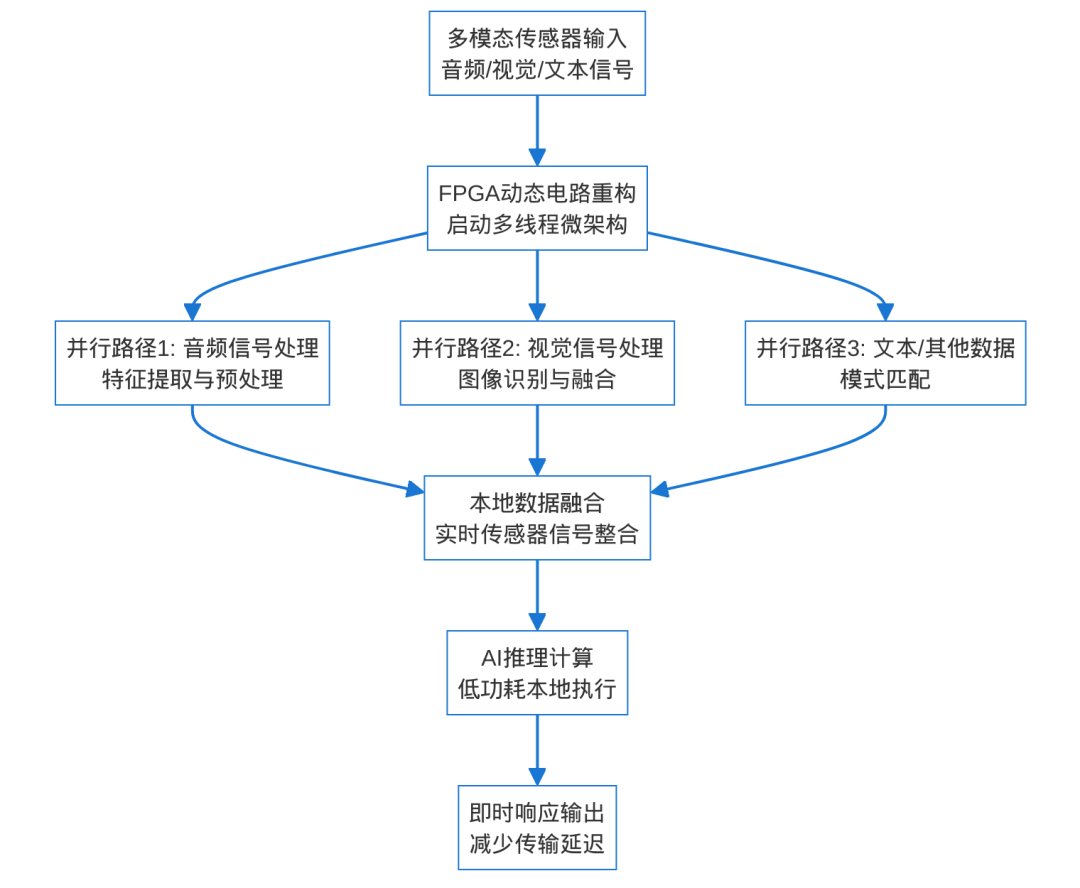
This diagram illustrates how FPGA achieves real-time fusion of sensor signals and AI inference through a multithreaded microarchitecture (such as the 16 logical cores of XMOS xcore.ai), emphasizing how parallel paths reduce latency and energy consumption, suitable for wearable devices and industrial scenarios; compared to the single path of traditional ASIC/GPUs, this process optimizes resource allocation and avoids the waste of multitasking switching.
▸ Breakthroughs in Personal Terminal Energy Efficiency: From Smart Wearables to Digital Companions
The flexible hardware architecture of FPGA is quietly changing the capability boundaries of personal terminals. In smartwatches, rings, and glasses, it enables the efficient operation of multimodal AI—intelligent systems that process sound, images, and motion signals simultaneously—through dynamically reconfigurable circuits. Not only is it fast, but it is also energy-efficient. This localized real-time processing capability allows devices to no longer just passively execute commands but to actively understand your state and make judgments.
Taking the XMOS xcore.ai SoC as an example, this chip has 16 logical cores that can process audio, image, and sensor data in parallel, avoiding the energy waste caused by frequent task switching in traditional processors. This year, three wearable devices equipped with xcore.ai have been launched, including the new smart ring from Oura, which uses an FPGA+AI architecture to continuously analyze heart rate variability, body micro-movements, and environmental sound spectra, accurately identifying whether the user is in light sleep, deep sleep, or REM stage. The entire process does not require internet connectivity, and all calculations are completed on the device. The next morning, users can open the app to view detailed distributions of their sleep cycles and recovery suggestions from the previous night.
As the complexity of sensor fusion increases, FPGA’s advantages in visual terminals become even more pronounced. Smart glasses using PolarFire FPGA, according to Microchip’s 2024 Q3 technical white paper, have static power consumption reduced by about 40% in typical scenarios compared to similar SRAM-based FPGAs, significantly extending standby time. More importantly, they can locally fuse voice commands and real-time images; for example, when a user says “replan route,” the system immediately overlays navigation prompts in their field of vision, without relying on the cloud throughout the process. This instant feedback not only enhances travel efficiency but also makes interactions safer and more coherent.
This localized intelligence is gradually expanding into more life scenarios. The optimization path of FPGA in personal terminals not only expands application scenarios through multimodal fusion but also achieves continuous intelligent services through efficient resource management. From monitoring sleep to real-time navigation, these devices are building a trustworthy interaction loop with local AI, providing millisecond-level responses while protecting privacy. For instance, in fitness scenarios, devices can analyze motion posture in real-time and provide corrective suggestions, making training safer and more efficient. According to Counterpoint’s Q2 2025 research report, the shipment volume of edge AI wearable devices is expected to reach 180 million units by 2025, with an annual growth of 23%. As the demand for edge computing rises, FPGA architecture is expected to penetrate more portable terminals, promoting the relationship between humans and machines from “tool usage” to “intelligent collaboration”—making digital companions truly natural, private, and always online.
FPGA-optimized smart ring sleep monitoring data processing flow

This flowchart demonstrates how FPGA achieves real-time fusion and parallel acceleration of multimodal data, ensuring low-latency analysis under low power consumption, allowing users to obtain personalized sleep reports through the app, including REM phase assessments and recovery suggestions. This design highlights the transition from passive recording to proactive health guidance.
▸ Intelligentization of Industrial Equipment: FPGA Drives the Implementation of Edge AI
When robots in factories no longer just act according to programs but can “see” deviations, “hear” abnormal sounds, and “think” of countermeasures, the boundaries of intelligent manufacturing are redefined. Behind this, FPGA is becoming the core engine for the implementation of edge AI. With its dynamic reconfiguration and parallel processing capabilities, it enables devices to complete the closed loop of perception, decision-making, and execution in milliseconds.
Andes Technology’s FPGA solution has been embedded in AI fiber industrial cameras, running real-time filtering and defect enhancement algorithms, allowing robots to accurately locate object coordinates within milliseconds. This not only improves the response accuracy of welding and assembly lines to the micron level but also avoids downtime losses caused by delays. Compared to the overhead of traditional CPUs frequently switching tasks, FPGA maintains stable low latency even in high-concurrency scenarios, allowing multiple robots to collaborate seamlessly on dynamic production lines.
The next step in intelligentization is to move from individual intelligence to system collaboration. Microchip Technology’s PolarFire FPGA, in conjunction with NVIDIA’s Holoscan platform, can fuse image and vibration data through the MIPI CSI-2 interface to locally identify early fault features such as bearing wear and temperature anomalies. Factories can run predictive maintenance models without uploading data to the cloud. According to Q4 2024 test data, the accuracy of fault identification has improved by over 40%, and the maintenance model has shifted from “repair when broken” to “prevent before it breaks.”
The PolarFire series adopts a Flash-based architecture, with power consumption reduced by nearly 50% compared to similar products (according to technical materials published by Microchip), providing a sustainable foundation for high-density deployment. Its universal development toolchain, Libero SoC, supports ONNX model import, allowing the same AI model to be quickly deployed on smart rings for sleep monitoring and migrated to industrial controllers for production line monitoring, shortening deployment cycles by more than half.
As the development of 6G progresses and distributed AI architecture is explored, the role of FPGA will further upgrade. It not only makes individual devices smarter but also connects the physical production line and digital twin systems through high-precision timing control and heterogeneous protocol conversion, achieving millisecond-level synchronization. This connection is gradually bringing the concept of “virtual-real symbiosis” in factories closer to reality.
FPGA-Driven Industrial Robot Real-Time Object Positioning Sequence
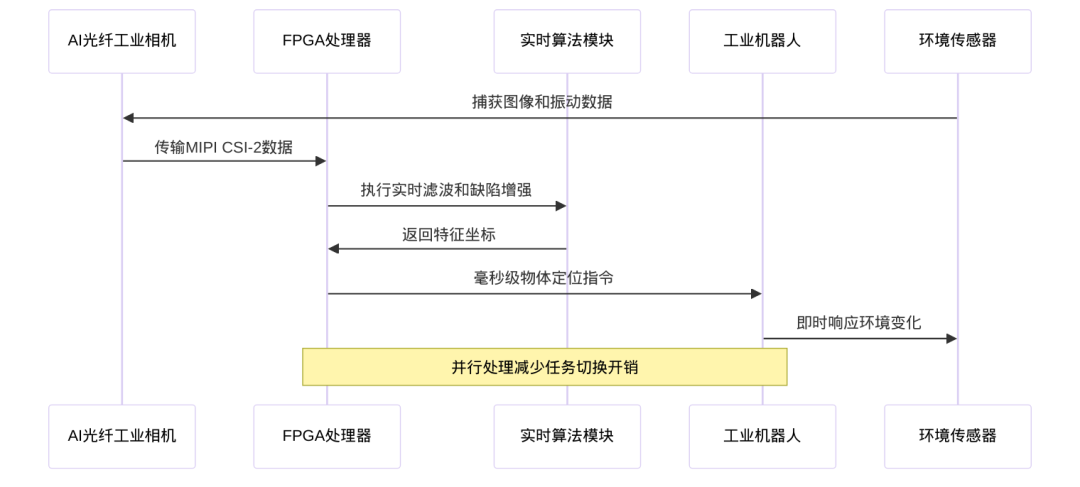
This diagram illustrates the interaction process of Andes Technology’s FPGA solution in AI fiber industrial cameras: from environmental data collection to millisecond-level response, helping to understand how parallel processing reduces delays and production interruptions, supporting the trend analysis of precise collaboration among robots in this chapter.
▸ The Eve of 6G: FPGA Opens a New Phase for Edge AI
As 6G compresses end-to-end latency to 0.1 milliseconds, can traditional computing architectures still bear the burden of real-time decision-making? According to the International Telecommunication Union (ITU), 6G may achieve commercial use around 2030 and is currently in a critical stage of technological breakthroughs, with peak rates expected to exceed 1 Tbps. This means that the closed loop from perception to decision-making must be completed in an extremely short time, posing unprecedented challenges for edge intelligence. FPGA, with its reconfigurability and parallel processing capabilities, is becoming a key support for the upgrade of edge AI, no longer just a data mover but an intelligent hub that dynamically adapts data flows and achieves hardware-level acceleration at communication nodes.
In wireless networks, FPGA is taking on deeper tasks. Companies like Qualcomm are exploring FPGA applications in 5G RAN intelligence, and pilot projects show significant potential in real-time perception of channel changes and dynamic optimization of beamforming—beamforming acts like an intelligent spotlight, accurately tracking user signals to enhance network capacity and coverage stability. In this architecture, FPGA can not only efficiently forward data but also coordinate the deployment rhythm of AI models between base stations and terminals, significantly reducing the response latency of edge computing while improving network efficiency.
Not only in the communication field, but this capability is also driving disruptive changes in urban air traffic. Imagine a swarm of drones flying under the support of a 6G network, equipped with FPGA-accelerated edge AI modules that can real-time fuse traffic, weather, and obstacle data, autonomously plan paths, and dynamically avoid obstacles. The past reliance on centralized scheduling for air traffic management is evolving towards distributed autonomy. The combination of global perception and millisecond-level response is quietly changing the operational logic of smart cities.
Similarly, this capability is reshaping industrial sites. With the help of 6G low-latency links, factory robots can share predictive maintenance models through FPGA-driven edge nodes, exchanging equipment status and process parameters in real-time, achieving self-healing and adaptive adjustments on production lines. Test data shows that in a certain smart manufacturing scenario, FPGA reduced edge inference latency by 60% and power consumption by 40%, and its low power consumption and rapid reconfiguration characteristics allow robots to flexibly switch task modes, forming an intelligent ecosystem of multi-machine collaboration, promoting production systems from automation to autonomy.
Advancements in underlying technologies are also accelerating this trend. The latest 2025 release of the “6G White Paper” points out that the integration of FPGA and AI is becoming the core direction for edge nodes, with multiple research teams worldwide advancing the development of new devices, such as using advanced semiconductor materials to enhance stability in high-temperature and high-radiation environments. The industry generally believes that new materials like wafer-level two-dimensional semiconductors are expected to significantly reduce power consumption and enhance anti-interference capabilities, providing a more reliable hardware foundation for the long-term deployment of 6G edge nodes in complex scenarios across air, space, land, and sea.
From industrial cameras to wireless base stations, and to urban intelligent entities, FPGA’s role has evolved from a single functional module to the backbone of intelligent infrastructure. It is solving the long-standing dilemma of edge AI in balancing low power consumption and high real-time performance, driving intelligent systems from local optimization to global collaboration. More importantly, FPGA is building a dynamic collaboration network across devices and scenarios, enabling intelligence to truly possess the ability for autonomous decision-making and continuous evolution.
Conclusion: The New Era of Edge AI Driven by FPGA
As FPGA transitions from merely an acceleration module to the intelligent hub of edge AI, a revolution concerning real-time decision-making and autonomous collaboration has quietly begun. From dynamic obstacle avoidance of drone swarms to self-repairing factory production lines, FPGA is enabling devices to truly “understand” the world and “hear” the environment. The breakthroughs of the Fudan University team on wafer-level two-dimensional semiconductor FPGAs will further push stability to extreme conditions, laying a solid foundation for global perception in the 6G era.
In the next three years, the deep coupling of FPGA and 6G will accelerate edge AI from point intelligence to ecological collaboration. Intelligent devices will no longer operate in isolation but will achieve cross-scenario scheduling and on-demand model deployment through reconfigurable hardware. Essentially, this is a reconstruction of intelligent infrastructure—whoever masters dynamic orchestration capabilities will hold the edge in the conversation about edge technology. It is expected that by 2030, subscription-based edge AI services will open up a market worth hundreds of billions, driving the comprehensive evolution of industries, cities, and personal terminals. Change is upon us; only those who adapt will survive. So, is your system ready to connect to this wave of intelligence?
Huaying Liangyun Technology (Chengdu) Co., Ltd.
Committed to becoming China’s leading AI enterprise intelligent service provider, driving industrial transformation through technological innovation, and empowering every enterprise with intelligent technology.