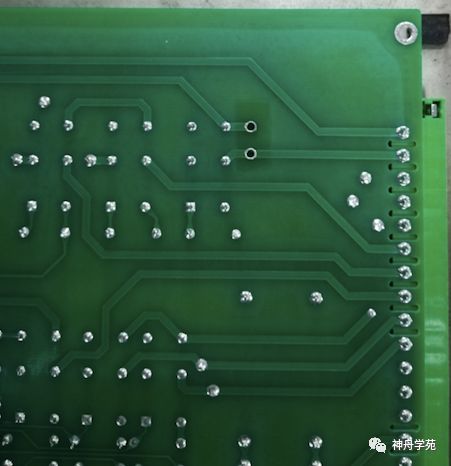
Question: Can you explain why the board surface turns white after wave cleaning? After using a hot air gun, the whitened areas return to normal!
Liao Xiaobo: This whitening of the board surface is mostly due to residual flux that has not been thoroughly cleaned, which appears when it absorbs moisture. Baking or using a “hot air gun” can temporarily remove the moisture molecules adsorbed by the flux residues, thus eliminating the “whitening” phenomenon temporarily. However, as long as these “residues” remain, they will eventually absorb moisture again and turn “white” once more. If these flux residues contain a high concentration of halogen elements, even if covered with a conformal coating, it is still difficult to prevent PCBA from corroding. In reality, because sometimes the halogen element concentration in these flux residues is low, it does not induce corrosion in the later stages of PCBA, leading many to mistakenly believe that the potential hazards of this “if” are insignificant.
However, in the electrical assembly process rules for high-reliability products, it is absolutely not allowed for boards with such “residues” to be released. Violating the rules and not encountering problems is a coincidence; encountering problems is inevitable! These flux residues that often induce the board surface to “whiten” are indeed difficult to clean thoroughly. I interpret this white substance as a hydrate of rosin-type resin residues in the flux (water molecules become solid substances after being adsorbed by the hydrophilic groups on the resin), which changes the original solubility characteristics of the rosin-type resin residues, making it very difficult to clean them with solvents.
Typically, this hydrate can only be removed using a water-based cleaning agent that contains a small amount of solvent and a trace of surfactant (emulsifier), aided by a certain temperature and stirring impact. The most effective methods to avoid this white residue are to choose the most suitable cleaning agent and to clean promptly after soldering.
(Thanks to Teacher A Hou for the question and image information)
Related Link 1: Electrical Assembly Basics 146: Analysis of the Causes of White Flux Residue Formation and Cleaning Mechanism
Liao Xiaobo
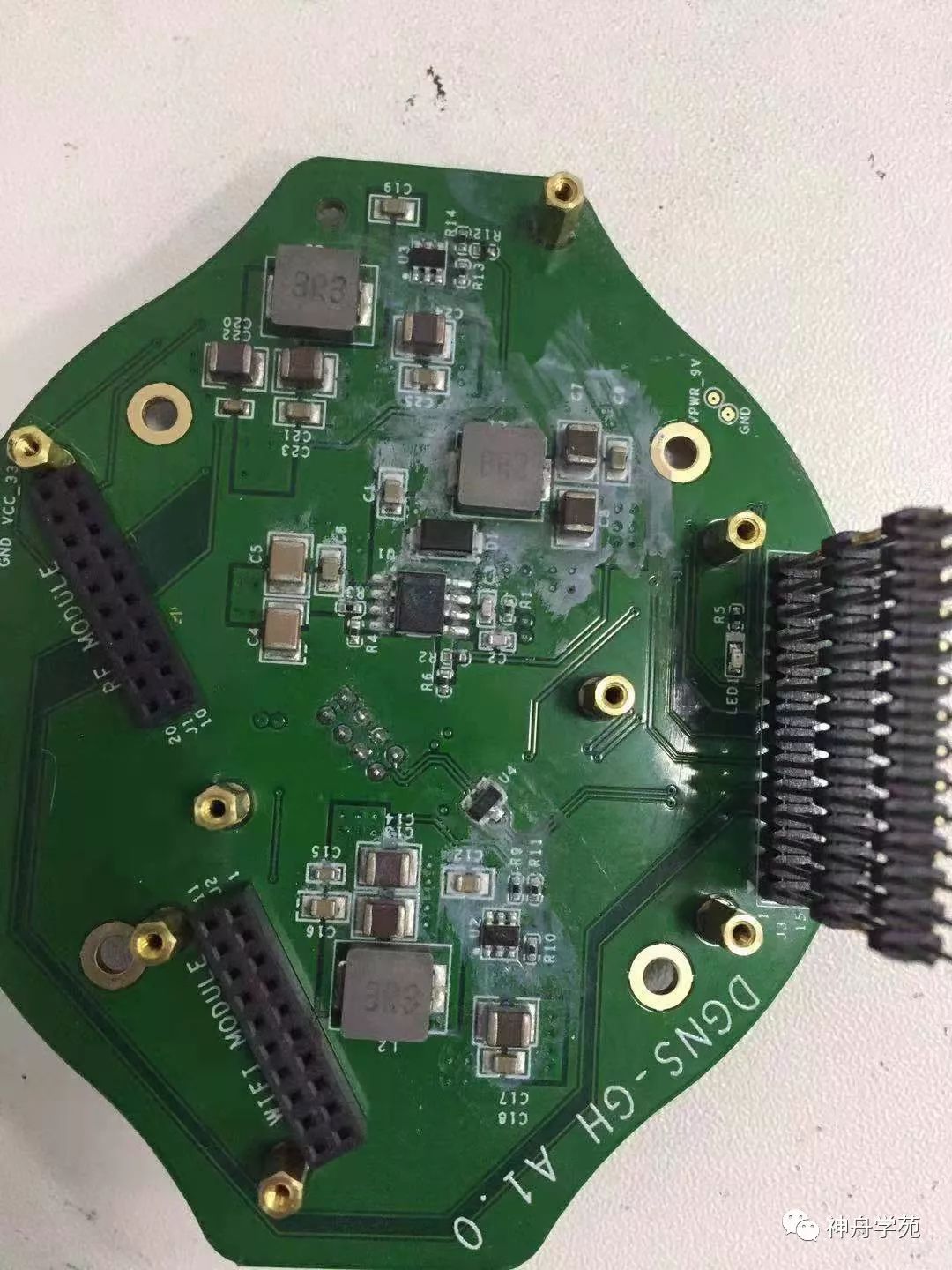
JUN:
Teacher Liao, I remember you wrote a short article introducing this white substance shown in the image, but I can’t find it now.
Liao Xiaobo:
What do you think caused this phenomenon? What treatments did the board undergo before this phenomenon occurred? How are you currently handling this situation? What are the results? Any confusion?
JUN:
After the supplier delivered the assembled printed circuit boards, we cleaned them with alcohol, and when the alcohol dried, this white substance appeared. We believe it’s flux, but we don’t know how to remove it. Previously, we didn’t notice it because we didn’t use alcohol for cleaning.
Liao Xiaobo:
This should be what I mentioned in a short article about “not cleaning the residual flux promptly after soldering, or not cleaning thoroughly, leading to rosin resin compounds absorbing moisture and becoming rosin resin hydrates, altering their solubility characteristics, making them particularly difficult to clean.”
Based on my experience, the state shown in the image should be due to the printed circuit board assembly being cleaned and then manually re-soldered without cleaning afterward, or the cleaning was not timely or thorough.
Additionally, if the electrical assembly factory used low boiling point organic solvents (such as pure alcohol) for cleaning after soldering (or re-soldering), if the humidity control in the cleaning workshop is improper and too high, and the solution is left exposed to the air for a long time, it will absorb moisture from the air, increasing the water content in the cleaning agent (the higher the purity of the alcohol, the stronger its tendency to absorb water). This not only significantly reduces cleaning efficiency, causing flux residues to remain, but also causes the residual flux’s rosin resin compounds to adsorb moisture, turning into a white powdery substance after drying.
Practice shows that once rosin resin compounds adsorb moisture (commonly known as “hydrates”), it is very difficult to remove them with a single alcohol solvent; it is necessary to use a cleaning agent with a composite formula of multiple solvents, and even strong scrubbing or ultrasonic cleaning may be required to remove them. At the same time, theoretically, cleaning the white powdery flux residues that have become hydrates with a water-based cleaning agent should be more effective than using pure alcohol. This is because, during the physical cleaning process with stirring or spraying, the water-based cleaning agent contains not only solvents that can dissolve (swell) rosin resin compounds but also surfactants that can penetrate the swollen rosin resin hydrates. These surfactants can penetrate the gel-like or white powdery flux residues, allowing the residues attached to the board surface to be infinitely divided into smaller and smaller pieces until they become extremely fine particles, which can ultimately be stripped off the board, thus more efficiently removing the typically difficult-to-clean white powdery substances.
You mentioned, “We didn’t notice it before because we didn’t use alcohol brushes,” does that mean the board only underwent alcohol soaking without brushing, and thus this “white spot” substance was not present? Conversely, the board soaked and brushed with alcohol showed this white spot?
JUN:
The boards supplied to us by the chip factory were used directly; this time we just wanted to clean them, and after using alcohol to brush them, the white substance appeared.
Liao Xiaobo:
This indicates that before you used the alcohol brush, those flux residues were still transparent and not easily visible to the naked eye. Instead, once you used alcohol soaking and brushing, they manifested as white spots. Based on my analysis above, the boards supplied to you by the electrical assembly factory had flux residues that had not yet absorbed moisture and thus remained transparent. However, upon contact with the highly volatile anhydrous ethanol, the cooling effect of evaporation caused moisture in the air to condense on these residues, turning them into white hydrates.
I remember that a well-known expert in the Taiwanese electrical assembly industry, George Tsao, once made a vivid analogy to explain your case: if a drop of sugar water is painted on a clean transparent glass surface and dried, it seems to leave no trace, and an uninformed person would still regard it as a clean piece of glass. However, if a drop of water is dripped onto this dry sugar water mark (in fact, it only takes placing this transparent sugar water mark above a cup of boiling water for a short while), one would see wrinkled little particles appear in the area of the sugar water mark.
(Thanks to JUN for the question and image information)
Related Link 2: Electrical Assembly Basics 139: How Long After Soldering Should Cleaning Be Done?
Liao Xiaobo
Question: Are there specific standards for cleaning aerospace products that stipulate how long after soldering the cleaning must be completed?
George Tsao: It is advisable to first understand what type of PCBA it is and what kinds of components are involved. Additionally, it is important to know which soldering method is used, such as wave soldering or reflow soldering. It is also necessary to consider whether the flux is no-clean. There are many factors to consider.
Liao Xiaobo: Timely cleaning after soldering is based on two reasons: 1. To prevent the residual active agents (halogen elements) in the flux from corroding the solder joints; 2. To prevent the residual rosin-type resin in the flux from absorbing moisture from the air, becoming hydrates, which increases the difficulty of subsequent cleaning. Different flux types have different residual and moisture absorption characteristics, making it difficult to define a unified “post-soldering dwell time” value to determine its impact. Therefore, most “standards” use qualitative descriptions such as “as soon as possible” or “timely.” As far as I know, most companies require cleaning to be completed within “the same shift” (4-8 hours), and it is rare for it to exceed 8 hours. Therefore, blindly pursuing the specific time mentioned in some corporate standards without consideration is unrealistic and unscientific.
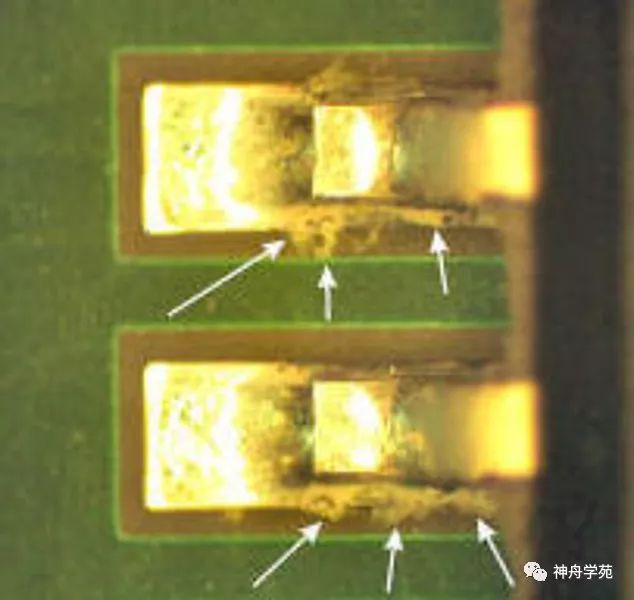
Flux Residue
The residual rosin-type resin, after absorbing moisture and “hydrating,” becomes very difficult to clean, leading to “board surface stickiness” or “residual white powder.” These sticky substances and “white powder” also become carriers for absorbing halogen elements, ultimately causing ionic contamination on the board surface.
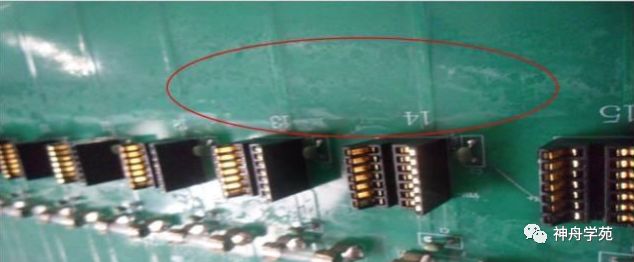
Whitening After Cleaning
Some PCBA assemblies show no abnormalities on the surface after cleaning, but after thermal cycling tests, the board surfaces turn white, which is mostly due to residual trace rosin-type resin compounds that were not cleaned properly after soldering, appearing transparent under dry conditions, and absorbing moisture from the air during thermal cycling tests, thus becoming white hydrates.
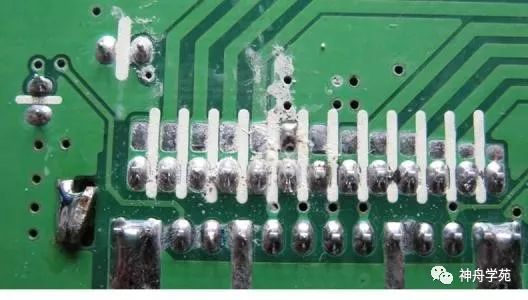
Whitening After Thermal Cycling Test
George Tsao: Therefore, PCBA that needs cleaning should be cleaned as soon as possible after soldering; otherwise, once the residual flux hardens completely, it becomes like the “old grime” stuck around a frying pan, making it extremely time-consuming and difficult to clean…. Haha.
Liao Xiaobo: It is wise and scientific for standard setters not to provide such “time” data. Blindly pursuing a specific time mentioned in some corporate standards without critical thinking can lead to missteps.
(Thanks to Teacher George Tsao for sharing)
(Images in this article are sourced from the internet, some images are from ZESTRON.COM)
Liao Xiaobo

I have been engaged in surface treatment process research for many years; later worked in the PCB manufacturing industry for over 30 years, serving as the chief engineer on the production line; currently the deputy chief engineer (and chief process engineer) at Chengdu Xinxin Shenfeng Electronics Technology Co., Ltd.; now a specially invited process expert at Chengdu Hongming Electronics Co., Ltd. Chengdu Hongming Electronics Co., Ltd. is a high-tech certified enterprise in Sichuan Province and a national enterprise technology center. Since 1987, it has been recognized as one of China’s top 100 electronic component enterprises for over 30 years. In 2018, it was rated as a “National Technology Innovation Demonstration Enterprise.”
Disclaimer: Reproduction is welcome,please indicate the source.This account is non-profit, and all articlestext, images, audio, and video, etc., are sourced from the internet, and the copyright belongs to the original author.If relevant rights holders have objections, please contact:[email protected] to delete.The content of this article represents the views of the original author and does not represent this public account’s agreement with their views or responsibility for their authenticity.
01 Start Your Learning Journey
Long press to recognize the QR code to follow the [Shenzhou Academy] subscription account and start our joint learning journey.

02 About Shenzhou Academy
[Shenzhou Academy] is the WeChat subscription account of the Shenzhou Academy Yantai Branch of the China Academy of Space Technology, affiliated with the Shandong Aerospace Electronic Technology Research Institute, serving as an information exchange platform for internal enterprise training applications.
03 We Look Forward to Your Participation
[Shenzhou Academy] welcomes you to actively participate, write articles, shoot videos, send pictures, remember the editor’s email: [email protected],friends, come and share your sense of achievement!
Quality advertisements are also supported, thank you very much.