Conformal coatings were originally applied only in high-tech fields of printed circuit boards (automotive industry, aerospace, and maritime). As electronic devices are increasingly used in daily life, consumers are also paying more attention to product quality and reliability. The use of conformal coatings allows manufacturers to effectively improve product quality, and thus they are now widely used in civilian and commercial applications.
1. Functions of Conformal Coatings:
Conformal coatings have excellent high and low-temperature resistance. After curing, they form a transparent protective film with superior insulation, moisture-proofing, leakage prevention, shock resistance, dust-proofing, corrosion resistance, aging resistance, and corona resistance. Under real-world conditions, such as chemical exposure, vibration, high dust, salt spray, humidity, and high temperatures, circuit boards may suffer from corrosion, softening, deformation, mold growth, and other issues, leading to circuit failures. Conformal coatings applied to the surface of circuit boards form a protective film (the three protections refer to moisture-proof, salt spray-proof, and mold-proof). In environments containing chemicals (e.g., fuels, coolants, etc.), vibration, humidity, salt spray, and high temperatures, circuit boards that do not use conformal coatings may be corroded, experience mold growth, and cause short circuits, leading to circuit failures. The use of conformal coatings can protect the circuits from damage, thereby improving the reliability of circuit boards, increasing their safety factor, and ensuring their service life. Additionally, because conformal coatings can prevent leakage, they allow for higher power and closer spacing between printed circuit boards, thus meeting the goal of component miniaturization.
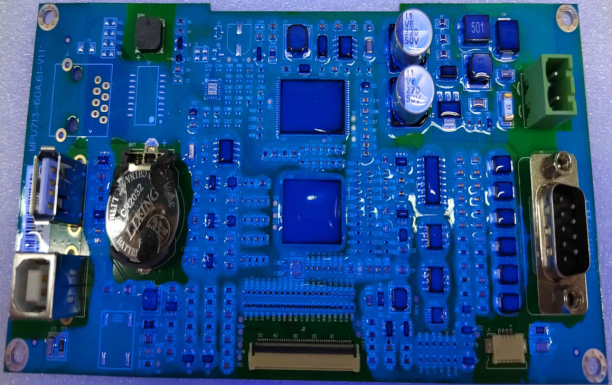
2. Common Components Not Suitable for Conformal Coating:
High-power heat sinks, heat dissipation fins, power resistors, high-power diodes, cement resistors, dip switches, potentiometers (adjustable resistors), buzzers, battery holders, fuse holders, IC sockets, tactile switches, relays, and types of sockets, pin headers, terminal blocks, as well as DB9 connectors, plug-in or surface-mounted light-emitting diodes (non-indicating), digital tubes, and grounding screw holes.
3. Requirements for Brushing Conformal Coatings:
1. Before brushing, all dust, moisture, and rosin on the surface of the PCBA must be thoroughly removed to ensure good adhesion of the conformal coating to the circuit board surface.
2. After the first piece of the product is completed, make conformal coating spraying tools according to the document requirements, focusing on confirming the parts that should not be coated, which need to be covered with protective covers. If the protective cover does not provide adequate coverage, high-temperature adhesive tape must be used for protection.
3. Place the PCBA into the fixture, close the cover, and position it in the conformal coating machine. Edit the program parameters according to the SOP.
4. The brushing thickness should be between 0.1-0.3mm. If a thicker layer is desired, two thinner layers can be applied (the second layer can only be applied after the first layer is completely dry).
5. After brushing, place the PCBA into a UV curing oven to accelerate curing.
4. Quality Requirements for Conformal Coatings:
1. There should be no dripping or leakage on the PCB surface, nor should there be semi-wetting phenomena.
2. The conformal coating layer should be flat, shiny, and uniformly thick, protecting the pads, surface-mounted components, or conductor surfaces.
3. The surface of the coating layer should not have orange peel, bubbles, pinholes, or ripple phenomena.
4. Components that do not require protection should not be coated with conformal coatings.
5. The printed circuit board after conformal coating should be clean and tidy, with no damage to components.
6. There should be no dirt, fingerprints, ripples, shrink holes, dust, or other defects and foreign objects on the board surface and components, with no powdering or peeling phenomena.
The above is an introduction to the coating requirements and uses of conformal coatings. With the advancement of technology, more and more products are choosing to use conformal coatings due to their many functions and superior properties such as insulation, moisture-proofing, leakage prevention, shock resistance, dust-proofing, corrosion resistance, aging resistance, and corona resistance. This is particularly important for military, automotive, and aerospace products and quality assurance. Therefore, when applying conformal coatings to products, it is essential to operate according to customer standards and requirements.
