👆👆👆Click the blue text 👆👆👆 to follow us
Tianjin Technology Manager Development Promotion Association
Leading Players in Touch Screen Technology

The concept of touch technology was proposed as early as the 1940s, and the first true touch screen was created in 1965 by engineer Eric Arthur Johnson from the Royal Radar Establishment in the UK. Johnson initially described his achievement in an article published in Electronics Letters, which we now refer to as a capacitive touch screen.
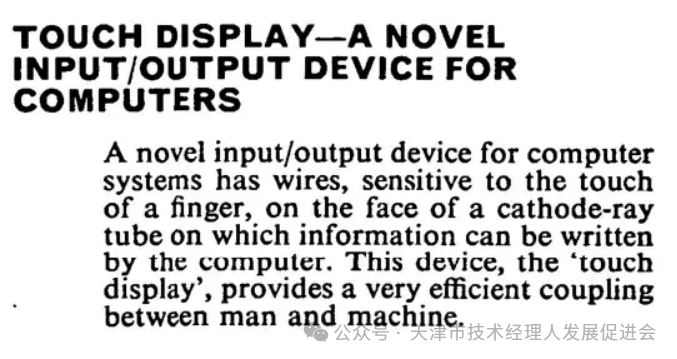
Article published by Johnson in Electronics Letters
(Image source: Internet materials)
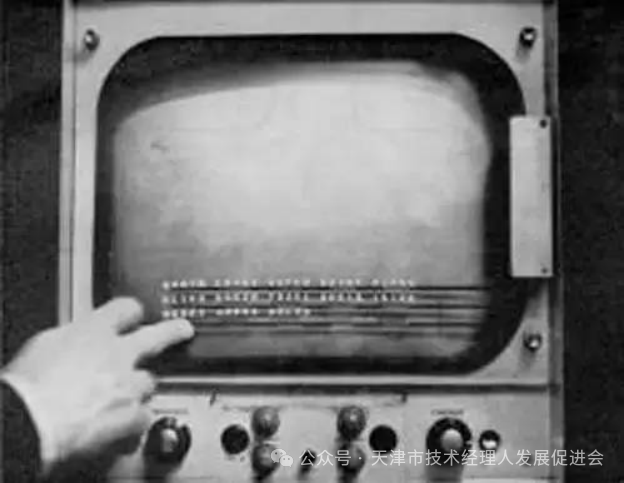
The first touch screen
(Image source: Internet materials)
The capacitive touch screen works by sensing the electrical current of the human body, which can be simply viewed as a screen made up of four layers: the outermost layer is a glass protective layer, followed by a conductive layer, the third layer is a non-conductive glass screen, and the innermost fourth layer is also a conductive layer.
The working principle is as follows: when a finger touches the capacitive touch screen, a high-frequency signal is activated on the working surface, and at this moment, the finger and the touch screen working surface form a coupling capacitor, equivalent to a conductor. When the finger touches, it draws a small current at the touch point, which flows out from the electrodes at the four corners of the touch screen. The current flowing through the four electrodes is proportional to the straight-line distance from the finger to the four corners, and the controller can calculate the coordinates of the contact point based on the ratio of the four currents.
However, its prototype was mainly used on radar screens for air traffic control. These early screens were likely not fully transparent, or their transparency and precision were insufficient to overlay on ordinary display devices, providing direct, visual interaction. Its greatness lies in validating the feasibility of capacitive touch theory. E.A. Johnson is the pioneer and prototype maker of capacitive touch screen theory.
The “Philosopher’s Stone” Dream in CERN Control Room
In 1973, Geneva, Switzerland, at the European Organization for Nuclear Research (CERN). Here, the world’s top physicists and engineers gathered, aiming to unveil the deepest mysteries of the universe—by colliding microscopic particles at nearly the speed of light using massive particle accelerators. However, alongside these futuristic machines, scientists faced the most primitive human-computer interaction dilemma.
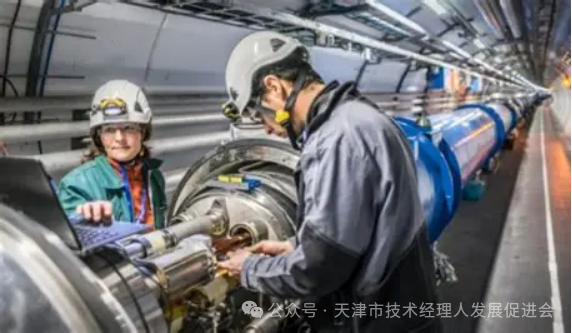
(Image source: Internet materials)
The control room was filled with oscilloscopes flashing green lights and large computer terminals. Researchers needed to analyze the massive and complex data generated from collisions, which appeared on screens as trajectories and curves. To accurately measure the parameters of a specific trajectory, they had to laboriously type line after line of keyboard commands or navigate through deeply nested menus, then use a light pen for rough pointing. This process was slow, clumsy, and prone to errors, completely at odds with the equipment representing the pinnacle of human intelligence in the laboratory.
This inefficient interaction method deeply troubled a Swedish electronic engineer named Stuart Johnson. He imagined how natural and efficient it would be if he could directly point at the screen with his finger, like a child pointing at a picture book, telling the computer, “I want this one.”
In that moment, inspiration struck. Stuart Johnson and his team overlaid a transparent sensor covered with a fine metal grid on a regular display screen. When a finger touched the screen, it would slightly change the capacitance at the touch point, which could be detected by the precise sensor. They successfully created the world’s first transparent capacitive touch screen. This allowed users to directly click and select images with their fingers, achieving a truly “what you see is what you get” graphical touch interaction.
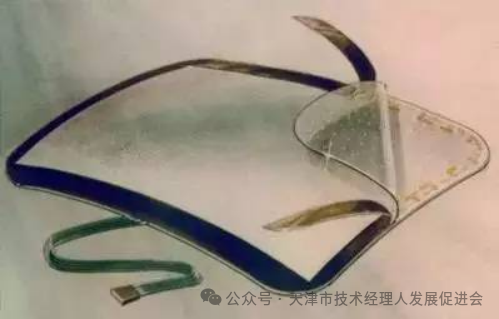
(Image source: Internet materials)
In the laboratory records of that time, they enthusiastically wrote: “This device will turn any CRT display into an effective data input terminal, without relying on bulky keyboards and confusing light pens.” Their work laid the foundation for the modern form of touch screens.

Fun Fact
This revolutionary invention was originally intended to allow scientists to work more “lazily” and efficiently—perfectly exemplifying the driving force behind many great innovations: humanity’s endless pursuit of “simplifying operations.”
However, like all miracles born in the “ivory tower,” this rough yet significant touch screen, after astonishing CERN colleagues, was locked away like a treasure map in a safe, and for many long years, it was almost forgotten. The long and winding road from the temple of high-energy physics to the palms of ordinary people far exceeded anyone’s imagination.
01
A Long Winter: The “Delicate Toy” of the Laboratory (1970s-1980s)
Eric Arthur Johnson’s invention was undoubtedly pioneering in technology, but it was labeled with tags that seemed insurmountable at that time: expensive, fragile, and low precision.
First, the nightmare of cost and craftsmanship.Early transparent capacitive materials were extremely difficult to manufacture, with a pitiful yield rate. Accurately etching micron-level metal lines onto glass or plastic substrates required expensive equipment and clean rooms. This meant that the cost of each small touch screen was staggering, only suitable for aerospace, military, or top research institutions like CERN, completely disconnected from the consumer market.
Second, severe limitations in performance.This initial touch screen had very basic functions. It could only sense a rough touch point, could not achieve multi-touch, and could not recognize complex gestures. Its precision might be sufficient for locating particle trajectories, but it was inadequate for graphic operations requiring pixel-level accuracy. Moreover, it was slow to respond, easily interfered with, and lacked stability.
A thought-provoking comment:The early dilemmas of touch screens are a microcosm of many innovations that are “technologically ahead” but “market not yet arrived.” It solved a “niche” professional problem in extreme environments but had yet to find a connection point with the daily lives of the general public. In an era without personal computers or graphical operating systems, a touchable screen was like a magical mirror of unknown utility to ordinary people—novel but useless.
Thus, this revolutionary patent was quietly stored in the archives. Like Fleming’s penicillin culture, it quietly awaited a “waker” who could understand its value and be willing to fight for it.
02
Awakening and Relay: Multiple Explorations in the Business World (1980s-1990s)
As the wheel of time rolled into the 1980s, the personal computer revolution began to take root. The emergence of graphical user interfaces (GUIs), particularly the rise of Apple Macintosh and Microsoft Windows, made “clicking” the new mode of interaction. This provided the first breath of spring for the revival of touch screen technology. A group of visionary companies and researchers began to set off from CERN’s starting point, embarking on a long relay race along different technological paths.
The First Leg: A Flourishing of Technological Routes

Since capacitive technology had a high threshold, people began to look for more easily achievable alternatives.
Resistive Touch Screens:This path became the backbone for the next two decades. It consists of two layers of transparent conductive films with a slight gap in between. When a finger or any object presses down, the two films make contact, and the position is determined by measuring the voltage change. Its advantages include relatively low cost, resistance to dust and water stains, and the ability to be triggered by any object (including fingernails and styluses). The disadvantages are slightly poorer transparency, requiring a certain amount of pressure to activate, and the soft plastic layer on the surface is easily scratched.
Surface Acoustic Wave Touch Screens:These screens install acoustic transmitters and receivers at the edges, creating a matrix of intersecting sound waves on the screen surface for positioning. When touched, the finger absorbs some sound waves, allowing for precise location detection. Its advantages include extremely high transparency, undamaged image quality, and good durability, but it is easily affected by dirt and grease.
Infrared Touch Screens:These screens are surrounded by densely arranged infrared emitters and receivers, forming an intersecting infrared light grid. Any opaque object touching the screen will block some of the beams, allowing for positioning. They are low-cost and easy to integrate but are easily interfered with by strong light and cannot prevent false touches.
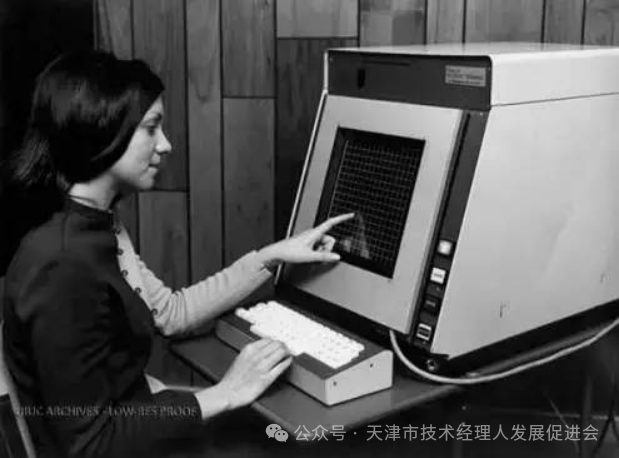
The first touch screen computer for classrooms—PLATO IV
(Image source: Internet materials)
PLATO IV was the first touch screen computer for classrooms, allowing students to touch the screen to answer questions, but it did not use capacitive or resistive touch technology; instead, it supported an infrared system.
The Second Leg: Finding “Killer Applications”

These technologies each found their early commercial footholds and began the arduous process of market education.
Industrial Control and Information Kiosks: Control panels in factories filled with dust and oil needed durable interfaces; ATMs and information kiosks on the streets required simple and intuitive operations. Resistive and infrared screens shone here, making cold machines “touchable” and greatly simplifying operational processes.
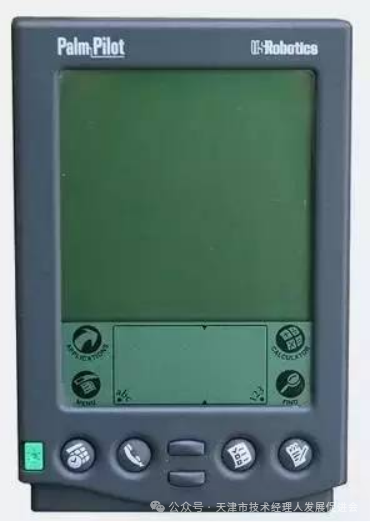
Pioneers of Handheld Computers: In the 1990s, handheld computers (PDAs) took the historical stage. Among them, Apple’s Newton MessagePad and Palm’s Pilot series both used resistive touch screens, paired with styluses for input and operation. This was the first time touch screens came so close to the personal consumer electronics field.
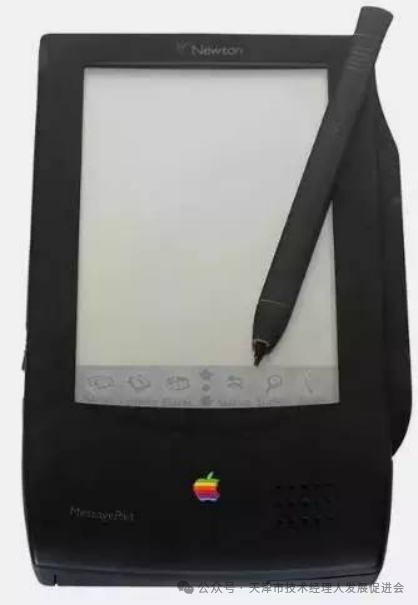
Apple’s MessagePad 100
Products from Palm Computing
(Image source: Internet materials)

Fun Fact
The poor handwriting recognition rate of Apple’s Newton became a joke in the industry, but it marked that giants had begun to seriously attempt to make touch screens a mainstream input device. This was a failed charge, but it accumulated valuable experience for future success.
Despite these advances, touch screens throughout the 1990s never broke out of the categories of “professional tools” or “geek toys.” They were either hidden inside ATMs or required a cumbersome stylus, and the operational experience was far from “natural and intuitive.” It wasn’t until the early 2000s that a critical, transformative breakthrough quietly occurred in another unassuming laboratory.
03
The “Fleming and Chain” Breakthrough: The Birth of Gestures (Early 2000s)
In the story of penicillin, Fleming and Chain’s team completed the transformation from “antibacterial substance” to “injectable drug.” In the story of touch screens, this role was played by a small company named FingerWorks and its founders.
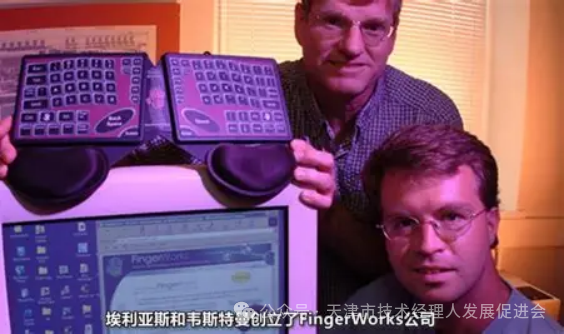
John Elias and Wayne Westerman
(Image source: Internet materials)
John Elias and Wayne Westerman, two PhDs and professors from the University of Delaware, were also troubled by repetitive stress injuries (such as carpal tunnel syndrome). They wanted to create an input method that did not require frequent clicking and moving. Based on their deep understanding of human-computer interaction and expertise in sensor technology, they invented a revolutionary technology: touchpads capable of simultaneously recognizing multiple touch points and interpreting combinations of these touch points into complex gestures.
This marked the true beginning of multi-touch technology.

FingerWorks’ touchpad could recognize zooming with two fingers, scrolling and rotating with multiple fingers. These operations, which we now take for granted and have even become muscle memory, were groundbreaking at the time. They applied for numerous core patents for these gestures, almost defining the grammar of modern touch interaction.
However, they also faced a “Fleming and Chain” dilemma:
Awkward Market Positioning:Their products were independent, expensive touchpads, primarily sold as peripherals for computers.
Limited Application Scenarios:The initial target users were efficiency-seeking professionals and individuals needing assistive technology. Despite the creativity of the product, it never entered the mainstream consumer view.
Technology Needs Integration:While their technology was an excellent “engine,” it had yet to find a perfectly matching “body”—a consumer-grade product that could make this powerful heart beat.
FingerWorks was like a magician who had mastered the art of alchemy but struggled to find a heavy enough stone to cast all its magic. Their technology awaited a similarly extreme “integrator” to complete the final leg and rush to the finish line.
04
The “iPhone” Moment: The Perfect Storm of Consumer Applications
On January 9, 2007, at the Moscone Center in San Francisco, Steve Jobs took the stage amid great anticipation and uttered the historic opening line: “Today, Apple is going to reinvent the phone.”
He then pulled out the first-generation iPhone. As his finger naturally slid across the smooth glass screen, zooming in on photos and scrolling through lists, the world realized that one era had ended and another had begun.
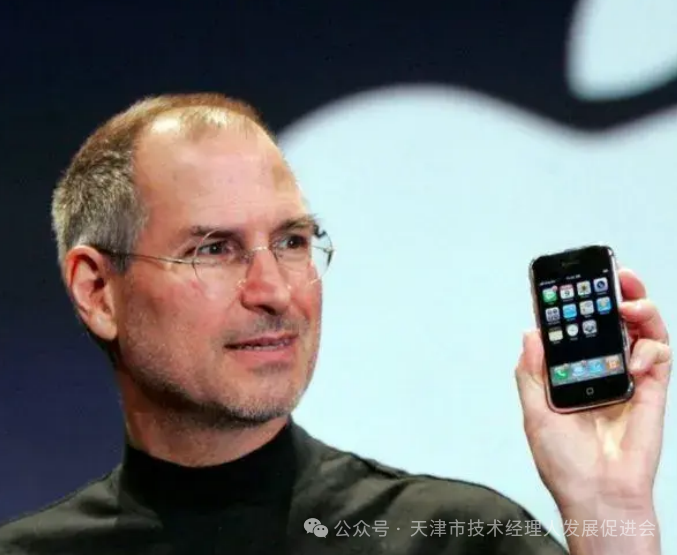
Steve Jobs at the Apple press conference
(Image source: Internet materials)
Apple perfectly played the role of the “American pharmaceutical company” in the penicillin story—it was not the original inventor of the technology, but it was the ultimate integrator of technology, the definer of experience, and the implementer of scale.
How did Apple solve the ultimate problem of “mass production and experience”?
Technological Integration and Re-Innovation:Apple keenly realized that FingerWorks’ multi-touch gestures were the key to unlocking natural interaction. They secretly acquired FingerWorks, incorporating its patents and technology. Then, they abandoned the mainstream resistive screens of the time, opting for the more dazzling and smoother projected capacitive touch screens. They seamlessly integrated this sensitive screen, a powerful customized processor (designed by Samsung), and an iOS operating system born for touch into a whole. This was not a mere stacking of technologies, but a precise symphony.
The Miracle of Engineering and Supply Chain:Producing millions of high-quality, high-precision, high-yield capacitive touch screens was a massive engineering challenge. Apple leveraged its strong supply chain management capabilities and significant investments, collaborating with global suppliers (such as TPK and Wintek at the time) to overcome the bottlenecks of large-scale production and successfully control costs within the acceptable range for consumer electronics.
Defining Interaction Paradigms:This was Apple’s core contribution. Jobs and his team adhered to the philosophy of “direct manipulation.” On the iPhone, there was no stylus; your finger was the ultimate tool. The software interface was designed to be a touchable entity—lists would scroll with the inertia of your finger, and images could be pinched to zoom. This interaction was no longer about “controlling the machine through tools” but rather “as if touching the real world.” Apple transformed FingerWorks’ “technical grammar” into an “interaction language” that users worldwide could instantly understand.

Fun Fact
When the first iPhone was released, it did not support copy/paste functionality and had no App Store. This was because Apple believed that users must first thoroughly understand and master the core interaction paradigm of “touch” before gradually adding complex features. This extreme control over the experience was one of the keys to its success.
From then on, touch screens were no longer part of ATMs, POS machines, or factory control panels; they became the forefront of the digital world itself, the default channel for interacting with the universe of information.
05
The Catalyst of the Era: The “War” of Mobile Internet
In the story of penicillin, World War II was the ultimate accelerator of technology transformation. In the story of touch screens, this “war” was the wave of mobile internet that swept the globe in the early 21st century.
This war without gunpowder created several rigid demands:
Demand for Larger Screens:Mobile phones needed to do more than just make calls; they needed to browse the web, watch videos, and play games, necessitating the removal of physical keyboards that occupied valuable space.
Demand for More Natural Interaction:In a mobile state, complex cursor and menu operations are anti-human; intuitive finger operations became inevitable.
Demand for Device Integration:Users needed a pocket device that integrated communication, entertainment, and office functions, rather than a bunch of peripherals that needed to be connected.
The emergence of the iPhone perfectly met these demands. It was not only a showcase for touch screen technology but also the gateway to the entire mobile internet ecosystem. Google’s Android system quickly followed suit, completely reshaping the smartphone industry. This “war” swept away the feature phone and PDA markets, giving rise to a brand new, trillion-dollar mobile application economy.
The invisible hand of the market and the visible hand of government coordination played significant roles in the mass production of penicillin;in the story of touch screens,the global supply chain, venture capital investment, and fierce market competition together formed the perfect storm accelerating its popularization.
05
Aftermath and Insights: A World Changed by Touch
Today, we live in a world surrounded by touch screens. From smartphones to tablets, from car dashboards to smart refrigerators, from airport check-in counters to electronic menus in restaurants, touch interaction has become as natural as breathing. It has completely changed:
Industry Landscape:Nokia, Blackberry, and other giants have collapsed, while Apple and Google have become the kings of the new era; it has spawned millions of mobile application developers as a new profession.
Human Behavior:“Swipe,” “like,” and “zoom” have become instinctive reactions; children attempt to “control” TV screens with their fingers before they learn to speak.
Ways of Information Acquisition:The presentation and interaction of information have become unprecedentedly intuitive and efficient.
Reflecting on the thirty-four-year journey of touch screens from CERN’s green screens to the iPhone, we can draw several profound insights:
The Nonlinear Nature of Technology Transformation and Long-Termism:Great innovations rarely happen overnight. They require a long “technology latency period,” with participants from different fields and purposes succeeding each other, accumulating experience through seemingly failed efforts, and ultimately exploding when conditions are ripe.
User Experience is the Ultimate Battlefield of Technology:The touch screen at CERN solved the “efficiency” problem, while the iPhone’s touch screen solved the “pleasure” and “intuitiveness” problems. The latter is the key to technology entering the homes of ordinary people. Hiding complex technology behind an extremely simple experience is the core insight Apple has brought to all industries.
Both “Integrators” and “Inventors” are Equally Great:We admire invention, but we should not overlook the value of integration. Apple’s greatness lies in its ability to integrate dispersed, laboratory-stage technologies (capacitive screens, multi-touch gestures, mobile OS) into a complete product that shocks the world. This system-level innovation is as challenging and impactful as breakthroughs in individual technologies.
The Power of Ecosystems is Greater than the Glory of Individual Products:The success of the iPhone is not only due to the touch screen hardware but also because of the App Store ecosystem built by countless developers behind it. An open and prosperous ecosystem can, in turn, reinforce and promote the continuous development of hardware technology.
However, the popularization of touch screens has also brought new social issues: digital addiction, information silos, privacy security, and the degradation of traditional interaction skills (such as handwriting). This reminds us that any powerful tool is a double-edged sword.
Interactive Question
The epic of touch screens tells us that its birth did not stem from consumers’ desire for “touch phones” but began with scientists’ pursuit of efficiency in analyzing particle trajectories. Its path to maturity was filled with “curve-saving” in industrial control, PDAs, and other fields. So, in today’s era, do you think the driving force behind the next disruptive technology (such as brain-computer interfaces or quantum computing) will lean more towards frontier explorations like CERN’s “what is different” or towards precise excavations of market “pain points”? Which of these two motivations is more likely to bring us unexpected futures? We look forward to your insights in the comments section!

Previous Reviews
Technology Transfer Case Study | Understanding 50 Technology Transfer Stories (Issue 3) – Penicillin: From Mold to Life-Saving Drug
Technology Transfer Case Study | Understanding 50 Technology Transfer Stories (Issue 2) – Willow, Aspirin, and Heroin
Technology Transfer Case Study | Understanding 50 Technology Transfer Stories (Issue 1) – The “Tianjin” Story of a Cucumber
Disclaimer: The content of this public account is original, reprinted from the internet, or edited and organized based on non-confidential public information. The relevant content is for reference and learning exchange only. Due to some text, images, etc. sourced from the internet, the true source cannot be verified. If there are any related disputes, please contact us. We are committed to protecting the intellectual property rights or copyright of authors. The intellectual property or copyright of the content in this public account belongs to the original author. This public account has the final interpretation right of this statement.
Source: Regional Technology Manager Capability Building Research Institute
TATM

Editor / Feng Zhiping
Proofreader / Chu Yue
Reviewer / Wang Qi