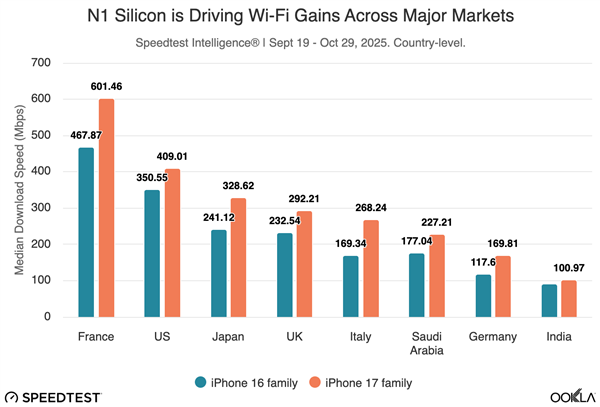
A recent study shows that thanks to Apple’s self-developed N1 chip, the upcoming iPhone 17 series and iPhone Air will achieve a significant improvement in Wi-Fi connection speeds compared to previous models. This analysis is based on global user network speed test data collected through Speedtest from September 19 to October 29 this year.
The research indicates that the N1 chip brings substantial technological advancements. Compared to the Broadcom Wi-Fi solution used in the iPhone 16 series, the iPhone 17, iPhone 17 Pro, iPhone 17 Pro Max, and iPhone Air equipped with the N1 chip show an average increase of up to 40% in download and upload speeds. In multiple markets, including the United States, France, Italy, the United Kingdom, India, and Japan, the new models exhibit faster Wi-Fi performance.
It is noteworthy that the optimization of the Wi-Fi experience by the N1 chip is more reflected in stability and minimum performance levels rather than merely pursuing peak rates. This means that in complex signal environments or areas with significant interference, the new devices can maintain a more reliable connection performance.
For example, in the United States, data shows that the average Wi-Fi download speed of the iPhone 17 series and iPhone Air reaches 409 Mbps, while the iPhone 16 series is at 350 Mbps, an increase of nearly 17%. Although previous information indicated that the N1 chip supports 160 MHz channel bandwidth under the Wi-Fi 7 standard and does not yet support 320 MHz, thus unable to reach the theoretical maximum speed of Wi-Fi 7, actual test results show that this limitation does not affect the user experience in most usage scenarios.
In summary, the introduction of the N1 chip represents a substantial upgrade in wireless connectivity technology for Apple. For users planning to purchase the iPhone 17 series or iPhone Air, its Wi-Fi performance is now more competitive and will not be a weak link in the overall device experience.