The annual ICCAD 2025 conference concluded in Chengdu, with Professor Wei’s keynote report being the highlight of the event. My acquaintance with Professor Wei also began at this conference a few years ago.
This year, Professor Wei delivered a keynote report titled “China’s Chip Design Industry Must Strive for Self-Reliance,” which has been widely shared and interpreted by various media outlets, so I will not repeat it here. From this report, I would like to raise a thought: Can China retain 500 chip design companies? As of now, there are 3,901 existing chip design companies in 2025.
There is already an article titled “Technological Innovation in Chips: Are Large Enterprises More Important than Small Enterprises?” which interprets and reflects on the issue raised by Professor Wei regarding the “small, scattered, and weak situation of chip design companies not having fundamentally improved.” It cites Schumpeter’s innovation theory from his 1911 work “The Theory of Economic Development,” which mentions that “innovation is a process of creative destruction,” and emphasizes the core role of small enterprises in “disruptive innovation” in his 1942 work “Capitalism, Socialism and Democracy.”
Both of these innovation theories are based on a key point—small enterprises are more innovative, with the advantage of having “no path dependence,” and do not have to consider and maintain the sunk costs of existing interests and technologies.
As an entrepreneur in a domestic chip design company, I have some personal experiences and insights. Small enterprises have a stronger sense of innovation and survival instinct; without innovation, there are no opportunities. The recent success of Sanwu Microelectronics with their Wi-Fi FEM is also a result of innovation, customizing chips based on market demand. When you have no way out and cannot compete with existing competitors in terms of capital, you have to innovate. Innovation brings high costs and high risks, but in the highly competitive domestic chip design industry, where the mid-to-low end has already completed the “domestic substitution” market background, not innovating is tantamount to waiting for death, while innovating may lead to failure.
The concept of “innovation” in the chip design industry is vast and broad. It includes process innovation, architecture innovation, product definition innovation, supply chain operation and management innovation, marketing, and sales channel innovation, among others. Some innovations mainly rely on funding, such as significant investments in R&D personnel and funds for various process and architecture innovation attempts; burning money is also a choice for innovation. Company H often uses this method, concentrating firepower on one gate. Capital investment itself is a threshold for innovation; if you cannot afford advanced processes, others can, which undoubtedly is an advantage for large enterprises in innovation.
However, small enterprises cannot afford such recklessness. With limited funds, they must balance and optimize to choose the most suitable innovation path. The single-point innovation of small enterprises cannot build competitive advantages and barriers; the competitive strength of small enterprises should come from comprehensive innovation capabilities, where each single-point innovation and advantage ultimately forms significant overall competitiveness.
Expanding on this topic is to return to the discussion of whether China can retain 500 chip design companies. Domestic chip design companies have only two paths to take—scale and innovation.
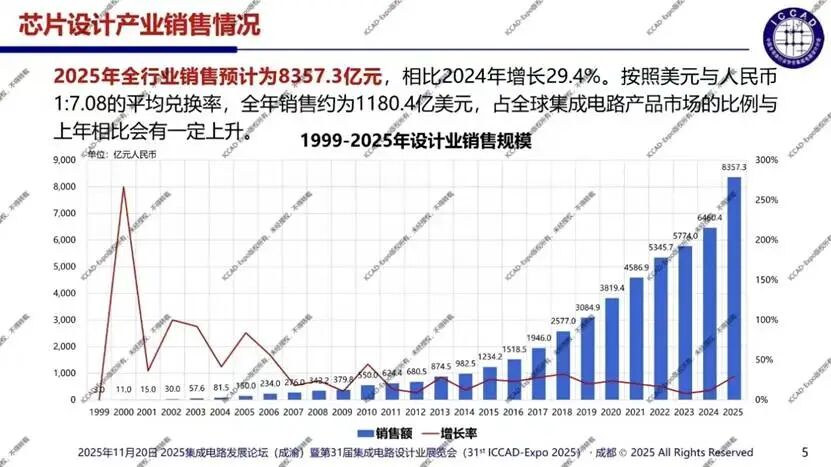
The total industry sales in 2025 are expected to reach 835.73 billion yuan, a growth of 29.4% compared to 2024, with a certain increase in the proportion of the global chip product market compared to the previous year.
In 2025, it is expected that 831 chip design companies will have sales exceeding 100 million yuan, an increase of 100 companies compared to 731 in 2024, with a growth rate of 13.7%.
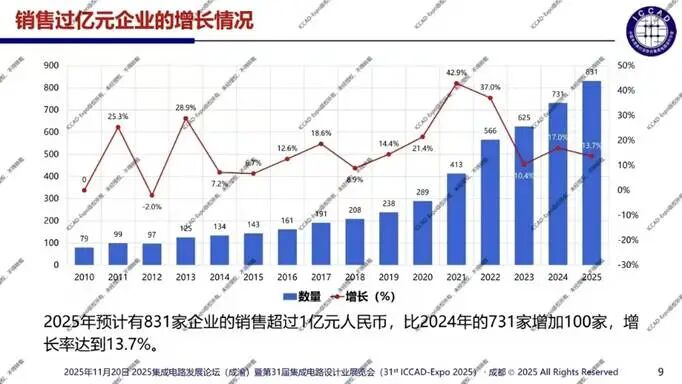
According to this development trend, by 2027, there will be 1,000 domestic chip design companies with sales exceeding 100 million yuan. Besides the more than 100 companies that are already listed, how many of the remaining companies will be able to go public or become profitable?
The chip industry is not only high-tech but also a scale-driven industry. 100 million yuan in sales is the minimum threshold for chip design companies to scale up. Without scale, there are no cost advantages; without cost advantages, it is difficult to achieve sustainable profitability; without sustainable profitability, it is impossible to move towards high-end markets. If one is overly focused on a very niche market with high profits, once larger and more profitable companies set their sights on it, the outcome could be disastrous.
Let us estimate how many of the 831 domestic chip design companies with sales exceeding 100 million yuan in 2025 will achieve profitability. I estimate that it will not exceed 50%. Even if there are 1,000 domestic chip design companies with sales exceeding 100 million yuan in the future, deducting the 200 companies that are listed, among the remaining 800 chip companies, at most 400 will be able to achieve profitability. If profitability is minimal, and they cannot go public, cannot buy back investors’ funds, or cannot reach an agreement with investors, these companies will be forced to sell. Personally, I am not optimistic about cross-industry acquisitions; the probability of success in the future is very low. Cross-industry acquisitions only solve one problem—the funding issue. The advantages brought by mergers and acquisitions, such as supply chain integration, technology integration, and market integration, will not materialize.
Today’s domestic chip design companies, if they do not see opportunities for going public in the future and want to continue operating independently in the market for the long term, must strive to achieve two points:
1. Achieve profitability and sales exceeding 100 million yuan
2. Solve the exit problem for early investors