As a core technology carrier for precision medicine and smart health management, biosensors have profoundly transformed disease diagnosis and physiological monitoring models. Biosensors convert the concentration of target substances into electrical signals through the synergistic action of biological recognition elements (such as enzymes, antibodies, and nucleic acids) and physicochemical transducers, thereby constructing an analytical system that includes signal amplification devices. As a cutting-edge branch, sweat biosensors have become a research hotspot in the field of wearable electronics due to their high selectivity, rapid response, low cost, and in-situ continuous monitoring capabilities.Sweat, as a “liquid carrier” of dynamic physiological information, has biomarker concentrations of glucose, lactate, and electrolytes that correlate with blood (Pearson coefficient) reaching 0.85 to 0.93, and is minimally affected by hydration. This characteristic makes it an ideal monitoring medium for metabolic diseases and exercise performance assessment. However, existing clinical testing systems are typically chromatography/mass spectrometry platforms, which have drawbacks such as large equipment size (>50 kg), long single test times, and high costs, severely restricting the development of personalized health management.Wearable sweat sensors can perform in vivo sweat analysis and provide immediate results, offering a solution to the aforementioned problems. Wearable devices designed for multi-parameter detection can simultaneously measure various components, ensuring a more comprehensive, accurate, and efficient monitoring of physiological information. This capability aids in the early detection of health issues, leading to personalized treatment; in terms of signal fidelity, the use of spatially isolated electrode designs and independent signal pathways can effectively reduce cross-interference and enhance detection sensitivity; regarding wearability, ultra-thin packaging structures and flexible substrate materials ensure comfort for long-term continuous wear. These technological advancements have propelled the application of wearable sweat sensors in diabetes management and sports medicine, marking a leap from concept validation to practical application in non-invasive monitoring.Multi-channel sweat sensors based on microfluidic technology can non-invasively monitor various biomarkers such as electrolytes, metabolites, and hormones in human sweat in real-time, providing high-value dynamic data for early disease warning, exercise health management, and personalized medicine. The miniaturization and integration design of the sensors break through the traditional detection technology’s reliance on laboratory environments, significantly enhancing the accuracy and practicality of wearable health monitoring devices, with considerable application potential in chronic disease prevention and control and exercise physiology optimization. Microfluidic technology achieves efficient directional transport and distribution of micro-scale sweat (microliter level) through precise fluid control, addressing the issues of low sample utilization and delayed detection in traditional sensors; by employing a multi-channel parallel analysis architecture, it synchronously detects multiple target components, balancing detection efficiency and data correlation, thus avoiding the cumulative errors caused by stepwise testing of multiple indicators; combined with chip surface functionalization techniques, it enhances the target molecule capture capability, achieving high selectivity detection in complex sweat matrices, with sensitivity improved to the pmol/L level. These characteristics of microfluidic technology enable the sensors to reliably output stable data in real sports or daily scenarios, promoting the intelligent and precise development of wearable medical devices.In recent years, research on wearable sweat sensors based on microfluidic chips has rapidly developed. Against this backdrop, researchers from the School of Electronic Science and Engineering at Jilin University and the Cardiovascular Department of the Second Hospital of Jilin University have explored the optimization of the topological structure of microfluidic chips, signal decoupling algorithms, and self-powered sensing technology from the perspective of multi-channel collaborative sensing, deeply investigating the mechanisms that enhance the synchronous detection performance of sweat multi-parameters. They further discuss the industrialization bottlenecks of this technology in terms of wireless energy supply, long-term biocompatibility, and the lack of clinical validation standards, aiming to provide a theoretical framework and technical reference for constructing a new generation of intelligent sweat monitoring systems. The research results have been published in the recent issue of the journal “Analytical Chemistry” under the title “Research Progress on Wearable Multi-Channel Sweat Sensors Based on Microfluidic Chips.”1 Multi-Channel Sample Collection in Wearable Microfluidic DevicesCompared to blood and other body fluids, the concentration of biomarkers in sweat is lower and changes dynamically, posing challenges to the reliability and accuracy of real-time monitoring. This low signal-to-noise ratio environment not only requires detection devices to have ultra-high sensitivity but also necessitates the establishment of a stable sweat capture and transport system to prevent the degradation or dilution of target molecules. Optimizing the sweat collection and transport mechanism is key to solving this problem, where microfluidic technology demonstrates unique advantages through precise fluid control.Microfluidic technology provides a systematic solution through biomimetic fluid network design and active/passive driving mechanisms, with the core being the construction of a “fluid isolation layer” between the skin interface and the detection unit. By utilizing the capillary effect and surface energy regulation of sub-millimeter channels, sweat is directed from the secretion end to a closed liquid storage chamber (such as a dendritic fractal liquid reservoir), with transport efficiency improved by 3 to 5 times compared to traditional passive diffusion. This “capture first, analyze later” strategy not only compresses the sample exposure time to within 10 seconds (evaporation loss rate <5%) but also intercepts epidermal contaminants through physical filtration structures, enhancing the reliability of detection results.The core of wearable sweat microfluidic devices lies in constructing a stable and controllable sweat driving mechanism. In addition to utilizing the pressure from sweat glands, passive driving methods such as capillary action, osmotic pressure, and evaporation pumps are gaining attention due to their lack of need for external devices. Notably, the three-dimensional microfluidic patch employs a design of vertically stacked sweat transport and detection layers, achieving active control of sweat flow rate while maintaining an ultra-thin thickness of 2 mm, providing a technical basis for dynamically compensating individual sweat secretion differences.Currently, the main challenges faced by sweat detection technology lie in the contradiction between the dynamic characteristics of sweat secretion and collection efficiency. Existing methods typically rely on vigorous exercise or drug stimulation (such as pilocarpine electrophoresis) to induce sufficient sweat secretion, but the former poses implementation barriers for patients with limited mobility, while the latter may cause side effects such as skin burns. Additionally, the low secretion rate of sweat glands in a resting state and the rapid evaporation effect of sweat make it difficult to collect sample volumes that meet the detection needs of conventional sensors. To address this issue, using waterproof skin-contact microfluidic systems can reduce sample loss through physical barriers, but their application scenarios are currently limited to sweat collection after warm water showers and cannot achieve continuous dynamic monitoring of thermoregulated sweat.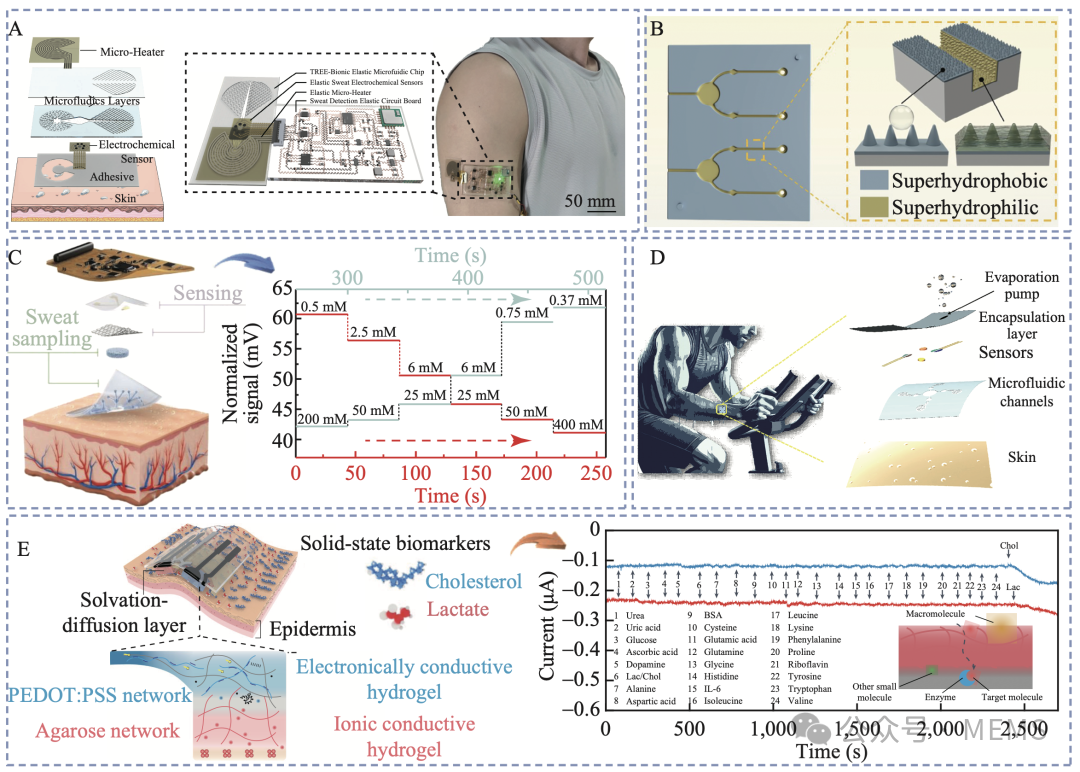 Figure 1 Sampling section of microfluidic sweat sensors2 Multi-Channel Sweat Detection in Wearable Microfluidic DevicesCompared to single analytical methods, multi-channel analysis has unique advantages, allowing for a more comprehensive and in-depth reflection of the physiological state of the human body through the collaborative analysis of multi-parameter data, providing multi-dimensional physiological information. Microfluidic technology, with its miniaturized channel structure and low sample consumption characteristics, provides the technical foundation for achieving synchronous multiplex analysis of various biomarkers and efficiently detecting complex biological samples on the same platform.
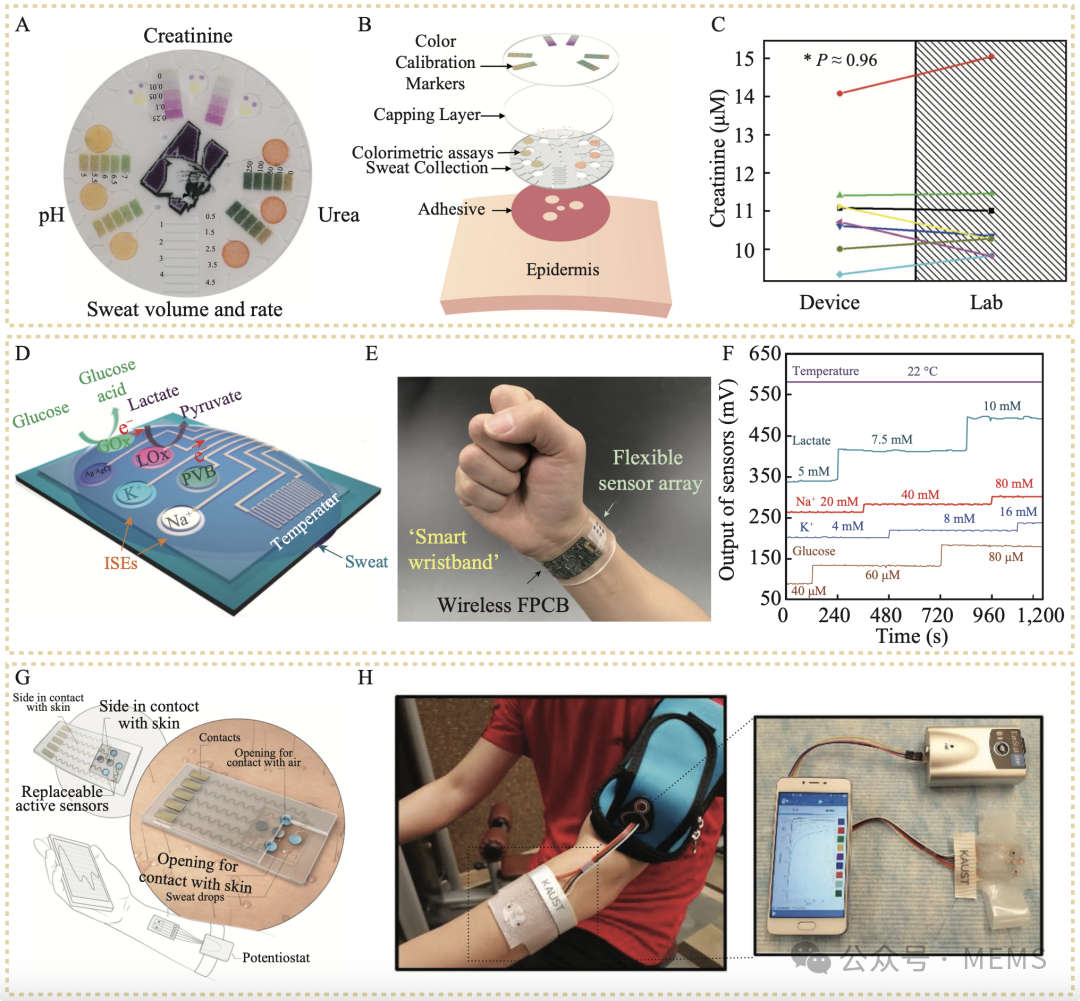 Figure 2 Microfluidic device for multi-channel sweat testingDespite significant progress in the health monitoring field, multi-channel microfluidic sweat sensors still face numerous challenges. First, the sensitivity and selectivity of the sensors need further enhancement to cope with the influence of various interfering substances in complex biological environments; second, the mechanical properties and biocompatibility of existing materials still need optimization to meet the demands of long-term wear; additionally, the integration level, power consumption, and wireless transmission capabilities of the sensors also require improvement to achieve real-time and continuous monitoring. Therefore, future research will focus on the following directions: developing high-performance new materials to improve detection performance; developing intelligent materials with self-repair and adaptive capabilities to further enhance the durability and comfort of sensors; promoting the deep integration of flexible electronics and microfluidic technology to create smaller, smarter wearable devices.3 Integration of Artificial Intelligence (AI) Technology in Wearable Microfluidic DevicesThe main challenge of multi-channel sweat detection technology lies in efficiently processing and analyzing the massive data from different sensors and extracting valuable physiological information from it. The introduction of artificial intelligence technology provides new ideas for solving this problem. Moreover, in the process of achieving precise sweat analysis, the high-fidelity collection of raw samples and the dynamic compensation for individual physiological differences are also major challenges faced by this technology. The spatiotemporal heterogeneity of sweat secretion is influenced by various factors such as age, gender, and exercise intensity, while the interference from epidermal contaminants (such as sebum and stratum corneum) can lead to distortion of biomarker concentrations. Microfluidic systems integrated with artificial intelligence technology can effectively address these challenges through “algorithm-structure” collaborative optimization. Machine learning models can dynamically analyze the nonlinear relationships between physiological variables and sweat biomarkers, while the closed microchannel design physically isolates cross-contamination, both of which enhance the reliability of detection results.The sensing routes based on artificial intelligence technology mainly fall into two categories: open visual sensing and closed self-driven sensing. The former relies on cloud or external devices for artificial intelligence analysis, suitable for complex data processing and personalized applications.Currently, existing systems still face three challenges: (1) Although microfluidic isolation designs can improve sample purity, increased flow resistance leads to reduced sweat flow rates and decreased collection efficiency; (2) The issue of inter-individual data drift remains unresolved, with existing transfer learning algorithms still exhibiting errors in cross-age generalization tests; (3) The heterogeneous feature extraction of multi-modal data (electrochemical, optical, and bioelectrical signals) lacks a unified framework, limiting real-time analysis efficiency. Future research could focus on developing low-flow-resistance biomimetic microfluidic interfaces to achieve efficient collection of resting-state sweat; constructing meta-learning models that integrate physiological characteristics (heart rate variability and skin impedance) to enhance algorithm personalization capabilities; designing lightweight system architectures to achieve cross-device data collaborative optimization while protecting privacy. Through cross-scale innovations in “materials-algorithms-systems,” the practical clinical monitoring applications of wearable microfluidic technology can be accelerated.
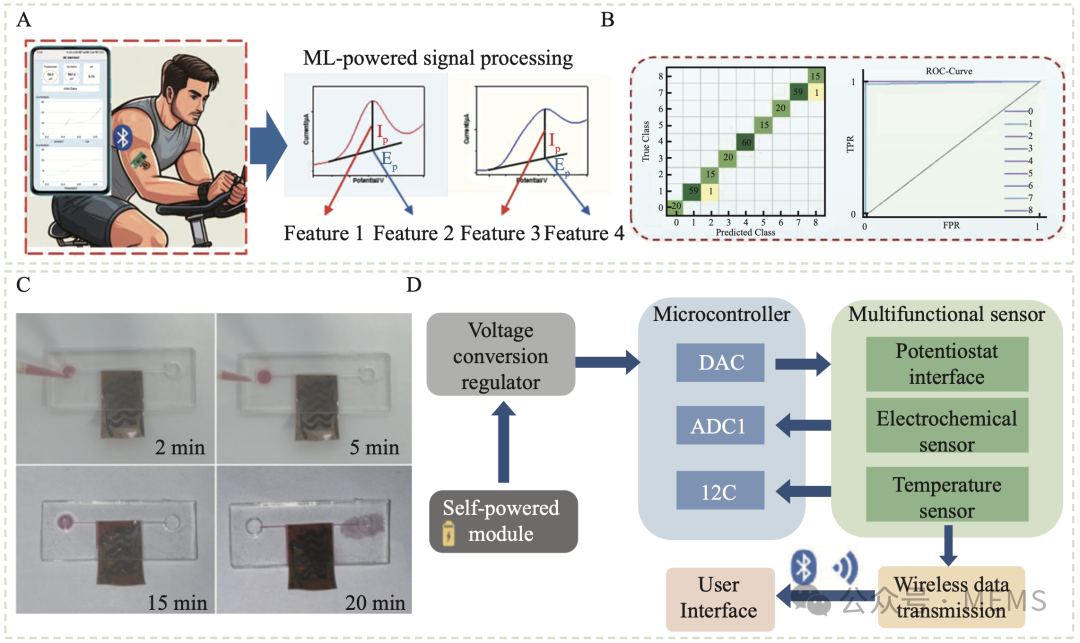 Figure 3 Sensors integrated with artificial intelligence technology4 Self-Powered Sweat SensorsThe introduction of artificial intelligence technology significantly enhances the data processing and analysis capabilities of wearable microfluidic devices, providing more efficient solutions for multi-channel sweat detection. However, the continuous operation of such devices relies on a stable energy supply, and self-powered technology offers a potential solution for the sustained energy supply of wearable devices. By combining artificial intelligence with self-powered technology, wearable microfluidic devices can not only achieve real-time monitoring of multi-channel sweat biomarkers but also operate stably for long periods without external power, providing more reliable technical support for personalized health management and early disease warning, further highlighting the importance of multi-channel sweat sensing in the wearable medical field.Currently, there are two main types of self-powered technology: one is energy harvesting through mechanical energy-to-electric energy conversion, such as triboelectric nanogenerators (TENG) and piezoelectric nanogenerators (PENG); the other is chemical energy-to-electric energy conversion (such as biofuel cells and redox batteries), which directly utilizes the biochemical properties of sweat for energy supply. These technologies break through the capacity limitations of traditional flexible batteries, providing a new model for constructing integrated “detection-supply” systems.Despite significant progress, existing self-powered systems still face challenges such as mechanical energy collection being limited by the intensity and frequency of human movement and insufficient stability of energy supply in static scenarios. Additionally, the efficiency of chemical energy conversion is significantly affected by individual differences and dynamic fluctuations in sweat composition; at the same time, there is a lack of multi-modal energy collaborative mechanisms, and mechanical and chemical energy conversion systems have not achieved effective coupling.
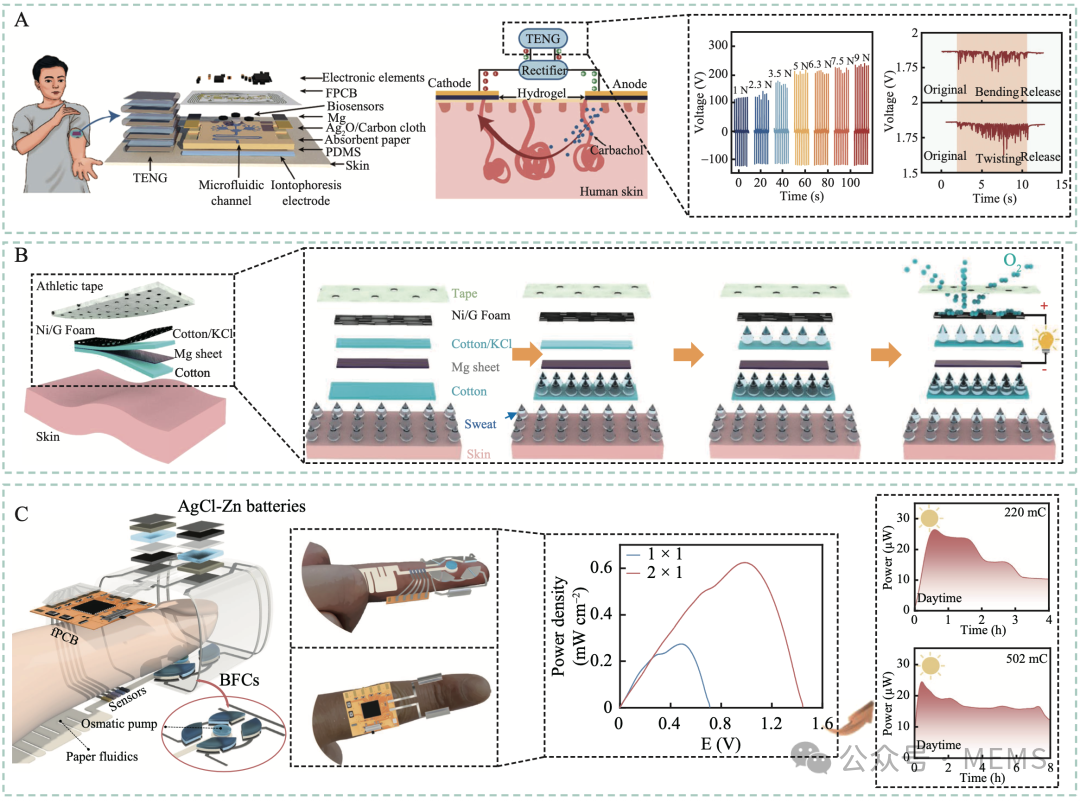 Figure 4 Microfluidic chip for self-powered sweat sensing5 Challenges and Future Development Directions of Wearable Microfluidic TechnologyWith the development of wearable sensing devices, microfluidic and wearable microfluidic technology will play an increasingly important role, particularly in the medical and sports fields. Therefore, wearable microfluidic platforms for sweat sensing must ensure the ability to provide accurate and reliable results over extended periods.To achieve this goal, numerous challenges must be overcome. (1) The mixed flow of electrolytes, metabolites, and gases in sweat may trigger laminar flow phenomena, leading to uneven distribution of sweat biomarkers in microchannels, which may dilute or locally enrich biomarkers, affecting the detection sensitivity of sensors; moreover, mixed flow may cause cross-interference between different components, deviating detection results from true values and reducing data reliability and accuracy. (2) The instability of sweat secretion rates during dynamic movement can have multiple impacts on sensor performance. First, it can lead to fluctuations in sensor signals, increasing noise interference and reducing the signal-to-noise ratio; second, it may alter the fluid dynamics characteristics within microfluidic channels, delaying the transport and detection processes of biomarkers, affecting real-time monitoring capabilities; finally, it requires dynamic calibration of sensors, increasing the complexity and difficulty of calibration algorithms. (3) The limited energy capacity of miniaturized devices leads to short battery life, limited functional expansion, and performance degradation at low power levels.To optimize sensor performance in response to the above issues, researchers can employ the following methods: (1) Introduce real-time calibration algorithms that dynamically correct detection results using auxiliary data such as skin temperature and environmental humidity; (2) Develop adaptive signal filtering technologies to effectively suppress noise interference caused by variations in sweat flow rates; (3) Design low-power hardware architectures to optimize the energy consumption of sensors and signal processing modules. These strategies are expected to enhance the stability and accuracy of sensors, providing technical support for the application of wearable devices in complex physiological environments.Although multi-channel sweat sensing technology has made certain research progress in laboratory environments, its commercialization still faces numerous challenges. First, cost control is one of the key issues, including material costs, manufacturing processes, and equipment maintenance expenses. For example, the precision processing of microfluidic chips and the integration of high-performance sensors may lead to high production costs, necessitating the optimization of manufacturing processes and large-scale production to reduce costs. Second, the feasibility of large-scale production needs further validation, including how to achieve high consistency, high yield manufacturing, and how to meet the customization needs of different application scenarios.The development of wearable microfluidic devices requires interdisciplinary collaboration (materials science, bioengineering, and data science), and breakthroughs in their research will promote personalized medicine from “intermittent testing” to “continuous dynamic perception,” providing users with low-cost and convenient home diagnosis and treatment solutions. Moreover, the most significant potential of using wearable microfluidics for sweat analysis lies in its ability for personalized monitoring. Over the past few decades, physiological research has primarily relied on analyses conducted in laboratory environments, which are typically performed under stable conditions and cannot fully reflect the complex situations in real scenarios, such as climate, exercise intensity, and other external factors that may significantly affect physiological responses.In recent years, the rapid development of artificial intelligence technology has also made significant progress in applied research in medicine and physiological sciences. This provides technical support for developing intelligent devices capable of real-time measurement, calculation, and prediction of body state trends, thereby optimizing health management or training models. By introducing AI-driven calibration learning algorithms, the detection values of biomarkers in sweat can be correlated with other key factors (such as changes in body temperature and microbiome), generating reliable data related to blood test values. Although challenges such as difficulties in data acquisition and measurement errors still exist, the continuous advancement of artificial intelligence technology is expected to reduce deviations caused by sweat conditions and sweat gland systems. Furthermore, future intelligent systems are expected to achieve personalized detection results, generating exclusive personalized models based on individual physiological characteristics. This personalized model can not only more accurately reflect an individual’s health status but also provide a scientific basis for personalized medicine and health interventions, thereby promoting the transition of medical research from generalization to personalization.6 Conclusion and OutlookThis article focuses on multi-channel sweat sensors based on microfluidic chips, systematically reviewing the latest progress in sweat collection, wearable sensing implementation, and the collaborative multi-parameter detection of artificial intelligence technology from the perspective of multi-channel collaborative sensing, discussing the key challenges currently faced by wearable microfluidic technology. Numerous studies have shown that the precise fluid control capabilities and efficient sample processing performance of microfluidic technology provide important technical support for the real-time, non-invasive detection of sweat biomarkers. However, in practical applications, issues such as the standardization of raw sweat collection, multi-channel sensing signal crosstalk, and the miniaturization and flexibility of devices remain urgent bottlenecks to be solved. Integrating artificial intelligence technology as a modifiable calibration factor into the wearable microfluidic technology system provides new ideas for addressing the current challenges faced by devices. In the future, with the deep integration of materials science, manufacturing processes, and artificial intelligence technology, wearable microfluidic technology is expected to achieve broader applications in personalized health monitoring, sports science, and early disease diagnosis.
Further Reading:
“Biosensor Technology and Market for Instant Diagnosis Applications – 2022 Edition”
“Wearable Sensor Technology and Market – 2025 Edition”
“Analysis of Abbott’s Freestyle Libre Continuous Glucose Monitoring Sensor Products”
“Analysis of Apple’s Patents and Industry Layout in Non-Invasive Glucose Monitoring”
“Patent Landscape Analysis of Raman Spectroscopy for Glucose Monitoring – 2024 Edition”
“Diabetes Management Technology and Market – 2025 Edition”
“Printed and Flexible Sensor Technology and Market – 2024 Edition”
“3D Electronics and Additive Manufacturing Electronics Technology and Market – 2024 Edition”