
Question:
>>> How to connect the analog world to the physical world?
Engineers will readily provide the answer—use ADC and DAC. Analog-to-digital converters (ADC) and digital-to-analog converters (DAC) are devices that convert analog signals into digital signals or vice versa. In this area, ADI offers a comprehensive range of data converter products, with DACs covering from 8-bit to 24-bit, catering to various applications such as industrial automation, programmable logic controllers, optical transceivers, and data acquisition, providing precise, reliable, and unparalleled conversion performance and value; ADCs achieve precise and reliable conversion performance across various applications, including communications, energy, medical, instrumentation and measurement, motor and power control, and industrial automation.
To better assist engineer friends in completing various stages of product selection to circuit design, we highly recommend ADI’s newly launched e-book ‘Basic Architecture of ADC and DAC’, which aims to clarify the key points and architectural examples related to the use of ADCs and DACs. We invite everyone to scan the code to receive it for free!

 Scan the QR code to get‘Basic Architecture of ADC and DAC’DAC Architecture DiscussionHighlights
Part 01


Rather than viewing DACs as black boxes with digital inputs and analog outputs, understanding the basic architectures of contemporary DACs will facilitate applications and simplify the selection process; otherwise, considering the plethora of DACs available in the market, product selection can be quite challenging. This section of ‘Basic Architecture of ADC and DAC’ will mainly discuss different basic architectures of DACs—“String” DACs, “Thermometer” DACs, Binary DACs, Segmented DACs, etc.
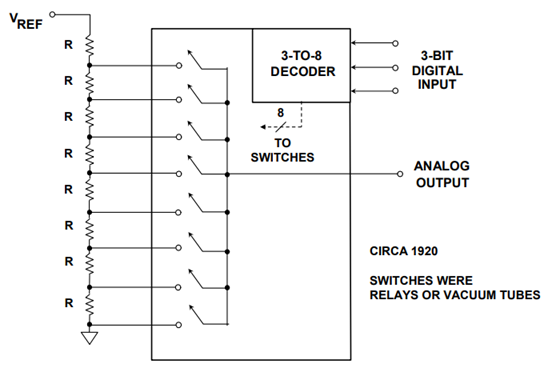
As shown in Figure 1, the simplest DAC structure can be formed using 2N equal series resistors and 2N switches (usually CMOS)—the Kelvin voltage divider or string DAC. This architecture is very simple and has one voltage output (though the output impedance is code-dependent) and is inherently monotonic; even if a resistor accidentally shorts, output n will not exceed output n+1. With slight modifications, it can yield a “digital potentiometer” (Figure 2).
 >
>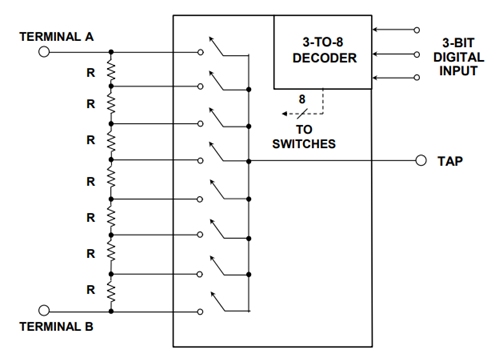
Figure 1. Voltage Output Thermometer DAC > Figure 2. “Digital Potentiometer”

As high resolution becomes increasingly demanded, binary-weighted DACs and segmented DACs constitute the pillar architectures of modern precision and high-speed DACs. In 1970, ADI launched the AD550 “μDAC” single-chip four-channel (4-bit) current-switching module IC, as shown in Figure 9. Note that the binary-weighted current is generated using an external thin-film network, while the on-chip laser-trimmed thin-film resistor technology was developed years later. The transistor area is proportional (8:4:2:1), ensuring equal current density across all transistors for optimal VBE matching. The basic circuit principles established by these early IC DACs remain widely applicable today.
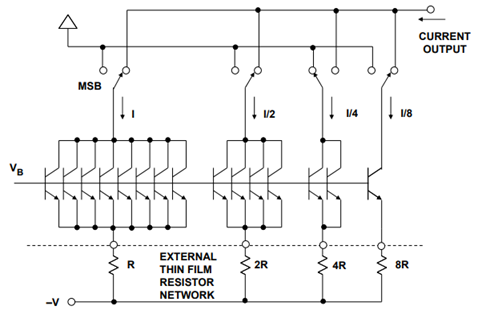
Figure 3. AD550 “μDAC” Four-Channel Switch
When designing a DAC with specific performance, it is likely that no single architecture is ideal. In this case, two or more DACs can be combined into a higher resolution DAC to achieve the desired performance. These DACs can be of the same type or different types, and the resolutions of each DAC do not need to be the same. In principle, one DAC handles the MSB, while another DAC handles the LSB, and their outputs are summed in some manner. This process is referred to as “segmentation,” and these more complex structures are called “segmented DACs.”
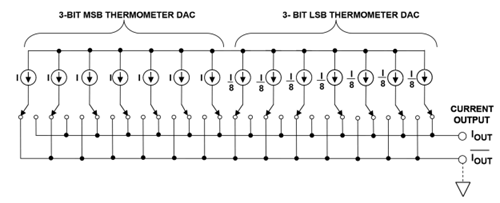
Figure 4. 6-bit Current Output Segmented DAC Based on Two 3-bit Thermometer DACs
Scan to download the complete e-bookLearn more about DAC architecture knowledgeDAC Interface PrinciplesHighlights
Part 02
More and more people simply regard DACs as devices with digital inputs and an analog output. However, the analog output depends on the presence of an analog input called the reference voltage source, and the accuracy of the reference voltage source is almost always the limiting factor of the absolute accuracy of the DAC. Design tools like the Voltage Reference Wizard are very useful when matching the reference voltage source with the data converter.
Various ADCs and DACs support the use of external reference voltage sources to replace internal reference voltage sources in various ways. The following diagram provides some common configurations—converters requiring external reference voltage sources; converters with built-in reference voltage sources; converters that use internal or external reference voltage sources but require additional package pins; external reference voltage sources; using a single package pin for external reference voltage sources to override internal reference voltage sources; connecting external reference voltage sources to override internal reference voltage sources…
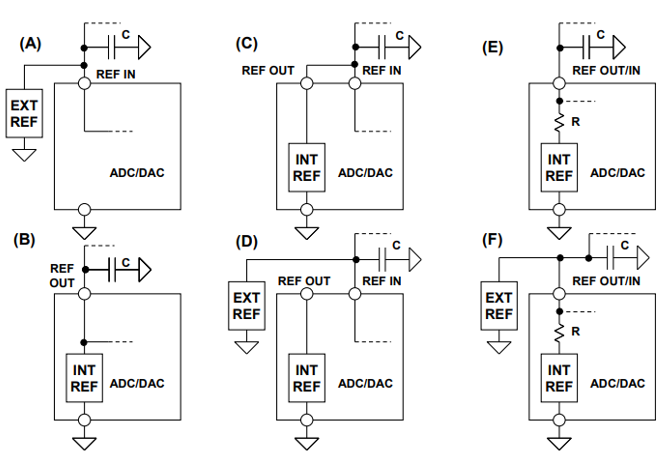
Figure 5. Common ADC/DAC Reference Voltage Source Options
The analog output of a DAC can be either voltage or current. In both cases, it may be necessary to know the output impedance. A well-designed reference voltage source can remain stable when using heavy capacitive decoupling. Unfortunately, some reference voltage sources do not achieve this, and the larger the capacitor, the more transient ringing oscillation will actually increase. Since converters almost always require some local decoupling, such reference voltage sources are practically useless in data converter applications. A suitable operational amplifier buffer can be added between the reference voltage source and the data converter. However, many high-quality reference voltage sources can remain stable when using output capacitance. This type of reference voltage source should be chosen for data converter applications instead of further complicating the operational amplifier and increasing costs.
Scan to download the complete e-bookLearn more about DAC interface knowledgeADC Structure AnalysisHighlights
Part 03
Based on type, ADC architectures can be classified in various ways:Flash converters; Successive Approximation ADCs; Σ-Δ ADCs; Pipelined ADCs; Folding ADCs; Counting ADCs; Integrating ADCs…
Among them, successive approximation ADCs have always been a mainstay in data acquisition systems. Recent design improvements have extended the sampling frequency of these ADCs into the megahertz range with a resolution of 18 bits. As successive approximation ADCs become increasingly popular, their resolution, sampling rates, input/output options, and costs have started to diversify. Nowadays, many SAR ADCs offer on-chip input multiplexers, making them ideal for multi-channel data acquisition systems.
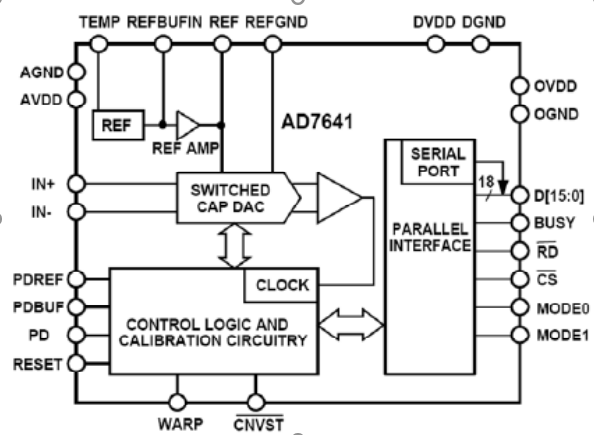
Figure 6. 18-bit 2-MSPS Switched Capacitor PulSAR® ADC AD7641
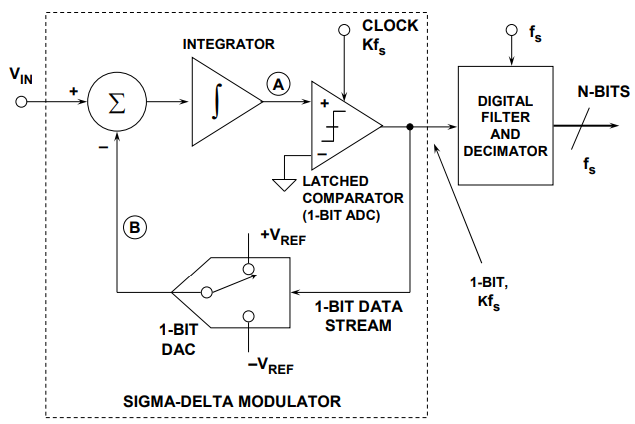
Meanwhile, Σ-Δ ADCs are favored converters in modern audio bandwidth, audio, and high-resolution precision industrial measurement applications. The highly digital architecture is well-suited for modern fine-line CMOS processes, allowing easy addition of digital functions without significantly increasing costs.
Scan to download the complete e-bookLearn more about ADC structures
In the book ‘Basic Architecture of ADC and DAC’, there are more chapters on nonlinear DACs, basic principles of direct digital frequency synthesis, voltage-to-frequency converters, etc. We welcome you to download and learn.
 Good materials should be shared widely~ Forward, like, and check it out?