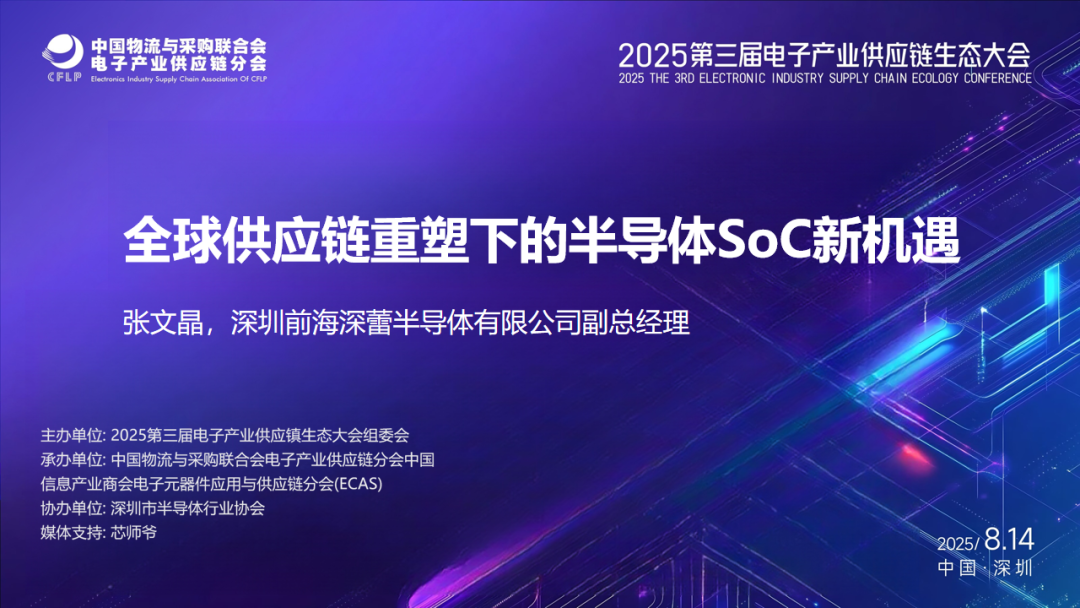
Amid the dual waves of global supply chain restructuring and technological revolution, the semiconductor industry is experiencing unprecedented changes and opportunities.On August 14, at the “Chip Chain: Innovating the Future Globally” forum, Zhang Wenjing, Deputy General Manager of Shenzhen Qianhai Shenlei Semiconductor Co., Ltd., delivered a remarkable speech titled “New Opportunities for Semiconductor SoCs Amid Global Supply Chain Restructuring,” analyzing the current state, challenges, and future directions of the semiconductor industry, and sharing the company’s strategic practices in globalization and technological innovation.
Globalization and Semiconductors: From Collaboration to Restructuring
Zhang Wenjing used the vivid example of “a smartphone embodying global wisdom” to reveal the highly globalized nature of the semiconductor industry— the birth of a chip requires collaboration across more than 30 countries, over 500 companies, and thousands of engineers. However, in recent years, issues such as geopolitical games, single-point risks in the supply chain, and regional development imbalances are accelerating the transition of the global supply chain from “efficiency-first” to “safety-first.”Zhang Wenjing pointed out: “The retreat of globalization and the trend towards regionalization are unstoppable, and China, as the core market for 40% of global semiconductor demand, is facing a historical opportunity to shift from ‘passive acceptance’ to ‘active leadership.’”
SoC: The “Ecological Heart” of the Semiconductor Industry
System-on-Chip (SoC) is hailed as the culmination of semiconductor technology, its importance lies not only in technological integration (such as the fusion of CPU, GPU, and AI computing power) but also in being the “source of ecological innovation.” However, Zhang Wenjing believes that China’s SoC industry still faces three major challenges:
Technological Bottlenecks: Dependence on imports for advanced processes and IP architectures;
Ecological Barriers: Global compatibility issues of Android and Apple ecosystems;
Market Breakthrough: High-end profits are monopolized by international giants, and the resistance to mid- and low-end exports is increasing.
Although Huawei’s Kirin chips once surpassed Qualcomm, the technological gap after sanctions warns the industry: autonomy must run parallel with a globalized ecosystem.
Path to Breakthrough: AI Revolution and “Trinity” Advantages
In the face of challenges, Zhang Wenjing proposed a breakthrough path of “technological revolution + market advantages + ecological innovation”:
• AI Empowerment at the Edge: After 2025, AI will migrate from the cloud to the device side, creating a market worth trillions. The success of companies like DJI and BYD has validated the path of “technological breakthroughs → product innovation → ecological leadership.”
• China’s “Trinity” Advantages: The world’s most complete education system, efficient semiconductor technology iteration capabilities, and rapid application deployment speed provide full-chain support from supply chain to product innovation.
Shenlei Semiconductor’s ongoing practices are a microcosm of this strategy:
Technical Aspects: Focus on edge AI processors, launching a full range of standardized chips;
Product Innovation: Integration of smart mobile terminals with AI interaction, covering scenarios such as enterprise consulting and hotel management;
Ecological Construction: Through an open-source hardware and software platform, collaborating with global developers and suppliers to create a “solution-level export” model.
At the end of the speech, Zhang Wenjing stated “The global chip chain is not only a sentiment but also a strategy; innovating the future requires not only technology but also ecology.” Only by connecting international ecosystems through open-source collaboration and relying on domestic supply chain and market advantages can we achieve a leapfrog in emerging fields such as AIoT and new energy vehicles.