Click the “Smart Dog” above to follow us
Everyone knows that mobile processors are a complete SoC that integrates modules like CPU, GPU, and baseband. Therefore, when performance is the only consideration, the model of the processor in a phone is the core factor. However, mobile processors are frequently updated, and “sister models” with different tail numbers often appear. If you can’t understand the significance of the tail number, you may encounter various problems when choosing a phone.
Genetic Quality Change
Representative Processor: Samsung Exynos 8890 → Exynos 8895
Many people traditionally believe that the first or second digit of the processor model is the key to determining quality changes. For example, Qualcomm Snapdragon 810 → Snapdragon 820, Snapdragon 820 → Snapdragon 835; MediaTek Helio X10 → X20, Helio X20 → X30; Kirin 950 → Kirin 960, Kirin 960 → Kirin 970, etc. We can interpret the updates of these mobile processors as architecture upgrades similar to PC processors, such as upgrading from the first generation Core processor to the second generation Core, which naturally brings significant performance and functionality improvements.
However, Samsung’s latest flagship processor, the Exynos 8895, breaks this tradition. Compared to the previous flagship Exynos 8890 (representing phones: Samsung overseas version S7 series, Meizu Pro6 Plus), the only difference is that the tail number changes from 0 to 5, but the performance between the two will be worlds apart.
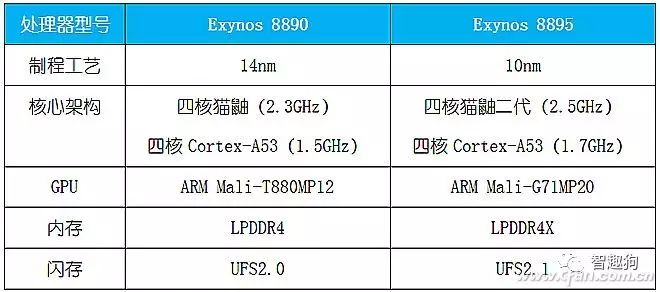
In simple terms, the Exynos 8895 uses the latest 10nm process technology, and the “big core” part of the CPU has been replaced with Samsung’s self-developed second-generation Mongoose core. Thanks to the lower energy consumption advantage of the 10nm process, the Exynos 8895 can run at 2.5GHz or higher clock speeds, while the GPU has also been upgraded to the new ARM flagship Mali-G71, which includes 20 computing cores, specifically Mali-G71MP20. In comparison, the Kirin 960 used in Huawei Mate 9/P10 also integrates Mali-G71 GPU, but it is only equipped with 8 computing cores, namely Mali-G71MP8.
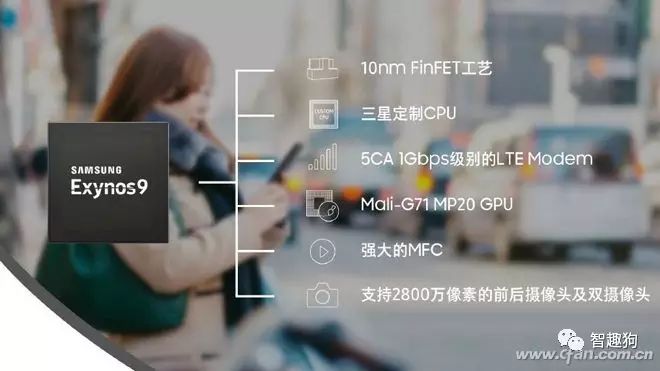
This isn’t the end; the Exynos 8895 integrates the latest gigabit modem, supporting FD-MIMO, LBT, and other licensed spectrum-assisted access technologies. The ISP has also been specially optimized for dual-camera setups. Additionally, to align with future trends in AI and VR technology, the built-in VPU of the Exynos 8895 incorporates machine learning technology to assist the CPU in motion target detection, image matching, video tracking, and object recognition calculations. In terms of security, the Exynos 8895 directly integrates an independent security chip, enabling hardware-level encryption.
Different Core Counts
Representative Processor: Qualcomm Snapdragon 650 → Snapdragon 652
Cases like the Exynos 8895, which arise from genetic quality changes, are extremely rare. However, situations where performance changes occur due to a tail number change do exist, with the most typical example being Qualcomm Snapdragon 650 and Snapdragon 652.
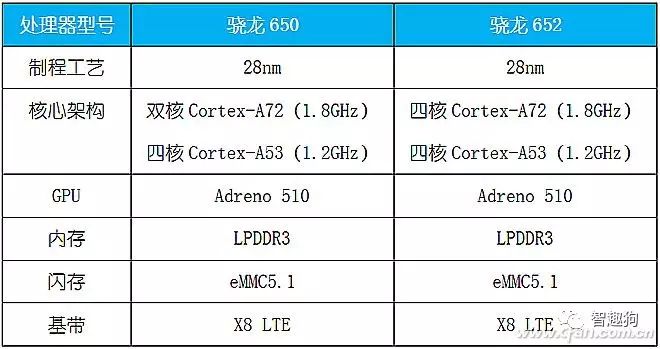
Both processors use the same process, GPU, and have identical functionality and performance in memory/flash and communication baseband. However, the Snapdragon 650 is a six-core processor composed of dual-core Cortex-A72 and quad-core Cortex-A53, while the Snapdragon 652 adds two additional Cortex-A72 cores, making it an eight-core processor. In multi-core performance tests, the Snapdragon 652 shows a significant performance advantage.

Core Architecture Differences
Representative Processor: Qualcomm Snapdragon 615 → Snapdragon 616 → Snapdragon 617
Setting aside the Exynos 8890 and Exynos 8895, the Snapdragon 650 and Snapdragon 652, other processors that only differ in tail numbers should not have significant changes, right? Unfortunately, there is another case that deserves our attention, which is the transition from Snapdragon 615 to Snapdragon 617.
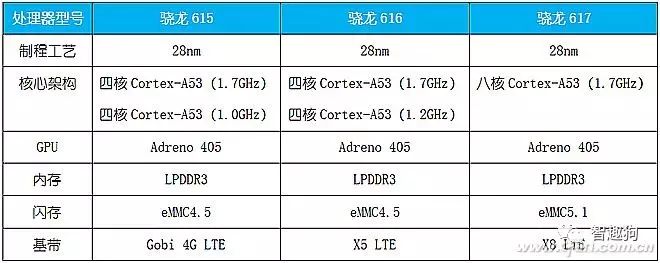
The suffix numbers of these three processors increase by 1, which gives the impression that it is merely an ordinary frequency upgrade. In fact, the change between the Snapdragon 615 and Snapdragon 616 meets our expectations, with the new Snapdragon 616 only increasing the little core frequency and switching to a better communication baseband. However, the Snapdragon 617 represents a change at the core architecture level.
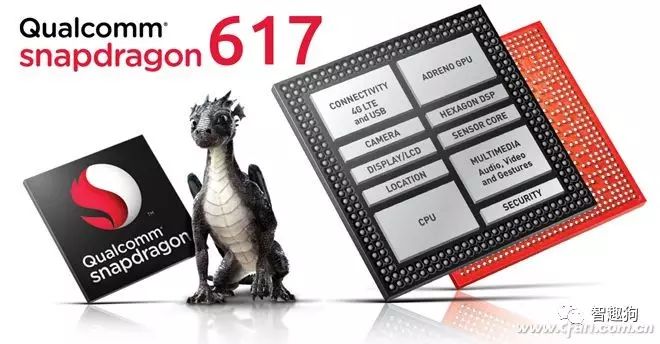
Whether it is the Snapdragon 615 or the Snapdragon 616, they are both eight-core processors composed of four high-frequency Cortex-A53 cores and four low-frequency Cortex-A53 cores. Although big.LITTLE allows all cores to work together, the efficiency still lags a bit due to the frequency difference between the big and little cores. The Snapdragon 617, however, directly adopts an eight-core Cortex-A53 architecture, allowing all cores to operate at 1.7GHz under full load, resulting in significantly better performance in testing compared to its two predecessors.
Updates Hidden Behind Frequency Changes
Representative Processors: Qualcomm Snapdragon 425 → Snapdragon 427, Snapdragon 430 → Snapdragon 435, Snapdragon 625 → Snapdragon 626, Snapdragon 652 → Snapdragon 653
In the development history of mobile processors, changes in tail numbers mostly indicate slight adjustments in frequency, achieving performance upgrades through higher frequencies, thus increasing selling points and hype. However, if it were merely a frequency modification, it might seem insincere, so many processors also “offer” many “Easter eggs” alongside frequency changes, and Qualcomm is a prime example of this.
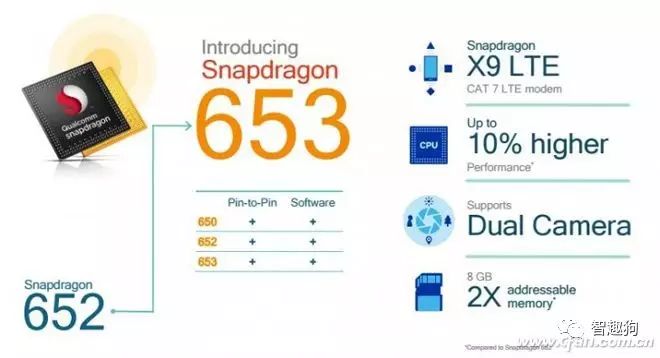
From the upgrades of Snapdragon 425/430/625/652 to Snapdragon 427/435/626/653, we can easily find a pattern. Taking the currently popular Snapdragon 652 and Snapdragon 653 as examples, the biggest difference between them is that the Snapdragon 653 increases the main frequency by 150MHz, resulting in a performance gain of 5% to 10%.
However, Qualcomm also upgraded the baseband chip for Snapdragon 653, from the X8 LTE of Snapdragon 652 to X9 LTE, achieving a 50% increase in maximum upload speed. In addition, Snapdragon 653 supports a maximum of 8GB of memory, which is more in line with future smartphone development trends.
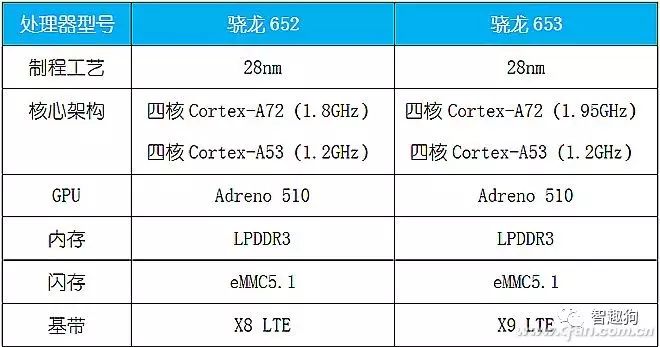
In fact, whether it is Snapdragon 653 or Snapdragon 427/435, all these new processors with tail number changes have adopted the strategy of increasing frequency + upgrading to X9 LTE baseband, which has improved the performance of the phones that use them in terms of benchmark scores and network performance. It is important to note that the difference between Snapdragon 625 and Snapdragon 626 is relatively minor, as Snapdragon 625 already integrates X9 LTE, while Snapdragon 626 only increases the frequency by 200MHz and adds support for TruSignal (antenna signal enhancement) technology.
In addition to frequency, there are functional optimizations
Representative Processors: Qualcomm Snapdragon 820 → Snapdragon 821, MediaTek Helio P20 → P25
There is a cycle for updating communication basebands, which means that many new mobile processor models cannot be updated to the most advanced basebands in time. To add more selling points and hype, chip manufacturers have thought of another approach: optimizing existing functions while increasing frequency due to tail number changes.
Taking Qualcomm Snapdragon 820 and Snapdragon 821 as examples, both adopt the same core architecture, GPU, and baseband technology, with the only specification difference being a slight increase in CPU and GPU frequencies for Snapdragon 821. However, considering that dual-camera technology has become a trend in Android phones, Qualcomm has endowed Snapdragon 821 with native support for dual-camera focusing, added All-Ways Aware technology (optimizing the intelligent processing center for sensor data collection), and provided Snapdragon VR SDK.

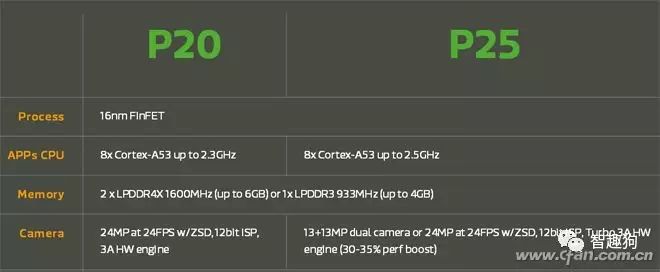
MediaTek’s Helio P20 and Helio P25 also adopt this approach, both based on 16nm process technology, using an eight-core Cortex-A53 architecture and integrating Mali-T880MP2 GPU, with Helio P25 increasing the maximum frequency from 2.3GHz to 2.5GHz, while also adding support for 12-bit dual ISP, resulting in some improvement in dual-camera photography.
Simply Frequency Changes
Representative Processors: Kirin 650 → Kirin 655, Kirin 950 → Kirin 955, MediaTek Helio X20 → X25, MediaTek MT6755 → MT6755M
The processors above represent what many people expect regarding tail number changes. Yes, the only difference is a simple frequency variation; apart from benchmark scores, there is virtually no difference in experience or functionality.
Taking MediaTek Helio X20 and Helio X25 as examples, both adopt a dual-core Cortex-A72 + quad-core Cortex-A53 (high frequency) + quad-core Cortex-A53 (low frequency) architecture design, integrating Mail-T880MP4 GPU. The only change between the two is that Helio X25’s maximum frequency is 200MHz higher than that of X20.
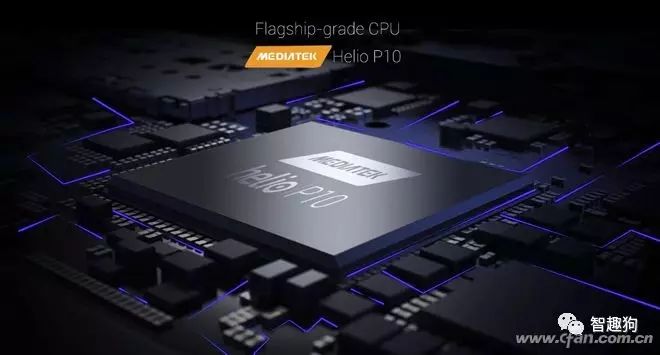
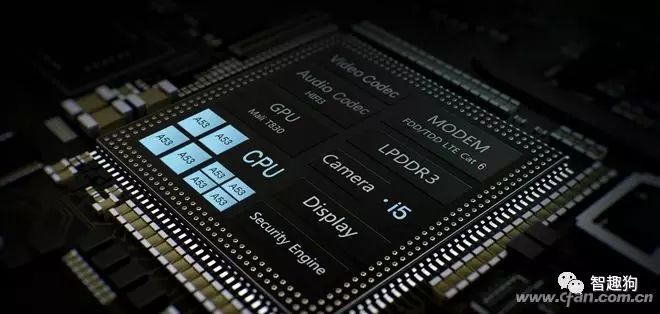
In MediaTek processors, there is also a common case, which is Helio P10 (MT6755). This processor was quite popular in the mid-range smartphone market in 2016, but attentive readers may notice an issue: some phones equipped with Helio P10 have a frequency of 2.0GHz, while others only have 1.8GHz. In fact, this is also a product strategy by MediaTek, segmenting Helio P10 into two sub-models, MT6755 (2.0GHz) and MT6755M (1.8GHz), with only frequency differences, where the latter has a lower cost.
Small Tip: Smartphone manufacturers occasionally adjust the frequency of mobile processors based on product positioning, as well as thermal and performance requirements. For instance, the Snapdragon 820 in Xiaomi 5 has a frequency of only 1.8GHz, while it should be 2.15GHz.
Rational Perspective on Tail Number Differences
In most cases, changes in the tail number of mobile processors represent slight upgrades, serving as a transitional solution for chip manufacturers before launching a new generation of processors. If the new processor does not exhibit significant changes in core (like Snapdragon 650 → Snapdragon 652) or architecture (like Snapdragon 616 → Snapdragon 617), even processors like Snapdragon 653 that increase main frequency and improve baseband are not particularly worth blindly purchasing.
The reason is simple: whether it’s a slight increase in frequency, improved baseband, or optimized dual-camera photography functions, they are unlikely to produce significant performance gains. For example, with MediaTek Helio X20, if it struggles to run a game smoothly, Helio X25 will not run it smoothly either; conversely, if X25 runs a game smoothly, X20 will have no issues. When the GPU model remains unchanged, the CPU’s clock speed has negligible impact on gaming performance.
Therefore, there is no need to “believe” in new processors with changes in tail numbers; chips like the Exynos 8895, which represent core quality changes, are indeed rare.
Finally, let’s summarize
Having read this, I believe you have gained some understanding of the differences in mobile processors due to different tail numbers. From a consumer’s perspective, we naturally hope that processors with higher tail numbers can achieve breakthroughs at the core or architecture level, or at least show improvements in network or functionality. Unfortunately, what we say does not count; only by understanding the relationships between them can we avoid the risks of being misled when purchasing.
After reading this article, 99% of readers will also click:


Click “Read the Original” below for more.