✅ Author Profile: A research enthusiast and Matlab simulation developer, skilled in data processing, modeling simulation, program design, complete code acquisition, paper reproduction, and scientific simulation.
🍎 Previous reviews, follow the personal homepage:Matlab Research Studio
🍊 Personal motto: Investigate things to gain knowledge, complete Matlab code and simulation consultation content via private message.
🔥 Content Introduction
During vehicle operation, various factors such as uneven road surfaces, acceleration, and braking can induce vibrations and changes in posture. The suspension system, as a key component connecting the vehicle body and wheels, primarily functions to buffer and attenuate these vibrations, ensuring vehicle stability and ride comfort. Traditional suspension system designs often rely on experience and static parameters, making it difficult to meet the high-performance requirements of modern vehicles under complex operating conditions. With the continuous development of vehicle technology, precise analysis and optimization of the dynamic performance of suspension systems have become increasingly important. The AVL response and longitudinal matrix formulation related to root loci provide new ideas and methods to address this issue. By constructing accurate mathematical models and adjusting parameters in the longitudinal matrix formulation, precise control over the dynamic response of the vehicle’s suspension system can be achieved, thereby enhancing the overall performance of the vehicle.
II. Related Theoretical Foundations
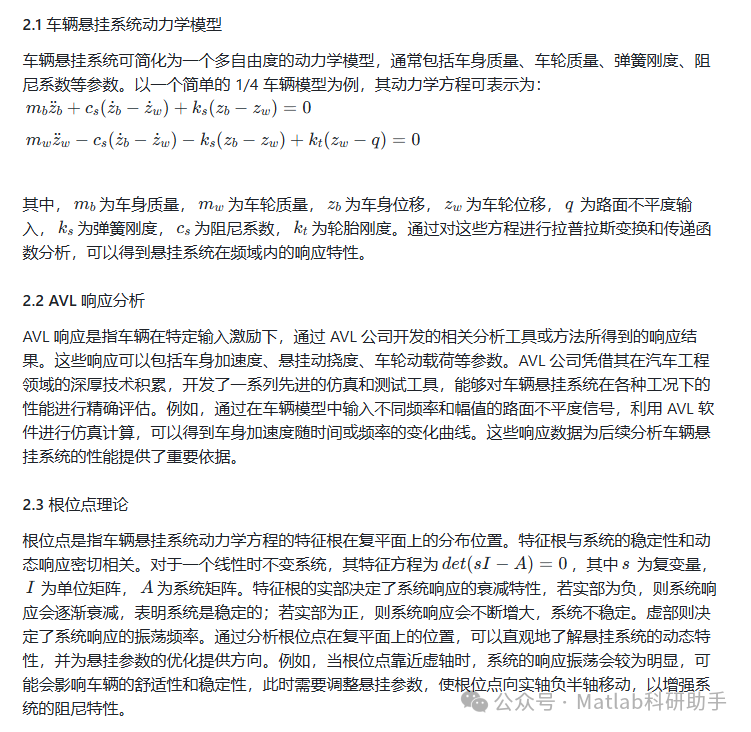
III. Principles of Longitudinal Matrix Formulation Design
3.1 Concept of Longitudinal Matrix
The longitudinal matrix is a mathematical model or set of parameters used to describe the characteristics of the suspension system during longitudinal motion of the vehicle. It contains information related to the spring stiffness, damping coefficient, and other relevant parameters of the suspension system, which can be adjusted according to different driving conditions and performance requirements of the vehicle. The longitudinal matrix considers not only the longitudinal dynamic characteristics of the vehicle during straight-line driving but also the response changes of the suspension system under conditions such as acceleration and braking. By reasonably designing the longitudinal matrix formulation, precise control over the dynamic performance of the vehicle’s suspension system during longitudinal motion can be achieved.
3.2 Key Factors Affecting AVL Response and Root Loci
In the design of the longitudinal matrix formulation, several factors can significantly impact the AVL response and root loci.
- Spring Stiffness: Spring stiffness directly determines the suspension system’s ability to support body displacement. Increasing spring stiffness can enhance vehicle handling stability, but it may also reduce ride comfort, as higher spring stiffness makes the body more sensitive to road irregularities. In the longitudinal matrix formulation, the value of spring stiffness needs to comprehensively consider the vehicle’s intended use, driving conditions, and the emphasis on comfort and handling. For example, high-performance sports cars may require higher spring stiffness to ensure stability during high-speed driving and aggressive handling, while urban commuter vehicles may prefer moderate spring stiffness to provide better ride comfort.
- Damping Coefficient: The damping coefficient controls the rate of vibration attenuation in the suspension system. An appropriate damping coefficient can effectively reduce body vibrations and avoid resonance phenomena. When the damping coefficient is too small, the suspension system’s vibration attenuation is slow, leading to prolonged residual vibrations after traversing bumpy roads, affecting ride comfort; when the damping coefficient is too large, although vibrations are attenuated quickly, it increases energy consumption in the suspension system and may affect vehicle handling performance in some cases, reducing tire grip on the ground. Therefore, accurately adjusting the damping coefficient in the longitudinal matrix formulation is key to achieving good AVL response and optimizing root loci distribution.
- Suspension System Structural Parameters: In addition to spring stiffness and damping coefficient, structural parameters of the suspension system, such as suspension arm length, kingpin inclination angle, and wheel camber angle, also affect AVL response and root loci. Changes in these parameters alter the kinematic and dynamic characteristics of the suspension system, thereby impacting vehicle stability and handling. For instance, appropriately increasing the kingpin inclination angle can enhance vehicle stability during straight-line driving, but excessive inclination can increase steering effort, affecting the vehicle’s steering agility. In the design of the longitudinal matrix formulation, it is necessary to consider the interrelationship between these structural parameters and spring stiffness and damping coefficient for collaborative optimization.
3.3 Construction Methods for Longitudinal Matrix Formulation
- Theory-Based Method: Based on the dynamic model of the vehicle suspension system and the theoretical analysis of AVL response and root loci, establish a mathematical relationship between the longitudinal matrix formulation and vehicle performance. By solving and optimizing the mathematical model, a longitudinal matrix formulation that meets specific performance requirements can be obtained. For example, using Linear Quadratic Regulator (LQR) theory, with performance indicators such as minimizing body acceleration, keeping suspension dynamic deflection within a reasonable range, and stabilizing wheel dynamic load, construct an objective function. By solving this objective function, optimal parameters such as spring stiffness and damping coefficient can be derived.
- Data-Based Method: By conducting extensive experiments on actual vehicles or vehicle test benches, collect AVL response data and suspension system parameters under different conditions. Using data analysis methods such as multiple linear regression and principal component analysis, establish empirical models relating the longitudinal matrix formulation to experimental data. Then, based on desired vehicle performance indicators, adjust parameters in the empirical model to derive suitable longitudinal matrix formulations. For instance, measure vehicle body acceleration, suspension dynamic deflection, and other response data under various road conditions and speeds, while recording corresponding suspension parameters such as spring stiffness and damping coefficient. By analyzing this data, establish functional relationships between response parameters and suspension parameters, and determine the longitudinal matrix formulation based on the required performance.
- Simulation Optimization Method: Utilize specialized vehicle dynamics simulation software, such as AVL Cruise or CarSim, to establish a detailed simulation model of the vehicle suspension system. In the simulation model, by adjusting parameters in the longitudinal matrix formulation, simulate vehicle performance under various conditions to obtain corresponding AVL response and root loci distribution. Then, employ optimization algorithms such as genetic algorithms or particle swarm optimization to iteratively optimize the longitudinal matrix formulation based on vehicle performance indicators until the optimal solution is found. For example, in AVL Cruise simulation software, construct a complete vehicle model, including powertrain, transmission system, and suspension system. By setting different longitudinal matrix formulation parameters, conduct multiple simulation calculations to obtain performance data for the vehicle under acceleration, braking, and cornering conditions. Use genetic algorithms to analyze and optimize this data, continuously adjusting the longitudinal matrix formulation to ultimately achieve the best performance.
IV. Longitudinal Matrix Formulation Optimization Process
4.1 Determine Optimization Objectives
Before optimizing the longitudinal matrix formulation, it is essential to clarify the optimization objectives. Optimization objectives are typically determined based on the vehicle’s design purpose and performance requirements. Common optimization objectives include:
- Enhancing Ride Comfort: The primary goal is to reduce body acceleration, allowing the vehicle to better filter vibrations caused by road irregularities during operation, providing passengers with a smoother and more comfortable ride experience. For example, using the root mean square value of vertical body acceleration as a comfort evaluation index, optimize the longitudinal matrix formulation to minimize this index under various conditions.
- Enhancing Driving Stability: By optimizing suspension system parameters, ensure that the vehicle maintains a stable posture during high-speed driving, emergency braking, and sharp turns, reducing body roll and pitch. For instance, using the side tilt angle and tilt rate of the vehicle during high-speed cornering as stability evaluation indices, adjust the longitudinal matrix formulation to keep these indices within a safe range.
- Improving Handling Performance: Enable the vehicle to respond more sensitively to driver commands, exhibiting good steering and acceleration/braking performance. For example, using steering response time and braking distance as handling performance evaluation indices, optimize the longitudinal matrix formulation to shorten steering response time and reduce braking distance.
4.2 Select Optimization Algorithm
Choosing an appropriate optimization algorithm based on the optimization objectives and characteristics of the longitudinal matrix formulation is key to achieving efficient optimization. Common optimization algorithms include:
- Genetic Algorithm: A genetic algorithm is a random search algorithm that simulates the biological evolution process. It gradually searches for the optimal solution through selection, crossover, and mutation operations on individuals in a population. Genetic algorithms have strong global search capabilities and do not require high continuity and differentiability of the objective function, making them suitable for complex nonlinear optimization problems. In longitudinal matrix formulation optimization, the parameters of the longitudinal matrix formulation are encoded as chromosomes, and through iterative operations of the genetic algorithm, the gene combinations of the chromosomes are continuously optimized to obtain the optimal longitudinal matrix formulation.
- Particle Swarm Optimization Algorithm: The particle swarm optimization algorithm is a group intelligence-based optimization algorithm that simulates the foraging behavior of birds. It finds the optimal solution through information sharing and cooperation among particles. Particle swarm optimization algorithms have advantages such as fast convergence speed and simple computation. In longitudinal matrix formulation optimization, the parameters of the longitudinal matrix formulation are treated as the positions of particles, and by continuously updating the particles’ velocities and positions, the particles move towards the optimal solution, ultimately obtaining a longitudinal matrix formulation that meets the optimization objectives.
- Simulated Annealing Algorithm: The simulated annealing algorithm is an optimization algorithm based on the physical annealing process. It conducts random searches in the solution space by simulating the annealing process of solids, accepting worse solutions with a certain probability to avoid getting trapped in local optima. The simulated annealing algorithm has strong global search capabilities and is suitable for solving complex optimization problems. In longitudinal matrix formulation optimization, starting from the initial longitudinal matrix formulation, gradually adjust the formulation parameters according to the rules of the simulated annealing algorithm, accepting solutions that worsen the objective function value with a certain probability during the search process to escape local optima and ultimately find the global optimal longitudinal matrix formulation.
4.3 Implementation of the Optimization Process
- Initialize Parameters: Based on the basic parameters and experience of the vehicle suspension system, determine the initial values of the longitudinal matrix formulation and set relevant parameters for the optimization algorithm, such as population size, number of iterations, crossover probability, mutation probability, etc.
- Performance Evaluation: Substitute the initial longitudinal matrix formulation into the vehicle dynamics model or simulation software, simulate the vehicle’s performance under various conditions, and calculate the corresponding optimization target values, such as body acceleration, tilt angle, etc.
- Optimization Iteration: Based on the selected optimization algorithm, iteratively optimize the longitudinal matrix formulation. In each iteration, generate a new longitudinal matrix formulation according to the rules of the optimization algorithm and evaluate the performance of the new formulation. Compare the performance of the new formulation with that of the current optimal formulation; if the new formulation performs better, update the current optimal formulation; otherwise, accept the new formulation with a certain probability according to the acceptance criteria of the optimization algorithm.
- Termination Condition Check: At the end of each iteration, check whether the termination conditions are met. Termination conditions typically include reaching the maximum number of iterations, convergence of the objective function value to a certain precision, etc. If the termination conditions are met, stop the iteration and output the optimal longitudinal matrix formulation; otherwise, continue to the next iteration.
V. Case Analysis
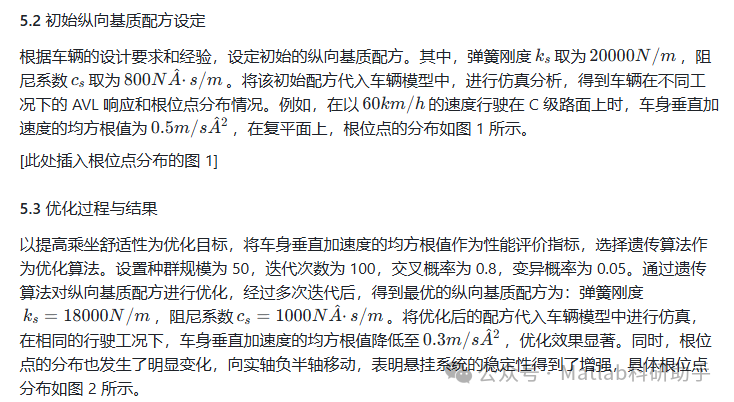
5.1 Vehicle Model Establishment
Taking a certain model of sedan as the research object, a complete vehicle dynamics model is established using CarSim software. This model includes sub-models for the body, suspension system, tires, power system, and transmission system. In the suspension system model, parameters such as spring stiffness, damping coefficient, and suspension arm length are set in detail to accurately simulate the dynamic characteristics of the vehicle’s suspension system. By comparing and validating with actual vehicle parameters, ensure that the established vehicle model has high accuracy.
VI. Conclusion and Outlook
Through the study of AVL response and longitudinal matrix formulation, the following conclusions can be drawn: the longitudinal matrix formulation, as an effective method for optimizing vehicle suspension systems, can significantly improve the dynamic performance of vehicles in longitudinal motion by reasonably adjusting suspension system parameters. Through various methods such as theoretical analysis, experimental data, and simulation optimization, longitudinal matrix formulations that meet different performance requirements can be constructed. Case analysis shows that the optimized longitudinal matrix formulation can effectively enhance vehicle ride comfort and driving stability.
However, there are still some shortcomings in the current research. For instance, in practical applications, the driving conditions of vehicles are complex and variable, and existing longitudinal matrix formulations may struggle to fully adapt to all conditions. Future research could consider integrating real-time condition monitoring with online adjustments of longitudinal matrix formulations, allowing vehicles to automatically optimize suspension system parameters based on actual driving situations. Additionally, further research could delve into the coupling relationships between the suspension system and other vehicle systems to achieve collaborative optimization of the entire vehicle system. With the continuous development of vehicle technology and the increasing demands for vehicle performance, AVL response and longitudinal matrix formulation will play an increasingly important role in the automotive engineering field, providing strong support for the development of high-performance and intelligent vehicles.
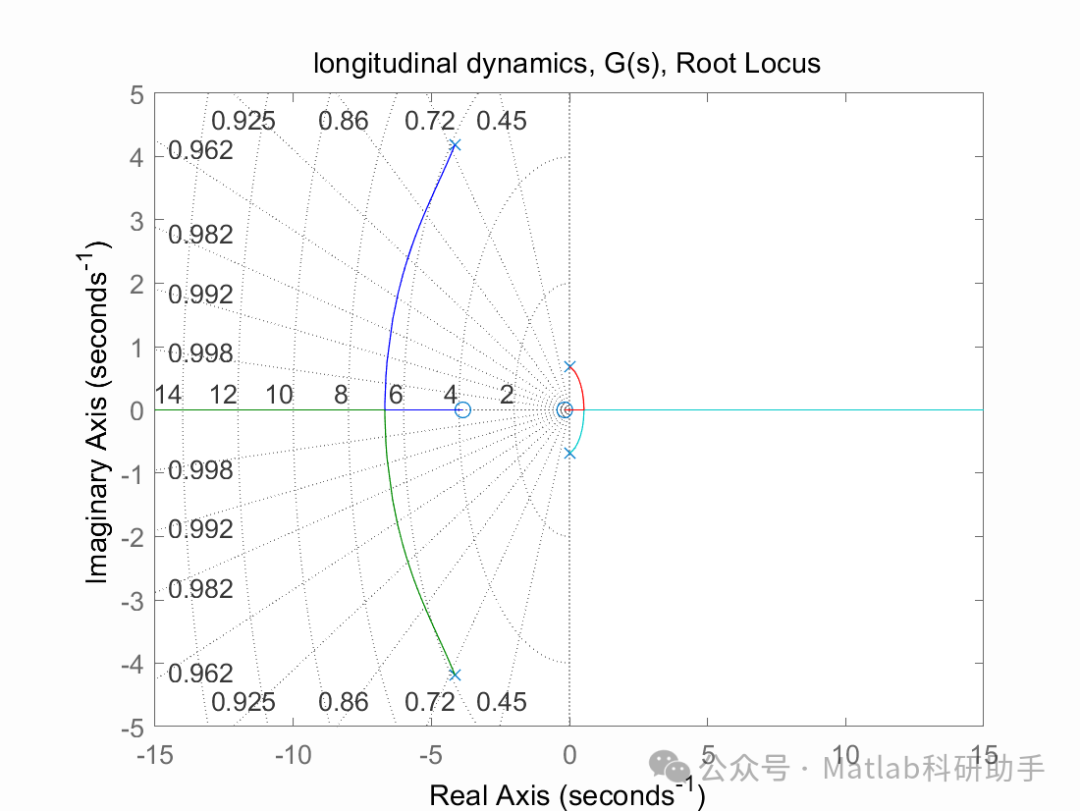
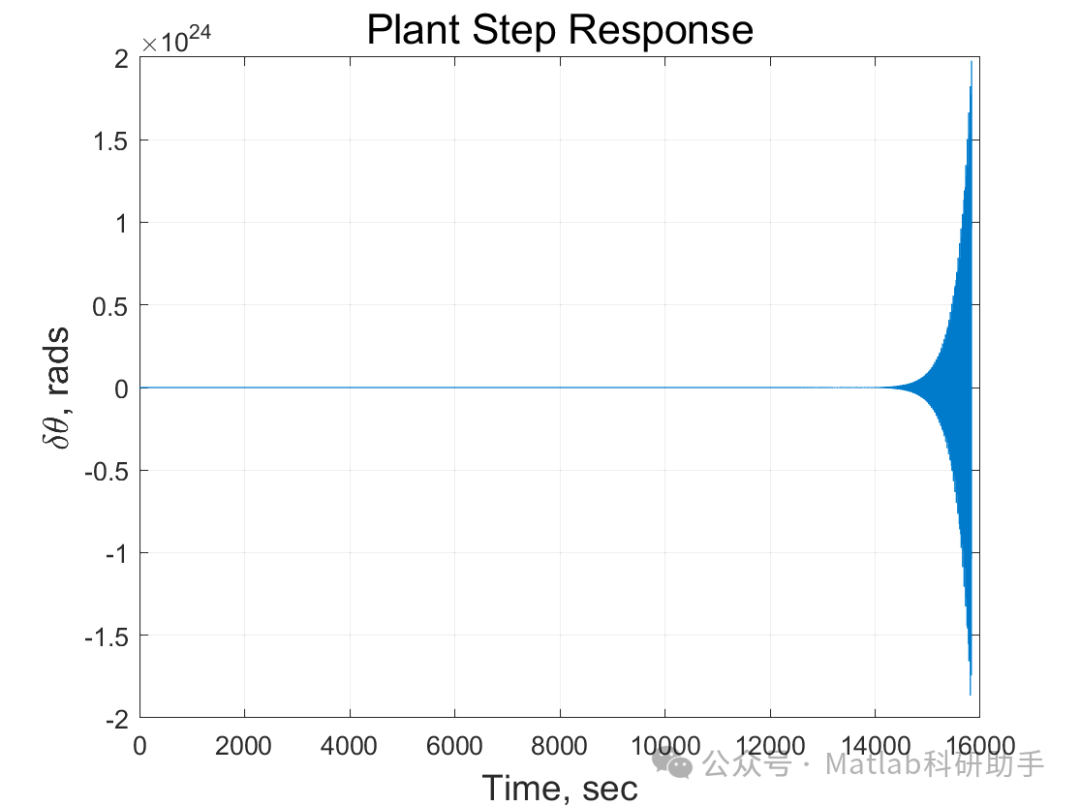
⛳️ Operation Results
🔗 References
[1] Li Yunqing, Wang Haiying, Cheng Chuan Song, et al. Research on Joint Boost and Matlab-Based Model Simulation and Calibration Methods [J]. Internal Combustion Engine Engineering, 2010(4):5. DOI:10.3969/j.issn.1000-0925.2010.04.017.
[2] Yin Zhongping. Experimental Study on the Interrelationship of Unsaturated Soil Color, Saturation, and Matrix Suction [D]. Tianjin University [2025-09-13].
[3] Chen Ke, Yang Xuejun, Yan Hua, et al. Design and Parameter Optimization of Fully Automatic Transplanting Machine Seedling Mechanism Based on Matlab [J]. Journal of Agricultural Machinery, 2013(S1):24-26.
📣 Partial Code
🎈 Some theoretical references are from online literature; if there is any infringement, please contact the author for deletion.
👇 Follow me to receive a wealth of Matlab e-books and mathematical modeling materials
🏆 The team specializes in guiding customized Matlab simulations in various research fields, supporting research dreams:
🌈 Various intelligent optimization algorithm improvements and applications
Production scheduling, economic scheduling, assembly line scheduling, charging optimization, workshop scheduling, dispatch optimization, reservoir scheduling, three-dimensional packing, logistics site selection, cargo location optimization, bus scheduling optimization, charging pile layout optimization, workshop layout optimization, container ship loading optimization, pump combination optimization, medical resource allocation optimization, facility layout optimization, visual domain base station and drone site selection optimization, knapsack problem, wind farm layout, time slot allocation optimization, optimal distribution of distributed generation units, multi-stage pipeline maintenance, factory-center-demand point three-level site selection problem, emergency supply material distribution center site selection, base station site selection, road lamp post arrangement, hub node deployment, transmission line typhoon monitoring devices, container scheduling, unit optimization, investment portfolio optimization, cloud server combination optimization, antenna linear array distribution optimization, CVRP problem, VRPPD problem, multi-center VRP problem, multi-layer network VRP problem, multi-center multi-vehicle VRP problem, dynamic VRP problem, two-layer vehicle routing planning (2E-VRP), electric vehicle routing planning (EVRP), hybrid vehicle routing planning, mixed flow shop problem, order splitting scheduling problem, bus scheduling optimization problem, flight shuttle vehicle scheduling problem, site selection and routing planning problem, port scheduling, port shore bridge scheduling, parking space allocation, airport flight scheduling, leak source localization.
🌈 Machine learning and deep learning time series, regression, classification, clustering, and dimensionality reduction
2.1 BP time series, regression prediction, and classification
2.2 ENS voice neural network time series, regression prediction, and classification
2.3 SVM/CNN-SVM/LSSVM/RVM support vector machine series time series, regression prediction, and classification
2.4 CNN|TCN|GCN convolutional neural network series time series, regression prediction, and classification
2.5 ELM/KELM/RELM/DELM extreme learning machine series time series, regression prediction, and classification
2.6 GRU/Bi-GRU/CNN-GRU/CNN-BiGRU gated neural network time series, regression prediction, and classification
2.7 Elman recurrent neural network time series, regression prediction, and classification
2.8 LSTM/BiLSTM/CNN-LSTM/CNN-BiLSTM long short-term memory neural network series time series, regression prediction, and classification
2.9 RBF radial basis function neural network time series, regression prediction, and classification
2.10 DBN deep belief network time series, regression prediction, and classification
2.11 FNN fuzzy neural network time series, regression prediction
2.12 RF random forest time series, regression prediction, and classification
2.13 BLS broad learning system time series, regression prediction, and classification
2.14 PNN pulse neural network classification
2.15 Fuzzy wavelet neural network prediction and classification
2.16 Time series, regression prediction, and classification
2.17 Time series, regression prediction, and classification
2.18 XGBOOST ensemble learning time series, regression prediction, and classification
2.19 Transform various combinations of time series, regression prediction, and classification
Covering wind power prediction, photovoltaic prediction, battery life prediction, radiation source identification, traffic flow prediction, load prediction, stock price prediction, PM2.5 concentration prediction, battery health status prediction, electricity consumption prediction, water body optical parameter inversion, NLOS signal identification, precise prediction of subway stops, transformer fault diagnosis.
🌈 In image processing
Image recognition, image segmentation, image detection, image hiding, image registration, image stitching, image fusion, image enhancement, image compressed sensing.
🌈 In path planning
Traveling salesman problem (TSP), vehicle routing problem (VRP, MVRP, CVRP, VRPTW, etc.), three-dimensional path planning for drones, drone collaboration, drone formation, robot path planning, grid map path planning, multimodal transport problems, electric vehicle routing planning (EVRP), two-layer vehicle routing planning (2E-VRP), hybrid vehicle routing planning, ship trajectory planning, full path planning, warehouse patrol.
🌈 In drone applications
Drone path planning, drone control, drone formation, drone collaboration, drone task allocation, online optimization of drone safe communication trajectories, vehicle collaborative drone path planning.
🌈 In communication
Sensor deployment optimization, communication protocol optimization, routing optimization, target localization optimization, Dv-Hop localization optimization, Leach protocol optimization, WSN coverage optimization, multicast optimization, RSSI localization optimization, underwater communication, communication upload/download allocation.
🌈 In signal processing
Signal recognition, signal encryption, signal denoising, signal enhancement, radar signal processing, signal watermark embedding and extraction, electromyography signals, electroencephalography signals, signal timing optimization, electrocardiogram signals, DOA estimation, encoding and decoding, variational mode decomposition, pipeline leakage, filters, digital signal processing + transmission + analysis + denoising, digital signal modulation, bit error rate, signal estimation, DTMF, signal detection.
🌈 In power systems
Microgrid optimization, reactive power optimization, distribution network reconstruction, energy storage configuration, orderly charging, MPPT optimization, household electricity.
🌈 In cellular automata
Traffic flow, crowd evacuation, virus spread, crystal growth, metal corrosion.
🌈 In radar
Kalman filter tracking, trajectory association, trajectory fusion, SOC estimation, array optimization, NLOS identification.
🌈 In workshop scheduling
Zero-wait flow shop scheduling problem (NWFSP), Permutation flow shop scheduling problem (PFSP), Hybrid flow shop scheduling problem (HFSP), zero idle flow shop scheduling problem (NIFSP), distributed permutation flow shop scheduling problem (DPFSP), blocking flow shop scheduling problem (BFSP).
👇