Introduction
Based on experience, if Matlab is introduced in theoretical mechanics teaching, students can master numerical solutions of algebraic and differential equations, symbolic derivation, animation demonstrations, etc., in just three classes. This leads to a significant improvement in students’ understanding of theoretical mechanics problems; meanwhile, some problem-solving techniques in teaching can be compressed, keeping the total class hours unchanged.
Specifically:
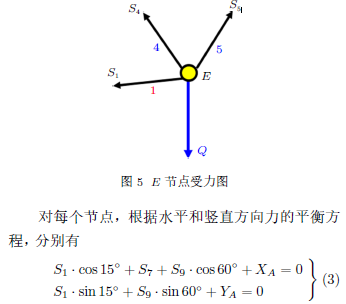
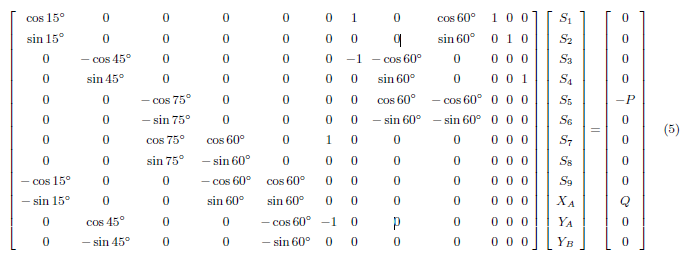
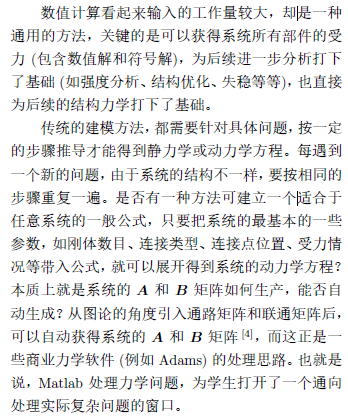
(1) In statics, the force analysis of complex systems traditionally requires appropriate separation of bodies and sometimes high-level skills. Due to the limitations of traditional computational capabilities, it often only requires solving for the forces on certain components. By using Matlab, a unified processing method can be employed to break down the entire system and quickly calculate the forces on all components, providing a more comprehensive understanding of the overall system and the forces on each component.
(2) In kinematics, traditional analysis of system motion emphasizes calculating the velocity and acceleration of specific points or rigid bodies at specific moments or positions, while the overall motion characteristics of the system and the trajectories of certain points can sometimes be difficult to visualize. By using Matlab, the velocity and acceleration of any point or rigid body at any moment can be calculated, especially with its graphing and animation capabilities, which can quickly and intuitively display the entire motion process of the system and provide the motion trajectory of any point.
(3) In dynamics, the vast majority of problems can only list the dynamic equations, usually without analytical solutions, and traditional mathematical analysis methods cannot be applied. The rich and complex dynamic phenomena of the system are difficult to discern from the equations. However, using Matlab allows for obtaining the forces, velocities, and accelerations during the entire motion process of the system, and it can also quickly and intuitively demonstrate the motion process of the system.
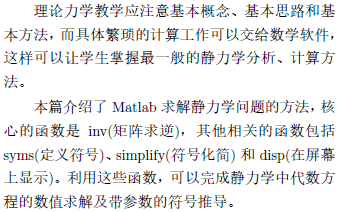
Considering that numerical computation and symbolic derivation are rarely introduced in current theoretical mechanics teaching, a series of theoretical mechanics teaching articles has been specially prepared. Each article introduces 1-2 typical theoretical mechanics problems and how to handle them using Matlab. The series is planned to be divided into the following topics:
(1) Statics Topic 1: Stress analysis of rigid body systems and trusses (focusing on numerical solutions of algebraic equations and symbolic solutions in Matlab);
(2) Kinematics Topic 1: Motion analysis of typical mechanisms (focusing on solving nonlinear equations in Matlab, animation display, and how to differentiate motion equations);
(3) Dynamics Topic 2: Motion and period of a simple pendulum and elliptical pendulum (focusing on numerical solutions of differential equations in Matlab, calculation reliability, and periodicity using fast Fourier transform based on data), and the rolling problem of a ping-pong ball (focusing on the handling of piecewise integration in Matlab and the issue of integration interruption points corresponding to segments);
(4) Comprehensive Application Topic 1: Data conversion problem (focusing on results seen in different coordinate systems, including motion and dynamics problems).
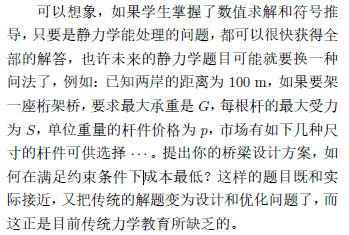
Through these articles, students can understand and become familiar with Matlab, greatly improving their problem-solving abilities.
Next, we will start with statics. Based on teaching experience, students often find the force analysis of rigid body systems and trusses in statics relatively difficult, usually requiring appropriate disassembly; otherwise, solutions cannot be obtained. However, Matlab can use a unified approach to solve this, reducing the technical skills required while providing more comprehensive answers.

Scan to read the full HTML article directly
01
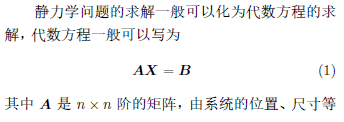
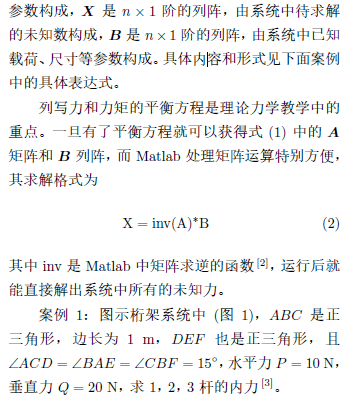
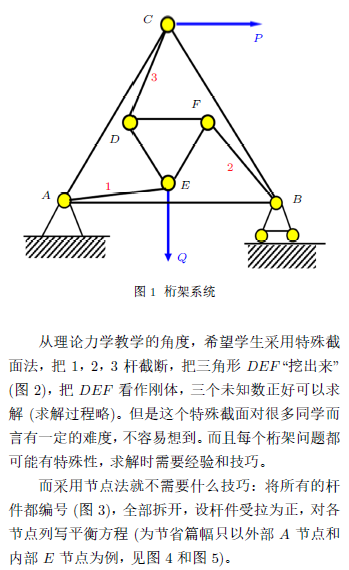
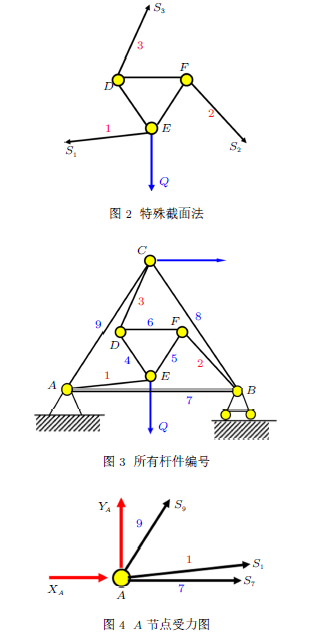
Solving Algebraic Equations in Matlab


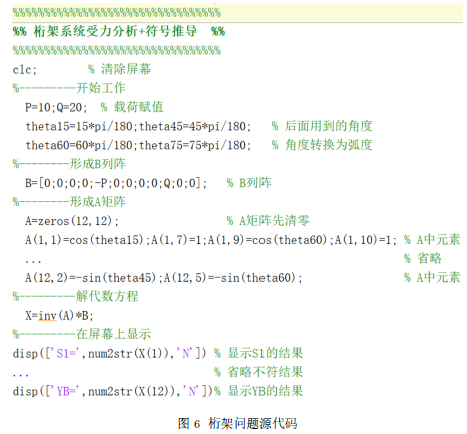
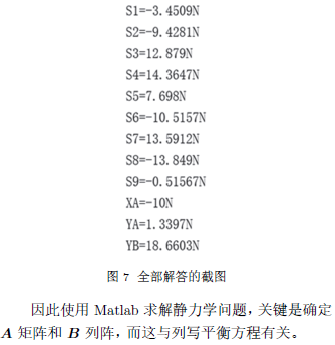
02
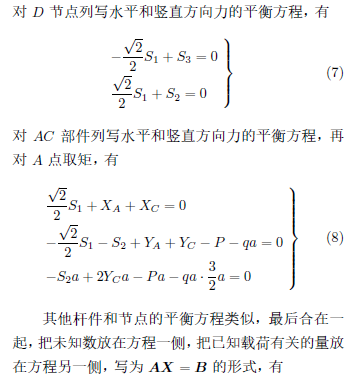
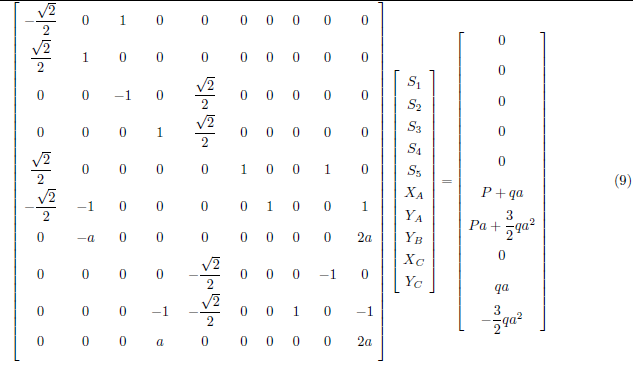
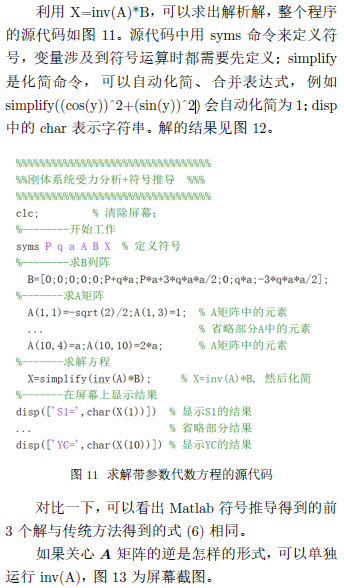
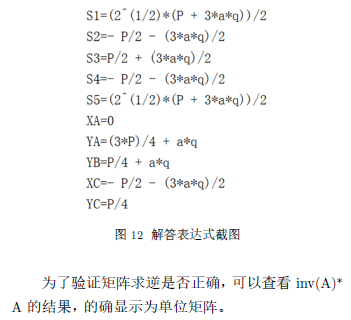
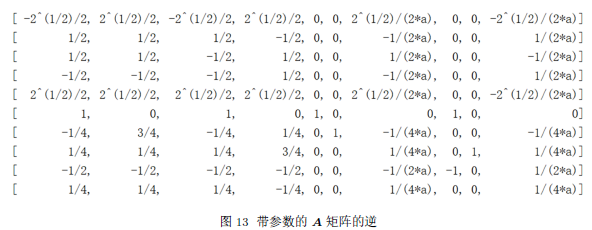
Parameter Algebraic Equation Solutions in Matlab
Algebraic Equation Solutions in Matlab
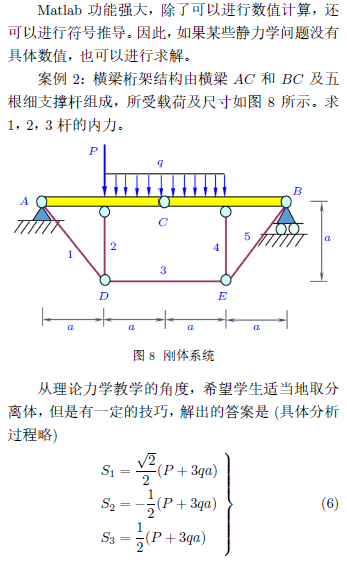
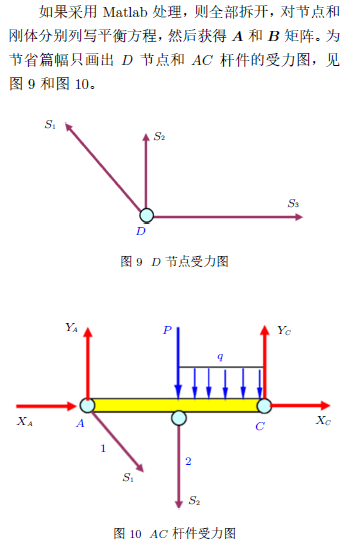
03
Summary


This article has been published in the Journal of Mechanics and Practice
2021, Volume 43, Issue 2
About Us:
Editorial Office of the Journal of Mechanics and Practice
Journal Homepage: http://lxsj.cstam.org.cn
Contact Email: [email protected]
Contact Phone: 010-62554107