 Arduino Sensor: HS-S01A Infrared SensorArduino Sensor: HS-S02P Infrared Sensor (Obstacle Avoidance)Arduino Sensor: HS-S03P Ultraviolet SensorArduino Sensor: HS-S05P Sound SensorArduino Sensor: HS-F07P Active BuzzerArduino Sensor: HS-F02P Passive BuzzerArduino Sensor: HS-S08P Flame SensorArduino Sensor: HS-S09LB Raindrop SensorArduino Sensor: HS-S09PC Soil Moisture Sensor
Arduino Sensor: HS-S10P Mist Sensor
Arduino Sensor: HS-S11-L Gas Sensor
Arduino Sensor: HS-S20P Ambient Light Sensor
Arduino Sensor: HS-S21P Tilt SensorArduino Sensor: HS-S22P Grayscale SensorArduino Sensor: HS-S24P Digital Temperature SensorArduino Sensor: HS-S26A Temperature and Humidity SensorArduino Sensor: HS-S28P Potentiometer
Arduino Sensor: HS-S31P Touch Sensor
Arduino Sensor: HS-S37PS Water Level Sensor
Arduino Sensor: HS-S38P Human Body Sensor
Arduino Sensor: HS-S40P Hall Magnetic Sensor
Arduino Sensor: HS-S45P Barometric Pressure Sensor
Arduino Sensor: HS-S46P Weighing Sensor
Arduino Sensor: HS-S59P Slot Photoelectric Sensor
Arduino Sensor: HS-S70P Heart Rate and Blood Oxygen Sensor
Arduino Sensor: HS-S71P Thin Film Pressure Sensor
Arduino Sensor: HS-S72P Metal Detection Sensor
Arduino Sensor: Photoresistor Sensor
Arduino Sensor: Infrared Receiver Module
Arduino Sensor: Infrared Transmitter Module
Arduino Sensor: Clock Module
Arduino Sensor: Rotary Encoder Module
Arduino Sensor: Dual-axis Joystick Module
Arduino Sensor: Gyroscope Module
Arduino Sensor: Voice Broadcast Module
Arduino Sensor: Voice Recognition Control Module
Arduino Communication Module: Bluetooth Module
Arduino Power Module: Motor Driver Module
Arduino Power Module: DC Motor Fan Module
Arduino Power Module: Mini DC Gear MotorArduino Control Module: Mini Servo ModuleArduino Storage Module: SD Card Module
Arduino Control Module: Conductive Switch Module
Arduino Interaction Module: Button Switch ModuleArduino Control Module: Self-locking Button Module
Arduino Execution Module: Electromagnet Module
Arduino Execution Control: Water Atomization Drive ModuleArduino Detection Module: Ultrasonic ModuleArduino Positioning Module: Linear Laser Spotlight Module
Arduino Control Module: Relay Module
Arduino Display Module: LED Light ModuleArduino Display Module: RGB Light ModuleArduino Display Module: Traffic Light ModuleArduino Display Module: RGB Strip Light ModuleArduino Display Module: RGB Ring Light ModuleArduino Display Module: Single Digit DisplayArduino Display Module: Four Digit DisplayArduino Display Module: 8*8 Dot Matrix DisplayArduino Display Module: Electronic Ink ScreenArduino Display Module: OLED ScreenArduino Display Module: LCD Liquid Crystal DisplayArduino Display Module: TFT Liquid Crystal Color Screen— Previous Recommendations —

01Basic Understanding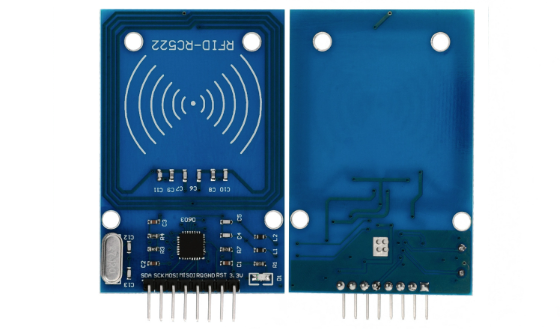 Model:RC522Name:IC Card Induction ModuleSeries:Recognition ModuleDescription:This is a non-contact radio frequency identification module based on a frequency of 13.56MHz, with the core function of reading and writing passive IC cards that comply with the ISO 14443A standard (such as Mifare 1K cards), allowing data exchange to be completed within a distance of 5-10cm without contact; the module integrates the radio frequency circuit and control logic, connects to Arduino via the SPI communication protocol, and supports card recognition, data reading and writing, and encryption verification functions; passive IC cards consist of a chip and an induction antenna, encapsulated in a PVC card with no exposed components, obtaining energy from the electromagnetic waves emitted by the reader (no built-in power supply required), achieving “contactless, passive” data transmission, making it a core recognition component in access control systems, identity recognition, payment terminals, and other scenarios, and a commonly used module for achieving “card interaction” in Arduino IoT projects.Usage Scenarios:Arduino access control system (unlocking with IC card, controlling door locks with relays), campus one-card simulation (storing student information, reading identity through the module), library borrowing and returning system (recording book borrowing status), primary and secondary school information technology experiments (exploring radio frequency communication principles, wireless data transmission logic, in line with the “Guidelines for General Education in Artificial Intelligence for Primary and Secondary Schools (2025 Edition)” practical requirements), DIY electronic lockers (opening corresponding cabinet doors with specified IC cards), logistics label recognition (sticking IC cards on small materials, module recognizing item information).Disciplinary Integration:Physics,Mathematics,Information TechnologyEthical Education:When using, it is necessary to protect the privacy data stored in the IC card (such as personal identity information), avoiding unauthorized reading, reflecting data security awareness; the application of radio frequency identification technology must comply with the “Personal Information Protection Law”, prohibiting illegal collection or abuse of others’ card information; communication between the module and the card must use encryption mechanisms (such as the encryption algorithm of Mifare cards) to prevent data from being tampered with or copied; discarded IC cards must be properly handled to avoid data leakage from the chip; in teaching scenarios, it is necessary to guide the correct use of recognition technology, cultivating an ethical view of “technology serving safety and convenience”.Note: Images are sourced from the internet, and products are based on actual purchases.
02Technical Parameters
Working Principle:
The core of the module consists of “radio frequency transceiver circuit + control chip (RC522) + SPI interface circuit”, achieving energy and data transmission with passive IC cards through electromagnetic waves: Energy supply: the module emits electromagnetic waves at a fixed frequency of 13.56MHz, and the LC series resonant circuit inside the IC card (with a frequency consistent with the module) resonates under the excitation of electromagnetic waves, storing charge in a capacitor through a unidirectional electronic pump, and when the voltage reaches 2V, it powers the chip inside the card; Data communication: the electromagnetic waves emitted by the module superimpose command and data signals, which the IC card receives and processes data (read/modify/store), and feeds back the response signal to the module through the antenna; the module transmits data to Arduino via the SPI interface, completing the “recognition – interaction” process; Security mechanism: supports CRC verification and three mutual authentication encryption to prevent eavesdropping or tampering during data transmission.
Parameter Analysis:
VCC: Module power positive terminal,Operating Voltage 3.3V (do not connect to 5V, as it will burn the RC522 chip)RST: Reset pinGND: Module power groundIRQ: Interrupt request pinMISO: SPI communication master input/slave output pinMOSI: SPI communication master output/slave input pinSCK: SPI communication clock pinSDA/SS: SPI chip select pinOperating Frequency: 13.56MHz (complies with ISO 14443A standard, compatible with Mifare series cards)Reading Distance: 5-10cm (related to card antenna size and environmental interference, best without obstruction)Supported Card Types: Mifare 1K (S50), Mifare 4K (S70), Mifare UltraLight, Mifare Pro, and other ISO 14443A standard cardsCommunication Interface: SPI (maximum speed 10Mbps, compatible with Arduino hardware SPI)Operating Current: standby current ≈10mA, reading card current ≈13-26mAEncryption Function: supports CRC, parity check, and three mutual authentication encryption, ensuring data security03Code Example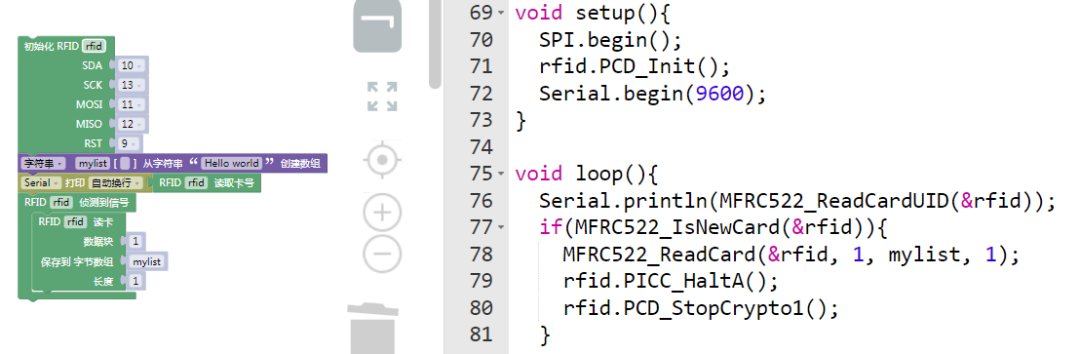
Connect the pins as default.
Note: Library needs to be loaded
04Safety Measures
1. Power Safety: Strictly use a 3.3V power supply, do not connect to Arduino 5V pin (RC522 chip is rated for 3.3V, 5V will directly burn it), it is recommended to power through Arduino 3.3V pin or use a 3.3V voltage regulator module;
2. Wiring Specifications: SPI pins (MISO/MOSI/SCK) must be connected to the corresponding SPI hardware pins on Arduino (different boards have different pins, e.g., Mega2560’s MISO=50), SDA/SS pin must connect to a digital pin to avoid communication failure due to incorrect connections;
3. Data Security: When reading sensitive information (such as identity data), the module’s encryption function (three authentication) must be enabled, plaintext transmission is prohibited; important data in the IC card must be stored encrypted to prevent cracking;
4. Anti-interference Measures: Keep the module at least 5cm away from metal objects (metal absorbs radio frequency signals), avoid placing it close to strong electromagnetic interference devices such as motors and relays, and add shielding if necessary;
5. Electrostatic Protection: The RC522 chip is an electrostatic sensitive component, wear an anti-static wrist strap during operation, avoid direct contact with chip pins, and be especially cautious about static discharge in dry environments;
6. Card Protection: IC cards should be kept from bending, folding, or being near strong magnetic fields (such as magnets) to prevent damage to the internal antenna or data loss;
7. Debugging Safety: Check the power voltage (confirm 3.3V) before debugging, then gradually test the card reading function; if the module does not respond, prioritize checking the power and SPI connections rather than repeatedly powering it on;
8. Privacy Protection: Prohibit the illegal reading of others’ IC card information using the module, and the collected card number data must be properly stored in compliance with data privacy protection regulations.
05Expansion
Students can try the following methods:
1. RFID Access Control System: Interact with relay module and LCD1602 display, when swiping an authorized card, the relay engages (opens the door), LCD displays “Welcome”, unauthorized cards display “Access Denied” and trigger a buzzer alarm;2. Electronic Locker: Use multiple RC522 modules to control different cabinet doors (with multi-channel relays), each IC card corresponds to a unique cabinet door, swiping the corresponding card opens the specified cabinet door, which automatically closes after 3 seconds;3. Campus One-Card Simulation: IC card stores student name and class information, the module reads and sends it to the host via NRF24L01 wireless module, the host displays student information on OLED screen, achieving attendance records;4. Consumption System Simulator: IC card stores virtual balance, the module reads it and inputs consumption amount via button module, after confirmation, modifies the card balance and displays transaction records (balance before/after consumption) on TFT screen;5. Book Borrowing Registration: Each book has an IC card (storing ISBN number), the module reads it and interacts with DS3231 clock module, recording “book name – borrowing time – return time” in the SD card, achieving automatic registration;6. Smart Drawer Lock: Connect the module to a servo, swiping an authorized card rotates the servo 90° (unlocking), swiping again rotates it back to 0° (locking), suitable for securely storing personal items. Follow the public account and add the customer service above, reply with the corresponding name to gain access to the following knowledge base reading permissions.