
Printed Circuit Board
printed-circuit board; PCB
Definition: A circuit board formed by etching copper foil covered on an insulating substrate into conductive lines that meet the connection requirements of components, allowing for the installation and connection of electronic components.
Discipline: Computer Science Technology _ Computer Hardware _ Computer Engineering Manufacturing
Related Terms: Circuit Board
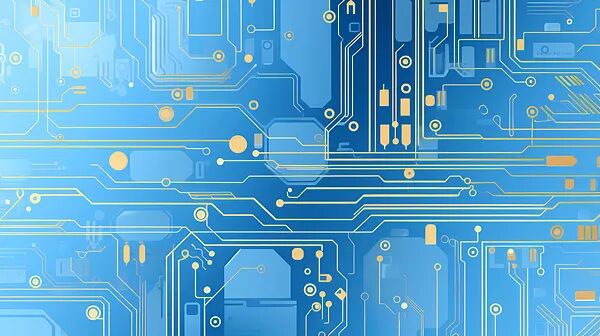
Image Source: Visual China
【Further Reading】
The printed circuit board serves as the physical carrier of electronic systems, forming a network of conductive lines through etching processes on an insulating substrate, enabling electrical interconnection and mechanical support for electronic components. Its role is akin to the “nervous system” of electronic devices, with most electronic devices relying on printed circuit boards to establish stable current pathways and signal transmission channels, from miniature medical implants to spacecraft control systems.
Currently, printed circuit board technology is highly mature but continues to undergo ongoing transformations.
High-density interconnect technology is a significant direction in the development of printed circuit board technology. It achieves higher interconnect density per unit area through laser micro-holes, fine lines, and multilayer stacking processes, primarily applied in space-constrained high-performance devices such as smartphones, miniature medical probes, and autonomous driving sensors.
High-frequency and high-speed circuit technology meets the demands of 5G/6G communication in the millimeter-wave frequency band by using low dielectric constant substrates to reduce signal transmission loss, effectively minimizing attenuation and group delay during signal propagation. This technology has been widely applied in fields such as 5G base stations, RF front-end modules, millimeter-wave radar, satellite communication devices, and high-speed data transmission systems.
Flexible electronics technology is an advanced electronic manufacturing technology based on flexible materials (such as polyimide), primarily consisting of flexible printed circuits and rigid-flex boards. Its core advantage lies in utilizing the bendable characteristics of materials to achieve flexible layouts in three-dimensional space. This technology plays an irreplaceable role in applications requiring high adaptability to deformation, such as dynamic bending circuit designs in the hinge areas of foldable screen devices and the manufacturing of bioelectrodes that conform to the contours of the human body in wearable devices, showcasing the unique value of flexible electronics in space-constrained and dynamically deforming environments.
Frontier explorations in printed circuit board technology are achieving breakthroughs across multiple dimensions: at the system integration level, embedded substrates and through-silicon via technology are reconstructing the collaborative design paradigm of chip-packaging-circuit board; in the field of materials science, new substrates, from liquid crystal polymers supporting 110 GHz transmission to biodegradable cellulose-based materials, continuously push performance boundaries; and in the direction of heterogeneous integration, advancements in optical waveguide printed circuit boards are breaking through the bandwidth bottleneck of optical interconnects between data center boards, heralding the evolution of next-generation interconnect technology.
Further Reading Author: Li Jinping, Deputy Editor of University of Science and Technology of China Press
Source:National Committee for the Standardization of Scientific and Technical Terms