
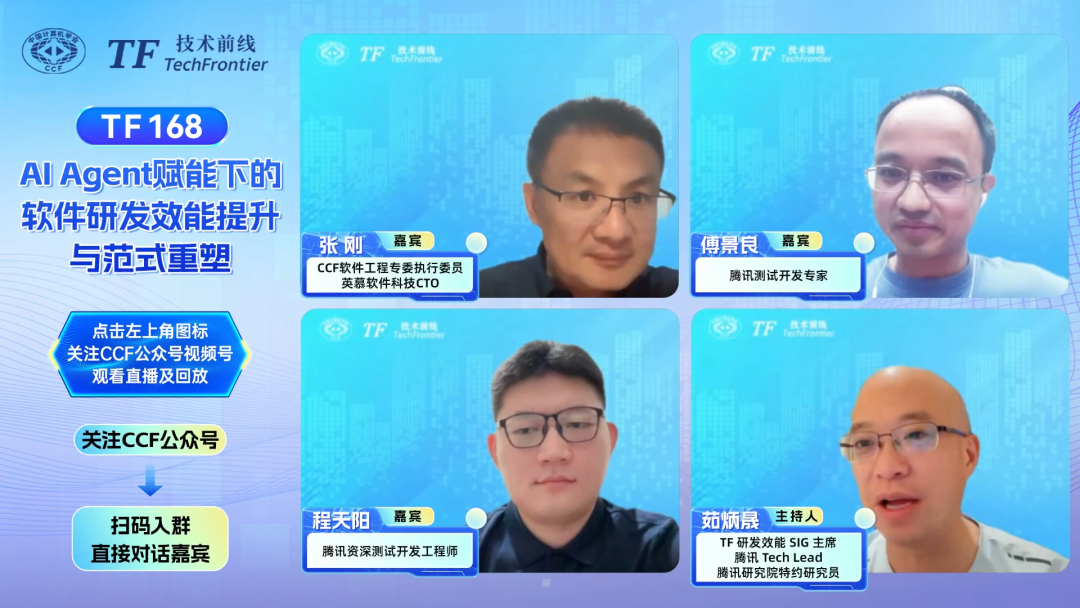
On July 29, 2025, CCF TF held its 168th event, themed “Enhancing Software Development Efficiency and Paradigm Reshaping Empowered by AI Agents.” This event was organized by the CCF TF R&D Efficiency SIG and featured speakers including Zhang Gang, Executive Committee Member of CCF Software Engineering, CTO of Yingmu Software Technology; Fu Jingliang, Testing Development Expert at Tencent; and Cheng Tianyang, Senior Testing Development Engineer at Tencent. The event was conducted via online live streaming, attracting numerous professionals. This article will systematically summarize the core viewpoints and technical insights from this event, presenting the latest development trends in AI Agent deeply empowering software development.
Scan to watch the replay
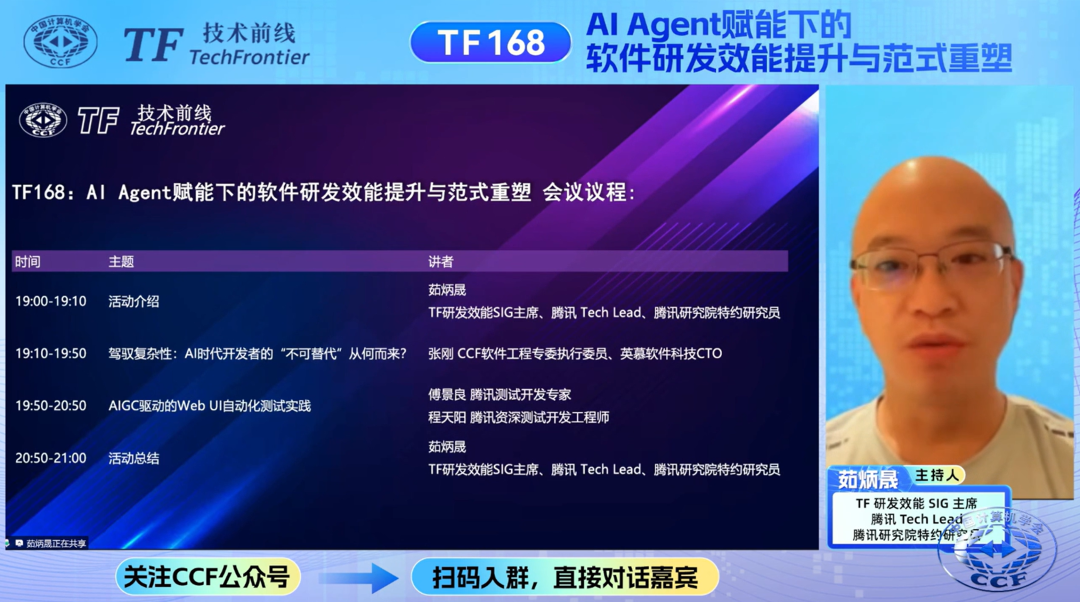
The event was hosted by Ru Bingsheng, Chairman of the TF R&D Efficiency SIG, Tech Lead at Tencent, and Visiting Researcher at Tencent Research Institute. He first introduced the purpose of CCF TF and the event’s agenda, then guided the participants into the thematic discussion.
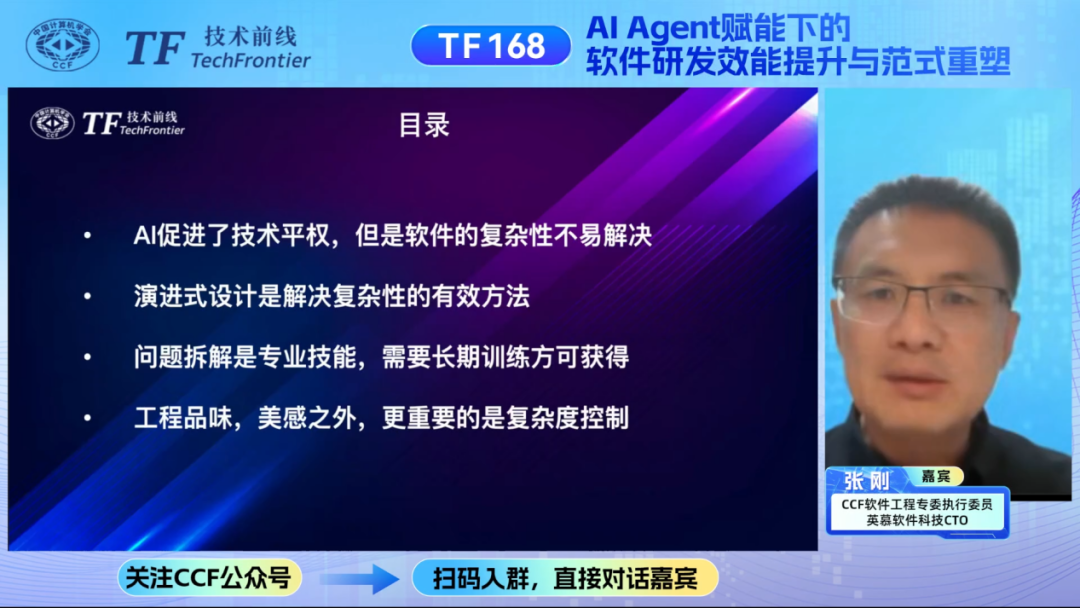
Zhang Gang, Executive Committee Member of CCF Software Engineering and CTO of Yingmu Software Technology, shared on the topic “Mastering Complexity: Where Does the ‘Irreplaceable’ Value of Developers Come From in the AI Era?” He discussed how professional developers can achieve efficient collaboration with AI through evolutionary design thinking, high-quality problem decomposition, and design quality control, using practical cases.
He believes that the rapid development of AI programming capabilities has further focused the core value of developers. The ability to effectively manage and control software complexity determines development efficiency and the quality of human-machine collaboration. Evolutionary design breaks down complex problems that cannot be solved at once into smaller problems that can be gradually refined through multiple iterations. The core idea is to “break down large problems into smaller ones while ensuring quality, clarifying and solving problems step by step that are difficult to articulate and resolve at once.”
Therefore, evolutionary design thinking has become increasingly important in the AI era: facing vague and complex requirements, it is challenging to describe a complete solution to AI at once. However, adopting a “layered approach”—first solving a simpler sub-problem and then gradually advancing—is more feasible and efficient. However, evolutionary design is not just a concept; it requires long-term deliberate practice.
Furthermore, Zhang Gang pointed out that since today’s AI can efficiently complete coding tasks, evolutionary design significantly shortens the feedback cycle between “defining problems” and “solving problems,” allowing developers to focus more on value discovery and solution design. Developers who master evolutionary design capabilities can free themselves from tedious coding work and return to the essence of being engineers—addressing real-world complex challenges through continuous exploration, iteration, and creation, achieving a transition from “code monkeys” to value creators..
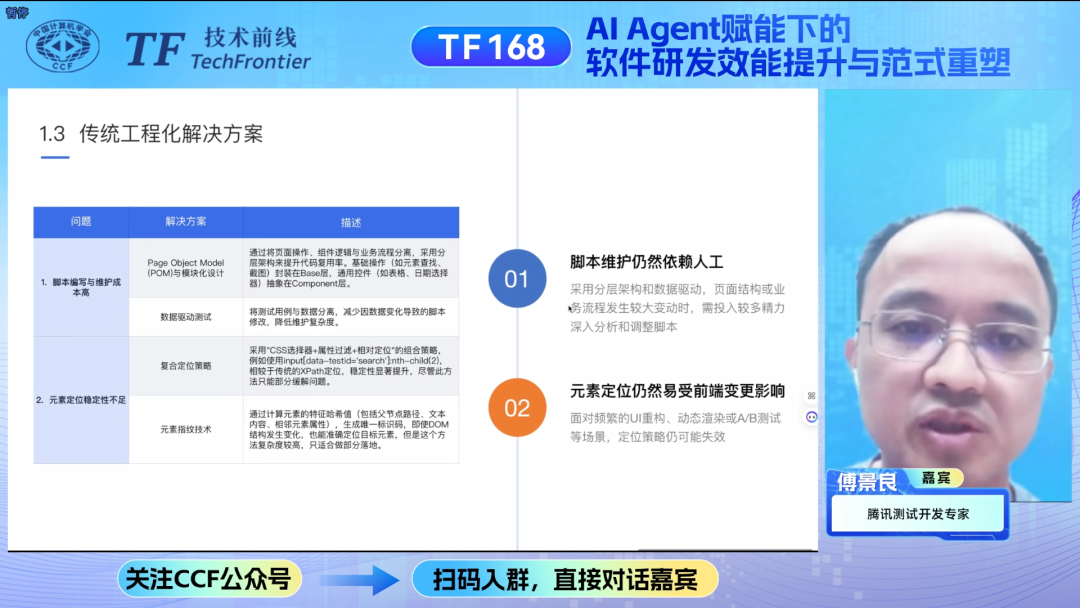
Tencent Testing Development Expert Fu Jingliang and Senior Testing Development Engineer Cheng Tianyang shared on the topic “AIGC-Driven Web UI Automation Testing Practices,” presenting the latest technical practice case of Web UI automation testing for Tencent’s advertising delivery system.
First, Fu Jingliang explained the background of the case: with breakthroughs in large model technology, AIGC is bringing a new transformation to Web UI automation testing. Traditional UI automation testing relies on script development, which has high script maintenance costs and unstable element positioning, making it not intelligent or efficient.
Therefore, Fu Jingliang and Cheng Tianyang built a semantic script-driven Web Agent from scratch based on Tencent’s Hunyuan large model, which automatically converts test scripts into executable scripts. The core process includes perception, decision-making, verification, and other stages. On this basis, they achieved automatic generation, execution, checking, alerting, and self-healing of test cases, forming a complete closed-loop process.
They mentioned that through AIGC-assisted case generation and maintenance, the accuracy rate reached over 90%, and the efficiency of case writing and maintenance improved by more than five times, significantly reducing the costs of manual script writing and maintenance, effectively solving the problems of traditional automation testing where scripts easily fail and are difficult to maintain.
At the same time, they are exploring the dynamic evolution of cases driven by traffic recording, achieving rapid conversion of incremental functions to regression cases, continuously optimizing test coverage. Additionally, a fully automated model training workflow has been realized, automatically collecting user operation data and generating high-quality training sets, with plans to gradually achieve full-process automation of data processing and model training in the future.
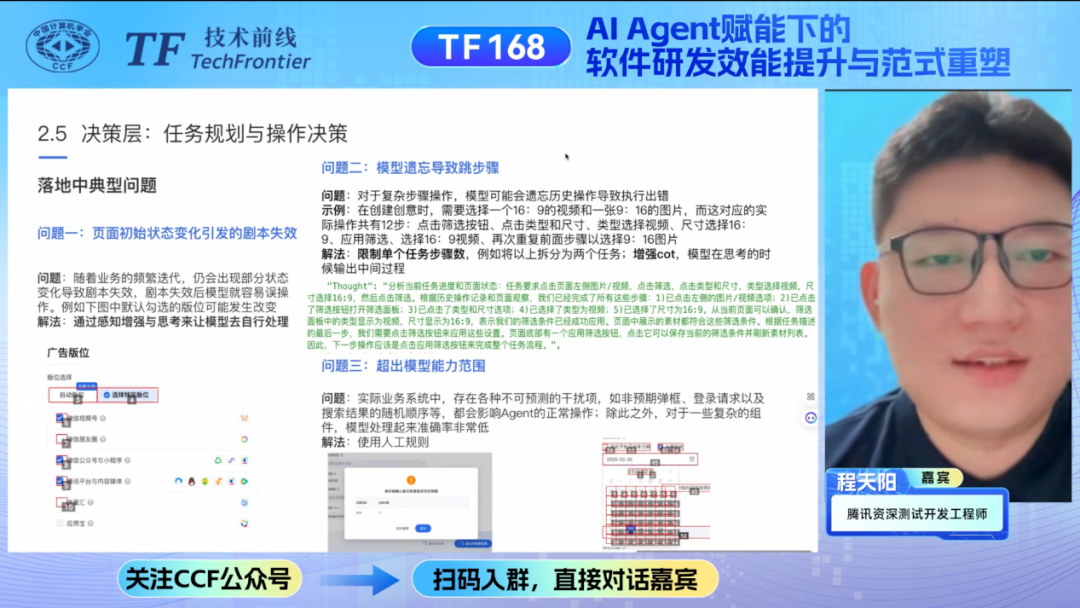
During the Q&A session, based on the enthusiastic questions from the audience, the host and the three speakers engaged in a lively discussion on related topics, particularly sharing thoughts on “how to measure the improvement of R&D efficiency by AI.”
About TF:
CCF Technology Frontline (TF) is a collaborative exchange platform built specifically for frontline engineers in enterprises, covering core areas such as architecture, artificial intelligence, cloud-native, security engineering, and intelligent manufacturing through 12 SIGs (Special Interest Groups), focusing on the pain points of technology implementation and helping engineers break through career bottlenecks.
Related Reading:
AI Coding Technical Architecture and Best Practices | Review of TF Technology Frontline Issue 167

Click “Read the original text” to watch the TF168 review video.