In the wave of artificial intelligence, we are witnessing a great transformation from simple interactions to intelligent collaboration. From the initial simple prompts to today’s AI Agents that can independently complete complex tasks, this is not just a technological iteration but a revolution in human-machine collaboration.
1. The Evolution from Prompts to AI Agents
(1) From Prompts to AI Agents
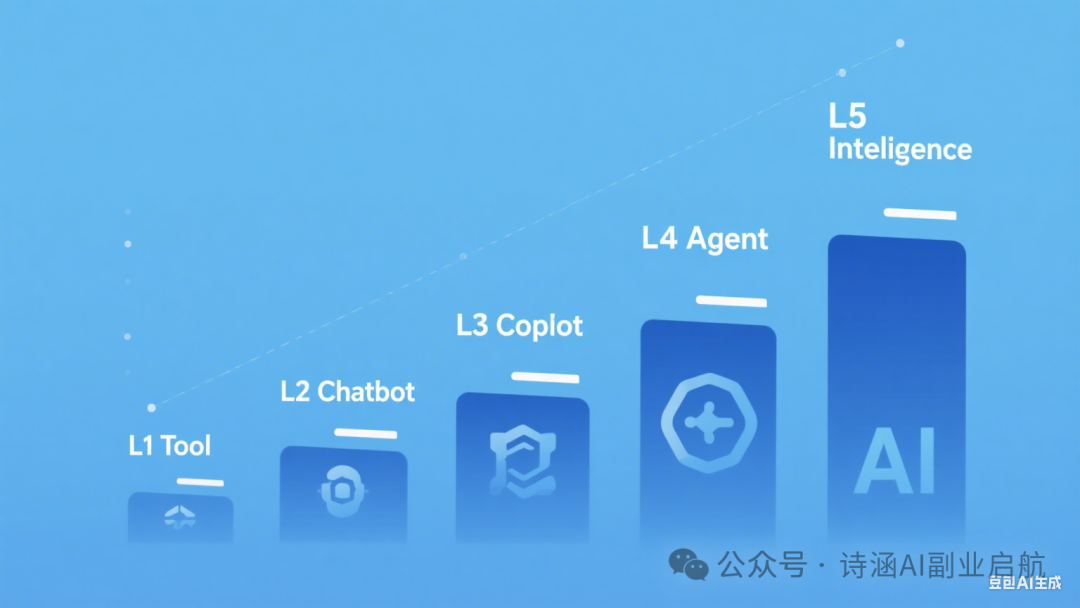
Let’s first look at the different stages of AI development. In the L1 Tool stage, humans complete all tasks without any significant AI assistance, which is quite common in most traditional application scenarios. By the time we reach the L2 Chatbot stage, like the first generation of ChatGPT, humans still do most of the work, asking AI for opinions and information, while AI provides information and suggestions but does not directly handle tasks.
Then we move to the L3 Copilot stage, such as GitHub Copilot, Midjourney, and ChatGPT with Plugin, where the workload is roughly equal between humans and AI. AI drafts initial work based on human requests, while humans set goals, make modifications, and ultimately confirm the results. In the L4 Agent stage, like AutoGPT, AI completes most of the work, with humans responsible for setting goals, providing resources, and supervising results. AI breaks down tasks, selects tools, and controls progress, autonomously ending work upon achieving goals. Finally, in the L5 Intelligence stage, there is no need for human supervision; AI autonomously breaks down goals, seeks resources, selects and uses tools, completing all tasks with humans only needing to provide initial objectives. Perhaps in the future, we will even see Von Neumann-like robots… or humans?
(2) The Limitations of Large Models and the Birth of AI Agents
While large models are powerful, they also have significant limitations. Due to the timeliness of training data, large models cannot answer questions about knowledge that emerged after the training data cutoff; because they use publicly available data, they cannot address issues related to proprietary corporate data; and due to context (Token) limitations, they cannot handle long texts. The emergence of AI Agents is precisely to solve these problems.
(3) The Concept of AI Agents
Why should we pay attention to AI Agents? Because products like Coze are closely related to AI Agents. Coze is a product based on the technological concept of AI Agents, where creating a Bot on Coze is essentially creating individual AI Agents. Only by understanding AI Agents can we better understand and utilize Coze.
Agent can be translated as agent or agency, which is an entity that helps us complete a certain type of function, which can be a person, machine, or application. An AI Agent is an Agent that applies the capabilities of large models. The emergence of large models represented by GPT has elevated the capabilities of Agents to unprecedented heights, and AI Agents are also referred to as intelligent agents.
For example, if we want to write a 200,000-word book on the latest technologies in artificial intelligence, without an AI Agent, the process is cumbersome: first, we use search engines to find relevant books and information to open our minds, then form an outline and consider the content of each chapter, followed by writing content for each chapter and possibly adjusting the outline. While writing later chapters, we may forget earlier content and need to refer back. After the initial draft is completed, we seek professional revisions, and after several adjustments, the book finally takes shape.
When attempting to use large models to optimize prompts for the writing task, although it allows the large model to first write an outline, then content, and play different roles for discussion and optimization, it also has drawbacks: a standalone large model cannot access the latest artificial intelligence technologies due to training data limitations; large models lack memory capabilities and are constrained by context, making it difficult to complete a 200,000-word article in one go, leading to incoherence; and the logic of first writing an outline, then chapters, and then discussing becomes very complex in terms of prompts.
(4) The Core Formula of AI Agents
The core formula of AI Agents is: AI Agent = LLM (Large Model) + Planning + Memory + Tools. Here, the large model is more accurately described as LLM (Large Model + Prompts). We can think of LLM + Planning + Memory as the human brain, while Tools are like human limbs.
Continuing with the example of writing the latest artificial intelligence book:
LLM (Large Model + Prompts) is like the core part of the human brain;
Planning is the process of writing the book, such as searching first, then writing an outline, discussing with others, etc., commonly referred to as workflow;
Memory is similar to the notebook or computer used while writing, allowing for easy reference to previously written content;
Tools, such as Google Chrome, can access the latest information.
(5) Will AI Agents Always Exist?
The concept of AI Agents emerged to address the limitations of LLMs. If large models have sufficiently long contexts and strong reasoning capabilities, there may be no need for a knowledge base (memory capabilities); if large models have strong reasoning abilities, perhaps dedicated planning algorithms are unnecessary; and if computational power and technology allow for real-time training of large models, they could possess the latest network knowledge without needing to use search engines for real-time data. However, at present, these assumptions have not been fully realized, and AI Agents still have their necessity.
2. Demystifying Intelligent Agents
(1) What Are the Intelligent Agents Available on the Market?
The formula mentioned earlier, AI Agent = LLM (Large Model) + Planning + Memory + Tools, describes the complete form of an intelligent agent. However, in reality, any Agent that can solve specific problems can be called an intelligent agent. For example, to meet the need for writing ordinary documents, a large model + prompts is sufficient; to address the pain point of large models lacking real-time data, a large model + search engine (tool) can suffice. Therefore, the key to intelligent agents is not their complexity but their ability to solve problems.

(2) Principles for Building Intelligent Agents
There are two core principles for building intelligent agents:
Clearly understand your needs;
Understand the current capabilities and limitations of AI Agents, including the boundaries of large models + prompts, as well as what problems planning, memory, and tools are designed to solve.
If you want to build a satisfactory intelligent agent, you need to think from these two aspects to create an intelligent agent that meets your needs.
3. Conclusion
From prompts to AI Agents, artificial intelligence is changing our lives and work at an astonishing speed. In this process, we need to continuously explore and innovate to better utilize the capabilities of AI Agents, bringing more convenience and efficiency to our lives and work.