Currently, the technologies related to AI Agents and their applications are undergoing rapid iteration and implementation. This dual advancement has led to many applications not reaching maturity before being impacted by continuous technological disruptions, resulting in a regression in application maturity and even a complete overhaul of business models. A deeper understanding of AI and the technological and developmental status of Agents can more effectively assist business managers in leveraging AI technology to achieve innovative breakthroughs in their strategic planning.
1. Key Technologies and Frameworks
Current Status of Key Technology Development
Large models and GenAI technologies are the foundational base and key technologies for the implementation of native AI Agent enterprises. To gain a more comprehensive understanding of the technological and developmental status of native AI Agent applications, this report analyzes based on the Gartner Technology Maturity Curve.
Due to the explosion of GenAI, Gartner has separated traditional AI (Artificial Intelligence) and Gen AI (Generative Artificial Intelligence) into two independent technology curves starting in 2023. The AI curve focuses on the intelligent transformation of traditional industries and AI governance, while the GenAI curve emphasizes innovation, generalization, and disruptive use cases based on generative artificial intelligence.
(1) Traditional AI Technology Curve
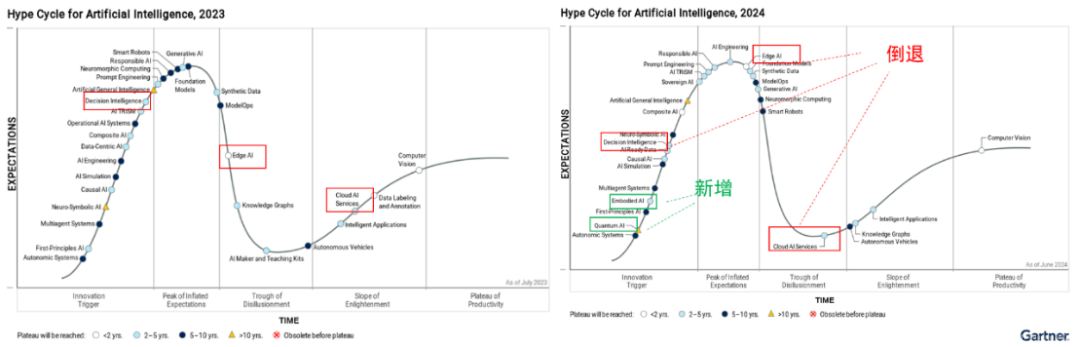
Artificial Intelligence Technology Curve (2023-2024)
From the Hyper cycle for Artificial Intelligence (2024) technology curve, there are currently 29 sub-technology types, which is roughly the same as the number in 2023. The types mainly include: AI industry applications and AI governance.
Overall, new technologies are continuously emerging, with most technologies still in the early stages of development and growth; a few technologies that have been in development for many years are gradually maturing, entering a stable growth cycle, or even sliding out of the curve’s focus range; however, some technologies, such as Edge AI and Cloud AI Services, have shown a regression trend due to certain influencing factors.
-
Application-oriented Technologies
Application-oriented AI technologies include: computer vision, augmented intelligence applications, knowledge graphs, autonomous driving, decision intelligence, embedded AI, foundational models, GenAI, intelligent applications, Cloud AI Services, Edge AI, etc. Due to the long evolution of AI technologies, the starting times and maturity levels of various technologies show some differences.
Among them, a few application technologies, such as computer vision, augmented intelligence applications, knowledge graphs, and autonomous driving, have begun to move out of the “trough of disillusionment” and enter the “slope of enlightenment”.
GenAI, synthetic data, and foundational models, although still in the hype phase, are evolving rapidly and have crossed the peak inflection point. Gartner believes they will enter mainstream applications within 2 to 5 years. It is recommended that enterprises adopt these technologies early to gain significant competitive advantages and alleviate issues related to the use of AI models in business processes.
Due to the intervention of new technologies like GenAI, the maturity of Cloud AI Services, Edge AI, and decision intelligence technologies has regressed to varying degrees. This further illustrates that, within the current time cycle, the accelerated iteration of AI technologies and the rapid implementation of AI applications are synchronized, leading to many applications not maturing before new technologies emerge, resulting in regression in industry application maturity or disruption of business models.
Additionally, compared to 2023, embodied intelligence (Embodied AI) and quantum AI (Quantum AI) have been separately listed for the first time in 2024, attracting widespread attention. Among them, the market focus on embodied intelligence is rapidly increasing, and although it is currently in the experimental and prototype validation stage, it may become one of the core breakthroughs in the next stage of AI development, especially in achieving pathways to general intelligence (AGI). Quantum AI represents long-term disruptive potential, with the technology still in experimental research and concept validation stages, not suitable for short-term implementation.
-
AI Governance Technologies
These mainly include: responsible AI, AI TRiSM (AI Trust, Risk, and Security Management), Prompt Engineering (PE), and sovereign AI. Overall, these technologies are entering a “peak of inflated expectations” phase, reflecting the increasing concerns of enterprises and individuals regarding governance and security as the use of AI expands rapidly.
Responsible AI refers to the concept and practical framework that fully considers ethical, social, legal, and environmental impacts during the design, development, deployment, and use of AI systems, ensuring that AI technology generates positive value for humanity and society while avoiding potential risks. Its core goal is to ensure that AI systems possess interpretability, fairness, safety, and accountability for their decision-making results, preventing technological abuse or harm to specific groups. Influenced by the application of large models, expectations for this technology have increased compared to 2023, with the belief that it will see widespread application within 2-5 years.
The AI TRiSM framework, proposed by Gartner in 2022, aims to provide management measures to address the risks of AI use and its own safety risks through control measures and trust mechanisms, helping enterprises ensure the governance, trustworthiness, fairness, reliability, robustness, effectiveness, and data protection of AI models. According to the 2024 curve, AI TRiSM has reached the peak of the hype cycle and is currently in a critical phase of attention.
PE, also proposed by Gartner in 2022, primarily aims to enable GenAI to produce outputs that better meet human expectations through formatted or unformatted inputs. Currently, it is rapidly developing as a new linguistic discipline for human-AI interaction. With the upgrade of large language models’ intelligence, some predict that PE may only be a transitional technology in the early stages of AI development, and that formatted PE may eventually disappear.
(2) GenAI Technology Curve
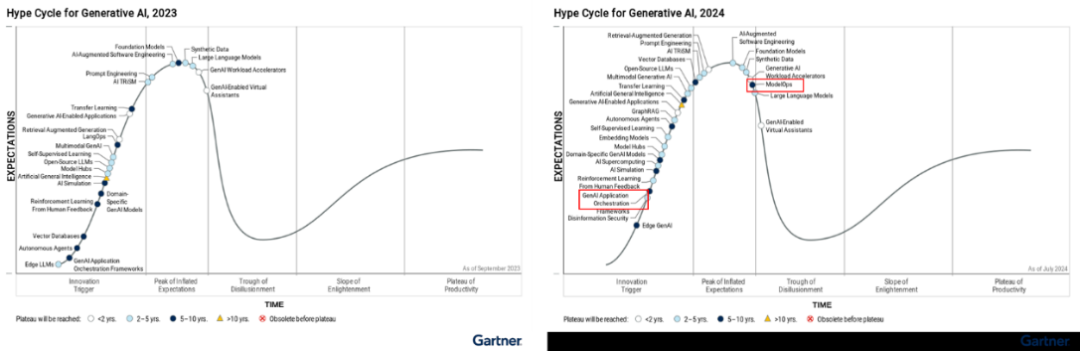
Gen AI Technology Curve (2023-2024)
The Hyper cycle for Generative AI (2024) technology curve shows that Gen AI is still a relatively new technology, but the sub-technology categories have reached 28, divided into four major categories: large models, AI engineering tools, applications and use cases, supporting technologies, and infrastructure.
In terms of trends, new technologies in the GenAI field are emerging exponentially, with the technology density significantly increasing compared to 2023, and currently, some technologies have crossed the “trough of disillusionment”. However, research indicates that 70% of these technologies will become mainstream applications within 2 to 5 years. This also indicates that GenAI technology is showing a trend of centralized explosion, with technology development and market penetration occurring almost simultaneously. However, this explosive development may also pose uncertainty challenges for application entities.
-
First Tier Retrieval-Augmented Generation (RAG), GenAI virtual assistants, GenAI applications, and GenAI workload accelerators (GPUs) are currently the four categories with the highest maturity on the GenAI curve, having become mainstream applications.
-
Second Tier foundational models, large language models, multimodal technologies, embedded models, model hubs, open-source LLMs, prompt engineering, as well as AI TRiSM and misinformation security, are expected to rapidly become mainstream applications within 2 to 5 years. Among them, foundational models, large language models, and multimodal technologies are transformative technologies that enterprises should prioritize in their strategic planning, while also considering the application of AI trust, risk, and security management technologies to mitigate risks.
-
Third Tier Edge GenAI, GenAI orchestration, specialized GenAI models, and ModelOps (model operations) are considered by Gartner to require about 5 to 10 years or even longer for widespread application. From an application perspective, these technologies are primarily core capabilities in the later stages of AI transformation, optimizing AI-native architectures, and governing model ecosystems to support substantial industry development. In particular, ModelOps and GenAI application orchestration, as two emerging technologies newly entering the curve in 2024, are developing rapidly. ModelOps focuses on end-to-end governance and lifecycle management of all advanced analytics, AI, and decision models. MLOps, as one of the core capabilities of ModelOps, will focus on monitoring and governance of ML models. This is particularly important for enterprises laying out AI-native strategies, and it is recommended to maintain ongoing attention to these technologies from a long-term development perspective.
AI Agent Technology Architecture
In the implementation process of AI Agent technology, research teams both domestically and internationally have proposed different system framework ideas. Typical examples include: the NLP team at Fudan University proposed the “Brain, Perception, Action” framework; Renmin University of China proposed the “Analysis, Memory, Planning, Action” general framework; and OpenAI engineer Weng Lillian proposed the “LLM, Memory, Planning, Tool Usage” architecture. Some studies have further divided these frameworks into three-module and four-module structures.
Overall, these concepts are not mutually exclusive, all containing three basic modules: large models, perception, and tool invocation, with the core difference being whether the Agent’s execution logic includes “task planning”.
From the perspective of the evolution and development process of Agent technology architecture, these ideas also reflect the early ReAct architecture and Plan-and-Execute architecture. ReAct and Plan-and-Execute are two fundamental conceptual frameworks in the evolution of Agents from generative Agents to autonomous Agents, representing two phased characteristics of Agent technology iteration, laying a solid foundation for the realization of Agent technology. The current mainstream understanding of Agents is “perception, planning, decision-making, and action”, with the Plan-and-Execute architecture being relatively mainstream.
With the implementation of AI Agents, Multi-Agent (multi-agent collaborative architecture), Memory-Augmented Agents, Graph-based Agents (graph process-driven), and platform-hosted architectures have been successively developed based on ReAct and Plan-and-Execute.
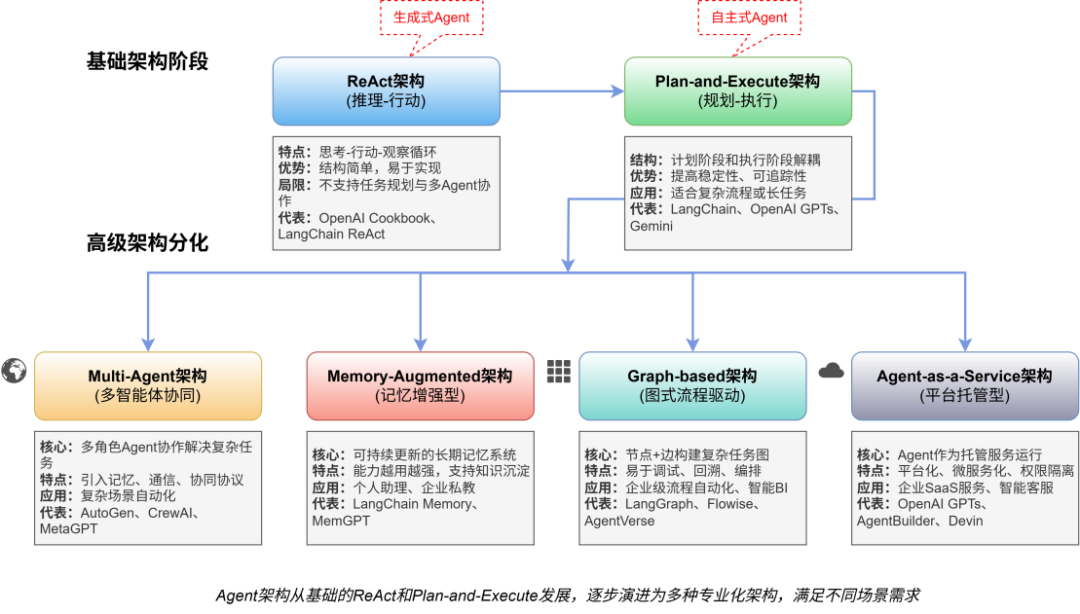
AI Agent Technology Architecture and Evolution
(1) ReAct Architecture (Reasoning and Acting)
Originally proposed by Google, it is the most basic Agent architecture.
-
Characteristics: The model completes tasks through a cycle of “thinking – acting – observing”;
-
Advantages: Simple structure, easy to implement;
-
Limitations: Does not support task planning and multi-Agent collaboration, suitable for lightweight tasks;
-
Representative Implementations: OpenAI Cookbook, LangChain ReAct Agent, MiniChain, AutoGPT, CrewAI.
(2) Plan-and-Execute Architecture
Reconstructed execution reliability and controllability, mainly promoted by OpenAI and LangChain.
-
Structure: Breaks tasks into “planning phase” and “execution phase” for processing, decoupling them;
-
Advantages: Improves stability, traceability, and ease of task management;
-
Applications: Suitable for complex processes or long tasks;
-
Representative Implementations: LangChain (Structured Agent), OpenAI GPTs+Tools, Google Gemini Agent API.
(3) Multi-Agent Architecture
Solves complex tasks through multiple collaborative Agents (different roles), supporting division of labor, negotiation, feedback, and other intelligent behaviors. A typical workflow is: task assignment → multi-role Agent collaboration → main control Agent evaluation results → integration output.
-
Characteristics: Introduces memory, communication, and collaboration protocols, simulating real “teamwork”, suitable for complex task processing;
-
Application Scenarios: Suitable for complex scenario automation, such as software development, financial analysis, and multi-department workflows;
-
Representative Frameworks: AutoGen (Microsoft), CrewAI, MetaGPT, ChatDev, CAMEL.
(4) Memory-Augmented Agent Architecture
Agents possess a sustainable and updatable long-term memory system for contextual association, habit learning, and knowledge accumulation.
-
Characteristics: The more it is used, the stronger its capabilities become, supporting knowledge retention, suitable for building personalized and long-term interactive Agents;
-
Application Scenarios: Personal assistants, corporate tutors, knowledge management assistants;
-
Representative Implementations: LangChain Memory, MemGPT, LlamaIndex Agent + Memory, Reverie Agent.
(5) Graph-based Agent Architecture
Constructs complex task graphs in the form of nodes (tasks) + edges (control flows) to achieve visual scheduling and parallel control.
-
Characteristics: Easy to debug, backtrack, and orchestrate, suitable for building complex processes and DAG control logic;
-
Application Scenarios: Enterprise-level process automation, intelligent BI, supply chain, operational task scheduling;
-
Representative Frameworks: LangGraph, Flowise, GraphRAG, AgentVerse (Alibaba).
(6) Agent-as-a-Service Architecture
Runs Agents as a hosted service, supporting multi-user access, permission control, state management, etc.
-
Characteristics: Combines API gateways, user management, and workflow platforms, featuring platformization, microservices, and supporting elastic deployment and permission isolation;
-
Application Scenarios: Enterprise SaaS services, intelligent customer service, RPA enhancement, AI-native collaboration tools;
-
Representative Platforms: OpenAI GPTs (supporting users to configure custom Agents through natural language, providing tool invocation and service sharing capabilities), Alibaba AgentVerse (a multi-Agent collaboration platform for enterprises, providing low-code Agent construction, scenario-based deployment, and ecosystem integration services), Baidu AgentBuilder (focusing on lightweight Agent development, quickly generating task-oriented Agents through a visual interface and templates, supporting API integration), ByteDance OneAgent (integrating ByteDance ecosystem capabilities, providing Agent creation, scheduling, and multi-scenario adaptation services, focusing on enterprise-level efficiency tool integration). Additionally, Microsoft Azure AI Agent Framework (providing standardized Agent development kits and cloud service deployment capabilities), Anthropic Claude Agent (Agent service interface based on the Claude large model, supporting custom task orchestration) are also important practical platforms for the AaaS architecture, collectively promoting the service-oriented and inclusive development of Agent capabilities.
2. AI Agent Application System Framework
Basic Framework and Components
The AI Agent application system, as the core business system of native AI Agent enterprises, is the lifeblood driving enterprise operations and the cornerstone of strategic development. Its essence is a data-intelligent system built on large language models and Agents, typically composed of four basic modules: large models, AI Agent applications/platforms, knowledge systems, and interaction systems.
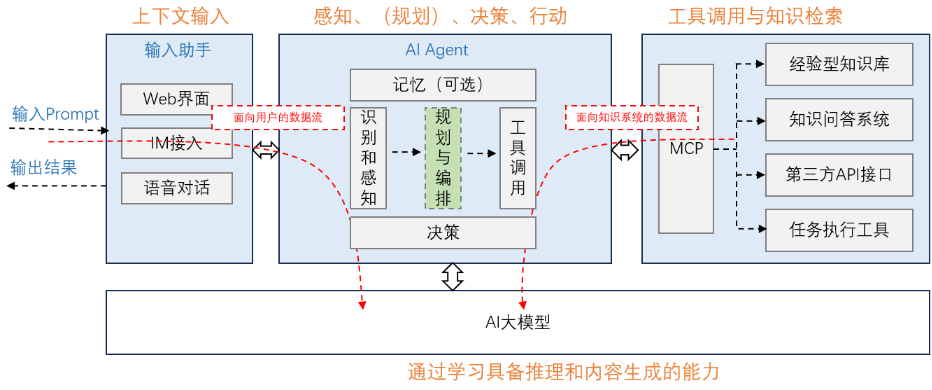
Basic Prototype of AI Agent Application System
(1) Foundational Models
Large models are the “intelligent base” and “brain” of the AI Agent application system, providing natural language understanding, knowledge generation, general reasoning, and other core intelligence, enabling Agents to possess understanding, thinking, and planning capabilities, serving as the core engine for all Agent intelligent decision-making.
(2) AI Agent Applications/Platforms
AI Agent applications/platforms are the main carriers of large model behavioral capabilities and the technical framework for enterprises to achieve intelligent business processes, automated applications, and vertical intelligent agents. This module encapsulates model capabilities into standardized functional components and supports multi-task and multi-Agent collaboration through integrated APIs, plugins, databases, and other toolchains. Product forms include applications, platforms, and services.
(3) Knowledge Systems
Knowledge systems support the knowledge enhancement and long-term memory of Agents through proprietary knowledge injection (private knowledge bases), semantic search, and contextual retrieval (RAG), compensating for the inability of large models to update or remember in real-time. Typically includes structured data, unstructured text, knowledge graphs, vector databases, etc.
(4) Interaction Systems
Interaction systems are the front-end modules for user-Agent interaction, providing dialogue entry or graphical interfaces, capable of integrating voice, image, video, and other multimodal inputs, supporting dialogue management, multi-turn context maintenance, and visual display functions. They are the direct medium for achieving “human-machine collaboration” and determine user experience.
From the perspective of the four-layer structure of information systems, the Agent application system differs significantly from traditional information systems.
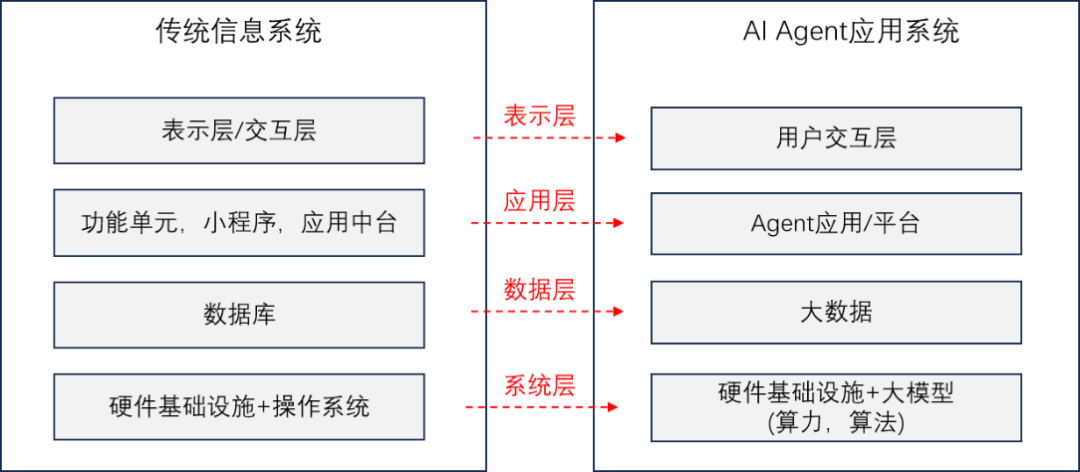
Comparison of Structures between Traditional Information Systems and AI Agent Application Systems
System Layer: Evolved from server-centric hardware and operating systems to intelligent infrastructure primarily providing “algorithms + computing power”;
Data Layer: Expanded from structured databases (such as MySQL, Oracle) to unstructured/multimodal big data used for model training and inference;
Application Layer: Evolved from modular business process software to intelligent Agent applications/platforms that support natural language-driven, business orchestration, and execution capabilities;
Representation Layer: Upgraded from traditional forms and button-based interactions to user interfaces that support multimodal, human-machine dialogue, and natural language interactions.
Enterprise-level Framework Based on Agentic AI Ecosystem
In May 2025, Oliver Morris, founder of Agentico, collaborated with change management expert Simon Torrance to propose and publish the “Agentic AI Stack for Enterprises” on the AI Risk platform.
This framework maps the Agentic AI ecosystem from the perspective of enterprise operations, aiming to provide a strategic perspective for understanding the Agentic AI ecosystem. It is divided into three levels from the bottom up: data layer, capabilities layer, and engagement layer, clearly defining the path for enterprises to evolve from traditional systems to Agent-driven architectures from both technical and operational management dimensions. It can help enterprises systematically evolve to “Agent-native” from the ground up with strategic thinking and controllable methods.
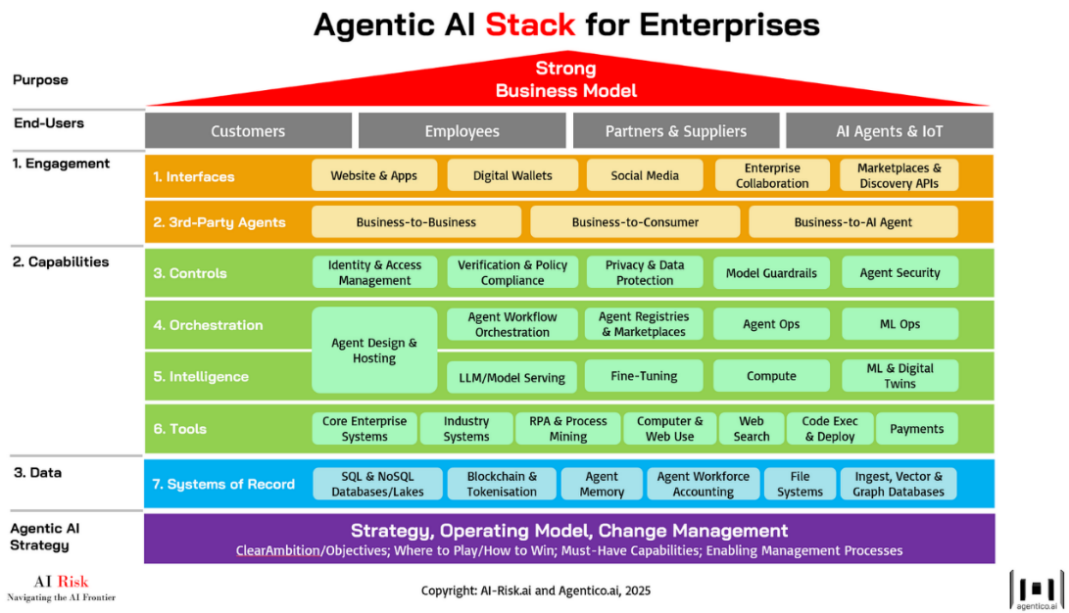
Agentic AI Stack for Enterprises
(1) Data Layer
The data layer focuses on the underlying data foundation and governance, forming the knowledge base of the Agentic AI system. Its core value ensures that all inputs and outputs of intelligent agents are traceable, achieving verifiable learning and audit trails.
Functions include: building structured and unstructured data storage systems (databases, data lakes, knowledge graphs, vector storage), managing data quality, auditing, and compliance, providing data pipelines for Agent training, inference, and self-review.
(2) Capabilities Layer
The capabilities layer is the “intelligent hub” for building enterprise-level Agent systems, consisting of four sub-modules: Controls, Orchestration, Intelligence, and Tools.
-
Controls (Control Module) is mainly responsible for identity, security, compliance, and policy management of Agent operations, ensuring that the system is trustworthy, compliant, and controllable.
-
Orchestration (Orchestration Module) defines the management and scheduling of multi-Agent, tasks, and workflows, serving as the coordinator between inputs, models, and execution.
-
Intelligence (Intelligence Module) provides Agents with true “intelligent capabilities”, namely large language models, computing power, and self-learning mechanisms.
-
Tools (Tools Module) provides the “skill plugins” that Agents call to execute tasks—specifically executable tools or APIs.
(3) Engagement Layer
The engagement layer is the front-end interface for AI Agents to interact with humans or systems, serving as the window for “perception and presentation”. It includes Interfaces and Third-party Agents as two components. Its core value is to enable Agents to be discovered, composed, executed, and authorized across platforms, serving as the entry point for Agent services.
-
Interfaces: Interfaces for users and systems, such as chat, forms, APIs, IoT.
-
Third-party Agents: Support collaboration and mutual trust authorization between Agents.
 Cooperation Phone: 18311333376Cooperation WeChat: aqniu001Submission Email: [email protected]