Bluetooth to CAN devices typically integrate a CAN communication interface circuit and a Bluetooth communication module. They continuously monitor the CAN bus and Bluetooth bus, and when data is detected on the CAN bus, it is immediately parsed and converted into a Bluetooth communication format, which is then sent out via the Bluetooth module. Conversely, when data is received from a Bluetooth device, it is converted into CAN bus data format and sent onto the CAN bus, enabling bidirectional data conversion between the two.
1. Function of Bluetooth to CAN Module
1. Wireless Convenience:
No physical connection is required, freeing devices from the constraints of cables, facilitating mobility and layout adjustments, and enhancing system flexibility and scalability.
2. Easy Integration:
Typically compact in size with various mounting options, such as standard DIN rail mounting or simple fixed methods, they can be easily integrated into existing CAN bus systems and various devices.
3. Safe and Reliable:
Some Bluetooth to CAN devices utilize opto-isolation technology for their CAN interfaces, providing excellent anti-interference capabilities and electrical isolation, effectively protecting the devices and data. Additionally, Bluetooth communication can ensure data transmission security through password settings and other methods.
2. Application Scenarios
1. Industrial Equipment Debugging and Monitoring:
Engineers can use mobile terminals such as smartphones or tablets equipped with Bluetooth serial port assistants to wirelessly connect to the CAN bus network via Bluetooth to CAN devices, conveniently debugging industrial equipment, reading operational data, and monitoring device status without needing a physical connection near the equipment.
2. Automotive Electronics Testing:
In automotive repair and testing, technicians can use Bluetooth to CAN devices to connect handheld testing equipment to the vehicle’s CAN bus, wirelessly reading CAN bus data from various systems in the vehicle, such as the engine control unit and transmission control unit, for fault diagnosis and performance analysis.
3. Smart Building Control:
In smart building systems, Bluetooth to CAN devices can transmit data from CAN bus-controlled devices, such as elevators, air conditioning, and lighting, to the mobile terminals of management personnel or central control systems, enabling remote monitoring and management of building equipment.
4. Wireless Sensor Networks:
By connecting Bluetooth sensors to the CAN bus network through Bluetooth to CAN devices, data collected by Bluetooth sensors can be transmitted to the CAN bus, achieving centralized management and processing of sensor data, suitable for scenarios where wiring is difficult or flexible sensor placement is required.
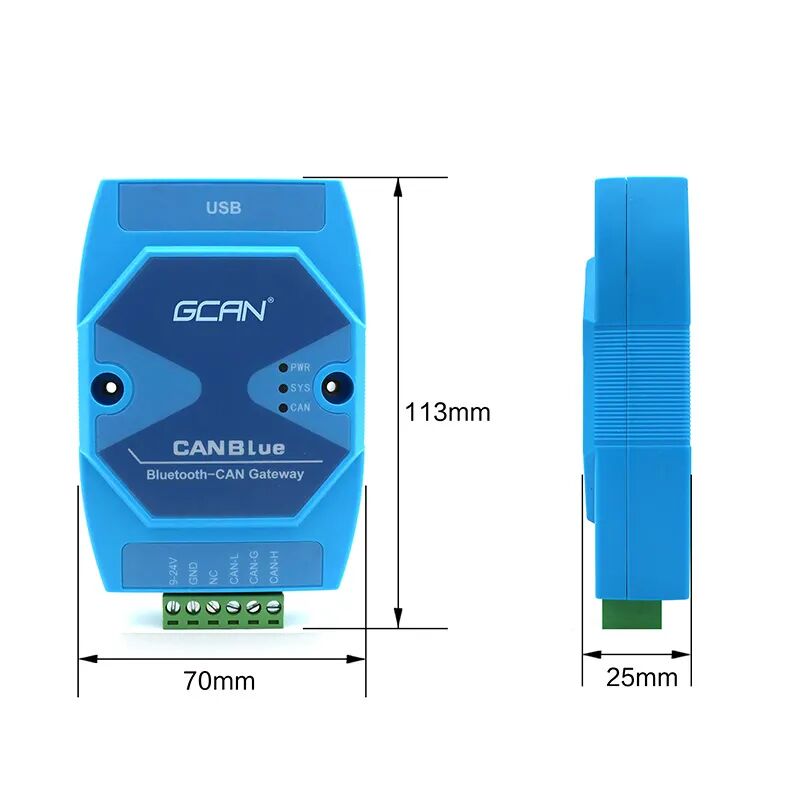
Dimensions of Bluetooth to CAN V2 and V5 versions
3. Selection of Bluetooth to CAN Modules
1. Bluetooth version 5.0 or 2.0
2. Powered by 9~30V DC
3. Operating temperature range: -40℃ to +85℃:
4. The CAN bus interface uses electrical isolation, with isolation voltage: DC1500V;
5. Use CANBlue 5.0 Config to configure operating modes and parameters:
4. Advantages of CAN to Bluetooth
1. Wireless Convenience:
No physical connection is required, freeing devices from the constraints of cables, facilitating mobility and layout adjustments, and enhancing system flexibility and scalability.
2. Easy Integration:
Typically compact in size with various mounting options, such as standard DIN rail mounting or simple fixed methods, they can be easily integrated into existing CAN bus systems and various devices.
3. Safe and Reliable:
Some Bluetooth to CAN devices utilize opto-isolation technology for their CAN interfaces, providing excellent anti-interference capabilities and electrical isolation, effectively protecting the devices and data. Additionally, Bluetooth communication can ensure data transmission security through password settings and other methods.
Conclusion
Bluetooth to CAN devices typically integrate a CAN communication interface circuit and a Bluetooth communication module. They continuously monitor the CAN bus and Bluetooth bus, and when data is detected on the CAN bus, it is immediately parsed and converted into a Bluetooth communication format, which is then sent out via the Bluetooth module. Conversely, when data is received from a Bluetooth device, it is converted into CAN bus data format and sent onto the CAN bus, enabling bidirectional data conversion between the two.
If you need specific information about CAN to fiber optic devices from Shenyang Guangcheng Technology, you can call 18104011359 for detailed inquiries.