A counterintuitive data point reveals the golden three years for storage chips.
Did you know? The HBM (High Bandwidth Memory) market, which was only $3 billion in 2023, is expected to skyrocket to $53 billion by 2027, a 17-fold increase that far exceeds AI computing chips!
Even more surprisingly, DRAM prices have risen for six consecutive months, with DDR4 increasing by 30% in a single month,
breaking the traditional 3-4 year cycle of the industry.
Missing out on AI computing is not scary, but missing out on AI’s “granary”—storage chips—could mean waiting another decade.
If you want to learn about storage chips and related fields; semiconductors, AI computing, liquid cooling, GPUs, solid-state batteries, and other key industry analyses, latest developments, and research notes, they are only published on Knowledge Planet. If interested, feel free to join us👇🏻

1. Why is it a “super cycle”?
The supply-demand gap reaches 3%, with price increases continuing until 2027.
Many people are puzzled: isn’t the storage chip industry cyclical?
This time is different, the core is the explosion of AI-driven demand + rigid supply shortages.
From the demand side, the DRAM capacity of a single AI server is 8 times that of a regular server,
and the NVIDIA H100 requires 640GB HBM + 2-4TB DDR5, directly amplifying storage demand by 4-8 times.
UBS predicts, that the growth rate of DRAM demand will exceed 19% in both 2025 and 2026, and by 2027, AI applications will account for 53% of the DRAM market.
However, the supply side is severely constrained:
Samsung, SK Hynix, and Micron are conservatively expanding capacity from 2025 to 2027, prioritizing high-value products like HBM and DDR5, leading to a shortage of standard storage chips.
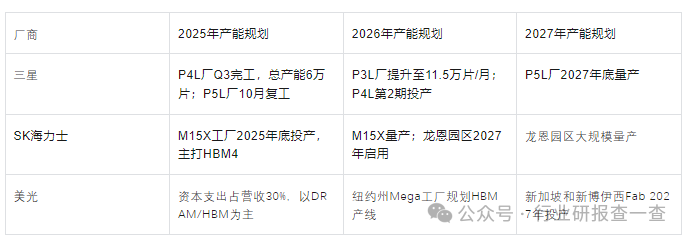
More critically, the wafer capacity consumed by HBM is 3 times that of regular DRAM, further squeezing production capacity.
Industry estimates indicate that by 2026, the DRAM supply-demand gap will reach 3%, and this imbalance will last at least until 2027.
A private equity manager in the community shared that he heavily invested in leading storage chip companies at the beginning of this year, and his returns have doubled since then. His core logic is “AI demand is irreversible + supply side is hard to expand.”
2. Three Major Segments: Which Technology Has the Highest Value?
There is no need to get entangled in the entire industry chain; just focus on three high-potential directions, each with clear application scenarios:
HBM (High Bandwidth Memory): the growth king of technology, Counterpoint data shows that demand will increase by 89% year-on-year in 2025, and another 67% in 2026,
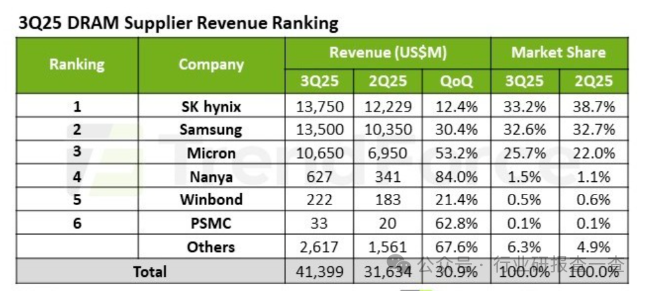
with Samsung and SK Hynix’s 2026 capacity already fully booked by AI companies, and SK Hynix’s market share reaching 60%.
Focus on the packaging and materials segment, with domestic Changjiang Storage achieving a 95% yield rate for HBM packaging, already compatible with multiple AI device manufacturers.
DDR5: Accelerating mainstream adoption in servers, Gartner predicts that by 2026, DDR5 will account for over 60% of server memory, with a single-channel bandwidth 2.6 times that of DDR4, and data center demand growing over 50% annually.
Domestic Zhaoyi Innovation has increased its DDR5 market share from 1% in 2023 to 7% in 2025,
and is expected to reach 15% by 2026, the fastest growth globally, already used in domestic cloud computing data centers.
NAND Flash: Prices are rebounding from the bottom, with TrendForce data showing that global NAND capacity utilization will reach 90% by Q4 2025,
Changjiang Storage’s 294-layer 3D NAND has achieved over 90% yield, with continuous read and write speeds exceeding 7000MB/s,
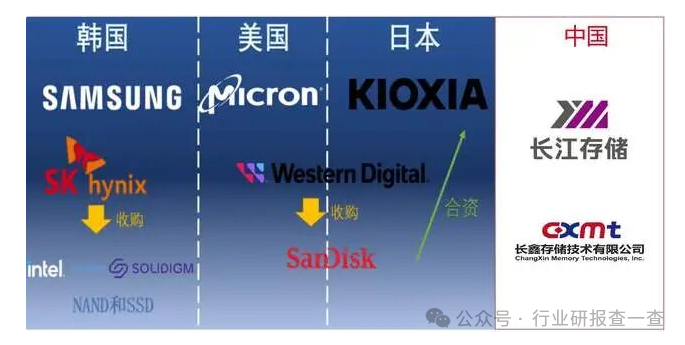
performance surpassing that of Samsung and Micron’s comparable products, with monthly production capacity expected to reach 200,000 pieces by 2026, supporting storage needs for domestic consumer electronics and industrial equipment.
3. Domestic Substitution: From 8% to 48%, a Qualitative Change in 2027
Many people worry that domestic technology is lagging, but the data does not lie:
Policy Support: The National Big Fund Phase III has allocated 500 billion yuan to focus on the storage industry chain, and the Ministry of Industry and Information Technology has clearly stated that by 2027, the self-sufficiency rate of storage chips will increase from the current 8% to 25% (Morgan Stanley even predicts that the NAND self-sufficiency rate will reach 48%).
Technological Breakthroughs: Changjiang Storage’s first fully domestically produced production line will begin trial production in H2 2025, with a domestic equipment rate of 45%, and core processes such as etching and deposition have been replaced, with Xtacking technology mass-producing 294-layer 3D NAND, achieving read and write speeds exceeding 7000MB/s.
Capacity Explosion: Changjiang Storage’s current monthly production capacity is 130,000 pieces (accounting for 8% globally), expected to exceed 200,000 pieces by 2026, aiming for a 15% global market share; CX’s LPDDR5 market share has jumped from 0.5% to 9%, the fastest growth globally.
Let’s imagine: by 2027, nearly half of the NAND flash memory will be “made in China,” and the self-sufficiency rate of DDR5 memory will reach 26%, which means that the valuation of domestic storage companies will be completely reassessed.
4. Layout Strategy: Avoiding 3 Major Traps, Focusing on 2 Main Lines
No matter how big the opportunity, risks must be avoided:
Beware of Traps:
① Technology iteration risk (domestic lithography equipment has not yet broken through 28nm, limiting the development of NAND beyond 300 layers);
② Geopolitical escalation (the U.S. has restricted 17 Chinese storage companies);
③ Production capacity ramp-up not meeting expectations (domestic production line yield needs to stabilize above 80%).
Core Main Lines:
① Localization of equipment and materials (Zhongwei Company, Yake Technology, benefiting from Changjiang Storage’s capacity expansion);
② Leading storage companies for AI/automotive applications (Lankai Technology, Jiangbolong, tied to AI server and smart vehicle demand).
Short-term focus on equipment companies in the technology validation phase, mid-term (2026) layout for storage chip leaders with capacity expansion, and long-term (2027) hold on segmented champions with domestic substitution rates exceeding 40%.
In summary, the AI-driven “super cycle” + the “qualitative change dividend” of domestic substitution make storage chips one of the most certain focus areas in the next three years, with HBM, DDR5, and domestic NAND being key directions to watch.
Among the three major segments (HBM/DDR5/domestic NAND), which one do you think has the most potential? Share your views in the comments section.
Disclaimer: This article does not constitute any investment advice, guidance, or commitment, and is for academic discussion only. Please read carefully. The market has risks, and investment decisions should be based on rational independent thinking.
Knowledge Planet
We update industry information, investment bank data, and selected analysis reports daily on the planet. If you wish to gain deeper insights ahead of others, feel free to subscribe to view.
 Click “
 “
“ ” to show your recognition, sharing is encouragement!