The laser chip industry has made significant progress in recent years, particularly in the fields of communications, laser processing, beauty, and displays. Many domestic and international companies have begun to focus on the research and development and market of laser chips. Let’s take a look at the characteristics of companies from both domestic and international markets:International companies leveragedecades of technological accumulation,full industry chain layout, andstandard definition rights to dominate the high-end market, with core players including:
|
Company Name |
Region |
Product Features |
Market Situation |
|---|---|---|---|
|
II-VI (Coherent) |
USA |
– Full platform coverage: includesIndium Phosphide (InP) and Gallium Arsenide (GaAs) two major material systems;– Star products: High-speed EML/DFB laser chips (data centers/telecommunications), high-power semiconductor laser chips (industrial), VCSEL chips (sensing);– Technical advantages: Leading silicon photonics integration technology, supporting 800G/1.6T optical interconnects. |
– Global leader: Integrates the entire chip design-manufacturing-packaging chain through acquisitions (e.g., Finisar), leading in high-end optical chiptechnology and market share;– Customer ecosystem: Covers top global equipment manufacturers (e.g., Huawei, Cisco) and cloud giants (e.g., AWS, Alibaba Cloud);– Market position: Approximately35% global market share in optical communication chips (2025 data). |
|
Lumentum |
USA |
– High-end communication and sensing expert:① Telecom-grade EML/DFB laser chips (long-distance transmission, linewidth ≤ 1MHz);② VCSEL arrays (3D sensing, LiDAR, efficiency ≥ 50%);– Technical barriers: Chip reliability (MTBF ≥ 1 million hours) and efficiency metrics are industry benchmarks. |
– King of high-end niche markets:① High-speed optical communication chips (100G+) market share approximately25%; ② Consumer electronics VCSEL (facial recognition in smartphones) market share approximately60% (core supplier for Apple);– Technical premium: Product prices are 30% higher than the industry average, maintaining high gross margins through technical barriers. |
|
Broadcom |
USA |
– High-speed optical module chips: Focused onmodulator and receiver chips (for 800G/1.6T optical modules);– Technical advantages: Fusion of optics and integrated circuits (CMOS), supportingCo-packaged optics (CPO) technology. |
– Communication chip giant: Approximately20% global market share in optical module chips;– Market positioning: Core supplier in the data center and cloud computing market (e.g., Google, Microsoft);– Growth driver: AI computing power demand drives high-speed chip sales (2025 revenue expected to grow by45%). |
|
Sumitomo Electric |
Japan |
– High-end semiconductor laser chips: Focused onoptical communication (1310/1550nm), displays (laser TVs), and medical (surgical lasers) fields;– Product features: Stable performance (wavelength tolerance ≤ ±0.5nm), long lifespan (≥ 50,000 hours). |
– Representative of Japanese precision manufacturing:① Approximately10% global market share in optical communication chips;② Approximately70% domestic market share in medical laser chips (Japan);– Market position: “Invisible champion” in specific high-end fields (e.g., aerospace, medical), with clients primarily being Japanese companies (e.g., Sony, Panasonic). |
Other notable companies include Lianya, Nichia Chemical, Niuwei, Mitsubishi, etc., which also have strengths in laser technology.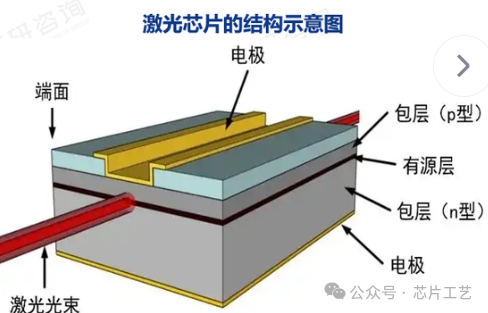 Domestic companies rely onpolicy support,local market demand, andIDM model (integrated design-manufacturing-packaging) to achieve breakthroughs inhigh power, high speed, and special wavelengths in niche fields, with core players including:
|
Company Name |
Region |
Product Features |
Market Situation |
|---|---|---|---|
|
Changguang Huaxin |
China |
– Leading high-power semiconductor laser chip:① Single chip power35W (internationally leading), brightness ≥10MW/cm²; ② Material systems coverGallium Nitride (GaN), Gallium Arsenide (GaAs), Indium Phosphide (InP);– Model advantages: The only domestic6-inch high-power chip production line (IDM model), with core chips being self-controlled. |
– Core of domestic high-power replacement:① Approximately40% market share in domestic industrial laser chips (2025);② Clients include leading manufacturers such as Raycus Laser and Chuangxin Laser;– Expansion direction: Horizontal layout in optical communication (25G DFB), VCSEL (LiDAR) chips, with R&D investment accounting for46.69% in 2025. |
|
Yuanjie Technology |
China |
– High-speed optical communication chip expert:① Focused on25G/50G/100G and above rate DFB/EML laser chips;② Technical breakthroughs:25G EML chips in mass production (market share approximately15%),100G EML chips samples sent;– Model advantages: IDM model (integrated design-manufacturing-packaging), yield ≥90%. |
– Pioneer in domestic optical communication:① Entered the supply chain of mainstream optical module manufacturers such as Zhongji Xuchuang and Guangxun Technology;② Approximately5% market share in the data center interconnect (DCIO) market (2025);– Growth driver: AI data center demand drives high-speed chip sales (2025 revenue expected to grow by60%). |
|
Shijia Photon |
China |
– Passive + active optical chip platform:① GlobalPLC optical splitter chip leader (market share55%, 2025);② Active chips: DFB laser chips (2.5G-100G), AWG chips (data center switching);– Product features: Covers the entire chain from “passive to active”, with low costs (20% lower than international giants). |
– Global leader in passive chips:① Access network (FTTH) market shareover 50%; ② Expanding into data center interconnect (DCI) (2025 DCI chip revenue share15%);– Model advantages: IDM model, production capacity (monthly production of100,000 pieces) is the largest in the world. |
|
Decoli |
China |
– High-speed long-distance transmission chips:① The world’s firstthin-film lithium niobate modulator chip (speed ≥ 400G);② Technical advantages: Self-research at the bottom (material growth + chip design), supportingsatellite laser communication;– Product features: Insertion loss ≤3dB, modulation bandwidth ≥60GHz. |
– High-end optical communication breakthrough:① Products have received overseas sample orders (e.g., European telecom manufacturers);② Approximately10% market share in satellite laser communication (2025);– Strategic layout: Binding with domestic satellite internet manufacturers (e.g., StarNet Group), with great potential for future growth. |
|
Huaguang Optoelectronics |
China |
– High-power industrial laser chips:① Industrial pump laser chips (915nm-45W, 976nm-50W);② Technical advantages: Epitaxial material growth (MOCVD) + chip process accumulation (≥10 years), lifespan ≥20,000 hours;– Product features: High brightness (≥8MW/cm²), suitable for thick plate cutting. |
– Leader in industrial laser chips:① Information laser device production and sales have been the first in China for over ten consecutive years;② Approximately30% market share in domestic industrial pump chips (2025);– Client coverage: System integrators such as Huagong Technology and Da Zhu Laser. |
|
Lixin Optoelectronics |
China |
– Special wavelength laser chips:① First in China to launch1940nm high-power laser chips (power ≥10W);② Product features: High water absorption rate (≈90%), suitable formedical beauty (soft tissue cutting), andspectrum analysis;– Technical advantages: Fills the domestic gap in this wavelength (previously reliant on imports). |
– Domestic alternative for special wavelengths:① Approximately20% market share in medical beauty chips (2025);② Client coverage includes domestic medical laser equipment manufacturers (e.g., Kylin, Feidun);– Growth driver: Upgrading of medical consumption drives demand for high-end chips (2025 revenue expected to grow by50%). |
-
International giants: Relying ontechnical barriers (e.g., Lumentum’s VCSEL, II-VI’s silicon photonics) andecosystem building (e.g., Broadcom’s CPO), dominate thehigh-end market (100G+ optical communication, consumer electronics sensing), with a combined market share of approximately70%.
-
Domestic companies: Achievedomestic substitution (combined market share of approximately30%) by focusing onniche fields (e.g., Changguang Huaxin’s high power, Shijia Photon’s passive chips) andIDM model, forminginternational competitiveness in areas such as high power and special wavelengths.
-
Future trends:Silicon photonics technology (integration),AI data centers (high-speed chips), andLiDAR (VCSEL) will become the core of competition. Domestic companies need to acceleratetechnology research and development andecosystem collaboration (e.g., binding with cloud vendors and equipment manufacturers) to narrow the gap with international giants.