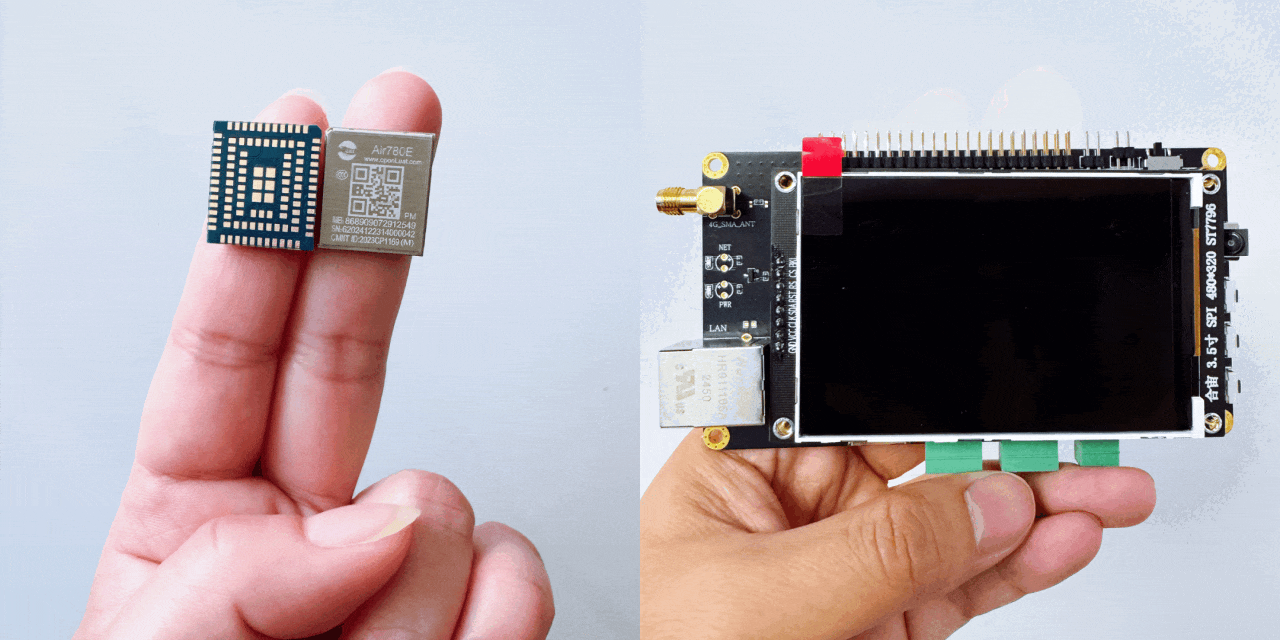
Air780EPM——Hezhuo’s low-power4G-Cat.1module launched in 2025,one of the main models,features 4MB of RAM, supports LCD, camera, Modbus, Ethernet, and CAN; it has more powerful secondary development resources, improved peripheral capabilities, and is more suitable for industrial scenarios.
Recently, an engineer friend asked:What is the ADC accuracy of the Air780EPM? They want to save an external ADC…
Today, I will share relevant content with everyone. Before designing the ADC hardware circuit, please be sure to check the description of the ADC-related library functions for LuatOS secondary development.
For the latest ADC library functions, see:https://docs.openluat.com/osapi/core/adc/
Let’s first review some core content:
The Air780EPM has 4 external ADC hardware channels, which are typically used to test voltage values.
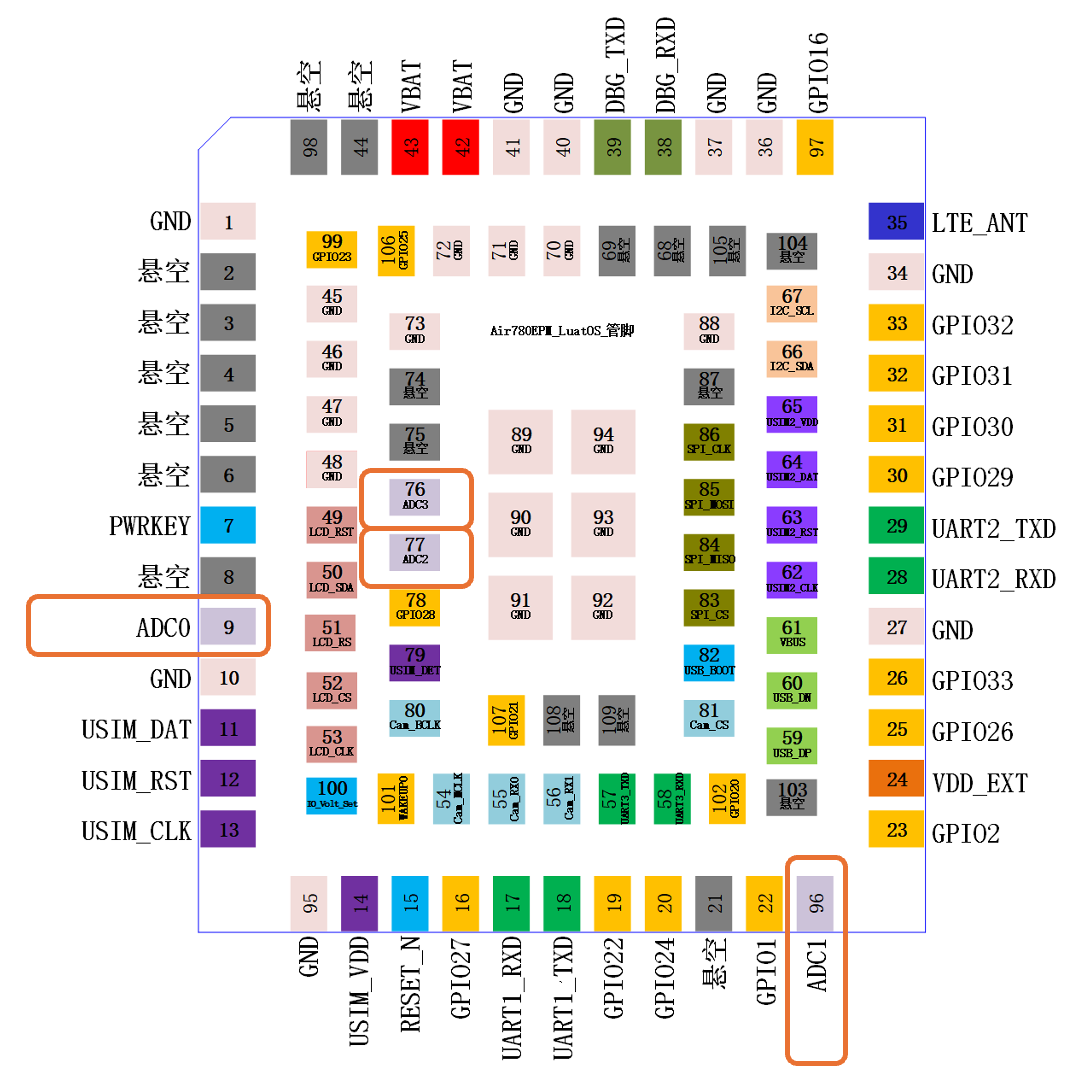
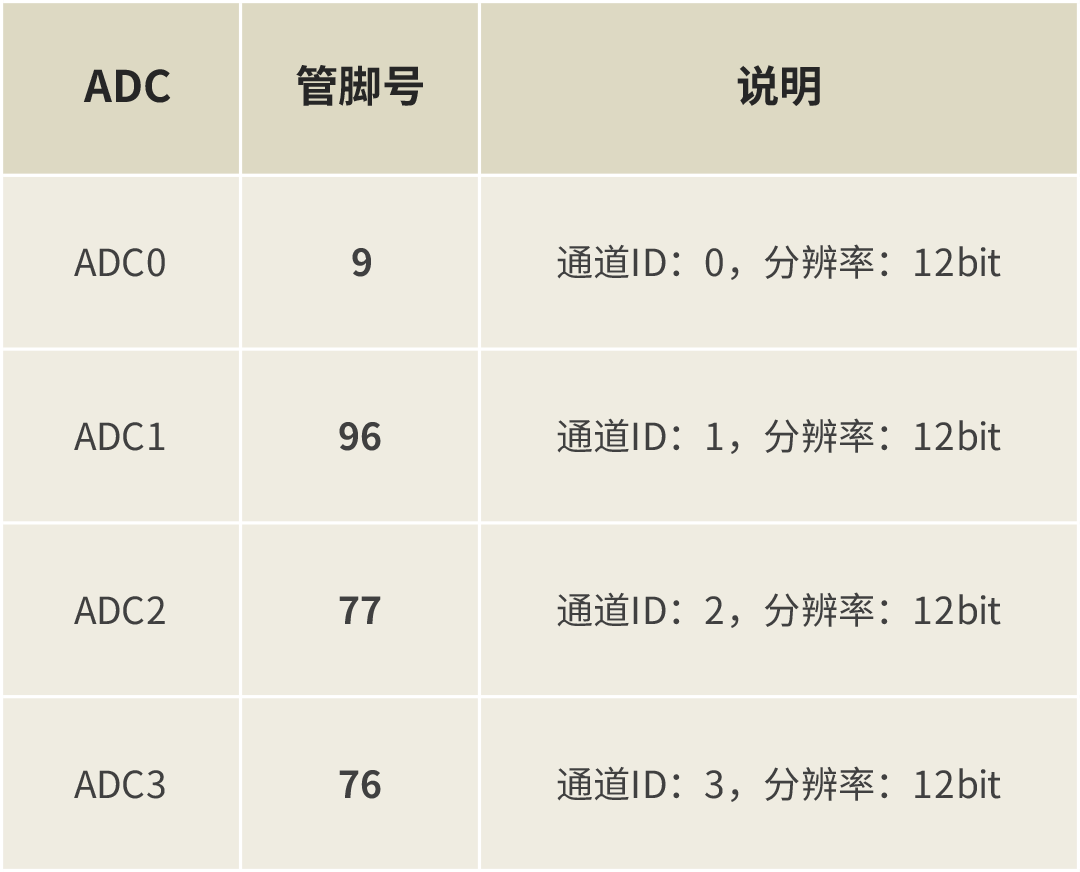
There are two ways to connect the ADC hardware to the measured voltage:
-
When the measured voltage is below 3.6V, the measured voltage can be directly connected to the ADC;
-
When the measured voltage is above 3.6V, the measured voltage must first go through an external resistor divider, and the voltage after division connected to the ADC must be less than 1.5V.
The above two hardware connection methods for the ADC correspond to different software settings, which will be mentioned later.
In addition to the 4 external ADC channels, the Air780EPM also has 2 internal ADC channels:
-
One is CH_CPU, used to measure the CPU temperature of the Air780EPM;
-
One is CH_VBAT, used to measure the vbat voltage of the Air780EPM (vbat, or written as VBAT, is the power supply voltage when the Air780EPM is operating, corresponding to PIN42/PIN43 of the Air780EPM).
Next, I will categorize and describe how to design the ADC hardware circuit based on common scenarios in practical applications.
1
– Measuring the VBAT Voltage of the Air780EPM –
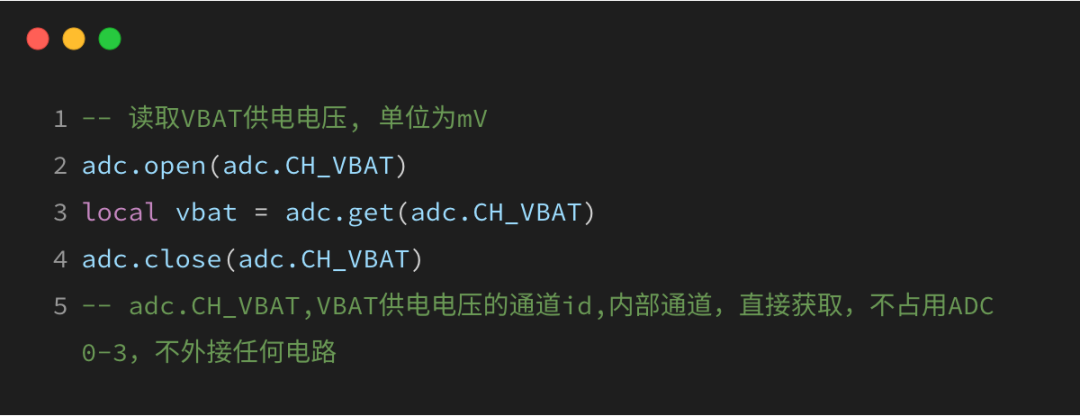
When measuring the VBAT voltage with the ADC, no external hardware circuit is needed.
The Air780EPM has an internal channel CH_VBAT:specifically used to measure the VBAT voltage of the Air780EPM, with a measurement range that corresponds to the normal operating VBAT supply range of the Air780EPM (3.3V-4.3V).
You can use the following code to read the VBAT voltage:
2
– Measuring Voltage Below 3.6V –
Here we discuss the scenario of using the 4 external ADC channels of the Air780EPM to measure voltages below 3.6V.
Why mention the number 3.6V?As mentioned at the beginning of this article, when the measured voltage is below 3.6V, it can be directly connected to the ADC without external circuitry.
Yes, the meaning of not needing external circuitry is that the measured voltage can be directly connected to the ADC without any processing.However, it is necessary to ensure that the measured voltage does not exceed 3.6V.
Accordingly, the software should do the following:
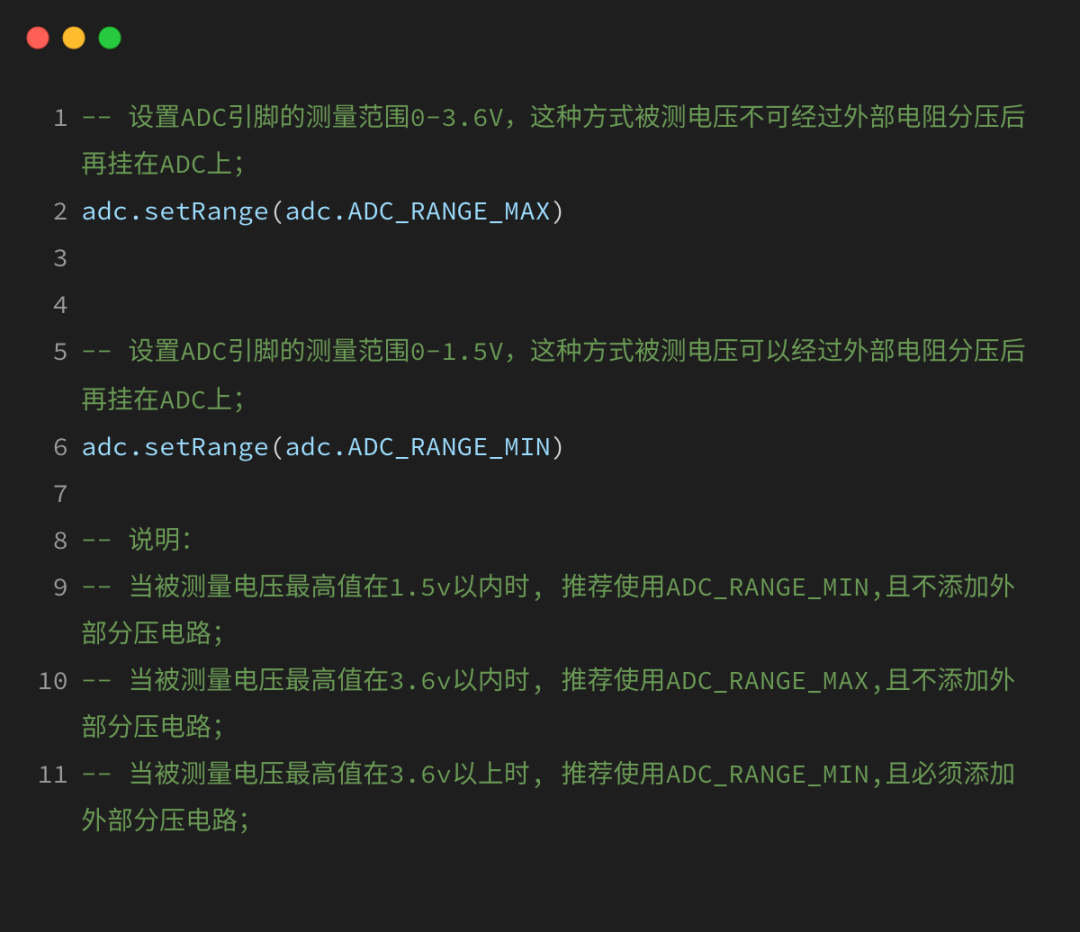
The core is that the software processes differently whenit is below 1.5Vandwhen it is greater than 1.5V but less than 3.6V.
If you find this confusing, that’s normal. You need to firstcheck the description of the ADC-related library functions for LuatOS secondary development, see:
https://docs.openluat.com/osapi/core/adc/
Alternatively, you can follow one principle:
When the measured voltage is below 3.6V, it can be directly connected to the ADC, and the rest is left to the software colleagues to handle.
3
– Measuring Voltage Above 3.6V –
We are still discussing the scenario of using the 4 external ADC channels of the Air780EPM to measure voltages above 3.6V.
When the measured voltage exceeds 3.6V, using the 4 external ADC for measurement:the external voltage must be divided using resistors to ensure that the voltage at the ADC is below 1.5V.
So, how to choose the voltage divider resistors?
-
First, it depends on the value of the measured voltage; the voltage divider resistors for measuring maximum voltages of 5V and 12V will definitely be different;
-
Secondly, the resistors must be of 1% precision to ensure that the voltage divider ratio meets the requirements;
-
Additionally, a filtering capacitor can be added at the ADC input to suppress high-frequency noise and avoid fluctuations in ADC readings.
The above are practical tips; now let’s take an example with a measured voltage of 5V:
Voltage Divider Ratio Requirement:
Vout/Vin=1.5V/5V=0.3,
that is: R2=0.3×(R1+R2),
Solving gives R1:R2≈2.33:1.
Recommended Resistor Values:
Pull-up resistor R1=2.4MΩ (±1% precision)
Pull-down resistor R2=1.0MΩ (±1% precision)
Actual Voltage Divider Ratio:
1.0MΩ/(2.4MΩ+1.0MΩ)≈0.294,
After dividing, 5V becomes 5V×0.294≈1.47V, which meets the range requirement.
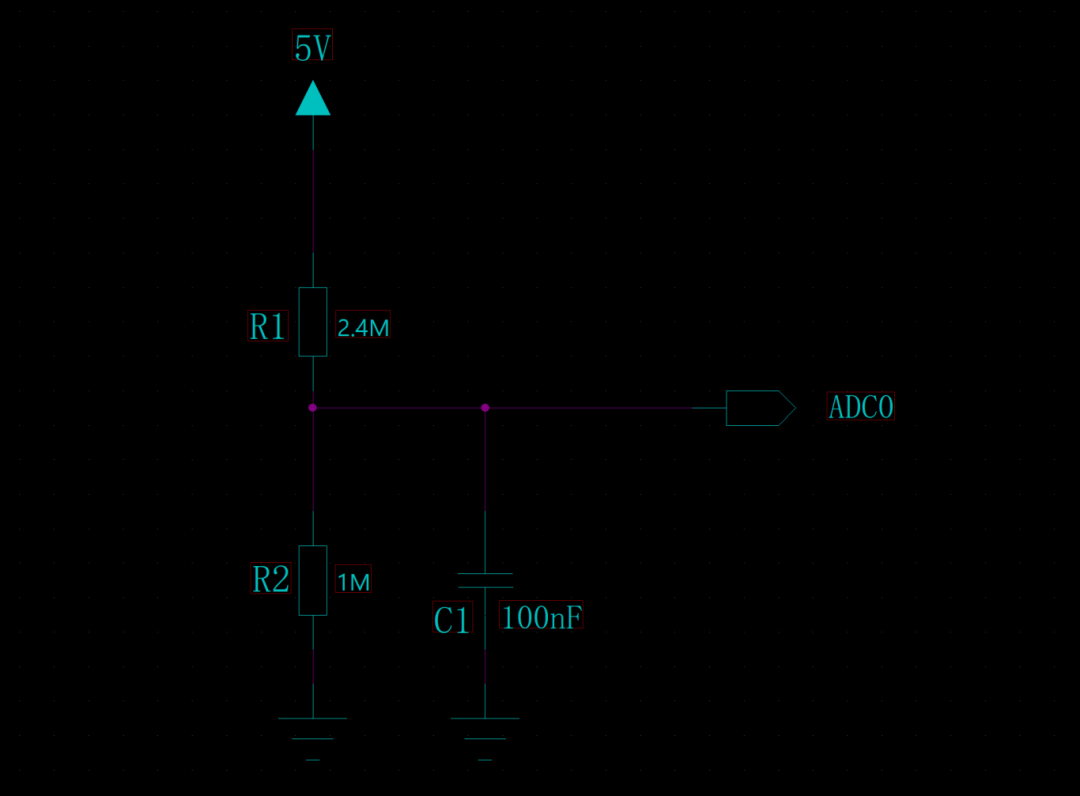
Accordingly, if the voltage measured by the ADC is 1.47V, the measured voltage can be calculated as:
1.47V/0.294=5V
It should be noted that even when using MΩ-level resistors, the system will still have a fixed power consumption waste:
Total current: I=5V/(2.4MΩ+1.0MΩ)≈1.47μATotal power consumption: P=5V×1.47μA=7.35μW
Power consumption is very low, suitable for low-power scenarios powered by batteries.

That’s all for today’s content~If you have any questions regarding IoT development selection, feel free to join the technical discussion group or contact the person in charge for further discussion.
For more development materials, see Hezhuo’s resource center:
docs.openluat.com

▼ Learn More About Hezhuo ▼
4G+ positioning + WiFi + Bluetooth, Air8000 complete development boardNew Air8101 core board + accessory board
Hezhuo’s low-power 4G module adds 4 more hardcore new products