 {Click the blue text to follow me}
A new wave of AI-driven toys is sweeping through the consumer market in 2025. Various interactive dolls can change expressions and communicate with users to alleviate loneliness; multifunctional robotic dogs not only answer questions and tell stories but also become close companions for children…
These AI toys, which possess interactive and nurturing characteristics, are increasingly favored by young people and children. Their rise not only brings innovative momentum to the traditional toy manufacturing industry but also spawns a burgeoning market worth hundreds of billions, attracting numerous market participants to actively engage.
01Market Overview: Scale Expansion and Form Evolution
This emerging sector is demonstrating tremendous market potential. At a recent press conference held by the Ministry of Industry and Information Technology, He Yaqiong, Director of the Consumer Goods Industry Department, pointed out that AI and large model technologies have endowed toy products with a new “soul,” greatly optimizing the interactive experience. AI toys with interaction, nurturing, personality, and memory capabilities have become the core focus of industry competition.
Data shows that by 2024, China’s AI toy market size will reach approximately 24.6 billion yuan, and it is expected to grow to 29 billion yuan by 2025.
In terms of product forms, AI toys mainly fall into three categories: dolls/plush toys, smart accessories, and robots/robotic dogs.
Doll products deeply integrate AI interaction modules, such as the “Eye-catching Bag” plush toy launched by ByteDance, which offers a unique user experience. Smart accessories excel in their flexibility, allowing them to be attached to ordinary toys, instantly granting them conversational abilities.
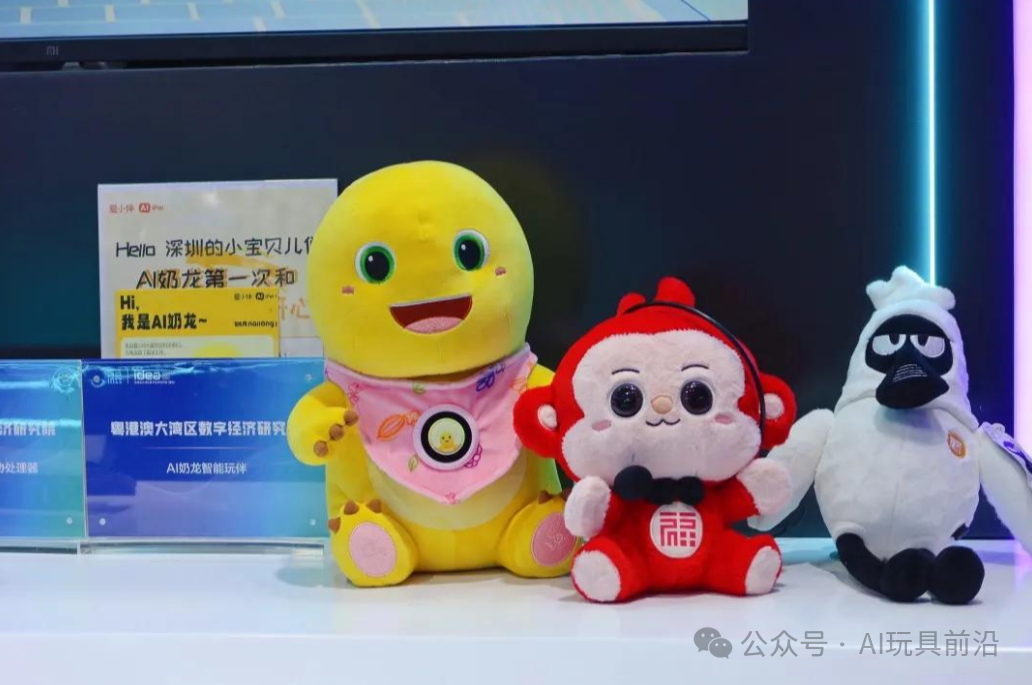
With technological advancements, the functions of AI toys have shifted from basic “talking and moving” to a deeper role as “emotional companions,” serving users across all age groups.
Products aimed at children focus on intelligent dialogue and educational enlightenment; trendy toys with emotional companionship and nurturing attributes are particularly popular among Generation Z consumers; while in the elderly market, companion products that can play classic music and tell stories to help delay memory decline are emerging.
China International Capital Corporation (CICC) emphasized in its research report that AI toys have transcended the traditional toy category, leveraging advanced large language models and multimodal interaction technologies to achieve natural communication and emotional exchange with humans. The continuous iteration of technology is creating vast market space to meet increasingly diverse consumer demands.
02Industry Dynamics: Capital Influx and Multi-Party Layout
The market’s enthusiasm is also directly reflected in the capital sector. According to IT Juzi statistics, as of November 17, there have been 21 investment and financing events in the AI toy field within 2025, a significant increase from 14 in 2024 and 3 in 2023.
Among these, there have been 12 financing events at the hundred million and ten million levels, attracting leading investment institutions such as Sequoia China, GSR Ventures, and Shenzhen Capital Group.
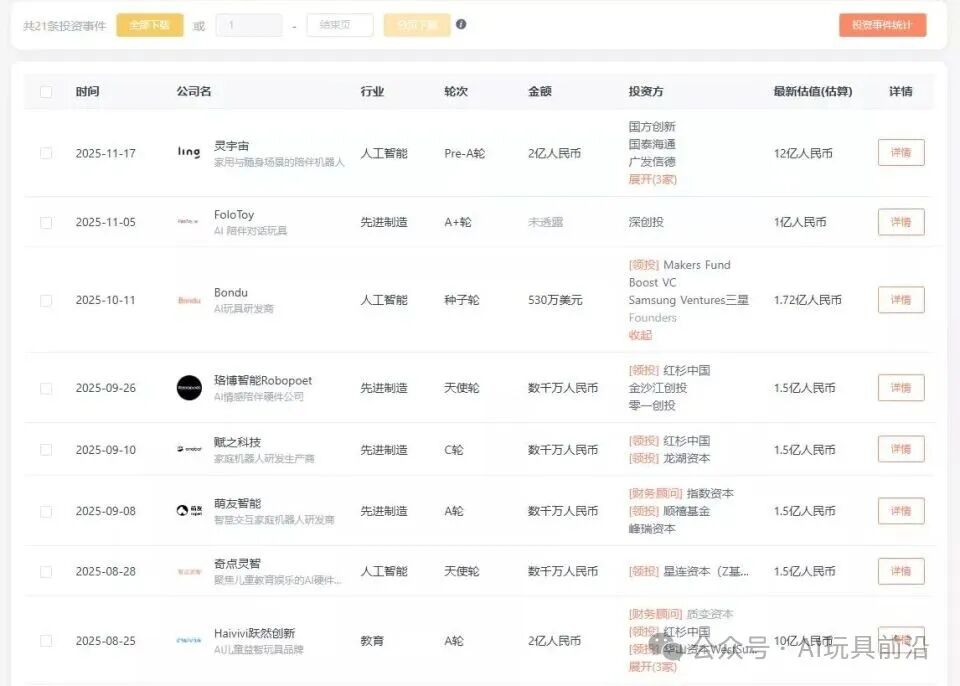
Representative company Haivivi completed a 200 million yuan Series A financing in August this year, led by CICC and Sequoia China, with a post-investment valuation reaching 1 billion yuan. The company’s first AI interactive accessory, “BubblePal,” has sold over 250,000 units since its launch.
Meanwhile, several A-share listed companies are also accelerating their layout in this field. For example, Shifeng Culture has established “AI Smart Electric Toys” as one of its core product lines and has launched multiple products. The company revealed that it is collaborating with Baidu Smart Cloud to develop AI toys themed around the Year of the Horse and exploring the “AI + IP” integration model, combining AI technology with popular IPs like “Good Baby.” Additionally, several new products, including desktop robots with composite interaction functions, are also in preparation.
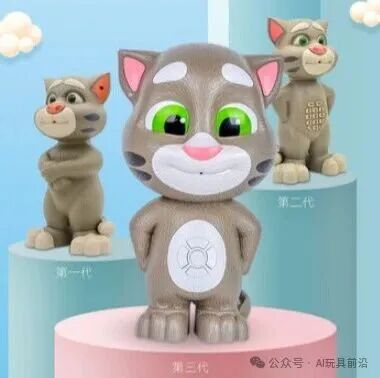
Companies with rich IP resources are also seizing this opportunity to seek new growth drivers. Talking Tom will launch its first-generation AI emotional companion robot by the end of 2024, aiming to build an ecological closed loop of “hardware + content + services.” Alpha Group is developing character-specific AI dolls based on well-known IPs like “Pleasant Goat and Big Big Wolf,” continuously enhancing their intelligent attributes and interactive experiences. Rongxin Culture also stated that its self-developed AI smart interactive toys will soon be launched on the market.
Upstream chip and module manufacturers, such as Rockchip, Espressif, and Guanghetong, are also launching targeted AI toy solutions to promote the intelligent upgrade of the industry from the hardware level.
03Policy Support and Development Challenges
The vigorous development of the AI toy industry is inseparable from technological progress and capital promotion, as well as clear policy guidance.
In 2024, the “Artificial Intelligence +” initiative was first included in the “Government Work Report”; the “Special Action Plan to Boost Consumption” released in March this year also explicitly requires the promotion of “Artificial Intelligence + Consumption” to open up a new high-growth consumption track.
Local policies have also followed suit. The Beijing Economic and Technological Development Area released a related implementation plan, clearly proposing to promote the industrialization of AI toys and other smart hardware. In September 2025, Guangdong Province will issue a special action plan, setting specific goals for AI toy penetration rates to exceed 30% by 2027 and cultivating several internationally competitive leading enterprises.
However, while the industry welcomes opportunities, it also faces challenges.
CICC’s research report warns that children’s information security and privacy protection are paramount issues. Additionally, minors may develop an excessive reliance on AI toys, which could potentially impact their real social skills and emotional cognition development.
In response, He Yaqiong, Director of the Ministry of Industry and Information Technology, stated that the next step will be to collaborate with relevant departments to promote high-quality industrial development from three aspects: first, strengthening policy guarantees to guide enterprises in using AI technology to create new demands; second, encouraging toy companies to collaborate with AI technology companies to create popular products that integrate technology and culture; and third, addressing data security and network security issues by enhancing assessments and formulating relevant standards in a timely manner to effectively ensure product quality and user privacy safety.
Follow me
to gain more insights into AI toy news