Source: Science Popularization China
Recently, a research team composed of the Institute of Artificial Intelligence at Peking University, the Wuhan Institute of Artificial Intelligence at Peking University, the Beijing General Artificial Intelligence Research Institute, and the School of Engineering at Peking University has revealed a “hand”. They successfully developed the world’s first robotic hand system, F-TAC Hand, which possesses both high-resolution tactile perception and complete motion capabilities, achieving human-like adaptive grasping with high-resolution tactile feedback. This achievement was published in the international academic journal “Nature Machine Intelligence”.
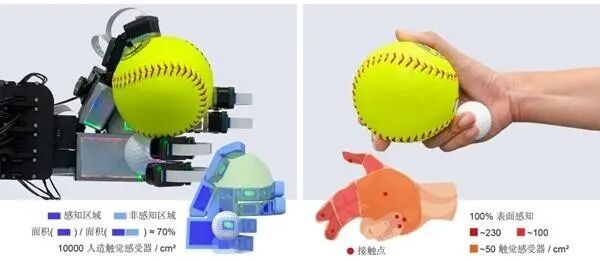 The performance comparison between the bionic robotic hand F-TAC Hand and human hands. Image provided by the research team
Integrating Tactile Feedback and Motion Capabilities
The study of human hand functions is at the forefront of embodied intelligence and robotics research. The human hand is characterized by a highly complex structure and extremely precise functions, composed of 27 bones and 34 muscles, with 24 degrees of freedom.
“When humans grasp a cup filled with water versus an empty cup, the position, angle, and method of grasping the cup may be completely different. However, in the field of robotics, achieving full hand tactile coverage without compromising motion functionality has always been a challenge,” said Zhao Zihang, the first author of the paper and a PhD student at the Institute of Artificial Intelligence at Peking University.
When humans pick up objects, it involves two major capabilities: tactile feedback and motion capabilities. Tactile feedback includes proprioception and skin sensation. The former perceives force through muscles, tendons, and joints, while the latter perceives contact states, textures, temperatures, and friction through the skin. Motion functionality refers to the ability of biological systems to achieve body movement through the coordination of the nervous and muscular systems, encompassing both kinematics and dynamics. In simple terms, tactile feedback is like “the body reporting to the brain,” transmitting physical characteristics such as force, temperature, and friction to the brain; motion functionality is “the brain issuing commands to the body” to achieve precise motion control.
Integrating tactile feedback and motion capabilities is one of the key challenges in robotics research. On one hand, it is necessary to avoid the impact of tactile sensors on the robot’s motion flexibility; current tactile sensing technologies struggle to meet practical application needs in terms of coverage, resolution, and durability. On the other hand, the robotic hand must efficiently process a large amount of tactile data while driving each joint to move in coordination, enabling it to perform complex tasks in high degrees of freedom spaces, which poses high technical demands.
In the absence of rich tactile feedback, current mainstream robotic hands or grippers struggle to handle complex operational tasks in dynamic environments. The joint research team has achieved high-resolution tactile coverage over 70% of the robotic hand’s palm surface while maintaining the complete motion capabilities of the robotic hand, allowing the robot to perform precise operations and adaptive grasping through tactile feedback, just like humans.
Zhao Zihang introduced that the spatial resolution of the high-resolution tactile sensors in F-TAC Hand reaches 0.1 mm, equivalent to about 10,000 tactile pixels per square centimeter, far exceeding the tactile perception capabilities of currently commercial robotic hands.
Clever Design Achieves Operational Stability
A series of human-like hand designs ensure that F-TAC Hand achieves high-resolution perception and diverse grasping.
Zhao Zihang explained that the human hand’s tactile system consists of two key elements: a dense array of tactile sensors distributed across the skin and a neural processing mechanism in the brain that specifically interprets these massive sensory inputs. F-TAC Hand simulates this design by integrating 17 high-resolution tactile sensors in six different configurations. At the same time, clever design ensures that the sensors serve as both sensing elements and structural components, achieving an unprecedented tactile coverage range without sacrificing flexibility. This design allows F-TAC Hand to perceive contact changes in real-time during grasping, similar to a human hand, and quickly adjust, greatly enhancing the robot’s operational stability in uncertain environments.
“The high degree of joint flexibility in robotic hands poses significant challenges for control algorithms. We address this issue by developing an algorithm that generates diverse human grasping strategies. This algorithm is based on probabilistic models and covers 19 common types of human grasping, enabling grasping methods that are very similar to those of humans,” explained Li Yuyang, co-first author of the paper and a PhD student at the Beijing General Artificial Intelligence Research Institute.
Experimental results show that when the theoretically optimal grasping strategy encounters obstacles in real environments, F-TAC Hand can perceive the situation in about 100 milliseconds and quickly switch to alternative strategies to ensure task completion. Compared to systems without tactile feedback, F-TAC Hand demonstrates significant adaptive advantages when facing execution errors and object collision risks, with the average success rate increasing from 53.5% to 100%. This tactile-based closed-loop feedback mechanism allows F-TAC Hand to maintain efficient and flexible operational capabilities in uncertain environments.
According to Zhu Yixin, corresponding author of the paper and an assistant professor at the Institute of Artificial Intelligence at Peking University, this research achievement has broad application scenarios in fields that require high operational precision, such as assistive surgery, high-precision assembly work, aerospace, and emergency response. “In the future, we will continue to deepen the integration of tactile perception and robot control, exploring more intelligent body-sensing interaction paradigms to lay the foundation for achieving truly general artificial intelligence,” Zhu Yixin stated.
Planning and Production
Source: Science and Technology Daily
Editor: Wang Mengru
Reviewers: Xu Lai, Lin Lin
[Disclaimer] The reproduction is for non-commercial educational and research purposes only, aimed at disseminating academic news information. Copyright belongs to the original author. If there is any infringement, please contact us immediately, and we will delete it promptly.