Wetlands are the terrestrial ecosystems with the highest carbon density and are severely threatened by drainage, with significant uncertainty regarding the response of their soil carbon pools to drainage. Traditional views suggest that soil organic carbon (SOC) in wetlands is primarily composed of undecomposed or partially decomposed particulate organic carbon (POC), which is prone to rapid degradation after drainage. However, previous work has found that metal-bound organic carbon (bound OC) is also an important component of the soil carbon pool in wetlands and may accumulate after drainage, thereby affecting the stability and changes in SOC in wetlands. In particular, drainage can promote the formation of bound OC through the induction of redox metal oxidation (i.e., the ‘iron gate’ carbon sequestration mechanism; Wang et al., 2017). However, the response of bound OC to drainage and its impact on the total soil carbon pool in different types of wetlands remains unclear.
Based on this background, the research team of Feng Xiaojun at the Institute of Botany, Chinese Academy of Sciences, conducted paired sampling surveys from 2020–2022 on 32 wetlands in China that have experienced long-term (15–55 years) artificial drainage (including 14 Sphagnum wetlands and 18 non-Sphagnum wetlands), and combined literature data for integrated analysis to explore the interaction between soil metals and organic carbon in response to long-term drainage. Additionally, soil cores (0–50 cm) were collected from 11 sampling sites, and the equivalent ash mass method was used to assess the changes in bound OC with depth and its impact on soil carbon sequestration in flooded and drained wetlands (Figure 1).
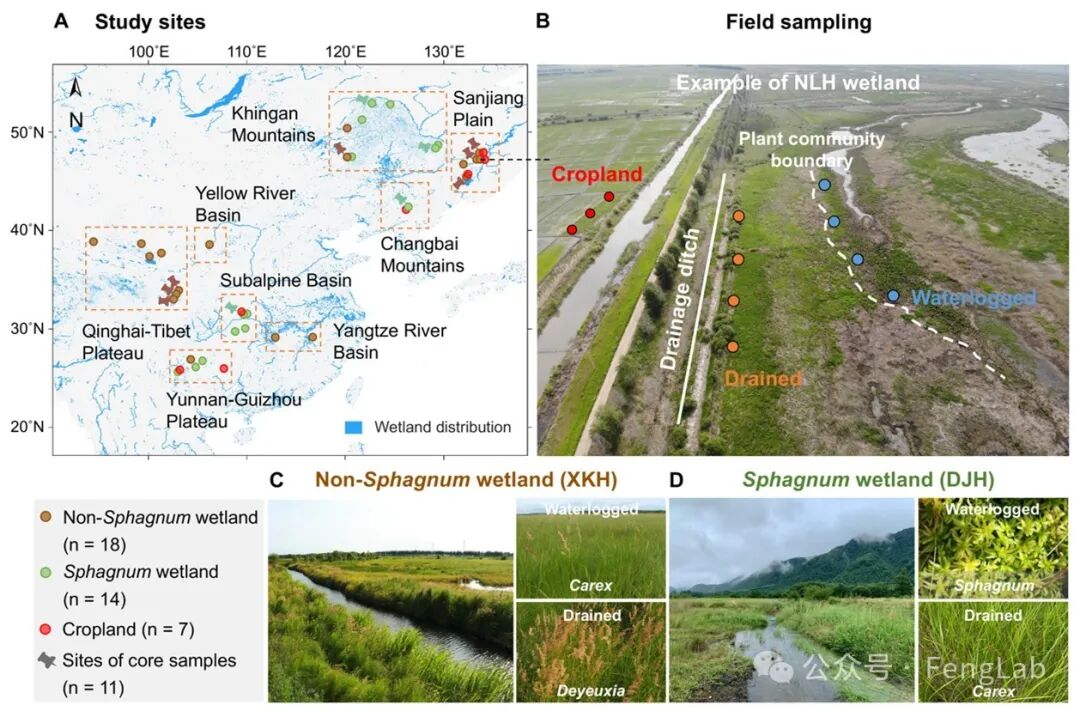
Figure 1 Research Sites and Experimental DesignResults indicate that long-term drainage significantly increased the proportion of bound OC in the surface layer of SOC (hereinafter referred to as “bound OC%“) in two-thirds of non-Sphagnum wetlands, while it significantly decreased in nearly half of the Sphagnum wetlands. This result suggests that the protective effect of drainage-induced metal oxidation on soil carbon (the ‘iron gate’ carbon sequestration mechanism) is prevalent in non-Sphagnum wetlands, but this mechanism is weaker or absent in Sphagnum wetlands (Figure 2A–D). To compare the responses of soil and plant properties to drainage, the study calculated the weighted response ratio (RR++; i.e., the ratio of drained wetlands relative to paired flooded wetlands) for bound OC% and related variables. The results indicate that, consistent with the ‘iron gate’ mechanism, drainage reduced soil pH in non-Sphagnum wetlands, increased the content of active iron and aluminum (i.e., 0.5Feo+Alo), bound OC%, and SOC content. Furthermore, drainage increased plant aboveground biomass and soil soluble phenols. In contrast, drainage increased soil pH in Sphagnum wetlands, reduced plant aboveground biomass, soluble phenols, and active iron and aluminum content—these changes may be related to plant community succession induced by drainage. The Sphagnum, known as the “rust engineer” (Zhao et al., 2023), was replaced by grass plants after wetland drainage, leading to the loss of its activation effect on iron oxides, and consequently, the bound OC% and SOC content in Sphagnum wetlands decreased (Figure 2E). The above results indicate that the differential response of bound OC% in non-Sphagnum wetlands and Sphagnum wetlands to drainage is closely related to changes in soil properties.
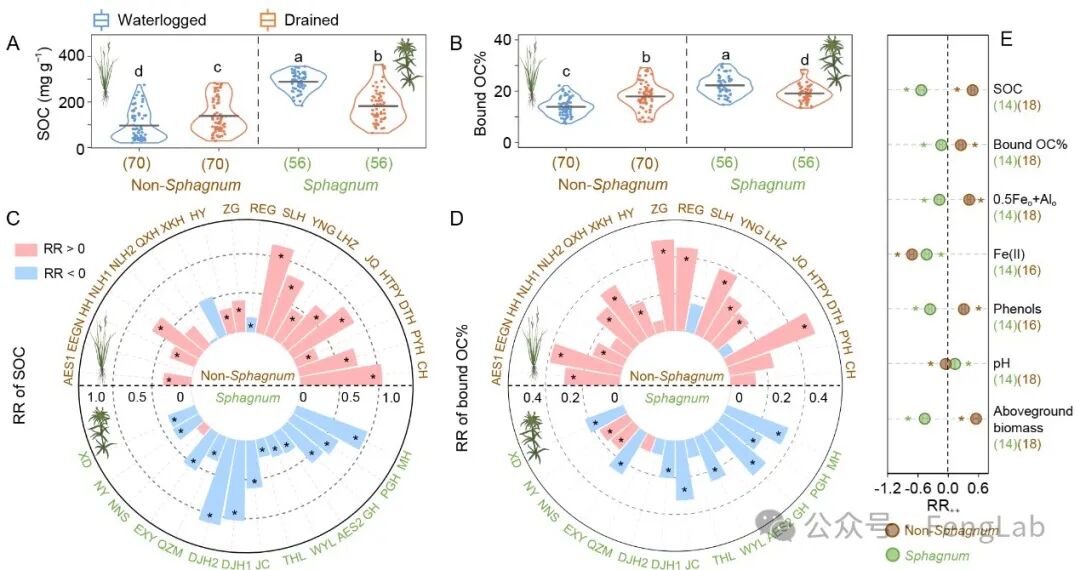
Figure 2 Differences in Metal-Organic Carbon Interactions and Soil Properties between Sphagnum and Non-Sphagnum WetlandsFurther structural equation modeling analysis indicated that in both types of wetlands, the content of active iron and aluminum is the main factor directly affecting bound OC%, followed by the content of soluble phenols. Soil pH did not have a significant direct effect on bound OC%. This result demonstrates that drainage increases the content of active iron and aluminum through inducing metal oxidation, significantly increasing bound OC% in non-Sphagnum wetlands. However, in Sphagnum wetlands, drainage reduces the content of active iron and soluble phenols due to the loss of Sphagnum cover, thereby decreasing bound OC% (Figure 3).
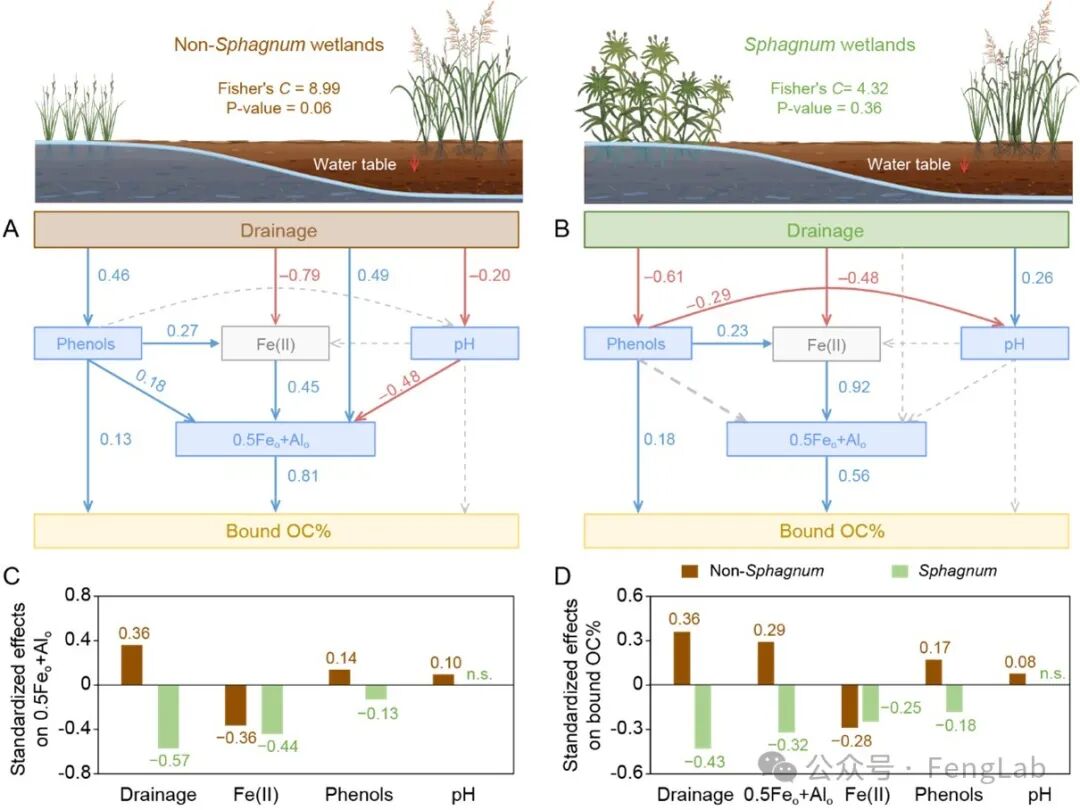
Figure 3 Pathways Regulating the Response of Bound OC% to DrainageIn contrast to the above findings, two recent global integrative analyses have shown that a decline in wetland water levels significantly reduces the surface (0–30 cm) SOC content. This discrepancy may be influenced by the type of land use after drainage. Therefore, this study utilized a paired survey of “flooded-drained-cultivated” (7 sampling sites) and integrated literature data to compare the effects of drainage and subsequent land use types on wetland SOC content. The results found that compared to simple drainage, “drainage followed by cultivation” exacerbated the loss of SOC (Figure 4). Therefore, when assessing the impact of drainage on wetland soil carbon, it is essential to distinguish between land use types after drainage.
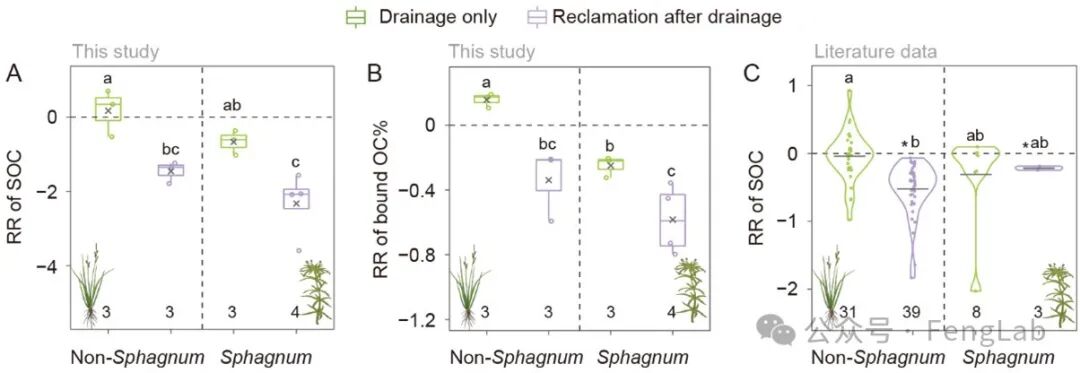
Figure 4 Effects of Drainage and Land Use Changes on Wetland Soil Organic CarbonTo clarify the impact of drainage on SOC below the surface layer, this study compared the changes in soil carbon with depth (0–50 cm) in “flooded-drained” wetlands (including 7 non-Sphagnum wetlands and 4 Sphagnum wetlands). The results indicated that compared to flooded soils, the SOC content in non-Sphagnum wetlands increased or remained unchanged after drainage, with a significant increase in bound OC% in most soil layers above the water level, and the differences in bound OC% between drained and flooded wetlands gradually diminished or disappeared near or below the water level (except for HY), indicating that the impact of drainage on bound OC% is water level regulated. However, in 75% of Sphagnum wetlands, the SOC content decreased in almost all soil layers; except for the MH flooded layer, the bound OC% in almost all soil layers of Sphagnum wetlands also decreased. This result indicates that the degradation of Sphagnum caused by drainage has profound effects on both SOC and bound OC, and this impact exceeds the depth of water level decline (Figure 5A–C). To elucidate the impact of changes in bound OC on soil carbon sequestration in wetlands, the authors assessed the stocks of bound OC and SOC in the soil profile. The results indicated that in three Sphagnum wetlands, drainage reduced the stocks of bound OC, accounting for 19–41% of the reduction in SOC stocks (Figure 5). However, in non-Sphagnum wetlands with increased active metal oxides, the increase in bound OC partially compensated for the loss of unprotected components (such as POC). Therefore, the changes in bound OC induced by drainage are an important mechanism regulating changes in SOC stocks during the drying process of wetlands.
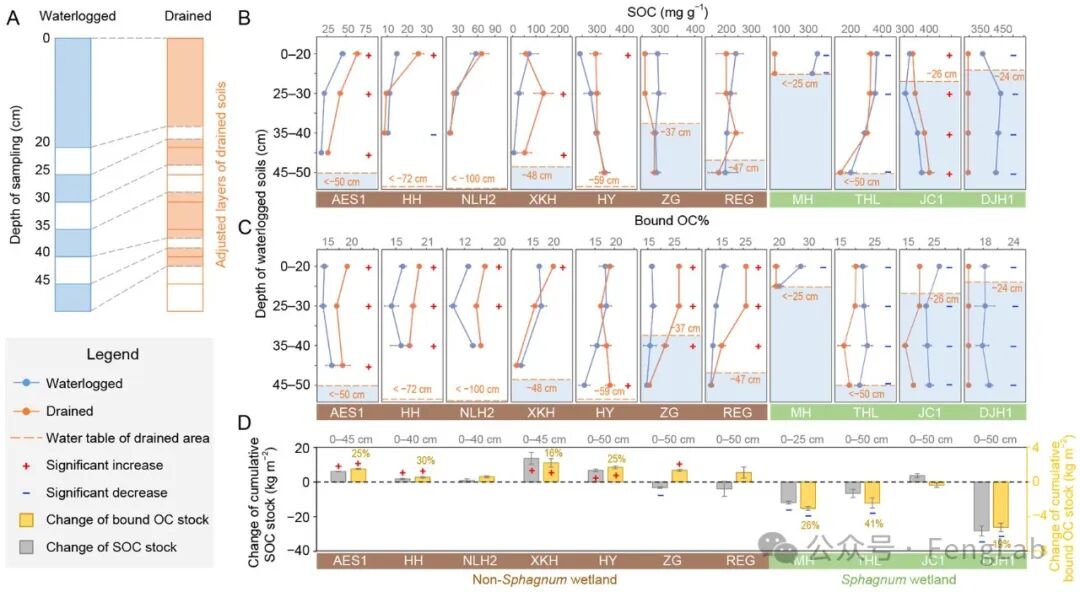
Figure 5 Changes in Soil Carbon Stocks with Soil Depth after DrainageIn summary, this study found that drainage-induced metal oxidation generally enhances the metal-organic carbon interactions in non-Sphagnum wetlands (the ‘iron gate’ carbon sequestration mechanism), but this mechanism does not exist in Sphagnum wetlands. Incorporating this mechanism into models can improve the accurate prediction of soil carbon dynamics in wetlands. This research was recently published online under the title “Metallic protection of soil carbon: Divergent drainage effects in Sphagnum vs. non-Sphagnum wetlands” in National Science Review (Read online: https://doi.org/10.1093/nsr/nwae178). PhD students from the Institute of Botany, Chinese Academy of Sciences, Liu Chengzhu and Zhao Yunpeng are co-first authors of the paper, and Researcher Feng Xiaojun is the corresponding author. PhD students Ma Lixiao, Zhai Guoqing, and graduated master’s student Li Xingqi, along with Professor Chris Freeman from Bangor University, made significant contributions to this research. This study was funded by the National Natural Science Foundation of China.References:Wang Y. Y., Wang H., He J-S & Feng X. J.* (2017) Iron-mediated soil carbon response to water-table decline in an alpine wetland. Nature Communications, 8, 15972.Zhao, Y. P., Liu, C. Z., Li, X. Q., Ma, L. X., Zhai, G. Q. & Feng, X. J.* (2023) Sphagnum increases soil’s sequestration capacity of mineral-associated organic carbon via activating metal oxides. Nature Communications, 14, 5052.Liu, C. Z.#, Zhao, Y. P.#, Ma, L. X., Zhai, G. Q., Li X. Q., Freeman C & Feng X. J.* (2024) Metallic protection of soil carbon: Divergent drainage effects in Sphagnum vs. non-Sphagnum wetlands. National Science Review, https://doi.org/10.1093/nsr/nwae178